16-year-old Helena Muffly wrote exactly 100 years ago today:
Saturday, April 29, 1911: Ma kept me busy a chasing the chickens out of the garden this afternoon. I get so mad at them. Carrie Stout came over this evening. Wanted me to go along with her up to McEwensville. She is afraid of the dark. Of course I went, although I looked like a witch.
Her middle-aged granddaughter’s comments 100 years later:
I wonder what Grandma and her friend Carrie were doing in McEwensville on a Saturday night. Today, I think that Saturday nights in McEwensville are generally pretty quiet—maybe it was hopping a hundred years ago.
Chickens
The chickens probably enjoyed eating the small emerging plants in the garden. It sounds like the family needed a fence to keep them out.
In the old days women often were able to earn a little “pin money” by raising chickens and selling their eggs. A hundred years ago women’s magazines—as well as farm magazines—had lots of poultry advice.
Paul Orr in the June 1911 issue of National Food Magazine in an article titled “Are Old Methods Best? Two Thousand Years Have Seen Little Progress in Poultry Raising” argued that the old ways of raising chickens were best—and that incubators and other “fancy” equipment were not needed. Poultry tips in that issue of the magazine included:
Beginners in poultry raising often owe their failure to the deluge of new-fangled suggestions by men who make things to sell. There are a hundred trinkets and devices on the market that are useless, and the beginner is the legitimate prey not only of egg sellers but of breeders and makers of all ilks of useless contrivances. The fact is that the old methods of poultry raising are often the best.
Advertisement in April, 1911 issue of Farm Journal
Two hundred heads are sufficient for employing the whole care and time of one person, provided that either a diligent old woman or a boy be appointed to keep watch over them, so they will not stray away or fall a prey to marauders. (Comment by Sheryl: Or I guess—at least in the case of the Muffly family—a diligent teen-aged daughter might be asked to chase after the chickens.)
They must not be allowed wander far from the coop when very young.
Let the custom be observed here, as with other cattle; pick out the best for breeding and sell the less good.
Also dispose of all hens over three years old, and those hatched after the solstice (June 21), as they will not attain their full growth.
Avoid the white kind, as they are not very hardy, and because of their conspicuous white color they fall an easy prey to hawks and eagles. Those of a reddish color, with black pinions, should be chosen.
Cartoon in April, 1911 issue of Good Housekeeping. Photo caption: “I insisted that he should see the Black Minorea”.
It is not expedient to keep a cock except he is exceedingly strong and vigorous of the same color as the hens and with the same number of toes . . . Such a male should be provided with five females.
When the breeding season begins. . the keeper must take care that the laying places are strawed with clean straw, and free from vermin; and the eggs are gathered every day and marked, so he may know that the freshest are put under the hens when they become broody. The freshest eggs are the most proper for hatching; yet such as they are stale may be set, provided they are not over ten days old.
The old hens are best suited for hatching, as they are more reliable than the young.
16-year-old Helena Muffly wrote exactly 100 years ago today:
Friday, April 28, 1911: Besse came out this morning to help with the kitchen. It seems we were working at it all day and I guess we were. Carrie Stout was over this evening. She brought Ma some flower seeds. Ruth and I went part of the way home with her.
Recent photo of the spot about half way between the Muffly farm and the Stout one. When Grandma and her sister Ruth walked their friend Carrie part way home, they might have turned around about here.
Her middle-aged granddaughter’s comments 100 years later:
A hundred years ago people commonly saved seeds in the fall to plant the following spring. Friends and neighbors often shared seeds with one another.
According to a book published in 1911 called The Practical Flower Garden:
One of the greatest pleasures to the gardener is in raising flowers, both perennials and annuals, from seed; and especially is it interesting to gather and sow the seeds saved from her own finest plants.
I always mark the plants whose seeds I wish to save by tying white strings about the stems when in full bloom as a sign to all that the blossom must not be cut . . . . [I keep] a box containing little pieces, about eight inches long and an inch wide, of white muslin, black cambric, pink cambric and turkey-red. I tie black upon the plants that are to be cast out in the autumn; scarlet upon the very bright red phloxes; a pink and white string upon all those of pink and white varieties; and a single white piece upon the choice white phloxes, and also upon all plants whose seeds I wish to save.
The seeds, after maturing, are gathered when dry, put into boxes, each of which is carefully labeled, and then sown either in August or the following spring.
Helena Rutherford Ely in The Practical Flower Garden (1911)
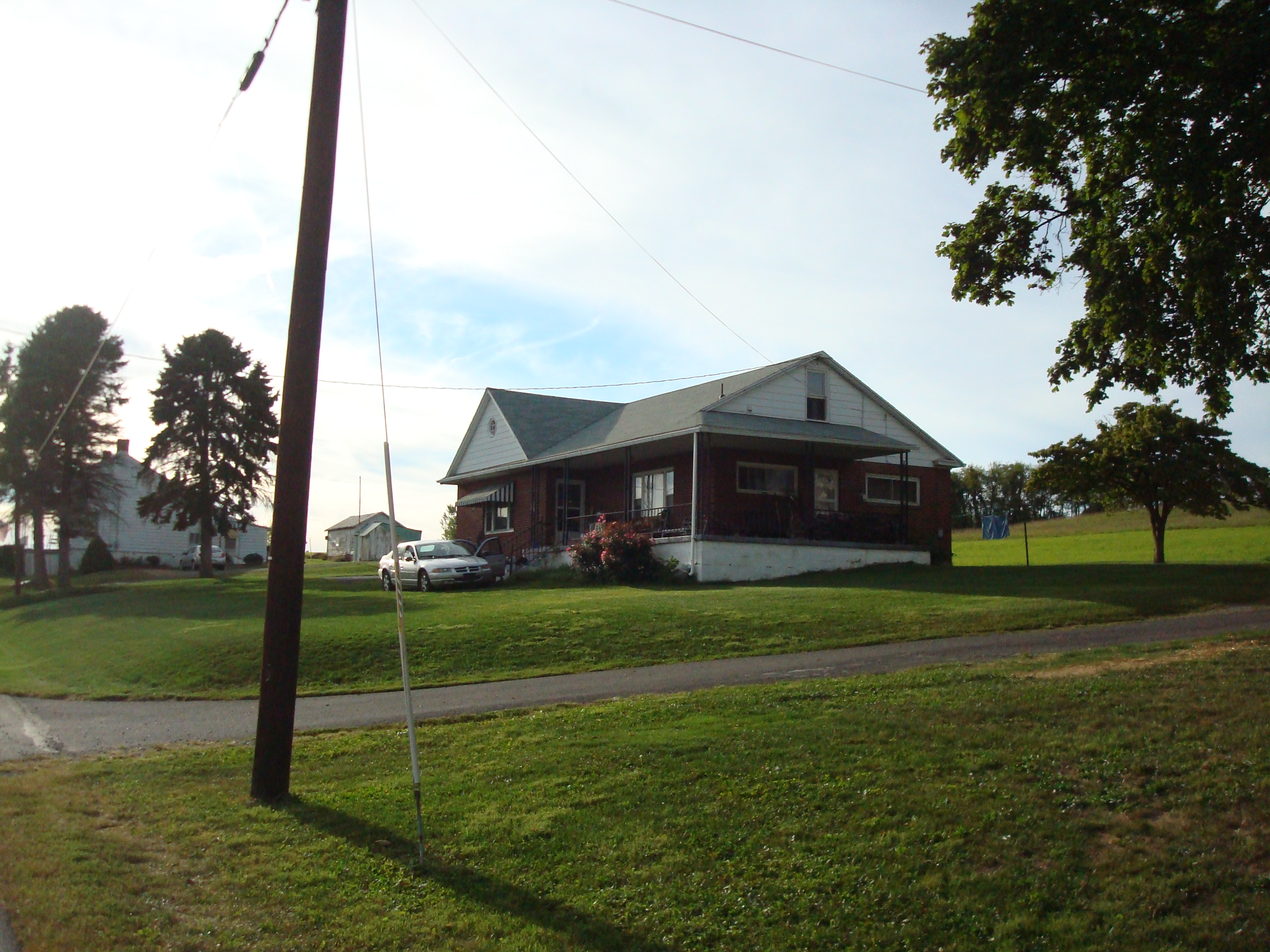
Recent photo of house where Grandma grew up. I wonder if Grandma once planted seeds in the same flower beds.The diary entry discusses friends and neighbors sharing saved seeds, but in 1911 people could also buy flower seeds. This ad is from the April 1911 issue of Farm Journal.
Thursday, April 27, 1911: Missing entry (Diary resumes on April 28.)
Since Grandma didn’t write a diary entry again today I’m going to share some memories of my cousin (and Grandma’s granddaughter) Anne Marie:
Michael, Donna Marie, and I loved to pop in on Grandma when we were outside playing as kids. We’d tell her that we needed some of her “pink pills for pale people” as she referred to them. Do you remember those pink candies that were the color and the taste of “pepto-bismol”? Well, we loved them and Grandma never failed to treat us to them.
Photo from last summer of the house that Grandma lived in during her later years.
This is a really embarrassing one but very true. One afternoon I was crawling around on Grandma’s porch pretending I was a cow (as if I didn’t already have enough dealings with cows) and decided the wrought iron railing that surrounded her porch would make great “cow stalls” so I stuck my head between two of them. Well, you know what happened next–of course my head didn’t come back out as easily as it had gone in due to those things on the side of one’s head called ears. Grandma tried unsuccessfully numerous times to get my head out and then started to panic. She ran for mom who quickly came to my aid (with a “for Pete’s sake” look on her face). Mom applied some pressure to the bars and quickly freed my head. Grandma was greatly relieved, and I was permanently mortified and remember it as clearly as if it were yesterday.
As a child, I always loved Grandma’s flowers and was always asking her questions about them. She is the one that taught me the various names and instructed me on planting and watering them. Soon after, I had my own little flower bed and it’s still one of my favorite things to do in the spring and summer.
Grandma was an avid reader and she spent many hours on her porch glider with a book in hand and her bible always laid open on her kitchen table.
Grandma also loved to play jokes on us. One day she told me she could do something with her teeth that I couldn’t do with mine. Of course, I found this quite hard to believe so I asked her to show me. No sooner had I made the request than she grabbed hold of her dentures and pulled them out of her mouth and dangled them in front of my face. Needless to say, I was awe struck and horrified at the same time as I’d never known of the existence of dentures. I must have had quite the look on my face, as she laughed and laughed at my expression.
One April Fools Day she took an old newspaper from her basement and carefully glued all of the pages together and quietly placed it in our newspaper box. I can still hear Mom laughing when she tried to read the paper that day and it didn’t take her long to figure out who the prankster was.
One day Grandma arrived at our door with a box of candy–those boxes that have each piece of chocolate individually wrapped. It was actually an old candy box that still contained all of the wrappers. She placed black checkers in each wrapper and was quite pleased with the joke she played on me and my siblings.
Since the teen-ager who became my grandmother didn’t write a diary entry again today, I’ll continue sharing memories of Grandma in her later years.
Yesterday cousin Stu wrote, “I remember Thanksgivings at her house, with her getting up in the small hours to start the turkey, and the kids (at least, the younger ones) at the round table in Grandpa’s study.”
Stu’s memory jogged memories that I have of eating at the round table. I guess this might not be exactly the right time of year to discuss Thanksgiving memories, but Easter memories bring back memories of other holidays, so here’s a Thanksgiving memory–
After their children were grown Grandma and Grandpa Swartz built a small brick bungalow on my uncle’s farm. It had a large kitchen—and at Thanksgiving Grandma brought extra tables into the room to make a long table that extended from one end of the kitchen to the other.
But the table wasn’t large enough to hold all of Grandma’s children, their spouses, and the grandchildren—so another table was set up in the den. Grandchildren old enough to eat without adult assistance—yet not old enough to sit nicely at the adult table—were relegated to the table in the den.
I really wanted to be big enough to eat with the adults like some of my older cousins, but was always assigned to the den.
Aunts periodically rotated dishes between the kitchen and the den. But after the exchange was made, the DOOR WOULD BE SHUT. . . AND, THEN some of my more imaginative cousins would come up with all sorts of great ideas.
I remember one year we all crammed into a closet in the den to see how many people would fit. One cousin stayed outside, slammed the door shut—and held the rest of us captive in the dark. We screamed—and maybe an adult came from the kitchen to see what was the problem—though I have no memory of any adults coming to our rescue and think that we remained imprisoned in the stuffy darkness until my cousin tired of holding the door.
Then one year, one of my younger cousins—who in previous years had occupied a high chair in the kitchen— was deemed old enough to move to the den, and I was deemed mature enough to move to the kitchen.
I felt so grown up—but, good grief, the conversation around that long table in the kitchen was so boring. When I heard distant screams emanating from the den I longed for the good old days.
Since Grandma didn’t write a diary entry again today I’m going to share some memories of my cousin (and Grandma’s grandson) Stu:
My recollection of Grandma was mostly as an elderly woman. I remember her peanut butter cookies with fondness. I remember Thanksgivings at her house, with her getting up in the small hours to start the turkey, and the kids (at least, the younger ones) at the round table in Grandpa’s study. It’s sobering to think that at those Thanksgivings in the early 60’s, she was only about 10 years older than we are now. The conveyor of life moves on, and us with it.
I remember her wicked delight in practical jokes. The bucket of water carefully balanced on the door was a favorite. Or her ongoing wars with farm cats. Or that she had a more-or-less full set of 14 cloth calendars, which she’d recycle depending on the year.
Stu Kurtz
One of the things that I’ve most enjoyed as I’ve worked on this blog is the opportunity to reconnect with relatives. And, as the years pass and the “conveyor of life moves on” I’ve discovered that it feels good to remember (or in some cases discover) some of those who were earlier on that conveyor.
One of my biggest surprises has been how many people remember some of the same smallest details about Grandma’s life.
In addition to the memory that is in the box above, Stu had another sentence in his email. It was about the cloth calendars and said, “This came up recently, and I can’t remember if it was your blog, or just Mom and I reminiscing.” The cloth calendars were in this blog—there was a posting on them on January 29.
I remember thinking when I wrote that post that cloth calendars were a silly thing to write about—yet I strongly connected them with Grandma. It’s fun to hear that others also remembered them—and that the calendar entry generated conversations totally outside of this blog. Stu reminisced about them with his mother; my children and I discussed them.
Stu’s mention of Thanksgiving at the round table in Grandpa’s study also brought back memories. Tomorrow, I’ll describe those Thanksgivings a bit more.
Sunday, April 23, 1911: Missing entry (Diary resumes on April 28.)
Her middle-aged granddaughter’s comments 100 years later:
Since again today there is no diary entry, and since I’ve been trying to understand how the teen in the diary evolved into the grandmother I remember, I’ll share an Easter memory of her (The 23rd wasn’t Easter a hundred years ago.)–
In 1966 my grandfather—Grandma’s husband—died a few day before Easter. Grandma was 71-years-old at the time. That year on Easter afternoon my parents, aunts, and uncles grimly gathered in Grandma’s brick bungalow and sat around her kitchen table writing thank you notes.
My cousins and I were banished from the kitchen and spent the afternoon chasing each other around Grandma’s yard. Around the trees—up and down the porch stairs— running, running and more running. I was 10-years-old that spring and the movement felt really good after all the days of mourning.
Fast forward one year to 1967—
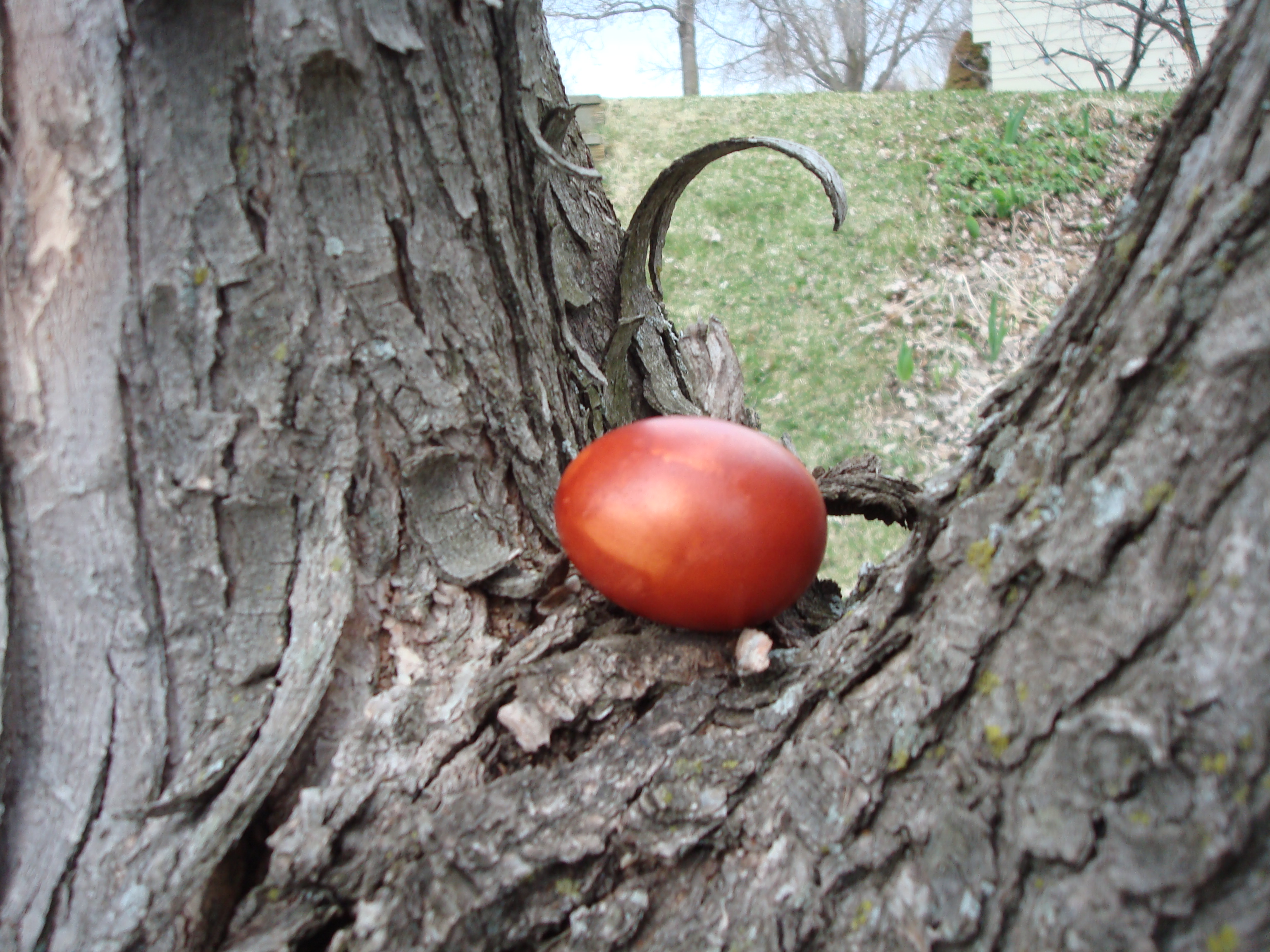
I can remember family Easter egg hunts at my house that began in 1967 and continued for probably another 8 or 10 Easters. Prior to my grandfather’s death I think that my family typically spent the day with extended family on my mother’s side of the family. But the year following his death, my parents began hosting an annual Easter egg hunt that drew relatives from both sides of the family.
I colored and hid two or three hundred eggs in our expansive yard each year. Children and adults paired up to hunt the eggs. Whenever a kid found an egg they were required to run back to their adult partner and give that person the egg before dashing off to search for another egg.
I can’t specifically remember Grandma at those Easter egg hunts—but each year one of her grandchildren would have been her partner. Other adults might have shouted encouragement to their youthful partners—Grandma won’t have.
Instead I picture Grandma’s eyes gleaming each time her grandchild partner dashed toward her carrying an egg—and that she probably secretly hoped her team would end up with the most eggs (but she won’t have outwardly shown disappointment if her team didn’t win).
Sunday, April 23, 1911: Missing entry (Diary resumes on April 28.)
Her middle-aged granddaughter’s comments 100 years later:
Since Grandma didn’t write a diary entry again today I’m continuing to share other relatives’ memories of Grandma. My cousin Stu told me to ask his mother (and Grandma’s daughter) about the macaroni story. This is what Aunt Eleanor told me:
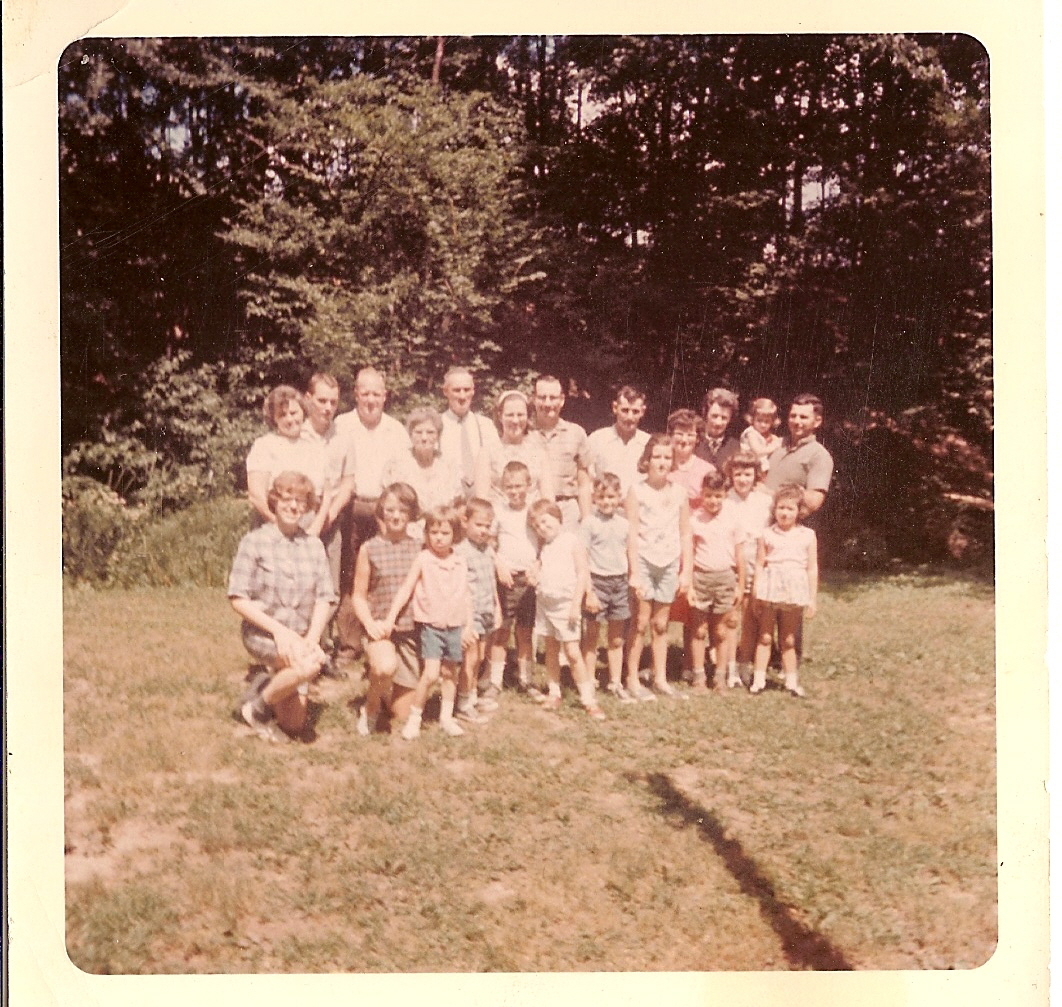
When we lived in suburban Philadelphia in the ’60s, the kids and I would visit upstate, first with my parents – until my father died and after that with my mother. We chose mid-August because that way we could catch the Swartz family reunion (on the third Saturday) and also because the tomatoes and sweet corn were at their absolute peak.
Helen(a) and Raymond Swartz and their descendents at the Swartz Reunion, White Deer Park, 1963 (Click on photo to see a larger version of it.)
On one visit after my father died, I offered to make brown-butter macaroni as a contribution for one of the meals. That’s just plain macaroni cooked al dente, drained, and then dressed with a small amount of browned butter. My hand must have slipped or something, and way more macaroni went into the pot of boiling water than I intended. By the time it was boiled and dressed, it was a LOT of macaroni.
My mother, never one to keep silent on such matters, complained that I’d cooked too much macaroni. And I, never able to accept her criticism passively, said no, that was about the right amount, the kids really liked their macaroni. Then dishing up as the kids were gathering round, I took advantage of my mother’s hearing deficit to whisper to them (rather forcefully), “You kids better help me out here and eat all of this!” And I’ve always been so proud of those little soldiers. My mother and I ate normal portions, but the kids ate all the rest.
Eleanor Kurtz
I had never heard of brown-butter macaroni so asked Aunt Eleanor several questions about how to make it. As with many old recipes there aren’t precise instructions, but she gave me some general directions.
Brown-Butter Macaroni
Cook 2 cups of macaroni in salted boiling water until al dente (follow package directions); drain. Meanwhile melt and lightly brown (using care not to burn) 2 tablespoons of butter in a skillet. Stir the macaroni into the browned butter; put in a dish and serve immediately.
My husband Bill and I really liked the brown-butter macaroni—and finished the entire bowl of it. Brown-butter macaroni has a delicate taste and tastes similar to some excellent pastas that I’ve eaten in upscale restaurants.