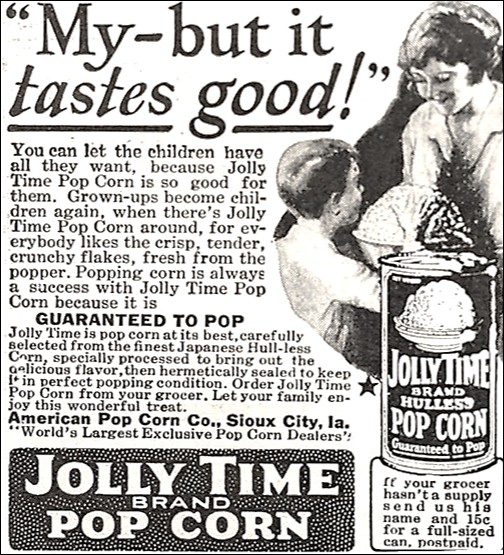
Popcorn was a popular snack in the 1920s (and it became even more popular during the depression years of the 1930s since it was an inexpensive snack). Technology, and new processing techniques, made it easier to make popcorn than it had been earlier in the 20th century. A 1926 Jolly Time Pop Corn advertisement highlighted that it was guaranteed to pop.
The American Pop Corn Company, which makes Jolly Time, began selling popcorn in 1914. In 1924, the company began packaging popcorn in metal cans. Popcorn pops best when it contains approximately 14-15% moisture. If it too moist or too dry, it does not pop well. The metal cans helped ensure freshness and a consistent moisture – and the company began advertising that its popcorn was guaranteed to pop. Consumers also liked that they could just buy popcorn that was ready to pop.
Historically, many people in the U.S. lived on farms and raised a little popcorn. People planted popcorn in the spring. In the fall. after the corn husks and stalks turned brown and felt dry, the popcorn was harvested by twisting or breaking the ears off the stalks and then pulling the husks away from the corn, but not removing the husks. The husks of several ears were tied together to enable them to be hung to dry in a shed or other well-ventilated, covered area.
After the ears dried for a month or so, the husks were removed and the popcorn was shelled. It was shelled by pushing the kernels on the ears sideways so they would separate from the cob. This could either be done by using fingers or a corn husking tool that was strapped on a person’s hand. After the first few kernels were removed from each ear, it was easier to break the remaining ones off. The popcorn kernels were then stored in a glass jar (and they hopefully had the right amount of moisture to successfully pop).
Whew, what a lot of work! It’s no wonder that packaged popcorn quickly became popular. (And, I can’t help thinking about how technology has continued to change the way popcorn is made and eaten.)
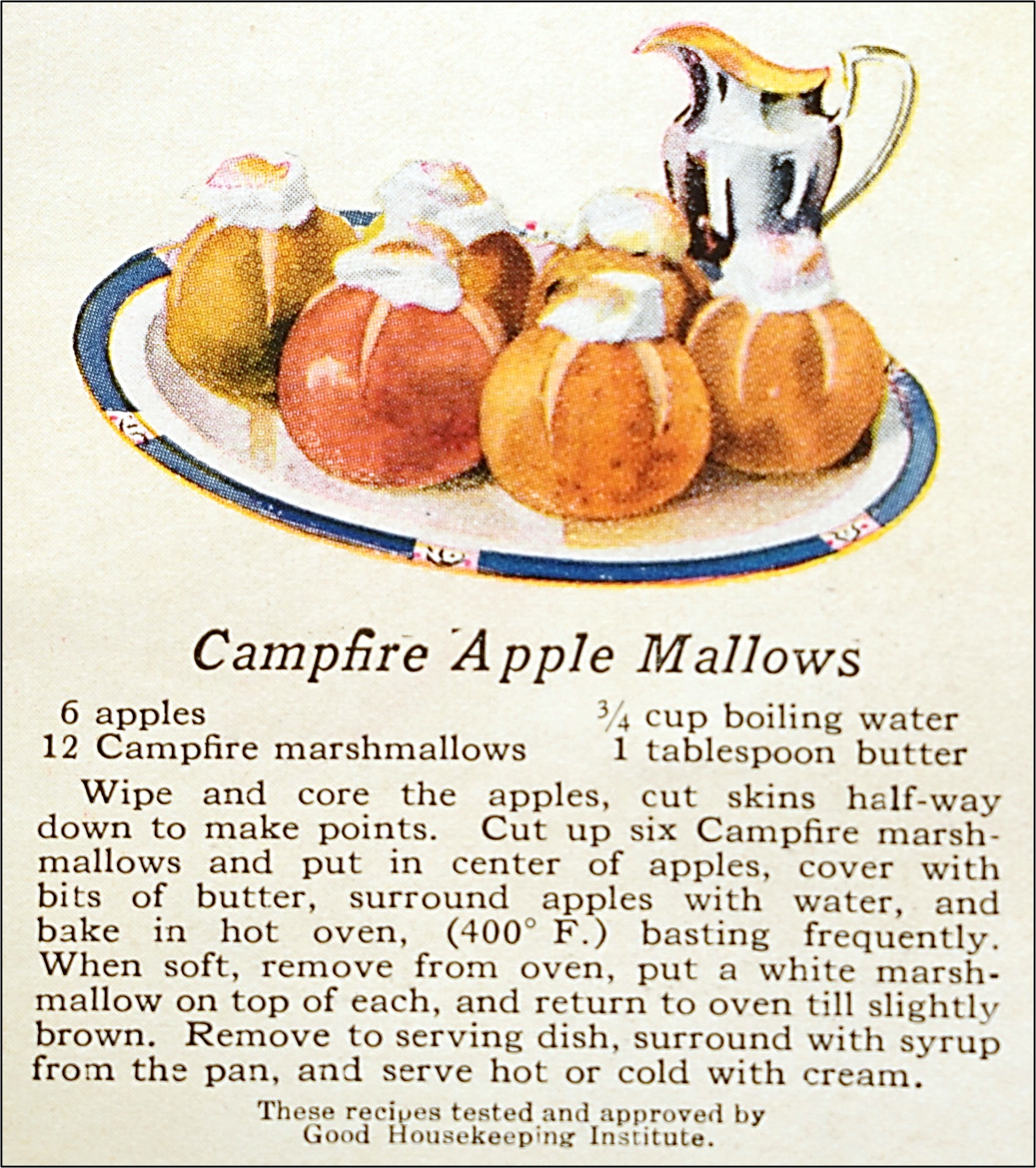
Baked apples are a classic fall comfort food. So, when I saw a hundred-year-old recipe for Apple Mallows (Baked Apples with Marshmallows), I decided to give it a try. The recipe was included in an advertisement for Campfire Marshmallows in the November, 1926 issue of Good Housekeeping. Here is the original recipe:
Source: Good Housekeeping (November, 1926)
Processed foods were rapidly becoming part of the U.S. diet by the 1920’s. Advertisers, including the Campfire Company, developed recipes that incorporated the food they were promoting into traditional desserts and dishes.
The advertisement said that the recipe was “tested and approved by Good Housekeeping Institute.” Apparently, the Campfire Company thought cooks would be more likely to trust that it was a good recipe if they were assured that the magazine’s research arm had tested it.
I agree with Good Housekeeping Institute’s decision to approve the recipe. Apple Mallows are a delightful variation of a classic dessert. Toasted marshmallows on top of the baked apples bring back memories of toasting marshmallows over a summer campfire, while marshmallows in the center of apples melt into a lovely, thick, sweet, gooey syrup.
The recipe indicated that the Apple Mallows should be served with cream. I didn’t have any cream, so I poured a little milk on some of the Apple Mallows. They were yummy. Additionally, I tried the Apple Mallows without any cream or milk, and they were also tasty that way.
The original recipe called for six apples and 12 large marshmallows, which is two marshmallows per apple. When I made the recipe, I used approximately three marshmallows per apple, so when I updated the recipe I increased the number of marshmallows to 18.
Similarly, I used more butter than the original recipe called for, so I increased the amount when I updated the recipe.
Since this recipe basically entailed just stuffing cored apples with marshmallows, the number of servings can easily be adjusted.
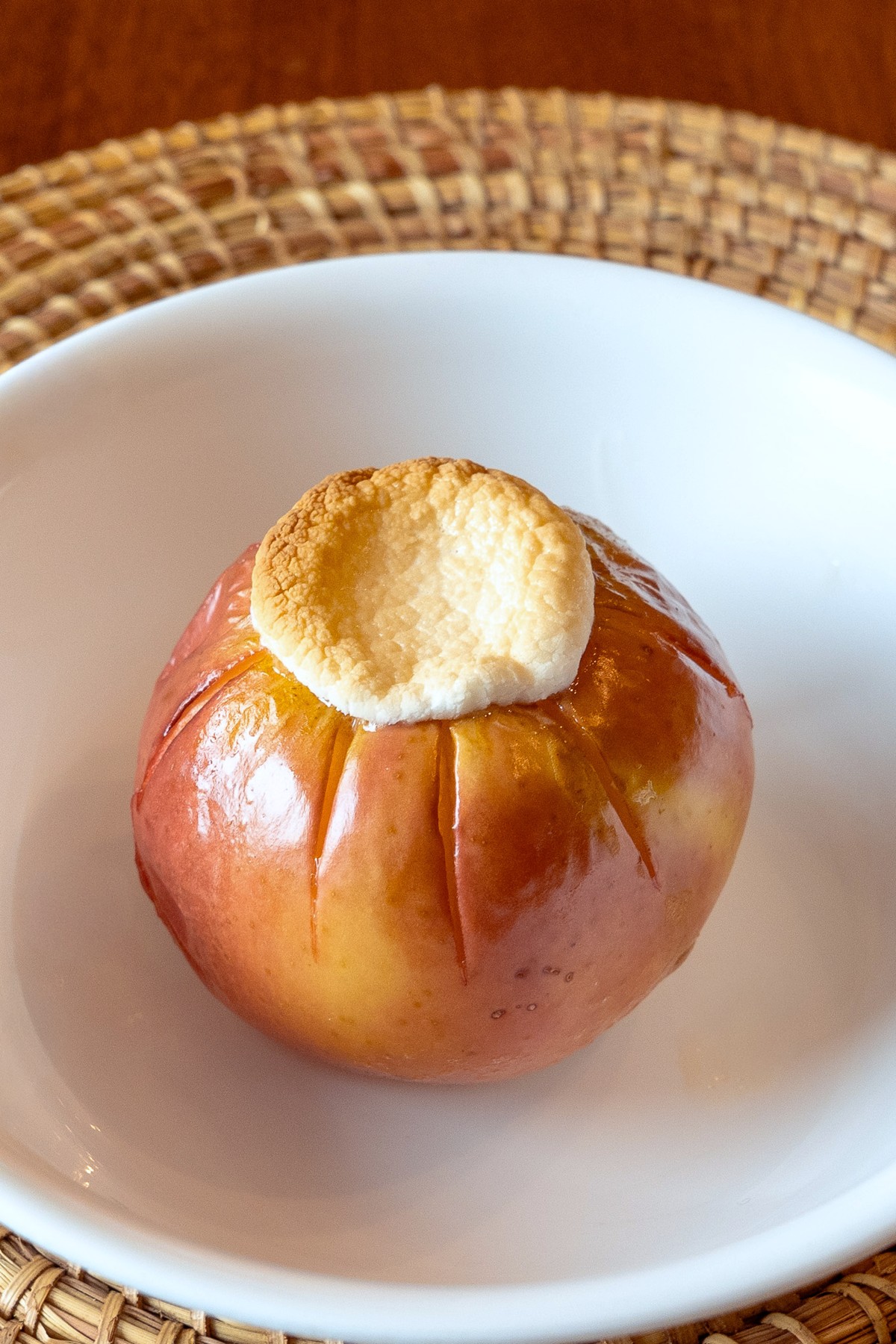
After the apples that had been stuffed with marshmallow pieces were baked, I added whole marshmallows on top. I then put the baked apples under the broiler for a minute or two to lightly brown the marshmallows prior to serving.
The original recipe says that the apples can be served hot or cold, but I served them hot. The gooey marshmallow filling in the middle of the apples was lovely. My sense is that the texture of the marshmallow filling would be quite different if the apples were served cold. When I updated the recipe, I indicated that this dessert should be served hot.
6 apples (Use an apple variety that keeps its shape when cooked – Haralson, Rome, Golden Delicious, Granny Smith, Braeburn, etc.)
18 large marshmallows
2 tablespoons butter
water
cream or milk (optional)
Step 1. Preheat oven to 400° F.
Step 2. Use a sharp paring knife or an apple corer to cut out the apple cores. Once it is cut, a spoon can be used to help scoop the core out. When cutting out the cores, do not go all the way through the apples. Leave about 1/2 inch of the apple at the bottom so that the marshmallow filling will not seep out.
Step 3. Make 6 or 8 vertical cuts in the skin of each apple that goes half way down the apple. Don’t cut all the way through the apple. Just cut the skin.
Step 4. Put the apples in a baking dish that can go under the broiler.
Step 5. Cut 12 of the large marshmallows into eights.
Step 6. Put the marshmallow pieces in the center of the apples. Put small bits of butter in the apples with the marshmallow pieces.
Step 7. Gently pour about 1/2 inch of water into a corner of the baking dish.
Step 8. Put into oven and bake until the apples are tender (about 35-45 minutes).
Step 9. Remove from oven and put a whole marshmallow on the top of each apple. The marshmallows are held in place by gently pushing the bottom of each marshmallow into the holes in the apples.
Step 10. Place under the boiler until the marshmallows are lightly browned (1-2 minutes). Remove from oven and serve. If desired, serve with cream or milk.
Ovaltine powdered drink mix has been around for more than a hundred years. I remember stirring the malt-flavored powder into milk when I was a child. I preferred the chocolate milk powders, but my mother insisted that Ovaltine was better for me because it had lots of vitamins.
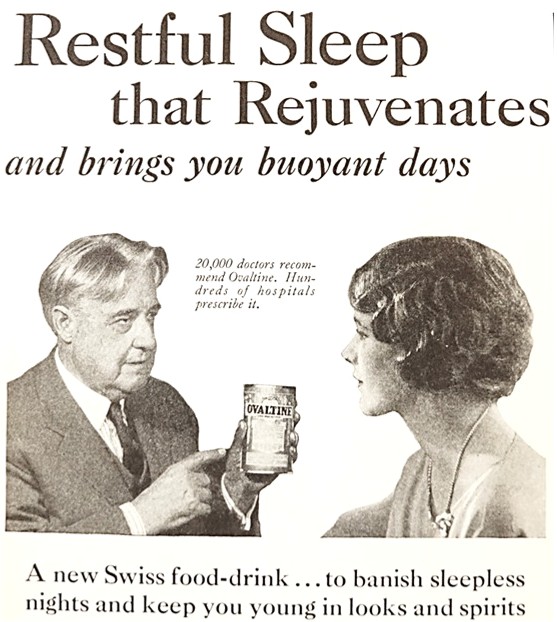
Apparently Ovaltine has always be considered a health drink. A 1926 advertisement emphasized how it could improve sleep quality:
Taken at night, a cupful of Ovaltine brings sound, restful sleep, quickly and naturally.
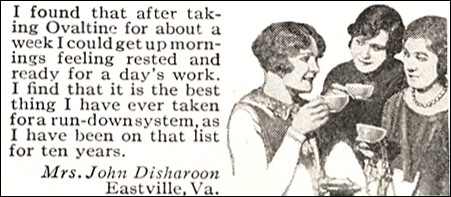
The word-heavy advertisement was aimed at women and contained testimonials. It included persuasive text and highlighted how Ovaltine would improve the lives of women who used it:
When you go to bed do your nerves stay up? Leaving you dragged out on the morrow –your morning logy, your energies drained by afternoon?
Modern science has found a natural way (a way without drugs) to overcome this; a way to restful sleep that quickly restores your tired mind and body.
Morning finds you a new woman. You are fresh, clear-eyed, buoyant. Youthful in looks and spirit. And, you have the energy to carry you right through the day and the evening’s social activities.
Times were a-changing and things were quickly modernizing. By 1926, many families, especially in the larger towns and cities, had electricity; and, electric refrigerators were quickly replacing the ice boxes which had been considered “modern” earlier in the 20th century.
Frigidaire refrigerators were so popular that people often just referred to their “Frigidaire.” The use of the term “Frigidaire” to generically refer to any refrigerator continued well into the middle years of the 20th century. I can remember my mother saying things like, “Get the food out of the Frigidaire.”
It is also fascinating how modern the woman’s outfit looks in the advertisement. Just a few years earlier, her dress would have been much longer and would have covered her ankles.
Good to know that 94 out of every 100 husbands supposedly preferred home-canned fruits and vegetables in 1926. And, guess who was going to do the canning . . .
Advertisements from a hundred years ago, such as this Ball Jar advertisement, sometimes portrayed women (and men) in roles that were stereotypical at the time.
In addition to the illustration and the caption in the ad, there was a lot of smaller text, which said in part:
Some women say, “Oh, it is too much trouble to do your own preserving and canning.” But is it? Canning not only means the best preserves at the lowest cost, but the improved methods make it a pleasure.
Millions of women – from their own experience – will tell you that modern methods eliminate drudgery. They make home canning quick and easy. . .
Home preserved fruits and vegetables have that delicious home made taste. An actual investigation showed that 94 out of 100 men preferred fruits and vegetables canned at home. Your husband, undoubtedly, will like them much better, too.
And when you put up your own fruits and vegetables – you know what you are getting. You know they are the finest and choicest. For you choose them yourself. They are pure and safe for your children. . .
Use the Right Jars
Be sure to get Ball “Perfect Mason” or “Ideal” Fruit Jars. Your grocer has them handily packed by the dozen. They are strong and the sealing shoulder is true. For they are the only jars made by the “Owens Process” – a patented process which absolutely insures an even thickness of glass – this giving strength and durability.
For your own success in canning be sure to get Ball “Perfect Seal” Rubbers and Caps. We urge this because they are especially made to fit Ball Jars. Thus they are air tight and insure a perfect seal. This is the only way you can be sure you are taking no chances.
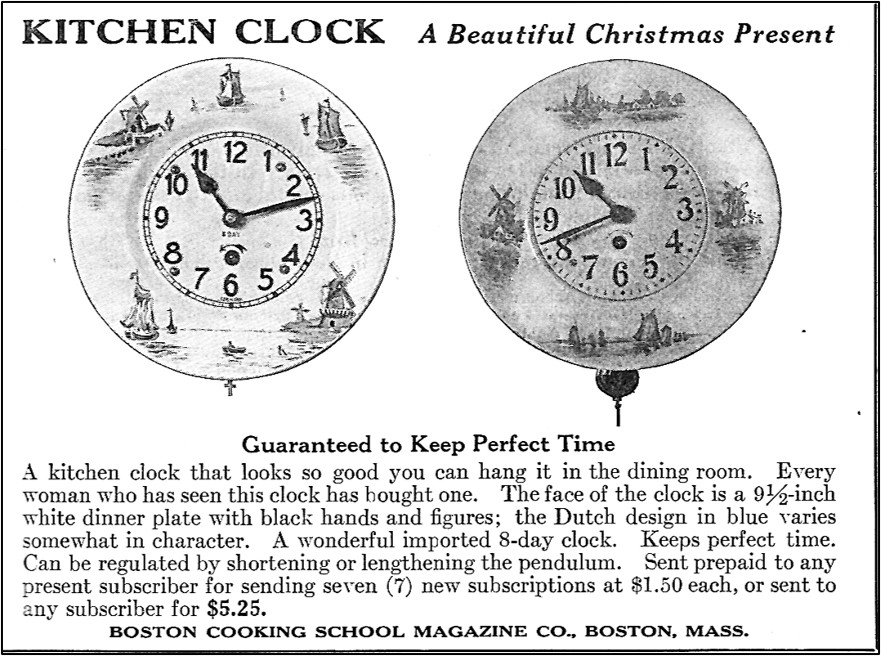
A hundred-year-old issue of American Cookery magazine contained an advertisement for kitchen clocks. To get a clock, people could send $1.50 plus sell seven subscriptions to the magazine, or they could just send $5.25 and not sell any subscriptions. I wonder how many people sold subscriptions to get a clock at a reduced price. I can’t imagine being able to sell subscriptions to seven people.
Actually, I don’t think that I’d purchase one for the full price either. I haven’t had a separate kitchen clock for many years. I just use the ones on my stove and microwave, but, of course, they didn’t yet exist in 1926, so if I went back in time, maybe I’d want one.
The clocks contained pendulums, and needed to be wound every eight days. 1926 was before the era of electric and battery-operated clocks.
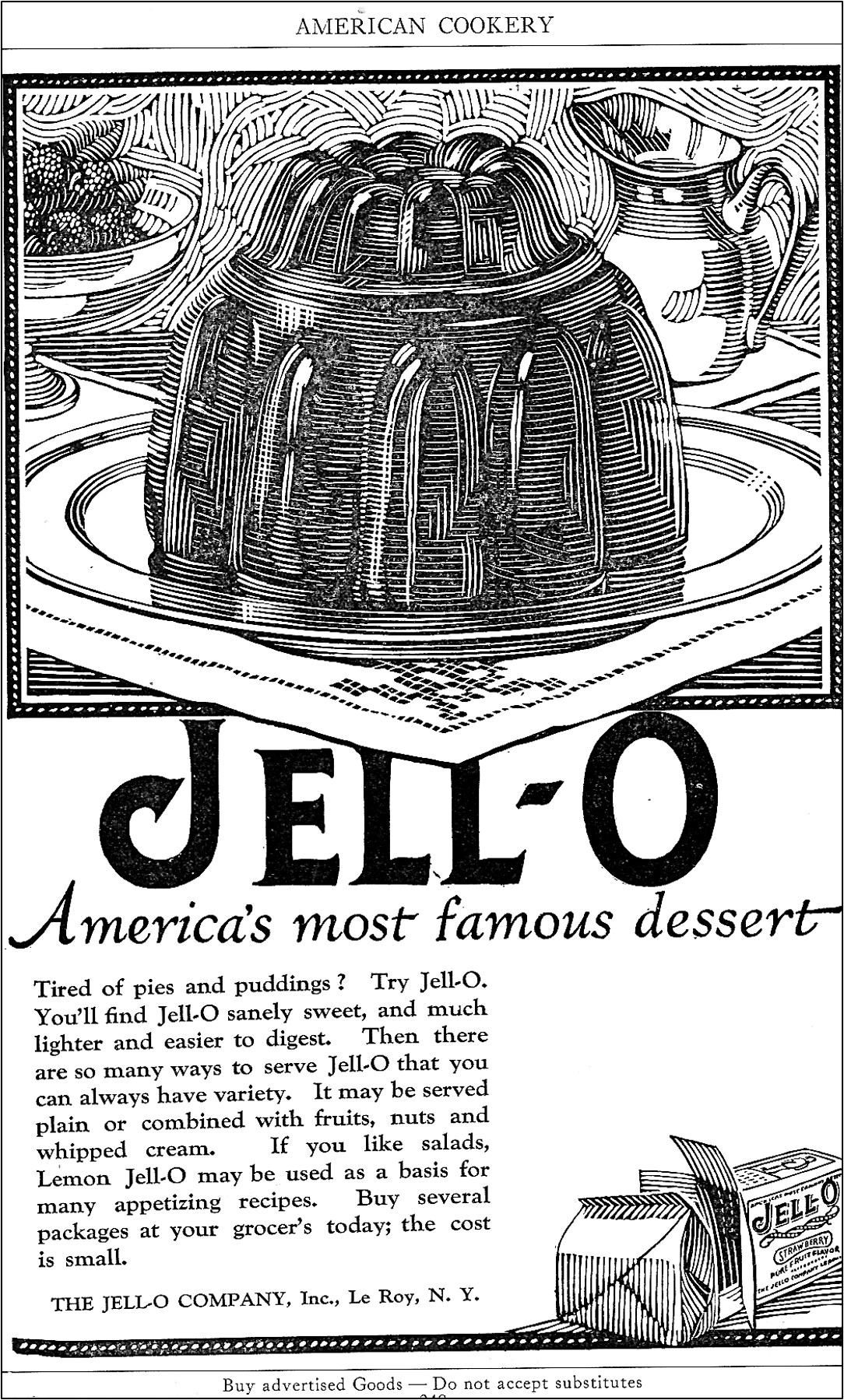
According to a 1926 Jell-O advertisement, Jell-O is the most famous American dessert. Really? Was that an accurate statement a hundred years ago? . . . or was it the aspirations of a company advertising a product?
I think that the old ad was referring to the U.S. when the it said “America,” but I’m not sure. Maybe it meant North America or all of the Americas.
Based on an informal survey of two people – my husband and myself – the most famous dessert in the U.S. is apple pie. Of course, it could have been something different a hundred years ago (Jell-O????).