Bijou Dream Theatre

16-year-old Helena Muffly wrote exactly 100 years ago today: 

Saturday, May 6, 1911: Ruth and I went to Milton this afternoon. I wanted to get my teeth filled but as the dentist was absent I was forced to wait until another day. While there we went into the theatre on Broadway.
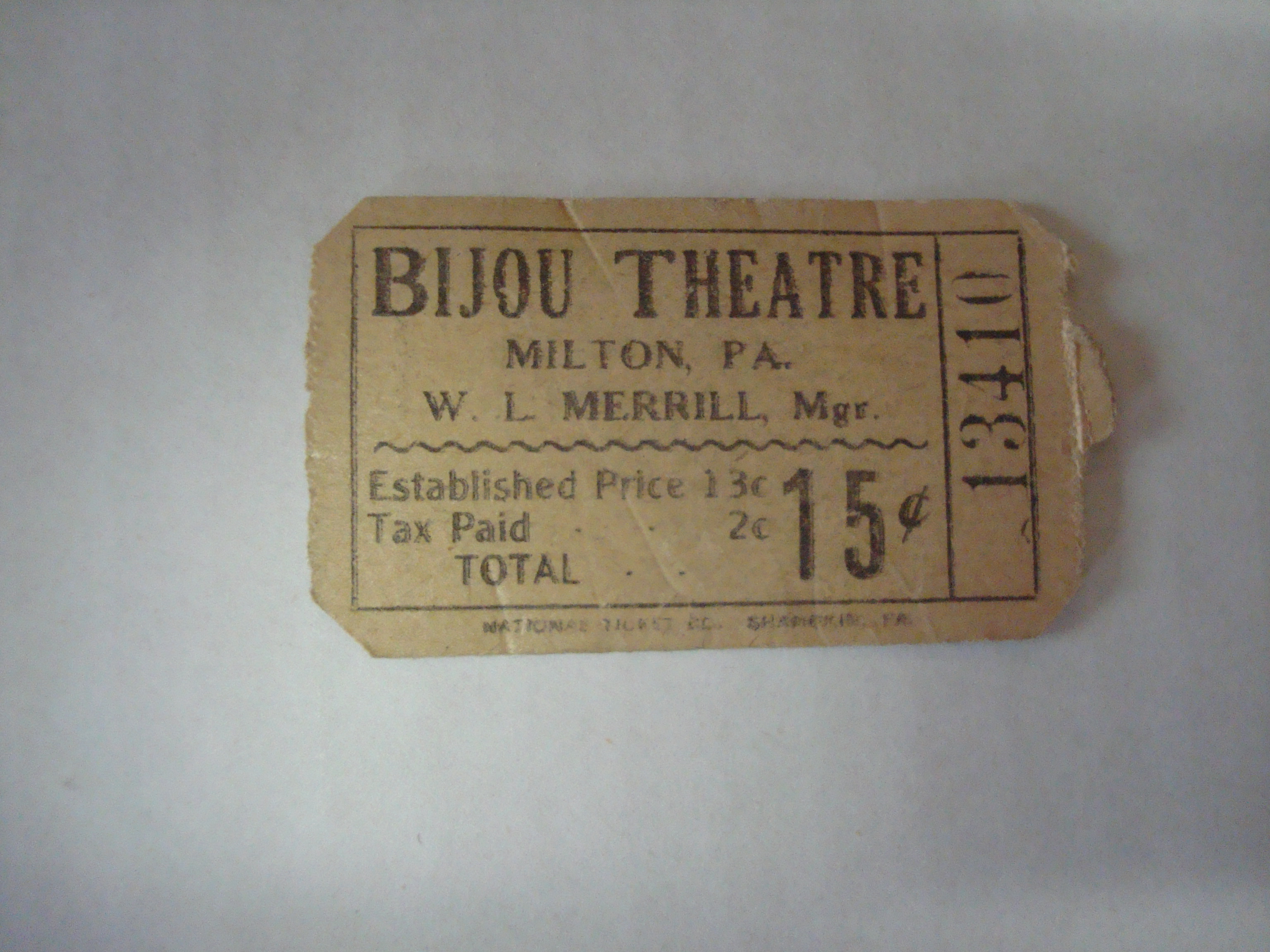
Bijou Dream Theatre Ticket (Source: Milton Historical Society)

Her middle-aged granddaughter’s comments 100 years later:

I get caught up in the story of Grandma’s life—and have worried that she has had a toothache since April 11 (and again mentions the pain on April 15 and 18), but has not treated it.

I feel relieved that Grandma finally tried to visit the dentist—and disappointed that he wasn’t there. (I guess this was the era before appointments.) Hopefully she’ll goon get the tooth fixed.

The Movies

In 1911 Milton had a movie theater on Broadway called the Bijou Dream that showed silent movies.
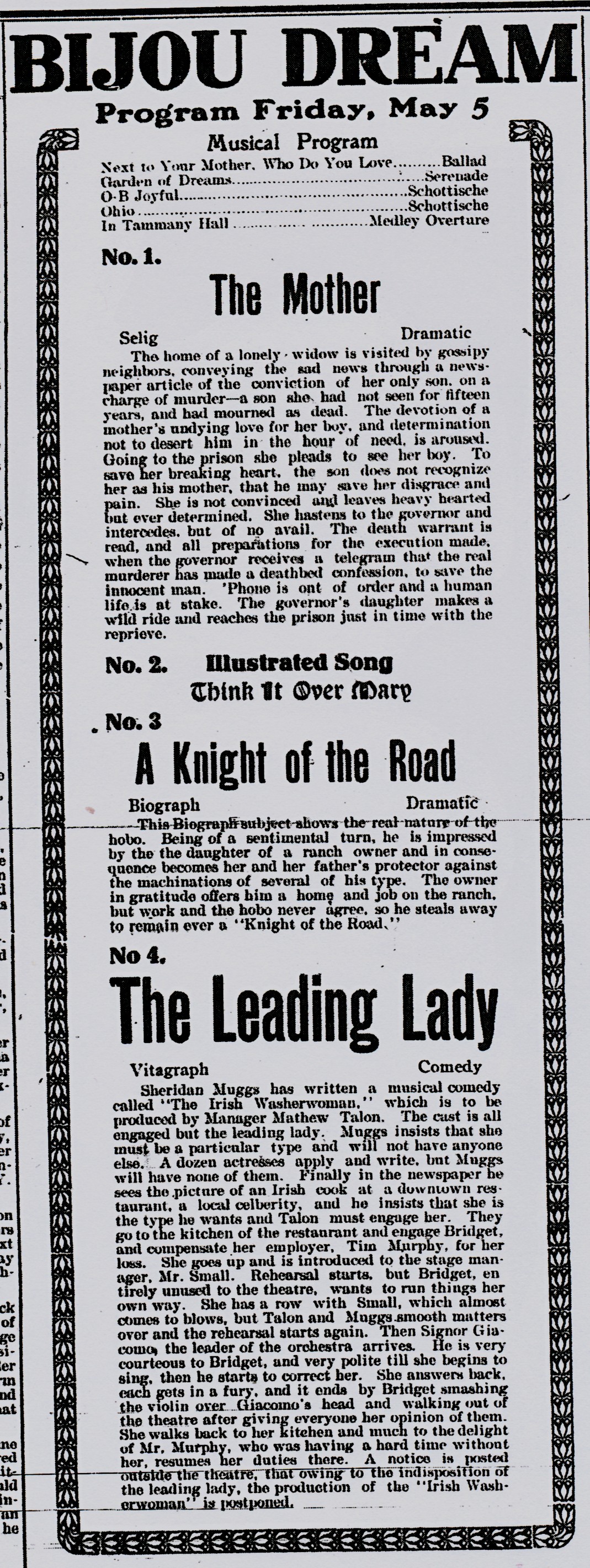
Advertisement in Milton Evening Standard, May 5, 1911

It looks like four short films were being shown in May 1911. In case it’s difficult to read the description of the movies in the photo above, I’ll reprint the description for  the first movie.

 No. 1. The Mother—

The home of a lonely widow is visited by gossipy neighbors, conveying the sad news of the conviction of her only son on a charge of murder—a son she had not seen for fifteen years, and had mourned as dead. The devotion of a mother’s undying love for her boy, and determination not to desert him in the hour of need, is aroused. Going to the prison she pleads to see her boy. To save her breaking heart, the son does not recognize her as his mother, that he may save her disgrace and pain. She is not convinced and leaves heavy hearted, but ever determined. She hastens to the governor and intercedes, but of no avail. The death warrant is read, and all preparation for the execution made, when the governor receives a telegram that the real murderer has made a deathbed confession to save the innocent man. Phone is out of order and a human life is at stake. The governor’s daughter makes a wild ride and reaches the prison just in time with the reprieve.

Whew, what melodrama in the old silent films. I can almost hear dramatic music (played by a live pianist) reaching a crescendo as the governor’s daughter makes the wild ride trying to reach the prison before the execution.

Why use Botox or Juvederm When You Can Use Paraffin?

16-year-old Helena Muffly wrote exactly 100 years ago today: 

Friday, May 5, 1911:  I believe I have forgotten all that I really did do today. It must have been a case of carelessness or laziness.

Her middle-aged granddaughter’s comments 100 years later:

Since it sounds like Grandma had a fairly quiet day a hundred years ago, I’m going to go off on a tangent —

Sometimes I’m surprised at the similarities between 1911 and 2011. According to the March 15, 1911 issue of Ladies Home Journal in an article titled ” Other Girls are Pretty: Why Can’t I Be? ” women a hundred years ago sought to erase wrinkles by going to beauty doctors for paraffin injections. Who would have thought?

Many women apparently got the paraffin injections, though there were risks. The woman profiled in the article had been to “one of the quack beauty doctors who belongs to that army of charlatans who promise to perform miracles.”

The woman was quoted as saying that the beauty doctor had, “filled my dimple and made it into a pimple and he turned two frown wrinkles into ridges, and the lines on my face are all lumps. They tell me nothing can be done. I don’t see how I’m going to spend the rest of my life with a face like this.”

According to the author, “The lines running from nose to mouth were raised like the ridges of mountain ranges on a model map, and two lumps protruded on her forehead where the paraffin, or whatever the injection was, had coagulated into an indissoluble mass.”

The author continued, “Now girls, a direct word to you—I mean you girls who think you are the only ugly girls in the world, and who grow morbid and sensitive and allow your shoulders to stoop dejectedly—I beg of you, do not look for beauty in the cheap parlors of a quack beauty doctor, or in the advertisements of lotions and beautifiers you see in the papers. . . .”

Have times changed??

Juvederm is a currently used facial filler designed to eliminate wrinkles. According to a  Q and A forum on Juvederm on the RealSelf website:

Question: Why does Juvederm leave bumps after the injections?

Answer: Juvederm Should Not Leave Lumps or Bumps.

Injecting filling agents such as Juvederm or Restylane is very much technique- and physician-dependent. In other words, the doctor must know what he or she is doing, and many do not.

When you inject Juvederm, if it is too deep, it is absorbed by underlying tissues and does not specifically fill the wrinkle. But if you inject too superficially or too close to the surface, you can end up with lumps. Generally, these will go away within a week, but for persistent lumps, you may need to undergo additional injections with an enzyme named hyaluronidase to dissolve the filler material.

Arnold W. Klein, MD – Beverly Hills Dermatologist

100 Year Old Craft: Make a Paper Doll Girl and Her Swimming Ducks

16-year-old Helena Muffly wrote exactly 100 years ago today: 

Thursday, May 4, 1911:  Helped to clean the hall this afternoon and also had to clean the carpet. I penned up some ducks this evening. Didn’t like it very well for I have rather a timid feeling towards them.

Her middle-aged granddaughter’s comments 100 years later:

Right after I read this diary entry, I happened to flip through the May 1911 issue of Good Housekeeping magazine, and saw directions for making a paper doll goose girl and her swimming geese. And I thought—Whoa, those geese look almost like ducks.

So if a child you know would like to make a paper doll girl and her ducks—they could pretend they were Grandma penning up her ducks so many years ago.

Supplies Needed to Make this Craft

Heavy stiff white paper

Pencil

Scissors

Paste or glue

Water colors, colored pencils or crayons

A “broomstraw” taken out of a broom

Pin

Thin white paper for tracing (optional)

Shallow pan half-filled with water (optional)

Directions

1. Click here for the patterns for the girl and the ducks, and then print. Cut the patterns out.

(In the old days people didn’t have printers or copying machines so they’d trace the pattern out of the magazine using thin paper.  If you’d like to be really authentic you can make the pattern by putting thin paper over the sheet with the outlines; trace; and then cut out the pattern that you created on the thin sheet of paper. Save the original sheet to make additional patterns in the future. )

To Make Girl

2. Fold a sheet of the heavy white paper in half. Lay the pattern of the girl on the paper with the straight edge of the sun bonnet and the straight edge of the dress on the fold of the paper. On the heavy paper draw a line around the edge of the pattern.

3. Cut out the doll. She will be double with two halves joined. (Be sure to make her feet as large as the feet in the pattern. It’s okay if her feet end up being even a little larger than the ones in the pattern. She will not stand if her feet are too small.)

4. Bend the dolls arms forward at the shoulder.

5. Open the doll up and spread paste or glue on the inside of the head and her clothes, except of the arms. (Do not put paste the arms, legs or feet). Press the two halves together making sure that the edges meet evenly.

6. Use the water colors, colored pencils, or crayons to make the dress.

7. To herd her ducks the girl will need a long stick. Remove a broomstraw from a broom for the stick. Punch a small hole in the doll’s right hand with a pin and then push the broomstraw through the hole.

To Make Ducks  (Make 3 or more)

8. Fold a sheet of heavy white paper in half and draw around the duck pattern like you did with the girl. The top of the duck’s head should be on the fold of the paper.

9.  Cut out the duck and fold the wings outward; then paste the sides together. Do not paste the wings or the stand.

10. Decorate the bird to make it look like a duck using water colors, colored pencils or crayons.

11. After the paste is dry stand the duck up.

12. Make several ducks. The girl can then drive the ducks into a pen and to the water.

To Make the Ducks Swim

14. Fold the two halves of each duck stand half way out so that the duck will sit flat on the table when you sit it down.

15. Gently put the ducks on top of the water. The flattened-out stand will hold the ducks up and they will float and swim about as if alive.

16. When finished, take the ducks out of the water and gently dry with a cloth (or paper towel); press the stand straight again as it originally was. After the ducks are dry they will again be able to stand.

(These directions are adapted and abridged from the Good Housekeeping directions.)

Ironing Collars with a Flatiron

16-year-old Helena Muffly wrote exactly 100 years ago today: 

Wednesday, May 3, 1911:  I did most of the ironing this morning. Ironed my Ma’s fancy collar, but somehow I didn’t iron it right, then I got a lecture for my pains. Sewed this afternoon.

Her middle-aged granddaughter’s comments 100 years later:

A hundred years ago, when it was much more difficult to launder and iron clothes than it is today, women’s dresses sometimes had detachable collars.

Also, detachable collars came in different styles which enabled people to vary the look of one dress by changing the collar.  If you’d like to see what they looked like, costumes.org has some vintage detachable collar patterns.

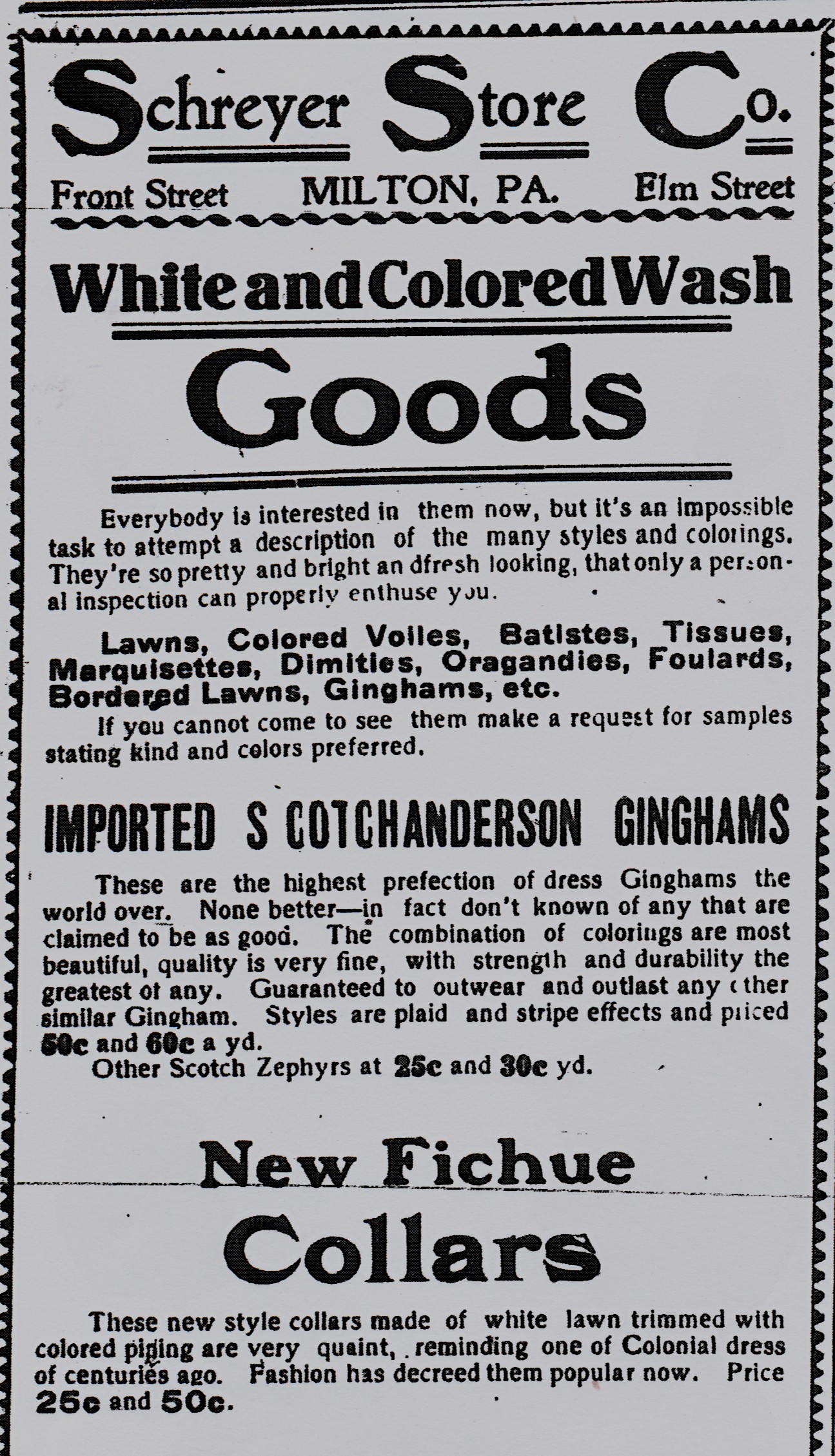
Advertisement for collars, Milton Evening Standard, May 8, 1911

Even with modern irons, it can be difficult to iron clothes correctly.  A hundred years ago ironing was even more complicated.

During the laundering process prior to ironing, the fancy collar probably needed to be starched to stiffen it to just the right degree of crispness. If the starch was inadvertently made too thin or too thick there was the potential for disaster.

And, when it was time to iron, the collar needed to be damp—but not too damp.  Grandma probably was using a flatiron that was heated by placing it on the wood stove. It needed to be hot enough to get the wrinkles out—but not so hot that it would scorch the collar.

A book published in 1909 by Juniata Shepperd called Laundry Work: For Use in Schools and Homes had lots of tips for ironing difficulties:

  • Make starch as directed for stiff starching, and use a clean, bare, unpainted table to work on. Things for stiff starching should be thoroughly dried before starching. . . Rub between the hands until the cloth is thoroughly saturated with starch. . . When well wiped, smooth out all wrinkles with the fingers, and hang to dry.
  • To dampen collars and cuffs dip a clean white towel in hot water and wring moderately dry. Lay a collar straight on the towel and turn one thickness over it. Put on another collar, and turn the towel over it and so continue until all are in. Keep straight, and, when ready to iron, take out just one at a time. Starched things should not be damp enough to stick to the ironing board. If they blister when ironed, it indicates that they are too wet and the dampening cloth should be wrung a little drier next time.
  • When set before a wood fire, irons heat well, but require frequent cleaning on account of the dust and ashes which are constantly coming in contact with them. They heat very well on the top of the kitchen range, but it must be made perfectly clean and free from polish where the irons set.
  • Put a goodly pressure on the iron, and do not raise it from the cloth, but move it quickly and evenly over the surface to be smoothed. When a wrinkle is made in ironing, dampen it again in that place with a wet cloth and smooth out.
  • Ironing should be done rapidly, otherwise much time is spent in changing the irons.
  • To remove scorch stains lay the article in the window where the hot sunshine may act upon it for several hours. If the stain is but slight it may be removed by placing a folded white cloth under it and rubbing it gently with a damp cloth. An obstinate stain may be removed by dampening, soaping well and bleaching in the dew and sunshine.

Milton A Hundred Years Ago

16-year-old Helena Muffly wrote exactly 100 years ago today: 

Tuesday, May 2, 1911: Ruth and I went to Milton this morning. Her highness got a dress and a pair of pumps. Don’t know when I will get mine, perhaps next winter.

Postcard showing Marsh Shoe Store in Milton a hundred years ago (postally used December, 1910).
Advertisement in Milton Evening Standard, May 4, 1911

Her middle-aged granddaughter’s comments 100 years later:

We’re five months into the diary–and even though Milton is probably only about 5 miles from the Muffly farm–this is the first time that it is mentioned in the diary. The only towns previously mentioned were McEwensville, Watsontown, and Turbotville. Whew, by today’s standards, Grandma never got very far from her home.

A trip to Milton probably felt like a trip to the big city.

A hundred years ago Milton had a humming downtown with lots of wonderful stores. Back then there were trolley tracks that ran between Watsontown and Milton, so Grandma and her sister Ruth probably walked to Watsontown and then took the trolley to Milton.

Milton Postcard, circa 1911 (Source: Milton Historical Society)

The trolley system was dismantled a few years after the diary was written:

 With the automobile came on the scene in the early years of the twentieth century, the trolley business began to slack. After a sharp decline in business, the L.M. & W. trolley company changed to gasoline buses in 1922. Even the buses couldn’t complete with the automobile and service ended in the early 1930s.

George Venios in Chronicles and Legends of Milton (2002)

An aside: I had a wonderful visit with George Venios, Deb Owens, and Joan Nunn at the Milton Historical Society yesterday. I enjoyed learning more about Milton, and they shared many wonderful artifacts with me including the early postcard in today’s posting. Additional Milton pictures from the historical society will illustrate future posts. Thank you!

I’d also like to thank the Milton Public Library and the Montgomery House Library for their awesome assistance with finding and navigating my way through old issues of the Milton Evening Standard and the Watsontown Record and Star. I’ll be periodically sharing materials from those newspapers.

The Treadle Sewing Machine

16-year-old Helena Muffly wrote exactly 100 years ago today: 

Monday, May 1, 1911: 

The month of May has come today

With many a happy pleasure.

With it, she brings the flowers of spring,

In full many a boundless measure.

Started to make a dress today. Want to get it finished this week, if I can. There was an awful heavy shower here this evening. It hailed some too but it soon cleared off and everything looked so fresh and beautiful.

Her middle-aged granddaughter’s comments 100 years later:

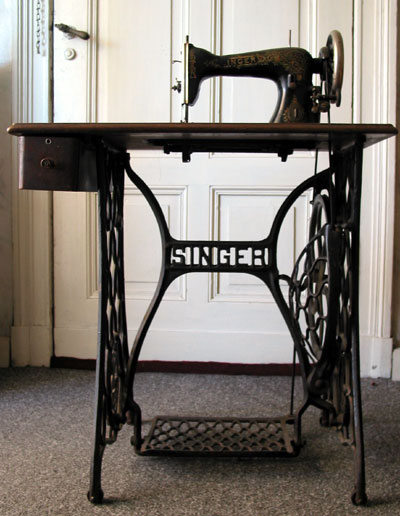
I loved to explore Grandma’s attic when I was a child, and remember that she had an old treadle sewing machine in her attic. Instead of using electricity, the machine was operated by moving your feet up and down.

I wonder if the sewing machine in the attic was the same one that she used to make the dress in 1911.

I can remember begging to be allowed to explore the attic. Off to the side of Grandma’s kitchen at the spot where the kitchen merged with the hall, there was a door that led to the attic stairs.

Grandma would open the door, and lead my cousins and me up the hardwood stairs. The stairs led to a huge sun lit room. (My memory is that it was always sunny whenever I was in the attic.)

At each end of the room were large casement windows. The ceiling sloped nearly to the floor along the sides. Grandma’s bungalow was really a 1 ½ story house, and I think that the attic was designed so that it potentially could be converted into bedrooms, so it had beautiful hardwood floors.

There were rows of wooden shelves in the attic filled with boxes, dishes, knickknacks, and other miscellaneous treasures. Amongst all the stored items sat the sewing machine. My memory is that Grandma actually used the treadle sewing machine, and that torn pairs of my grandfather’s overalls lay by the machine waiting to be patched. But my memory is very foggy on this—and maybe there really were no torn overalls–and the treadle sewing machine was no longer used and merely stored in the attic.

Old-time Recipe for Stirred Custard

16-year-old Helena Muffly wrote exactly 100 years ago today: 

Sunday, April 30, 1911:  Pa and Ma and Jimmie went away today. Ruth had invited Helen Wesner and Blanche Bryson to come and do justice to her very excellent cooking. I rode home from Sunday school with them. I choked at the dinner table which displayed my most excellent manners.

Her middle-aged granddaughter’s comments 100 years later:

It sounds like Grandma’s sister Ruth had fun cooking a meal for friends—and that Grandma displayed her sense of humor by pretending to choke on the food. A few days ago (see the April 25 and April 27 postings) two of my cousins shared memories about how much Grandma enjoyed practical jokes when she was an older woman. I can now see that this was a trait that she had throughout her life.

Menu page in April, 1911 issue of Good Housekeeping Magazine.

I wonder what her sister Ruth cooked. A hundred years ago Good Housekeeping magazine included sample menus each month. One of the April, 1911 Sunday dinner menus is below:

Sunday Dinner

Tomato bouillon

Roast veal, brown sauce

Mashed potatoes

String beans

Boiled custard*

Sponge cake

Coffee

An asterisk meant that the magazine contained the recipe.  For  the Sunday dinner menu, the only included recipe was for Boiled Custard:

Boiled Custard

Scald one pint of milk in a double boiler. Unless for some special reason milk should always be scaled, not boiled.

Beat the yolks of two eggs, or one whole egg, very light with two tablespoonfuls of sugar; and when the milk has scalded, pour it slowly on to the eggs and sugar, stirring all the while. The milk is added to the eggs and sugar instead of these being added to it, for two reasons. The slow addition of a small amount of hot liquid cools the egg, already divided by the beating in of the sugar, without coagulating it until it is so hard that it separates and permits the custard to separate. Also, in this way all of the egg and sugar is mixed with the milk. When an attempt is made to add adds to milk it is difficult, especially with a small amount, to clean out the dish properly. A little lost with small proportions may spoil or deduce the deliciousness of the dish.

Return the milk, eggs and sugar to the double boiler and cook for three minutes, stirring slowly, but steadily and carefully. A minute’s carelessness here may spoil the custard. If not sufficiently cooked the custard will have a raw “eggy” taste, and a minute too long cooks the egg too hard and the custard seemingly curdles. As soon as the custard coats the spoon, or as soon as it begins to feel thicker as one stirs, add the salt. [Note: I used ½ teaspoon salt.] Strain into a cool dish and flavor with a teaspoonful of vanilla. Properly made, the custard will be smooth and the consistency of rich cream.

I made this recipe using a sauce pan since I don’t own a double boiler, and it turned out fine.

The stirred custard  had a nice flavor—but the recipe directions are definitely right when it says that the custard has the consistency of rich cream.  As I look back at the menu in the old magazine, I see that it also lists sponge cake. After seeing the consistency of the Stirred Custard, I now think that it may have been used as a sauce on the cake.