Old-fashioned Apple Pudding

Apple Pudding

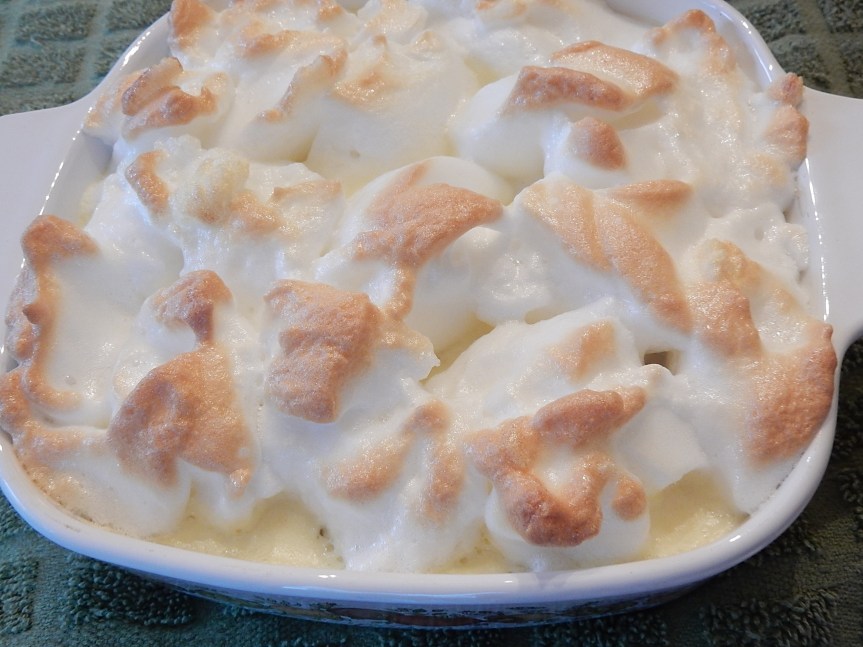
Fall is in the air, and it’s apple season. I found a recipe for Apple Custard in a hundred-year-old cookbook, and decided to give it a try. The Apple Pudding is made by putting stewed apples in a casserole dish, adding a lovely custard, and then topping with meringue.

This recipe is different from most modern recipes for apple desserts because it uses no cinnamon or other spices, and it calls for very little sugar (only 4 tablespoons). The result is a tasty, yet delicate dessert.

Here’s the original recipe:
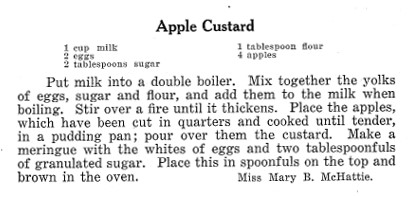
Apple Pudding Recipe
Source: General Welfare Guild Cook Book (Beaver Valley General Hospital, New Brighton, Pennsylvania, 1923)

Apples vary a lot  in size. Apples often were smaller a hundred years ago then they are today, so I interpreted the 4 apples called for in the recipe as approximately 2 cups of peeled, cored, and quartered apples.

Here’s the recipe updated for modern cooks:

Apple Pudding

  • Servings: 3 - 5
  • Difficulty: moderate
  • Print

Apple Pudding

4 apples (approximately 2 cups, peeled and quartered apples)

water

1 cup milk

2 eggs, separated

2 tablespoons sugar + 2 tablespoons sugar

1 tablespoon flour

Peel apples, remove cores, and cut into quarters. Place them in a saucepan and add a little water to prevent scorching until the apples begin to soften.  Bring to a boil using medium heat and then reduce heat. Continue to simmer gently until the apples are soft (approximately 10-15 minutes). Remove from heat and set aside.

Put egg yolks, 2 tablespoons sugar, and flour in a small bowl. Stir to combine then set aside.

In the meantime, put the milk in another saucepan. Bring to a boil using medium heat, while stirring frequently.

Place a small amount (approximately 1 – 2 tablespoons) of hot milk into the bowl containing the egg, sugar and flour mixture; then add the mixture to the hot milk. Stir quickly. (The egg is first combined with a little of the hot mixture to prevent it from turning into scrambled eggs when introduced into the milk.) Continue heating using medium heat, while stirring constantly, until the mixture thickens into a custard. Remove from heat.

Preheat oven to 400° F. Put the cooked apples in a casserole dish. (I used a 1-quart dish, which was quite full; an 8-inch square pan would also work.) Pour the custard over the apples.

Place egg whites in a bowl, and beat the egg whites until they form stiff peaks. Gradually add 2 tablespoons sugar while continuing to beat. Then spoon on top of the custard and swirl. Put in oven for 10 minutes or until the meringue is lightly browned.

http://www.ahundredyearsago.com

Hundred-Year-Old Tips for Gaining Weight

menus
Source: The Calorie Cook Book by Mary Dickerson Donahey (1923)

A 1923 cookbook called The Calorie Cook Book by Mary Dickerson Donahey contained menus for those who wanted to lose weight, as well as menus for those who wanted to gain weight. Here’s the sample Autumn “upbuilding”  menu for gaining weight. The cookbook also contained the following tips for those who believed they were too thin:

Hints for the Thin

The thin folks may feel that I have been stingy with them. They have been given only one menu a season instead of seven.

It is from no lack of interest or sympathy. It is simply that in their case there is a distinction with a difference.

There is always the fact that excessive thinness may mean ill health or overwork. No one can recommend a diet of more food, or richer food, unless quite certain that the person who is to eat all that extra stuff is able to get away with it.

So if your collar bones make you resemble a hat rack, and your vertebrae are altogether too interested in popping out to look at the world for themselves, first see your doctor. If he says you are physically fit – fall to and eat up! Only don’t try to pad out with dill pickles or sauerkraut.

Eat more of everything. Be sure you eat a variety. Eat starches, fats and the simpler sweets. Don’t think it necessary to dispose of French pastries by the dozen. You may gain flesh but you’ll lose your health. And good health is more to be prized than beauty. There’s no comfort without it, and really no lasting beauty, either.

You will notice in your menus that I have simply arranged a variety of fattening foods, well interspersed with green salads and fruits, and that things easy of digestion have been chosen most often. In your own planning, do likewise.

The meals suggested here are not so very big. No second helpings are allowed for, and almost everybody wants a second helping of something. If you can eat them, do of course. But if the meals on the other hand, seem too big, don’t force yourself to the point of disgust.

Don’t eat between meals – that is bad for everybody. But arrange for extra meals at regular hours. Milk is the best thing to take at such meals, as you aren’t apt to get enough anyhow, and it’s the best thing for you. but you may take cocoa, or simple ice cream, without extra rich sauces, or a bowl of rice – brown rice preferably – or oat meal, or whole wheat, steamed soft, with whole milk or cream and brown sugar. Have maybe five meals a day. Breakfast, early lunch, afternoon tea, dinner, and a bedtime supper. Food eaten just before you sleep produces more fat than food eaten at any other time.

You should reverse the advice given the fat folk. If possible have your food portions made with more butter, more creamy, than those served to other people – and if you can eat them, more generous, too.

Remember you need all the fresh air you can get, exercise, though that in moderation, and above all – peace! Don’t worry! You very, very seldom see a fat worrier!

The Calorie Cook Book (1923) by Mary Dickerson Donahey

Old-fashioned Shrimp Salad

Shrimp SaladSometimes I’m surprised how long some foods have been around. I recently came across a hundred-year-old recipe for Shrimp Salad that called for canned shrimp. I never would have guessed that canned shrimp was available in 1923.
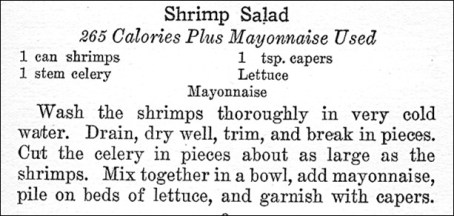
In any case, I decided to try the recipe. The recipe called for the canned shrimp, celery, and mayonnaise – plus a few capers to garnish the salad. This tasty recipe was quick and easy to make, and in some ways seemed very modern.

Here’s the original recipe:

Shrimp Salad Recipe
Source: The Calorie Cook Book by Mary Dickerson Donahey (1923)

Here’s the recipe updated for modern cooks:

Shrimp Salad

  • Servings: 2
  • Difficulty: easy
  • Print

1 can shrimp (either a 4-ounce or 6-ounce can will work in this recipe)

1 stalk celery, chopped

2 tablespoons mayonnaise

1 teaspoon capers

lettuce leaves, optional

Drain and rinse the canned shrimp. Unless the shrimp are very small, cut into pieces. Put shrimp, celery, and mayonnaise in a bowl; mix until thoroughly combined. Arrange lettuce leaves on plate(s), and place mounds of the Shrimp Salad on the lettuce. If desired the lettuce can be skipped, and the Shrimp Salad can be put in a bowl to serve. Garnish with capers.

http://www.ahundredyearsago.com

Popular Food Combinations a Hundred Years Ago

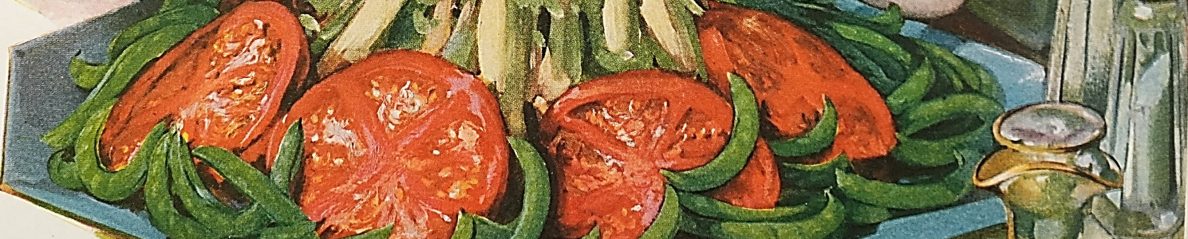
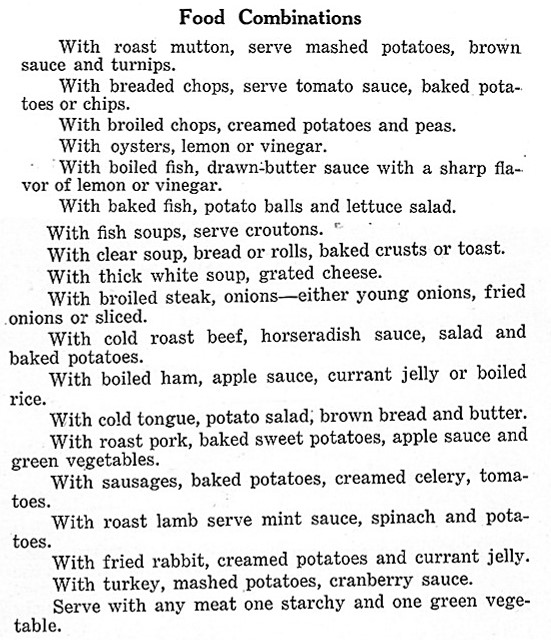
List of food combinations
Source: General Welfare Guild Cook Book (Beaver Valley General Hospital, 1923)

Some foods just seem to go together – bacon and eggs, burgers and fries, meat and potatoes. . . I could go on and on. I recently came across a list of food combinations in a hundred-year-old cookbook, and was surprised to see some of the suggestions.  Roast mutton, mashed potatoes, brown sauce, and turnips anyone?

Old-fashioned Oatmeal Fruit Muffins (Oatmeal Raisin Muffins)

Oatmeal Fruit Muffins

I recently made a hundred-year-old recipe for Oatmeal Fruit Muffins (Oatmeal Raisin Muffins). These classic muffins were delightful with the robust, warm, sweet flavor of molasses and a hint of nutmeg.

Here’s the original recipe:

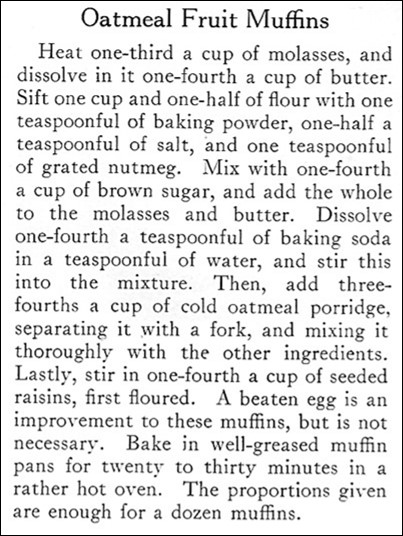
Recipe of Oatmeal Fruit Muffins
Source: American Cookery (June/July, 1923)

When I made this recipe, I went with the option of adding an egg. The batter would be very dry if the egg was not added. I’m not sure why the recipe called for dissolving the baking soda in a little water, but modern baking soda is not typically dissolved before combining with other ingredients, so I skipped that step.

Here’s the recipe updated for modern cooks:

Oatmeal Fruit Muffins (Oatmeal Raisin Muffins)

  • Servings: approximately 12 muffins
  • Difficulty: moderate
  • Print

1/3 cup molasses

1/4 butter

1/4 cup brown sugar

1 1/2 cups flour

1 teaspoon baking powder

1/4 baking soda

1/2 teaspoon salt

1 teaspoon nutmeg

3/4 cup cooked oatmeal (left-over oatmeal)

1 egg, beaten

1/4 cup raisins

Preheat oven to 400° F. Put molasses and butter in a saucepan. Heat, using low heat until the butter melts. Remove from heat. Stir in the brown sugar.

In a mixing bowl, combine the flour, baking powder, baking soda, salt, and nutmeg. Stir in the egg and molasses mixture. Add the raisins, and stir to combine.

Grease muffin pans (or use paper liners). Spoon batter into muffin  cups; fill each cup about 3/4ths full. Place in oven. Bake 20-30 minutes or until lightly browned and the muffins spring back when lightly touched.

http://www.ahundredyearsago.com

1923 Foss’ Pure Flavoring Extracts Advertisement

Advertisement for Foss' Flavoring Extracts
Source: The Boston Cooking-School Cook Book (1923)

Flavorings and extracts have been around for more than a hundred years. The 1923 edition of The Boston Cooking-School Cook Book had an advertisement for Foss’ Pure Flavoring Extracts in the back of the book. In Chapter 1, there was a description of flavoring extracts:

Flavoring Extracts

Many flavoring extracts are on the market. Examples: almond, vanilla, lemon, orange, rose, etc. These are made from the flower, fruit, or seed from which they are named. Strawberry, pineapple, and banana extracts are obtained from the fruits themselves or manufactured from chemicals.

The Boston Cooking School Cook Book (1923)

Old Fashioned Fried Chicken (with Milk Gravy)

Fried Chicken

I hadn’t made old-fashioned fried chicken in years, so was intrigued when I saw a recipe for Fried Chicken with milk gravy in a hundred-year-old cookbook and decided to give it a try. The chicken pieces are coated with flour then fried. The recipe called for frying the chicken pieces in a covered skillet. The coating on the chicken is not nearly as thick and crispy as many modern fried chicken recipes, but it is like the coating on fried chicken that I remember from my childhood. The milk gravy was lovely.

Here’s the original recipe:

Fried Chicken Recipe
Source: The Calorie Cook Book by Mary Dickerson Donahey (1923)

In the U.S. today, we generally refer to “skim milk.” The old recipe calls for “skimmed milk” rather than “skim milk.” Most milk was not homogenized a hundred years ago (and often it was not pasteurized), so the cream floated to the top. When using the milk, it could either be shaken to get “whole” milk or the cream on the top could be “skimmed” off to get the equivalent of skim milk. I don’t think that it matters whether skim, 2%, or whole milk is used in this recipe, so when I updated the recipe, I just called for using “milk.”

Here’s the recipe updated for modern cooks:

Fried Chicken

  • Servings: 4 - 6
  • Difficulty: moderate
  • Print

1 whole chicken, cut into pieces

1/2 cup flour

1/2 teaspoon salt

1/8 teaspoon pepper

fat (lard, shortening) or cooking oil

3 tablespoons flour

2 cups milk

Combine the flour, salt, and pepper; then roll the chicken pieces in the flour mixture.

In the meantime, heat 1/2 inch of fat or oil in a large skillet (that has a lid) using medium heat. When hot, carefully place the floured chicken pieces in the pan.  Cover skillet, and cook for approximately 5 minutes or until the bottom side of each piece is lightly browned, then gently turn, cover skillet, and fry until the other side is browned. The chicken pieces will need to be turned several times. Continue cooking until a meat thermometer indicates that the temperature is at least 165° F. (Put large pieces of chicken in the skillet and cook for a few minutes before adding smaller ones, if there is wide variation in the size of the pieces.)

Remove chicken from skillet, and pour most of the fat or oil out of the skillet. Put back on the stove at medium heat. Stir the 3 tablespoons flour into the remaining fat/oil and browned bits. Slowing stir in the milk. Continue stirring and cooking until the gravy thickens.  Remove from heat and serve.

http://www.ahundredyearsago.com