Hundred-year-old Tip for Storing Lemons

lemon under a glass

Hundred-year-old cookbooks often included hints and tips. Here’s one for storing lemons:

tip for storing lemons
Source: General Welfare Guild Cook Book (Beaver Valley General Hospital, New Brighton, Pennsylvania)

It may work to store lemons under a drinking glass, but I wondered if a plastic bag might be more convenient and work just as well – then I realized that plastic bags didn’t exist in 1923.  According to Dienamics, plastic bags were first used in 1957 when they were used to package rolls.

Old-Fashioned Pear and Pecan Salad

Pear and Pecan Salad on plate

Most of the time when I make recipes for this blog, I select recipes that sound good to me. I don’t generally go for the ones that are very dated and seem strange – but occasionally I’ve intrigued enough by an  old recipe that just doesn’t sound like I’d like it, to give it a try. Today is one of those days. I came across a recipe for Pear and Pecan Salad that called for putting chopped pecans on top of canned pear halves (good so far), but then the recipe called for topping it with mayonnaise –and it lost me. But . . .  The recipe sounded very easy to make, and I had all the ingredients in my kitchen, so I decided to proceed.

The verdict: I was pleasantly surprised by this recipe. The sweetness of the pears, the crunchiness of the nuts, and the creaminess of the mayonnaise worked well together to create a nice taste sensation.

Here’s the original recipe:

Recipe for Pear and Pecan Salad
Source: The Calorie Cook Book by Mary Dickerson Donahey (1923)

When I made this recipe I went with the main topping alternative – mayonnaise, and did not try the other options. I also thought that 3 heaping teaspoons (a heaping tablespoon!)  of mayonnaise on top of each pear half seemed like a lot, so I reduced the amount to 2 teaspoons per pear half.

And, here’s the recipe updated for modern cooks:

Pear and Pecan Salad

  • Servings: 2
  • Difficulty: easy
  • Print

2 halves of canned pears

2 tablespoons pecans, finely chopped

4 teaspoons mayonnaise

lettuce

Arrange lettuce leaves on two salad plates. Place a pear half on top of the lettuce on each plate. Sprinkle with the chopped pecans, then top each pear half with about 2 teaspoons of mayonnaise.

http://www.ahundredyearsago.com

Old-Fashioned Marcaroni with White Sauce

Macaroni with White Sauce

My first reaction when I saw a recipe in a hundred-year-old cookbook for Macaroni and White Sauce, was Mac and Cheese – yes. Mac and White Sauce. . . hmm, that’s different. But, I decided to give Macaroni and White Sauce a try. I was pleasantly surprised by the delicate taste of Macaroni and White Sauce. It’s similar to Mac and Cheese and has a creamy milkiness but without a cheesy taste.

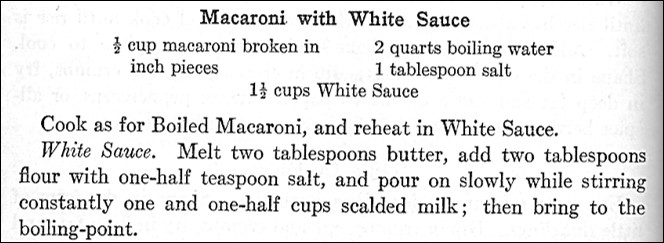
Here’s the original recipe:

Recipe for Macaroni with White Sauce
Source: The Boston Cooking School Cook Book (1923)

A hundred years ago macaroni came in long pieces that were broken into pieces. I just used the modern small pieces of macaroni when I made the recipe. I think that the tablespoon of salt was supposed to be added to the water that the macaroni was boiled in – however, that seems like a lot to me, so I put 1 teaspoon salt in the water.

Here’s the recipe updated for modern cooks:

Macaroni with White Sauce

  • Servings: 2 - 3
  • Difficulty: moderate
  • Print

1/2 cup macaroni

2 cups water

1 teaspoon salt + 1/2 teaspoon salt

2 tablespoons butter

2 tablespoons flour

1 1/2 cups milk

Put water and 1 teaspoon salt into a large saucepan, and bring to a boil using high heat. Add macaroni, and reduce heat so that the water gently simmers. Cook the macaroni until al dente, then drain and rinse with cold water.

In the meantime, in another pan, using medium heat, melt  butter, then stir in the flour and 1/2 teaspoon salt. Gradually, add the milk while stirring constantly. Continue stirring until the white sauce begins to thicken. Stir in the macaroni and gently simmer for 5 – 10 minutes while stirring occasionally, or until excess liquid has been absorbed by macaroni. Remove from heat and put in serving dish.

http://www.ahundredyearsago.com

Old-Fashioned Luncheon Caraway Bread

Luncheon Caraway Bread

I recently came across a hundred-year-old recipe for Luncheon Caraway Bread, and decided to give it a try. It is a white quick bread with caraway seeds. This tasty, easy-to-make bread was flavorful and slightly sweet.

Here’s the original recipe:

Recipe for Luncheon Caraway Bread
Source: The Boston Cooking School Cook Book (1923)

Here’s the recipe updated for modern cooks:

Luncheon Caraway Bread

  • Servings: 6-8
  • Difficulty: moderate
  • Print

1/4 cup butter, softened

3/4 cup sugar

1 egg

3/4 cup milk

3 teaspoons baking powder

1/4 teaspoon salt

3/4 teaspoon vanilla

1 2/3 cups flour

3 teaspoons caraway seeds

Preheat oven to 400° F.  Put butter in a mixing bowl, cream with the sugar. Add the egg and milk; stir. Stir in the baking powder, salt, and vanilla. Add flour and stir until mixed. Add caraway seeds, and stir. Put into prepared bread pan or 8″ X 8″ pan. Put in the oven and bake for 35 -45 minutes or until lightly browned. Serve warm.

http://www.ahundredyears.com

Hundred-Year-Old Tip for Whiter Boiled Potatoes

potatoes in water and milkHundred-year-old cookbooks often contain household tips. Sometimes they leave me scratching my head or wondering if they really work. For example, I had my doubts about the following tip:

When boiling old potatoes, put a tablespoon of milk in the water in which they are cooked and they will be much whiter.

General Welfare Guild Cook Book (Beaver Valley General Hospital, New Brighton, PA, 1923)

When I saw the tip, I could think of no reason why boiled potatoes would be whiter if cooked in water that had a little milk added. And, I wondered why anyone would care. My boiled potatoes generally look fine (even if they are cream colored).

When I tried this tip, I think (much to my surprise) that it actually worked. The potatoes seemed whiter than usual.

This tip also made me wonder about the use of the term “old potatoes.” Is there such a thing as old potatoes in today’s world? When I was young, I can remember potatoes starting to sprout, and getting soft and mealy in the spring – but I seldom see those types of potatoes during any season any more.