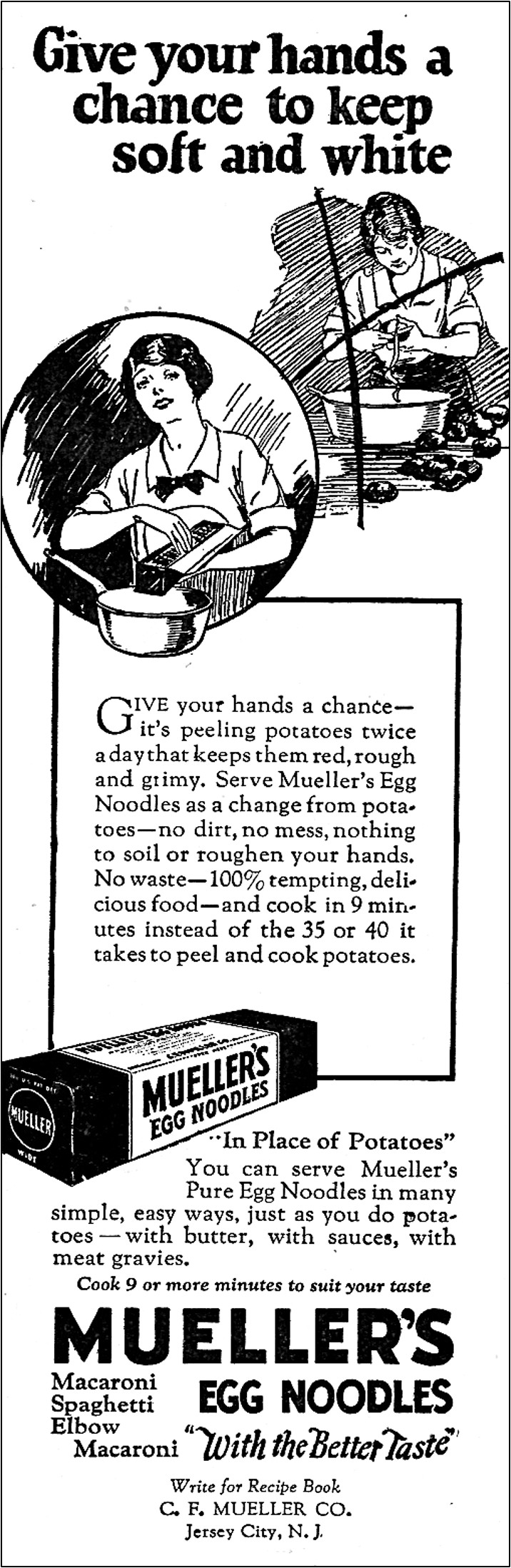
Hundred-year-old advertisements provide a window into the times. Sometimes these ads say things that are offensive or make little sense today. A 1926 advertisement for Mueller’s Egg Noodles in American Cookery magazine does both. It makes me cringe that the ad assumes that the magazine readers are white.
The ad is also very confusing. I get that noodles are a substitute for potatoes, and I also know that, both then and now, people were concerned about rough, dry hands. But then I get lost. Does peeling potatoes somehow result in rough hands?
Many people a hundred years ago ate potatoes at almost every meal. Potatoes were often peeled to make boiled, fried, or mashed potatoes. But, is peeling potatoes more likely to cause rough hands than other tasks related to cooking?
I don’t peel potatoes twice a day, and potatoes purchased at a store today generally have already been washed. But, I do regularly peel potatoes, and my hands are rough (though fortunately not grimy). Maybe I should decrease my potato consumption and serve more noodles. 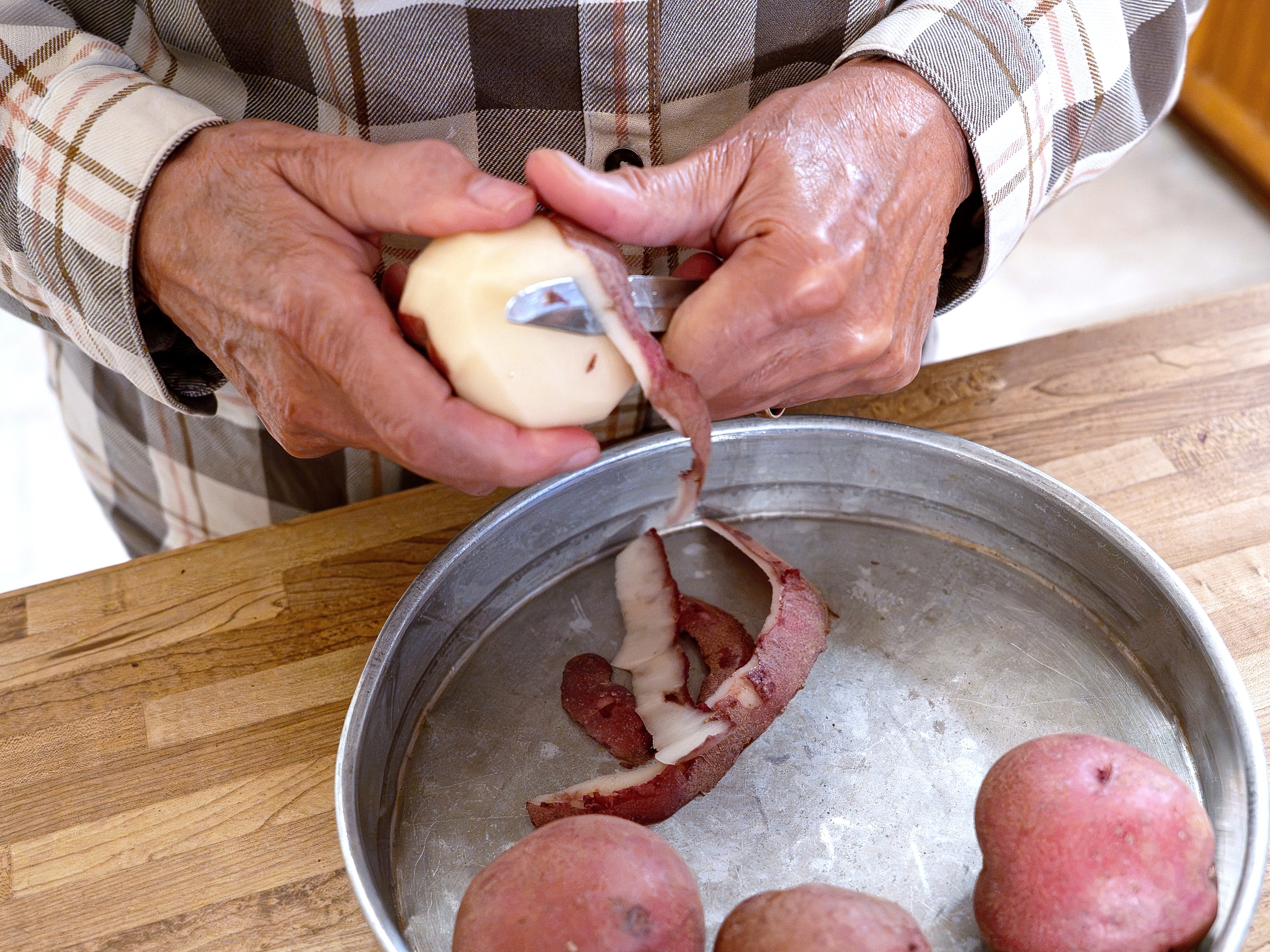
The ad also highlights that it takes less time to prepare noodles than to make potatoes. It says that that noodles can be cooked in 9 minutes, while it takes 35 to 40 minutes to peel and cook potatoes. Cooks, generally women, a hundred years ago embraced commercially-produced foods, and dishes that could be prepared quickly.

Well, 35 – 40 minutes sounds a long time to get those spuds ready, unless they’re being roasted. And on balance, I’d have thought they covered more nutritional bases than noodles. Although noodles also offer plenty of ways of being served – as do potatoes!
I also have the impression that potatoes are more nutritious than noodles – though neither are super nutritious. The length of time that it takes to cook boiled potatoes varies a lot depending upon the size of the pieces. I tend to cut potatoes into little pieces, but maybe if the potatoes were halved or left whole, it would take 35 or 40 minutes.
Fair point. I also tend to cut my chunks quite small.
Every year I make mashed potatoes to serve with Swedish meatballs for my winter solstice party. The timing of your post struck me as a fascinating coincidence because I’ve been debating making egg noodles instead of mashed potatoes this year, to save myself a little trouble and a little time.
mmm. . . Swedish meatball would be lovely with either mashed potatoes or egg noodles. The winter solstice party sounds like a lot of fun.
Love this!
It’s wonderful to hear that you enjoyed this post.
I did very much.
I always get potatoes wet under running water before I peel. On Saturdays at my dad’s restaurant, we peeled potatoes for French fries, so even as a kid, I peeled many. I was also a dishwasher, but I guess my young hands could take it.
Whew, it sounds like a lot of work – but I’m getting hungry just thinking about homemade French fries. I wonder if any restaurants today make French fries from scratch.
The restaurant Five Guys makes its own fries.
I learned something new. I hadn’t know that.
It’s very easy to get them to make a GF hamburger, and the fries are in a dedicated fryer, so there’s no cross-contamination.
Well, some advertising genius probably got a bonus for thinking that one up!
Advertising was amazingly sophisticated by the 1920s – though I probably shouldn’t be surprised. Women’s magazines were at their peak in the early 1900s, and print advertising in them was a major way that companies reached potential customers.
I’ll take the taters any day!
So would I.
The spin that advertisers put on things! I get it. I get very dirty potatoes from the local farm and scrubbing and rinsing is a must. It doesn’t strike a blow to my beauty routine though. I am a big fan of buttered egg noodles!
Good to know that rinsing potatoes doesn’t strike a blow to your beauty routine. Similarly to you, I like to eat a variety of starchy foods. I enjoy both potatoes and noodles.
I think that company is doing something called “problem-solution advertising” or the creation of artificial demand by saying there’s a serious issue going on when in fact there isn’t. Given all the housework women did in those days, I’m sure that dry or rough hands (especially in winter) would have been quite normal and caused by all the tasks piled on each other, particularly such chores as washing floors and doing laundry, not just by a single task – and a very minor one compared to the others – such as peeling potatoes. In fact, one way to tell a wealthy “lady” at that time was to check out her hands.
This ad reminds me of the famous Listerine campaign where the company fabricated a problem – halitosis – and reframed it as a serious medical problem that anyone could be afflicted with if not for their mouthwash. Halitosis is minor and usually neutralised by normal dental hygiene, but the Listerine company was very successful in getting people to be excessively worried about bad breath. There have been many such very successful advertising campaigns down through the years. Cheers.
Exactly! Great example of the classic Order out of Chaos theory.
This brings back memories of a leadership class I took once upon a time. 🙂
Thanks for explaining. I don’t know much about advertising, but it all makes so much sense. I really like the term, “problem-solution advertising.” It succinctly describes a type of advertising that’s probably really effective.
oh that’s funny! yes i remember as a child having to peel potatoes in very cold water (we lived in the mountains) and getting very cold rough hands!
sherry
Oh boy…I remember cold cold hands from peeling potatoes ….But I hated mixing meatloaf more with the cold meat and cold eggs!
🙂 I still don’t like to mix meatloaf.
brrr . . . just thinking about peeling potatoes in cold water makes me shiver.
You pointed out things I might have missed. You are sharp!
There’s a lot in this ad. If I was a teacher, I could base an entire history lesson on this advertisement.
For what it’s worth, I have been peeling potatoes the same way for (getting really close to) that hundred years.
Large bowl of water…add potatoes.
Peel and add to second large bowl of water.
They can stay in the second bowl indefinitely until going into the final processing step. Keeps them from turning black/brown.
Drain and chop/slice/ dice/ whatever!!!
Similarly to you, I’ve been peeling potatoes the same way for a long time. One “innovation” I’ve adopted over the years is the the use of a potato peeler. When I was young, we just used paring knives.
Your description of putting peeled potatoes in a bowl of water until you are ready to cook them, reminded me of when we prepared potatoes for Christmas, Thanksgiving, and other large family gatherings when I was child. We’d always peel lots of lots of potatoes first thing in the morning and put them in a large stainless steel milk bucket that was filled with water. (We lived on a dairy farm.). Forty-five minutes or so before meal time, we’d set the bucket on the stove and cook the potatoes; and then after they were cooked, we’d mash them. And, the mashed potatoes would always be one of the first dishes to be completely emptied. It was amazing how many mashed potatoes people ate at some of those meals.
I have tried to get used to using a peeler, but always end up going back to the trusty paring knife. I still have the one that I peeled potatoes with as a little kid. It has bone handles. It was the only paring knife in Mom’s kitchen.
My favorite paring knife was originally a paring knife that my mother-in-law gave my husband when he got his first apartment. I think that it was just a cheap used knife that she didn’t need, but it works wonderfully. It’s lasted a long time. We periodically sharpen it.
I have a little sharpening stone that is older than I am. Those old knives were meant to last
This one stirred me up. Early advertising is so easy to figure out and feel duped. This still goes on today, except it’s gotten cleverer . Hindsight is 20/20.
I enjoy those potatoes more today than any boxed pasta! 😛
It’s fascinating how advertising has evolved over the years.
Simply amazing – who would have thought!
Over the years, I have learned so much about what it was like a hundred years ago from reading old advertisements.
I’m so pleased you are sharing what you have learned!