It’s always fun to look through hundred-year-old cookbooks and magazines to find recipes to make for this blog. I generally select recipes I think would be tasty and fun to make. Often the recipes use seasonal ingredients.
This week I decided to make a hundred-year-old recipe for Marshmallow Fudge for a very practical (and perhaps boring) reason. Several weeks ago, I made Apple Mallows (Baked Apples with Marshmallows), and I had some left-over marshmallows. When I was flipping through an old cookbook and saw a recipe for Marshmallow Fudge, I immediately thought, “What a great way to use up those marshmallows in the cupboard!”
The recipe called for melting marshmallows in a hot fudge mixture. The melted marshmallows helped create a lovely smooth fudge, as well as provided some of the sugar in this recipe.
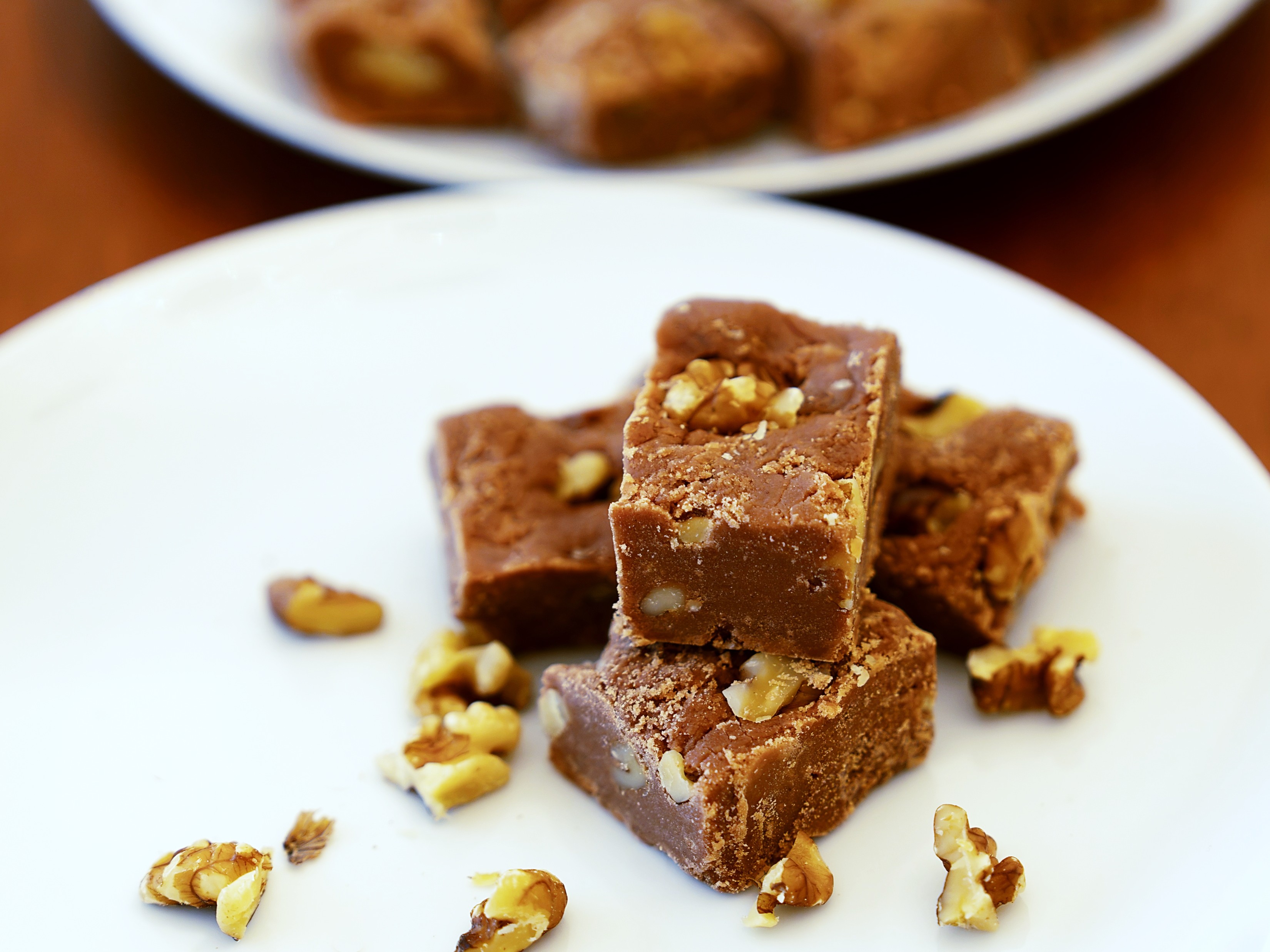
I’m glad I decided to make Marshmallow Fudge. It was easier to make than many candies and turned out beautifully. The fudge contained walnuts, was rich, and melted in my mouth. It was not the least bit grainy.
Here is the original recipe:
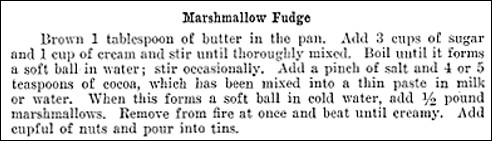
And, here is the recipe updated for modern cooks:
Marshmallow Fudge
1 tablespoon butter
3 cups sugar
1 cup heavy cream
1/8 teaspoon salt
5 teaspoons cocoa
3 tablespoons water
8 ounces marshmallows
1 cup chopped walnuts
Step 1. Melt and lightly brown butter in a large saucepan. (Use care not to burn the butter.)
Step 2. Add sugar and cream; stir until combined.
Step 3. Bring to a boil using medium heat, then reduce heat, but continue to gently boil until the mixture reaches the soft ball stage (235-240° F.). (Do not stir the boiling mixture to avoid crystallization.)
Step 4. In the meantime, put the cocoa in a small bowl; Gradually add the water while stirring. Stir until the mixture is smooth.
Step 5. Add the salt and the cocoa mixture to the boiling sugar mixture which has reached the soft ball stage; gently stir until thoroughly combined.
Step. 6. Continue boiling for a little longer until the mixture again reaches the soft ball stage (235 – 240° F.).
Step 7. Add the marshmallows to the mixture and immediately remove pan from heat; stir until the marshmallows are melted, then continue stirring until the fudge is creamy and begins to thicken.
Step 8. Stir the chopped walnuts into the fudge.
Step 9. Line a 9-inch by 9-inch pan with parchment paper (or thickly butter the pan), then spread the fudge in the pan. Lightly score the fudge to mark where it will be cut.
Step 10. Allow fudge to cool, then cut into pieces.

Mom used to make this for us. Now I want some but try to swear off sugar 🙂
Similarly to you, I try not to eat much sugar. When I made this recipe, I only allowed myself one piece a day.
Great plan I would freeze mine 🙂
Strangely, this seems more complicated than the recipe I use. Mine came down to me from my mother, and I suspect it’s the one printed on the old Hershey’s cocoa cans. It can be a little touchy (I’ve had a few batches harden in the pan), but I still use it, along with mom’s candy-making pan with the high sides, and her candy thermometer.
I think that my mother also made the fudge recipe that was on the old Hershey’s cocoa cans. (She definitely made the cocoa recipe that was on the cans.) Candies, in general, seem like they can be touchy. So many things (temperature, crystalization issues, air humidity, etc.) can affect the outcome.
I haven’t been happy with the recipe I have been using. I’m definitely going to give yours a try.
This recipe worked well for me. You should give it a try and see if you like it.
We are going to try it. I have it printed out and ready to go.
Looks easy enough Sheryl. My mom tried to make fudge all the time but was a bit impatient and never let it cook long enough. You mean fudge isn’t eaten with a spoon?
Nothing wrong with fudge that is eaten with a spoon! This reminds me of times when I made fudge that I ended up putting in the refrigerator in an attempt to make it firm.
This is pretty much the recipe I use this time of year…. But I grab a jar of the marshmallow whip. My husband thinks fudge is suppose to be hard and grainy because his mother made it that way… I tried to make it for him that way but it broke my chocolate loving heart to do that to chocolate !
Food memories really affect preferences. It’s interesting how people sometimes prefer foods that didn’t actually turn out like they were supposed to.
My secret tip for making sure that any sugary product isn’t grainy, is to bring the mixture reallllllly slowly to a boil so that the sugar is completely melted before it reaches the boiling point. (Pinch a bit of the hot mixture between your finger and thumb to check for grains)
Thanks for the tip. I’ll have to give it a try the next time I make candy.
It works!!
This sounds marvelous. Maybe there will be time to make it when the Danes come again.
Similarly to you, I tend to make treats like this when there is an upcoming visit from family.
Wow! Thanks for this recipe. I’ve never been happy with the results of the recipes I’ve tried so I’m looking forward to trying this one.
This recipe turned out well for me, and was very tasty.
Do you use marshmallows or fluff? I heard the coating on the marshmallows affected the fudge.
Until I read your comment, I had never heard anything about marshmallows having a coating. I used marshmallows and the fudge turned out fine – though marshmallow fluff would also work.
The hundred-year-old marshmallow fudge looks like absolute perfection. A breathtakingly delicious and nostalgic post, Sheryl!
It’s nice to hear that you enjoyed this post. The fudge was yummy.
Oh yum!!😋 perfect recipe to have on hand for the holidays coming up!
The Marshmallow Fudge would be perfect for the upcoming holidays. I am thinking about making some to include on my Christmas cookie tray.
I used to make this as a young girl. It was a Christmas time treat.
It’s wonderful to hear that this post brought back some warm food memories. Marshmallow Fudge is a perfect Christmas time treat.
Decadently delicious, I’m sure.
The Marshmallow Fudge is definitely decadently delicious.
My aunt would make something simpler to these during the holidays – yummy!
Homemade fudge and other candies make perfect holiday treats.