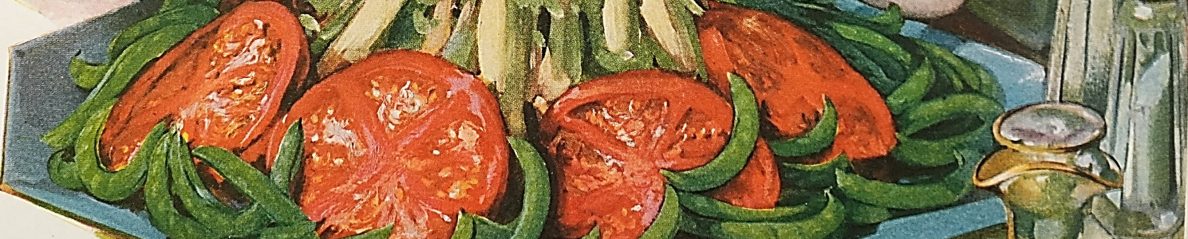
Old-fashioned Fried Eggplant, Julienne Style

Fried Eggplant, Julienne Style and Steak on Plate

The eggplants were beautiful at the farmers’ market, so I bought one – and then started searching for a hundred-year-old eggplant recipe.

I found a nice recipe for Fried Eggplant, Julienne Style. The eggplant strips were tasty, and a nice alternative to French fried potatoes.

Here’s the original recipe:

Recipe for Fried Eggplant, Julienne Style
Source: Balanced Daily Diet (1920) by Janet McKenzie Hill

Here’s the recipe updated for modern cooks:

Fried Eggplant, Julienne Style

  • Servings: 4-6
  • Difficulty: moderate
  • Print

1 eggplant

salt & pepper

1/2 cup flour

shortening or cooking oil

Peel eggplant, and cut into strips approximately 4 inches long, and 1/2 inch thick and wide. Sprinkle with salt and pepper. Put the flour in a shallow bowl, then roll the eggplant strips in the flour.

Heat 1/2 inch of shortening or oil in a large frying pan until hot. Place the floured eggplant strips in the pan in a single layer. Depending upon pan size, the eggplant strips may need to be cooked in several batches. Fry for about two minutes or until the bottom side of each piece is lightly browned, then gently turn and fry until the other side is browned. Remove from pan and drain on paper towels. Serve immediately.

http://www.ahundredyearsago.com

1920 Mapleine Advertisement

Advertisement for Mapleine
Source: American Cookery (April, 1920)

When I saw this hundred-year-old advertisement for Mapleine, my first thought was –  Is this product still made?  I thought that I had a vague memory of seeing Mapleine in the spice and extract section at the supermarket, but wasn’t sure.

Well, the answer is yes. It is still made. Mapleine has been around since 1908.  According to Wikipedia, Mapleine was even part of a court case:

An early enforcement action of the United States Pure Food and Drug Act in 1909 concerned a shipment of Mapleine confiscated in Chicago. The case was “United States of America v. Three Hundred Cases of Crescent Mapleine” in which it was found that the product was misleadingly labeled to represent actual maple extract. The case was cited as a precedent for the United States Supreme Court 1916 decision in United States v. Forty Barrels and Twenty Kegs of Coca-Cola.

By 1920, the Crescent Company, which made Mapleine, clearly knew that advertising needed to make it clear that Mapleine did not actually contain maple syrup. The advertisement says it is a “pure vegetable flavoring” – though I’m not exactly sure what that means.

Old-fashioned Crusty French Bread Recipe

Recipe for Crusty French Bread
Source: American Cookery (April, 1920)

My grocery store has yeast! It’s the first time that I’ve seen it in months, and I knew exactly which recipe I wanted to make – a hundred-year-old recipe for Crusty French Bread. Several years ago I’d tried to make French Bread – and I’d been disappointed in the results – so I wondered if an old-time recipe might make a more authentic French Bread.

As part of the rising process, the hundred-year-old recipe called for putting the bread dough in lukewarm water, and then waiting for it to float. I had my doubts, but it was easy to do – and I was very pleased with the results.

The Crusty French Bread turned out wonderfully. It was crusty on the outside, and soft and chewy on the inside. This recipe is a keeper, and I feel certain that I’ll make it again.

2 loaves of Crusty French Bread
Source: American Cookery (April, 1920)

Here’s the original recipe:

I had to use more water than the recipe called for when I made the dough by mixing water, yeast, and flour. The recipe called for 1/2 cup of water, but it was not enough to make the dough cling together.

And, here’s the recipe updated for modern cooks:

Crusty French Bread

  • Servings: 2 loaves
  • Difficulty: moderate
  • Print

1 packet dry active yeast

1/2 – 3/4 cup lukewarm water + 1/2 cup lukewarm water + additional lukewarm water for use during the rising process (all the lukewarm water should be 110 – 115° F.)

2 cups flour + 1 1/2 – 2 cups flour

1 teaspoon salt

milk, melted butter, or a sugar and water mixture (to brush on the top of the loaves) (I used milk.)

Blend the yeast with a little water in a measuring cup, and when smooth, add additional lukewarm water to make 1/2 cup. Put 2 cups flour in a mixing bowl, add the water and yeast mixture, and stir to combine. If it is too dry to knead, add additional lukewarm water until it can be kneaded. (It should be dryer than for most bread doughs). Put the mixture on a prepared surface and knead to form a stiff dough (about 5 minutes). Form the dough into a ball, and score it a couple of times across the top with a knife.

In the meantime, fill a Dutch oven or other large pan 2/3 full with lukewarm water. Put the ball of dough in the water with the scored side up. If the water does not cover the dough add additional water. Cover, and let the sit in a warm place until the dough swells and floats on top of the water (about 15-20 minutes). Lift the ball out of the pan using a large skimmer.

In a mixing bowl, dissolve the salt in 1/2 cup of lukewarm water, then add the ball of dough. Add 1 1/2 cups flour. (If needed, add additional flour to make the dough the right consistency for kneading.) Put the dough on a prepared surface and knead until smooth and elastic (about 5 minutes). Put in a large bowl, cover with a cloth, and place in a warm spot that is free from drafts until doubled in size (about 1 1/2 hours).

Divide dough into two equal parts, and shape into long narrow loaves. (I rolled each part into a rectangle approximately 9″ X 20″, then rolled starting from one of the long sides.) Place on a greased baking sheet. Score with light slanting strokes of a knife across the top of each loaf. Brush with milk, melted butter, or a mixture and water and sugar. Let rise until doubled (about 30 minutes).

In the meantime preheat oven to 400° F. Put the bread in the oven for 20 – 30 minutes or until lightly browned.

http://www.ahundredyearsago.com

Is this a Finger Bowl?

glass finger bowl

Is this a finger bowl? It is about 2 inches in diameter and 2 inches high. It was in my mother’s china cabinet for as long as I can remember, and then after my parents passed I brought it out to my house. My memory is that my mother called it a finger bowl.

The reason that I’m asking is because I decided to do a post on finger bowls, and I pulled out this old “finger bowl” illustrate the post. I then looked at Ebay to try to find similar bowls to determine its approximate age. I was shocked to discover that most finger bowls on Ebay were about 4 1/2 or 5 inches in diameter – and suddenly realized that the small glass bowl that I have may not be a finger bowl.

Let me step back a bit further, and share what I originally planned to post. I found information on finger bowls in two home economics textbooks that were a hundred years old. The first book contained a drawing of finger bowls and said:

line drawing of a finger bowl

If fruit needs to be pared or cut at the table a silver knife should be provided, and finger bowls should be used. It is well to use paper napkins instead of linen when fresh fruits are prepared at the table, for fruit juice stains are sometimes difficult to remove.

Household Arts for Home and School (Vol. II) (1920) by Anna M. Cooley and Wilhelmina H. Spohr

Hmm. . . I can’t tell for sure, but the finger bowl in the drawing looks larger than mine.

The second hundred-year-old home economics textbook said:

Use of Finger Bowls

Finger bowls are used after the fruit course of breakfast, and at the end of a luncheon or dinner. They should be placed on plates with a doily between the plate and the finger bowl. 

For breakfast, the finger bowls and plates may be brought in first. The finger bowl and doily should be removed to the left so that the same plates may be used for the fruit course. 

For formal luncheon or dinner, finger bowls on doilies and plates are brought in, one at a time, when removing the main dish of the dessert. The finger bowls and doilies are then set aside and the plate used for bonbons and nuts, which are passed on a tray. Or, if desired, the finger bowls may be brought after the bonbons. In this case the finger bowl and plate are exchanged for the plate of the dessert course. An informal way is to pass finger bowls on plates and doilies before the dessert course. Then the finger bowl and doily are set aside as at breakfast and the dessert served on the same plate. 

School and Home Cooking (1920) by Carlotta C. Greer

Some days I guess that I’m just destined to have more questions than answers. I still don’t know whether I own a finger bowl – and I’m now wondering whether people actually ended meals with two desserts a hundred years ago – a “main” dessert and a secondary dessert (bonbons, nuts).

Old-fashioned Custard Pie

Slice of Custard Pie on Plate

Sometimes the basics are best. For example, old-fashioned Custard Pie is a delightful, delicate pie that makes a perfect treat on hot summer days. The hundred-year-old recipe I used was easy to make, and only contained five ingredients: eggs, sugar, salt, milk, and vanilla extract.

Here’s the original recipe:

Recipe for Custard Pie
Source: The New Royal Baking Powder Cookbook (1920)

When I made the recipe, I used 1/2 teaspoon of salt. The one teaspoon of salt called for in the original recipe seemed like a lot. I couldn’t figure out why it was necessary to scald the milk prior to mixing with the other ingredients, so I skipped that step – and it worked fine. It did take longer for the filling to set than the recipe indicated. Maybe the time would have been reduced if I had scalded the milk first.

And, here’s the recipe updated for modern cooks:

Custard Pie

  • Servings: 5 - 7
  • Difficulty: easy
  • Print

3 eggs

3/4 cup sugar

1/2 teaspoon salt

2 cups milk

1 teaspoon vanilla extract

1 9-inch pie shell

Preheat oven to 425° F. Put eggs, sugar, salt, milk, and vanilla extract in a mixing bowl. Beat until smooth. Pour into pie shell.  Bake for 10 minutes. Reduce heat to 325° F.. Bake additional 50 minutes or until knife inserted into center of pie comes out clean.

http://www.ahundredyearsago.com

1920 Swift & Company Advertisement

Swift and Company Advertisement
Source: Good Housekeeping (June, 1920)

On a recent hot summer day, I lazily flipped through the pages of 1920 issues of Good Housekeeping. There were the usual advertisements for baking powder, canned fruit, bacon, and other foods. And, then I flipped another page – and  saw this1920 Swift & Company advertisement defending the large size of this corporation. Discussions about the size of businesses have been taking place for a long time!

Old-fashioned Blueberry or Huckleberry Muffins

Some fruits bring back warm memories of my younger days. Huckleberries are one of those fruits. I haven’t seen a huckleberry in decades, but they are a fruit of memories.

My father loved to pick huckleberries – or, as we often called them, wild blueberries. Dad worked hard all week farming, but found picking huckleberries relaxing and would often go to the mountains on sunny Sunday summer afternoons to pick them. He’d bring home buckets of the most lush berries. The huckleberries were smaller than store-bought blueberries and bursting with taste. We ate the fresh huckleberries by the handful, and made many wonderful baked goods. A favorite was huckleberry muffins.

So. when I recently came across a hundred-year-old recipe for Blueberry or Huckleberry Muffins, I had to give it a try for memory sake – even though I used blueberries instead of huckleberries.

The recipe was a winner. The muffins were easy to make and delightful.

Here is the original recipe:

Recipe for Blueberry or Huckleberry Muffins
Source: The New Royal Cook Book (1920), published by Royal Baking Powder Co.

One teaspoon salt seemed like a lot of salt for this recipe, so I reduced the salt to 1/2 teaspoon.  I also used butter instead of shortening.

And, here is the recipe update for modern cooks.

Blueberry or Huckleberry Muffins

  • Servings: approximately 15 muffins
  • Difficulty: easy
  • Print

2 cups all-purpose flour

3 teaspoons baking powder

1/2 teaspoon salt

1 tablespoon sugar

3/4 cup milk

2 eggs

1 tablespoon butter, melted

1 cup blueberries or huckleberries

additional flour, if desired

If desired, first coat the blueberries/huckleberries with flour. (Some assert that berries are less likely to sink to the bottom of the batter if coated in flour). To coat: In a separate bowl, toss the berries in flour to coat. Set aside

Preheat oven to 400° F. Combine flour, baking powder, salt, and sugar in a bowl. Add milk, eggs, and shortening; stir until combined. Then gently stir the blueberries or huckleberries into the batter.

Grease muffin tins (or use paper liners), and then fill each muffin cup approximately 2/3 full with batter. Bake for approximately 30 minutes or until lightly browned.

http://www.ahundredyearsago.com