Hundred-year-old Caramel Biscuits Recipe

Caramel Biscuits is the name of a recipe that I found in a hundred-year-old magazine, but the recipe name may be a misnomer.  This is a dessert or snack pastry, not the typical biscuit.

Caramel Biscuits are similar to cinnamon rolls, but contain no cinnamon. Instead nutmeg provides a more nuanced and sophisticated flavor when combined with the rich brown sugar filling that is embedded between each layer of bread. They are made using baking powder, rather than yeast, so are quick and easy to make.

Here is the original recipe:

Source: Good Housekeeping (July, 1917)

And, here is the recipe updated for modern cooks:

Caramel Biscuits

  • Servings: approximately 2 - 2 1/2 dozen 1 1/2-inch in diameter biscuits
  • Difficulty: easy
  • Print

1 cup light brown sugar

1/2 cup butter

2 cups flour

4 teaspoons baking powder

1 teaspoon salt

1 tablespoon butter + 1 tablespoon lard (or use 2 tablespoons butter)

1/3 cup milk

1/3 cup water

nutmeg

Preheat oven to 400° F.  Put the brown sugar and butter in a bowl; stir to combine. Set aside.

Place flour, baking powder, and salt in a mixing bowl, then stir together. Cut in the butter and lard, then add water and milk. Mix using a fork until dough starts to cling together. If needed, add additional water. Divide into two balls.  Put one ball put on a floured pastry board. Roll into a 1/4 inch-thick rectangle approximately 6 inches X 10 inches. Spread one-half of the brown sugar mixture on the rectangle of dough. Rolling from the wide side, roll up the dough, and then cut into 3/4″ slices. Place slices in a greased 10″ inch round (or similar-sized) pan. There should be about 1/4″ space between each slice. Repeat with the second ball of dough, again putting the slices in the pan. Sprinkle each slice with nutmeg.

Place in oven and bake for approximately 25-30 minutes or until lightly browned.  Remove from oven. Let cool for 5 minutes, then remove from pan. Serve either warm or cold.

Sugarless Sweets?? Sugar Substitutes During WWI

During World War I there were sugar shortages, so consumers were encouraged to use alternatives to white sugar. Here’s some excepts from a hundred-year-old article about “sugarless sweets” – though I tend to consider most of the alternatives to be sugars.

Sugarless Sweets: Delicious Desserts Made with No Sugar

The recent sugar shortage has brought home to us the fact that we need not be dependent upon white sugar for sweetening.

Brown Sugar. In substituting brown sugar – when we are lucky enough to obtain it – the same amount should be used as white. A cupful of brown sugar has less actual sweetening power than white sugar, but it makes up in flavor what it lacks in sweetness. 

Maple Sugar. In using maple sugar the same thing is true, and the usual recipe will be as successful as ever, the texture being the same and only the flavor changing – often for the better.

Maple Sirup. Maple sirup is not so sweet as sugar, and when used to replace it should be increased by one-half. Of course in this case allowance must be made for the increase of liquid. Using the amount of liquid called for in the recipe should be halved.

Corn Sirup. The same rule holds good for corn sirup. One and a half again as much sirup may be used, and to make up for a certain flatness of taste, it is desirable to use an extra amount of flavoring. When used in cakes and cookies better results are obtained if sirup is substituted for only half the sugar.

Molasses. In using molasses we find that no change need be made so far as amounts for sweetening purposes are concerned, because, like brown sugar, what it lacks in sweetness must be made up in flavor; but the same allowance must be made for liquid as when using sirup – it should be halved. When molasses is used in cake mixtures, soda should be used instead of baking powder in the proportion of one teaspoonful of soda to one cupful molasses.

Honey. Honey, probably the longest-used sweetening in the world, has not been in common use for cooking purposes recently. It has a distinct favor, which combines well with spices and its sweetening power is about the same as that of sugar. Honey is thicker than sirup, so it therefore adds less liquid, and in replacing sugar only one-fourth of the liquid in the recipe need be left out. As honey is slightly acid, soda in the proportion of half a teaspoonful to one cupful of honey should be used in cake or cookie mixtures.

Fruits. The sweetening qualities of fruits are not always recognized, but when raisins or dates are used the sugar may be appreciably lessoned. If twelve cut-up dates are added to two cupfuls of cooked oatmeal ten minutes before serving, no sugar will be required – unless your family has a very sweet tooth.

With all these sugar-saving sweets at our disposal, we shall certainly not find it difficult to cut down our use of sugar from the pre-wartime amount of four ounces a day to the two-ounce ration which the Food Administration is asking us to make our maximum.

Ladies Home Journal (March, 1918)

1918 Chop Suey Recipe from the Kansas State Council of Defense

In 1918, World War I was raging. There were food shortages, and the U.S. government was shipping wheat and other foodstuffs to the troops in Europe. To help cooks on the home front use “conservation as far as possible of food which can be sent abroad,” the Kansas State Council of Defense published One-Dish Meals.

The booklet is filled with lots of intriguing recipes, but the recipe that grabbed my attention was one for Chop Suey. It bore little resemblance to the typical chop suey recipe. The recipe called for ground beef, sausage, tomatoes, onions, and celery – and not for any of the usual bean spouts, bamboo shoots, or soy sauce.  That said, this recipe was delicious, and I’ll definitely make it again.

I would like to thank ResearchBuzz for alerting me to the Kansas State Council of Defense cookbook (and to a number of other publications ranging from Silos in Wartime to Use of  Wheat-Saving Cereals).

Here’s the original recipe:

Source: One-Dish Meals (Kansas State Council of Defense, March, 1918)

And, here is the recipe updated for modern cooks:

Kansas - Style Chop Suey

  • Servings: 5 - 7
  • Difficulty: easy
  • Print

1/3 pound bulk breakfast-style (farmer) sausage

2/3 pound ground beef

1 green pepper, chopped

1 large onion, chopped

2 stalks celery, chopped

1/2 cup sliced mushrooms

2 cups chopped tomatoes (or use 1 lb. can of tomatoes)

1/4 teaspoon pepper

1/2 teaspoon salt

1/8 teaspoon cayenne (red) pepper

4 cups cooked rice (or more, if you like lots of rice)

Brown sausage and ground beef in a skillet using medium heat. Add, green pepper, onions, and celery; cook until tender. Stir in tomatoes, mushrooms, pepper, salt, and cayenne pepper. Cover skillet and reduce heat to low; simmer gently for one-half hour. Remove from heat, and serve over rice.

I used less salt than called for in the original recipe, and it turned out just fine. I also thought that the original recipe called for very little rice, so I made more.

Old-fashioned Scalloped Asparagus

HAPPY EASTER!

Nothing says Spring like asparagus (or a refrigerator filled with rainbow-colored hard-boiled eggs). So I was thrilled to find a hundred-year-old recipe that called for both asparagus and chopped hard-boiled eggs.

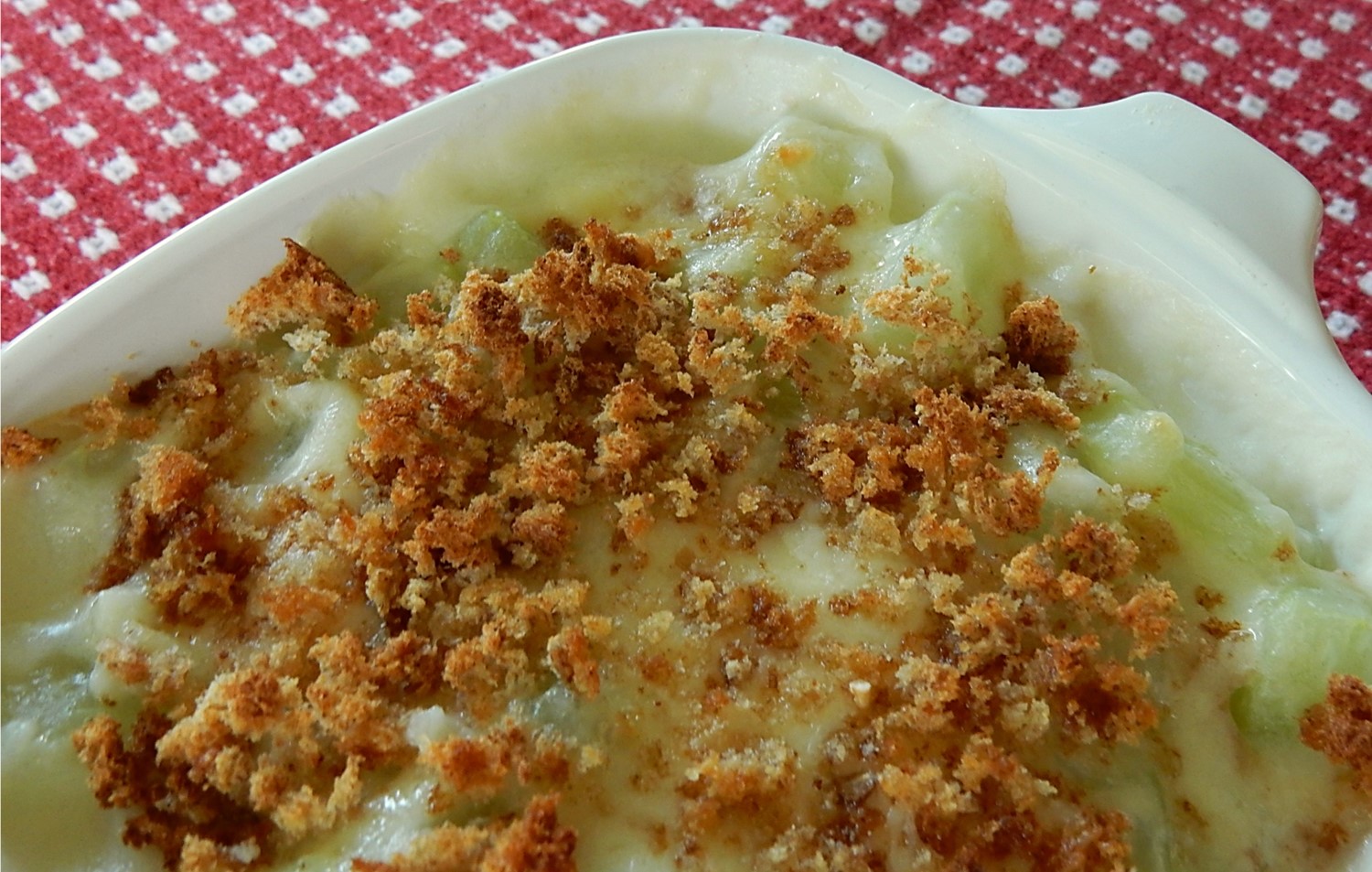
The Scalloped Asparagus turned out wonderfully. This classic dish was tasty, and made a lovely presentation with bits of asparagus and egg poking through the browned bread crumb and cheese topping.

Here’s the original recipe:

Source: The Housewife’s Cook Book by Lilla Frich (1917)

And, here’s the updated recipe for modern cooks:

Scalloped Asparagus

  • Servings: 4 - 5 servings
  • Difficulty: easy
  • Print

1 bunch asparagus (approximately 1 pound), cut into 1-inch pieces

3 tablespoons butter

3 tablespoons flour

1/2 teaspoon salt

1/8 teaspoon of pepper

1 1/4 cup milk

4 hard-boiled eggs, chopped

1 cup fine bread crumbs

6 tablespoons grated or shredded cheese (I used Parmesan cheese.)

Preheat oven to 375° F. Boil or steam asparagus until tender (2-3 minutes). 

Meantime in another saucepan, melt butter. Stir the flour, salt, and pepper into the butter. While stirring constantly, slowly pour in milk and bring to a boil using medium heat. Remove the white sauce from heat.

Put 1/3 of the cooked asparagus in a 1 1/2 quart casserole dish. Add a layer with 1/3 of the chopped eggs,  a layer of white sauce, a layer of bread crumbs, and a layer of 2 tablespoons cheese; continue layering with the final two layers being bread crumbs and cheese.

Bake for 1/2 hour or until the dish is hot and bubbly and the top is lightly browned. Remove from oven and serve.

Reviving Withered Root Vegetables

My refrigerator always seems to have a few miscellaneous food lurking in it that have seen better days – like the plastic bag filled with carrots that I bought several weeks ago, but somehow had never used. So I was thrilled to find a hundred-year-old suggestion for reviving carrots and other root vegetables.

Root vegetables, such as turnips and carrots, that have been withered need not be thrown away. Revive them by slicing off the ends and laying them in cold water. In a few hours their natural freshness will be restored.

Ladies Home Journal (March, 1918)

This tip worked wonderfully.  The revived carrots were almost as good as ones I’ve freshly pulled from my garden.

Hundred-year-old Peanut Butter Straws Recipe

Peanut butter is one of my favorite snack foods, so I was thrilled to find a hundred-year-old recipe for Peanut Butter Straws.

This irresistible snack contains peanut butter sandwiched between pieces of flaky pastry. The Peanut Butter Straws  have the essence of peanut butter sandwich crackers – though the shape is different, and they are less crispy.

Here’s the original recipe:

Source: Good Housekeeping (July, 1917)

When I updated the recipe for modern cooks, I changed the recipe name from Peanut Straws to Peanut Butter Straws because it more precisely describes this snack.  Here’s the updated recipe:

Peanut Butter Straws

  • Servings: approximately 75 4-inch straws
  • Difficulty: moderate
  • Print

1 cup flour

1/3 cup shortening

2 to 3 tablespoons cold water

1/3 cup peanut butter

water

milk

paprika

Preheat oven to 425° F.  Put flour into bowl. Cut in shortening  using two knives or a pastry blender. Add water and mix using a fork until dough starts to cling together. If needed, add additional water. (Or make pastry dough using a food processor).  Roll into a 1/8-thick rectangle on lightly floured surface.

Spread peanut butter on one-half the rolled dough. Just “slap” the peanut butter on the dough.  Do not worry if there are places here and there that have no peanut butter. The layers of the straws stick together better if there are places with no peanut butter.

Moisten the edges of the dough with water, then fold the other half of the pastry dough over on top of the dough that had been spread with the peanut butter. Roll lightly, and then prick here and there with a fork to prevent puffing up.

Cut into strips 1/2 inch wide by 4 inches long. Place on a greased cookie sheet, then brush with milk.  Put into oven and bake until straws are light brown (about 10 minutes). Remove from oven and sprinkle with paprika.