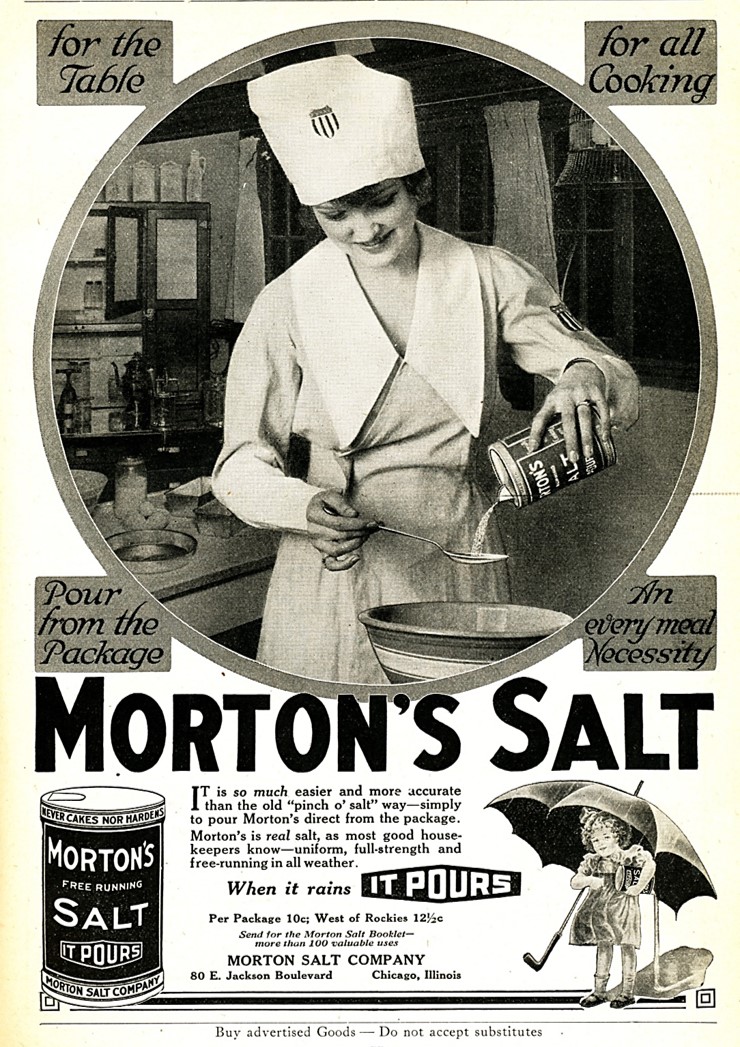
The advertising slogan “When it rains it pours” has been around for a least 100 years.
The advertising slogan “When it rains it pours” has been around for a least 100 years.

I have a plethora of radishes – most slightly past their prime. The recent hot weather has made them grow quickly, and they are rapidly becoming large and bitter. So when I saw a hundred-year-old recipe for Creamed Radishes that began with the following sentence, “For this radishes which are a little larger than those desired to eat may be used,” I knew that it was a recipe that I had to try.
I was pleasantly surprised by how well the Creamed Radishes turned out. They were soft and easy to cut when my fork, and the cream sauce nicely balanced the cooked radishes’ mild tangy zing.
That said, I was surprised and disappointed that radishes lose their lovely red color when boiled. The cooked radishes were pale pink – and a few were so faded that they were almost beige.
I’ve already made this recipe twice, so Creamed Radishes definitely are a vegetable that my husband and l enjoy. Perhaps the reason this dish is not popular is because of its homely color, but if you can get past the color, it is definitely worth a try.
Here’s the original recipe:

And, here’s the recipe updated for modern cooks:
2 bunches of radishes (about 2 cup after the leaves and roots are cut off)
water
1 teaspoon salt
2 tablespoons butter
2 tablespoons flour
3/4 cup milk
Wash the radishes and cut off the leaves and root, but do not pare off the red skin. Put radishes in a saucepan and cover with water. Add salt and bring to a boil using high heat. Reduce heat and simmer until tender (about 25 minutes), then drain.
In the meantime, in another pan, using medium heat, melt butter; then stir in the flour. Gradually, add the milk while stirring constantly. Continue stirring until the white sauce thickens. Gently stir in the cooked radishes. Remove from heat and serve.

Cookbooks are chock full of different words that describe how recipe ingredients are mixed together. Ever wonder how “stirring differs from beating? . . or how “creaming” differs from “rubbing”? Well, I found the answers in a hundred-year-old home economics textbook:
Methods of mixing are important, where several ingredients are combined. We seek for a way that will give the most complete mingling of all the substances with smoothness and lightness, at the same time saving time and strength.
Sifting, or putting materials through a fine mesh, is used to lighten flour that has been packed down, to remove coarse portions, or to mix thoroughly several dry ingredients.
Stirring is done with a spoon, and is a round and round motion, used for mixing a liquid and a dry ingredient.
Rubbing is used for combining a dry ingredient with a semi-solid substance like butter.
Creaming is a term used for the rubbing of butter until it becomes soft and creamy. A spoon should be used, not the hand.
“Cutting in” with a knife is used for combining butter with flour for biscuits and pastry where the butter should not be softened.
Beating with a spoon, or beater of the spoon type, is free over and over motion, the spoon being lifted from the mixture for the backward stroke. This is used for increasing the smoothness of the mixture after the first stirring, and for beating in air. It needs a strong free motion of the forearm. Beating is also accomplished by the rotary motion of a mechanical beater like the Dover.
Cutting and folding is the delicate process of mixing lightly beaten egg with a liquid or semi-liquid without losing out the air. The spoon is cut in, sidewise, a rotary motion carries it down and up again, and it folds in the beaten egg as it goes.
Kneading is an option used with dough, and is a combination of a rocking and pressing motion, accomplished by the hands. A good result can be obtained by some bread machines, and this is the cleaner method.
Rolling out is just what the term denotes, a rolling of a thick piece of dough by means of a cylindrical wooden “pin” to the thickness proper for cookies and crusts. Dry bread is also rolled to break it into fine crumbs.
Pounding and grindingare usually accomplished for us now in factories in breaking of spices and coffee. It is better to have a coffee mill at home.
Foods and Household Management: A Textbook of the Household Arts by Helen Kinne and Anna M. Cooley (1915)

Now that the weather is getting hot – and strawberries are in season – I wanted to find a recipe for a tasty and refreshing strawberry dessert. I searched through my hundred-year-old cookbooks, and I think I found the perfect recipe. Strawberry Bavarian Cream is creamy and cool, and it made a beautiful presentation.
This recipe was in a 1905 church cookbook from Berwick, Pennsylvania published by “The Ladies of Directory No. 2 of the Aid Society of the Methodist Episcopal Church.” I’m very curious how the cooks who made this recipe in the early 20th century chilled this dessert. Most won’t have had a refrigerator; perhaps they refrigerated the Strawberry Bavarian Cream in an ice box chilled with a block of ice, or maybe this recipe was often made during the winter months using strawberries that had been canned the previous summer.
Regardless of how cooks in 1905 kept the Strawberry Bavarian Cream cold, this silky, delectable dessert is a winner. I know that I’ll make it again in the near future.
Here’s the original recipes:

And, here’s the recipe updated for modern cooks:
2 envelopes (0.25 ounce each) of unflavored gelatin
1/3 cup cold water
1 cup boiling water
1 quart fresh strawberries
1 cup sugar
1 cup whipping cream
Place the cold water in a bowl; then sprinkle the gelatin over the water. Let sit for one-half hour.
In the meantime, slice strawberries into a bowl; add sugar and stir to combine. (Reserve several berries to garnish the molded dessert.) Let sit for at least 5 minutes or until the sliced berries begin to become juicy. Then thoroughly mash the sliced berries until no large pieces remain. (I used a potato masher to mash.)
Add boiling water to the gelatin mixture; stir until the gelatin is dissolved. Stir in the mashed strawberries. Chill just until the mixture is no longer warm.
In the meantime, beat the whipping cream until it is light and stiff peaks form. Then fold it into the strawberry and gelatin mixture. Pour into a 7-8 cup mold and chill until firm (at least 4 hours). (I used a 6-cup mold and had a little of the mixture left over after the mold was filled, which I put into a small bowl.)
To serve: Quickly dip the mold in hot water, then unmold onto serving plate.
Note: This recipe may also be made using 1/2 pint frozen or canned strawberries. If frozen or canned strawberries are used as a substitute for the fresh berries, do not add the 1 cup of sugar.
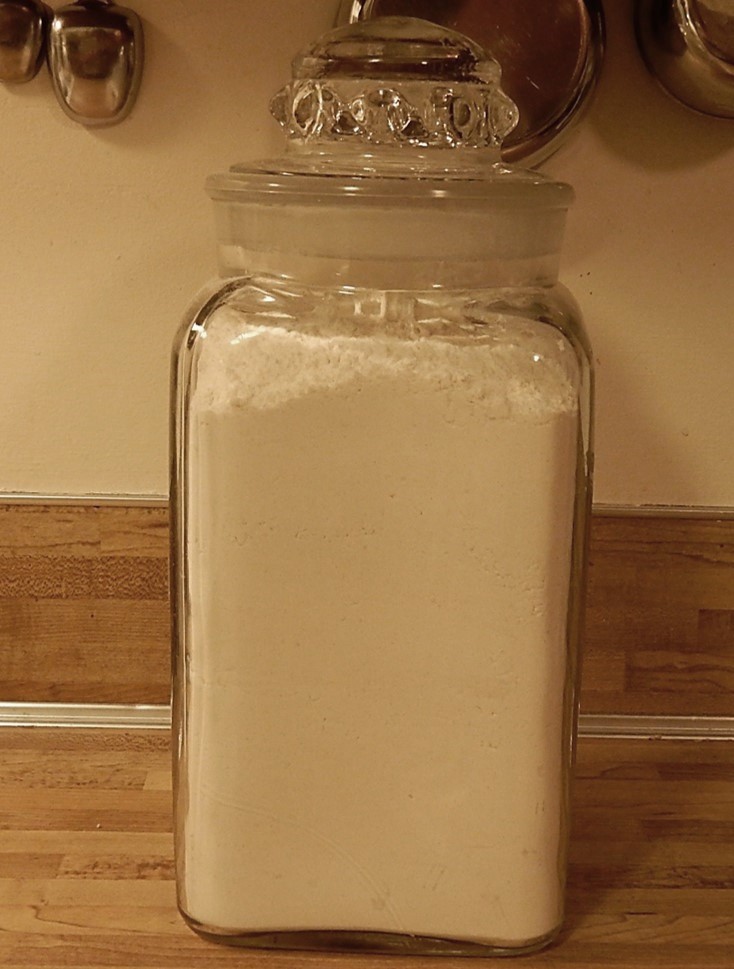
Today there are many tasty bread options. Some breads are made with wheat flour and contain gluten; others are gluten free. Here’s a hundred-year-old description of the different types of flour that might be used to make bread:
Flour
White flour is the most important in bread making. Wheat contains gluten, which is the name given to the protein content. When the grain is ground into a fine flour, the gluten is elastic and has the power of stretching and expanding; making it ideal for bread making since it retains the air and carbon dioxide and hardens on baking, forming the framework of the loaf of bread.
The protein in corn and oats lacks this quality and therefore they are combined with white flour for baking purposes. Rye flour may be used alone or with white flour in bread making.
The Housewife’s Cook Book by Lilla Frich (1917)

I recently found a delightful recipe for Orange Puffs with Orange Sauce in a hundred-year-old cookbook. The puffs are baked in a muffin pan, and are tender and moist with a hint of orange. Served with the refreshing, sunny orange sauce, this dessert is a winner.
Here’s the original recipe:

And, here’s the recipe updated for modern cooks:
Orange Puffs
1 cup flour
2 teaspoons baking powder
1/2 teaspoon salt
1/4 cup sugar
1/2 cup milk
1 egg, beaten
1 tablespoon melted butter
1 tablespoon grated orange peel
Preheat oven to 400° F. Put flour, baking powder, salt, and sugar in a bowl; stir to combine. Add milk, egg, and butter; and beat thoroughly. Then stir in the grated orange peel. Grease a muffin pan, then spoon batter into muffin cups. Fill each cup about 3/4ths full. Place in oven. Bake approximately 20 minutes or until lightly browned and the muffins spring back when lightly touched. Serve warm with Orange Sauce.
Orange Sauce
1 orange
1 1/4 tablespoons cornstarch
dash salt
2 tablespoons water + 1 cup water
Grate orange peel (reserving 1 tablespoon for the Orange Puffs) and then juice orange; set aside.
Put the cornstarch and salt in a sauce pan. Add 2 tablespoons of water; stir until smooth. Add additional 1 cup water. Bring to a boil using medium heat while stirring constantly. Continue stirring until the sauce thickens. Add orange juice and grated orange peel; bring back to a boil, then remove from heat. Serve warm.
Cook’s note: My rule of thumb for using cornstarch is 1 tablespoon cornstarch for each cup of liquid. The amount of cornstarch may need to be adjusted depending upon how much juice is gotten from the orange.

Every time I visit the dentist I seem to have a new cavity, so I was thrilled to find some advice about how to eat in ways that will prevent tooth decay in a hundred-year-old magazine. Here are some excerpts:
Diet in the Prevention of Dental Decay
Is there any mother who would not, if she could ensure a strong beautiful set of teeth for each of her boys and girls? Alfred Owre, dean of the dental department of the University of Minnesota feels strongly about the possibility of keeping teeth in a perfectly sound and healthy condition throughout life. He emphasizes the necessity of using hard foods, especially during the period when the bones of the jaws are developing in order to bring into full pay the organs of mastication, and he also emphasizes the necessity of eating plenty of coarse, fibrous food to keep the teeth well polished and to wear down irregularities of their surfaces.
Professor Henry Pierce Pickerill, director of the dental department of the University of Otago, and one of the foremost English authorities on the subject, agrees with Dr. Owre, on the points mentioned, but he emphasizes also the importance of keeping the mouth clean of sticky, sweet, acid-forming debris of food by selecting a preponderance of foods which are anti-acid, and eating at the end of meals such fibrous foods as celery, raw carrots, or apples. He calls attention to the scouring effect which these foods exert under the two-hundred-pound pressure of the normal bite, and their tendency to increase the quantity and quality of the flow of cleansing saliva.
It is only the residue of sweet and starch foods that is dangerous, particles of meat and other tissue-forming foods are not being fermentable or acid-forming. Our first safeguard then, lies in keeping the mouth as free as possible from sweet or starch particles of food. The second safeguard, and one which has been almost entirely neglected hitherto, lies in promoting, by a correct choice and sequence of food at meal time, a strong flow of highly alkaline saliva to neutralize the acid as it forms.
But it is long before a child begins to take solid food that the task of providing a strong set of teeth must be begun. Dr. J. I. Durand has proved that breast-fed babies stand the best chance of developing strong and beautiful teeth later in life. Babies fed on properly modified cow’s milk stand the next best chance. And babies fed on sweetened condensed milk are under the severest handicap. Moreover, Dr. Durance recommends the early addition of meat, fruits, and vegetables with their mineral constituents to the child’s diet. Orange-juice, he declares, may be given in small quantities any time after the first month, and vegetables, fruits, and meats, also in small amounts as early as the sixth or seventh month.
Then, too in babyhood the infant’s jaw is developing and it is very important that the child should be given an opportunity to exercise the muscles of mastication through chewing on tough crusts, tough strips of meat, bones, and other hard and tough articles. Otherwise the jaw does not develop properly and provide sufficient room for the teeth. When a jaw is too small the teeth are inclined to be crowded and irregular. This affects not only the child’s good looks, but it makes it easier for pieces of food to lodge between the teeth.
Good Housekeeping (January, 1918)
