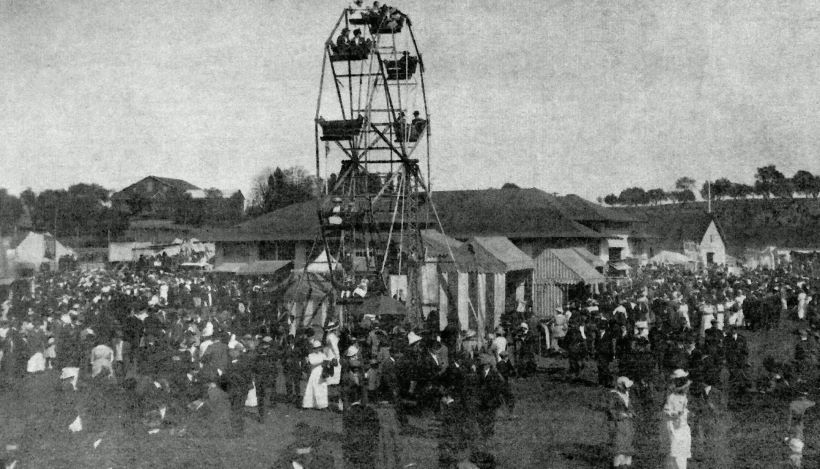
18-year-old Helena Muffly wrote exactly 100 years ago today:
Monday, October 13, 1913:
10/13 – 10/17: Nothing worth writing about for these days. Don’t go any place or do anything of much importance.
Her middle-aged granddaughter’s comments 100 years later:
Some days are just like that—they barely seem worthwhile. Today I hear so many recent college graduates worrying about whether it was worthwhile getting a college degree since the job market is so tight.
Was a college degree worth more a hundred years ago than it is now?
1913
According to a 1913 book called Rural Arithmetic by John E. Calfee:
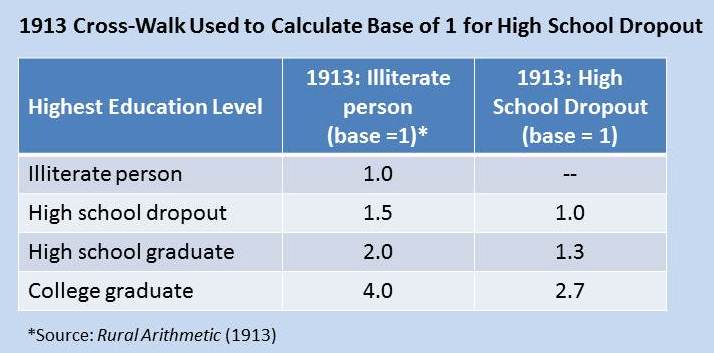
A business man who has studied the productive power of intelligent labor in New York reports that the man with a common-school education is able to produce one and one-half times as much wealth as the illiterate man, the high-school man two times as much, and the college man four times as much.
2013
According to Frontline on PBS (Public Broadcasting Service), today:
The average dropout can expect to earn an annual income of $20,241, according to the US Census Bureau. That’s a full $10,386 less than the typical high school graduate, and $36,424 less than someone with a bachelor’s degree.
Comparison
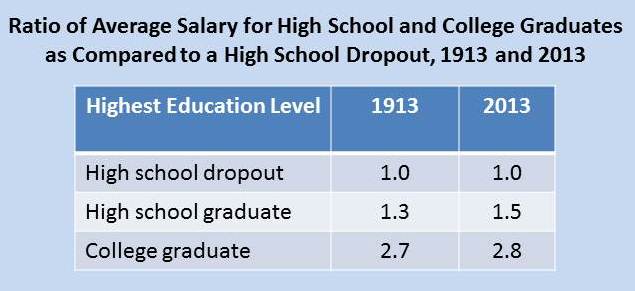
There’s more of an income benefit of earning a high school diploma today than back then—and the value of getting a college has also increased slightly.
In other words, today someone with a high school diploma earns on average 1.5 times as much as a high school graduate and someone with a college degree earns 2.8 times as much.
This can be compared to 1913 when (after the base was converted to 1 for a high school dropout), a high school graduate on average earned 1.3 times as much as the dropout, and the college graduate earned 2.7 times as much as the dropout.
For those who care about the details–
I assumed that the benefit of a college degree didn’t change much between 2012 and 2013. The data I used was from a 2012 article.
Rural Arithmetic is a math textbook. A subheading in one of the chapters was “Educated Labor”. The quote above was pulled from the introduction to that subsection. It was followed by a series of word problems about the value of education.
The 1913 book used the term “common school graduate” to refer to someone who had completed 8 years of education. For the purposes of this analysis I considered a common school graduate to be a high school dropout.
And, here is a chart that contains a crosswalk between the base (salary of illiterate person=1) used in the 1913 book, and the base (salary of a high school dropout = 1) that I used in the chart at the top of this post.
An aside–We must be doing something right with education today since we no longer even think about what the salary would be for an illiterate person.
.