Old-fashioned Maple Nut Cake


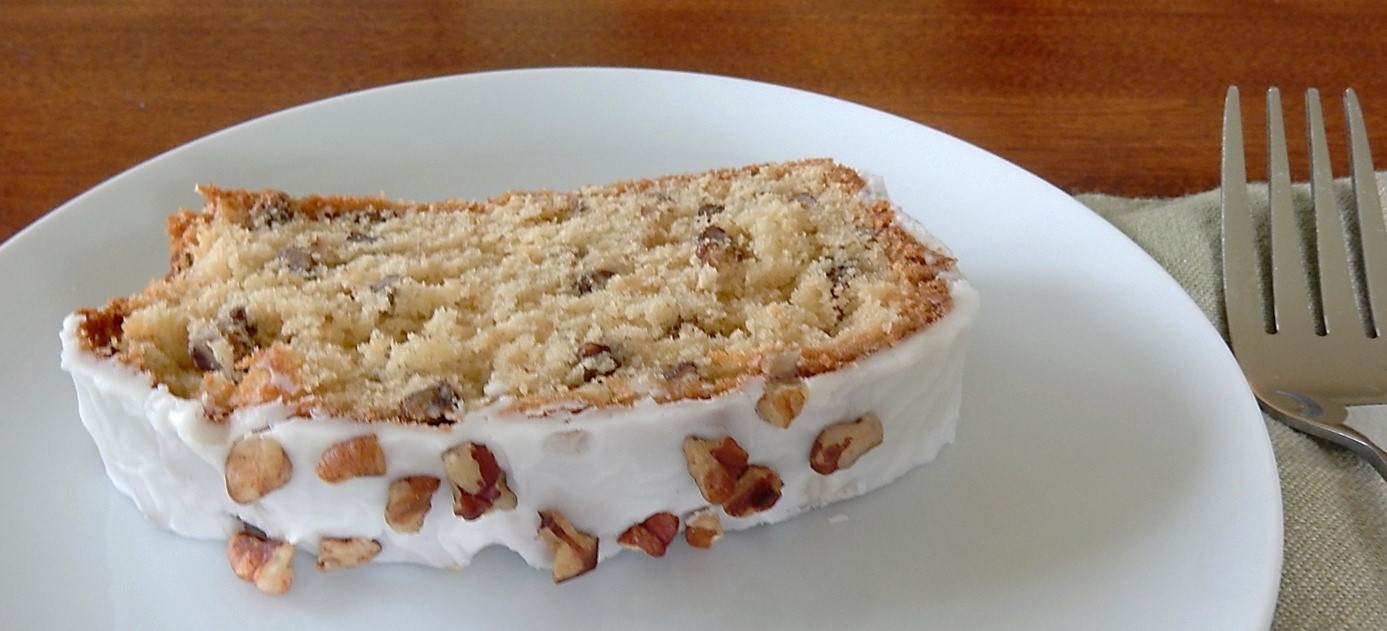
Slice of Maple Nut Cake on PlateOld-fashioned nut cakes bring back warm memories of family gatherings many years ago. There always seemed to be at least one nut cake – and often more – at family reunions. They were made by great aunts or other miscellaneous relatives. (I often was unsure of the relationship.) So when I saw a recipe for Maple Nut Cake in a hundred-year-old promotional cookbook published by the Royal Baking Powder Company, I decided to give it a try.

The cake is made in a loaf pan. The old recipe recommended using chopped pecans in the cake, so I went with that nut. The cake is iced with Maple Icing. It turned out wonderfully, and tasted just like those old-time cakes of memory.

Here’s the original recipe:
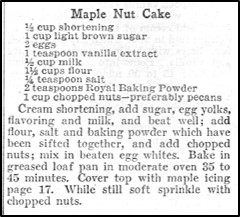
Recipe for Maple Nut Cake
Source: New Royal Cook Book (1920), published by the Royal Baking Powder Company

And, here are the original Maple Icing recipes. (The cookbook contained two icing options.):
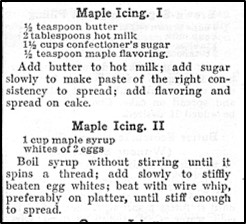
Two Recipes for Maple Icing
Source: New Royal Cooking Book (1920) by Royal Baking Powder Company

I interpreted a “moderate oven” to be 350° F. However, the cake was not even close to being fully baked after 45 minutes, so I continued baking until a pick inserted in the center came out clean, which was about 1 hour and 10 minutes after I put the cake in the oven.

I made the first Maple Icing recipe. I softened the butter, and did not bother to heat the milk.

Here’s the recipe updated for modern cooks:

Maple Nut Cake

  • Servings: 6 - 8
  • Difficulty: moderate
  • Print

Maple Nut Cake

2 eggs, separated

1 1/2 cups flour

1/3 cup shortening

1 cup light brown sugar

1/2 cup milk

1/4 teaspoon salt

2 teaspoons baking powder

1 teaspoon vanilla extract

1 cup chopped nuts – preferably pecans

additional chopped nuts for top of cake

Preheat oven to 350° F. Grease and flour a loaf pan.

In a large mixing bowl, beat the egg whites stiff peaks form.

In a separate mixing bowl put the flour, shortening, brown sugar, egg yolks, vanilla,  baking powder, and salt;  beat until combined. Then stir in the nuts, and gently fold the whipped egg whites into the mixture. Pour into prepared pan.

Bake 1 hour 10 minutes, or until wooden pick inserted in center comes out clean. Frost top with Maple Icing. (If desired, the cake can be removed from the pan. A slightly thinner icing can be made, and the icing can then be drizzled over the cake and allowed to run down the sides.).  While the icing is still soft, sprinkle with chopped nuts.

Maple Icing

1 1/2 cups confectioners’ sugar

1/2 teaspoon butter, softened

1/2 teaspoon maple flavoring

approximately 2 tablespoons milk

Put confectioners’ sugar, butter, and maple flavoring in a bowl. Add milk and beat until smooth. If the icing is too thick, add additional milk.

http://www.ahundredyearsago.com


Fish Is Best Right After It Is Caught

Boy fishing
Source: Household Arts for Home and School, Vol. II (1920) by Anna Cooley and Wilhelmina Spohr

When I buy fish, I always try to select ones that look “fresh.” But I often find it difficult to determine whether a fish is fresh. According to The Healthy Fish, when buying fish at the grocery store:

  1. Check the Texture. The meat of the fish should be firm, moist and freshly cut without any dry spots. …

  2. Beware of Strong Fishy Smells. …

  3. The Eyes are the Window to the Freshest Fish. .

That advice is similar to advice from a hundred years ago. Here’s what it said in a 1920 home economics textbook:

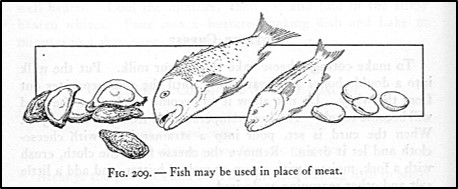
Fish has always been used in place of meat (Fig. 209). In general it has much the same composition and food value as meat and is as easily digested. In most localities it is cheaper than meat. Fish is always at its best when used just after it is caught (Fig. 210). However, great quantities are frozen and are kept for long periods of time.

fish
Source: Arts for Home and School, Vol. II (1920) by Anna Cooley and Wilhelmina Spohr

Fish spoils very easily and needs to be cooked or put into storage at once. If you live near the sea coast or near lakes or rivers where fish is caught, you should have no difficulty in getting fresh fish, but if you do not, you should be careful when buying to select fish with firm flesh, pinkish gills, and bright eyes; it should not have an offensive odor. If the fish is frozen, it should be cooked immediately on thawing it out. Unless good fresh fish can be bought it is more satisfactory to use salt fish or the canned product. 

Arts for Home and School, Vol. II (1920) by Anna Cooley and Wilhelmina Spohr

Orange Biscuits with Orange Filling

2 orange biscuits with orange filling

When browsing through hundred-year-old magazines, sometimes a recipe just jumps out at me. Orange Biscuits with Orange Filling was one of these recipes. Back then, there were few photos in magazines, but there was a picture of the biscuits. This recipe was obviously one that the magazine editors really liked, so I decided to give it a try.

orange biscuits with orange filling on plate
Source: American Cookery (April, 1920)

This recipe did not disappoint. The Orange Biscuits with Orange Filling had just the right amount of sweetness, and a bright, sunny, citrus flavor. They are perfect with coffee or milk. The Biscuits would also be a lovely brunch pastry. This recipe is a keeper, and I feel certain that I’ll make it again.

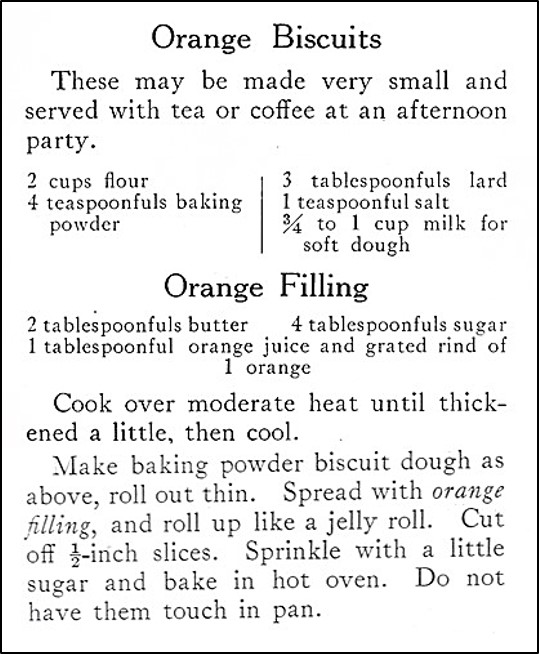
Here’s the original recipe:

Recipe for Orange Biscuits with Orange Filling
Source: American Cookery (April, 1920)

One teaspoon of salt seemed like a lot, so I only used 1/2 teaspoon of salt when I made the recipe. I cut the slices about 3/4 inch thick because it was difficult to cut 1/2 inch slices, and that just didn’t seem quite thick enough. I also could not figure out why the filling needed to be cooked when it was then cooled – and would again become a butter and sugar spread – so I did not cook it prior to spreading on the biscuits. This worked fine.

And, here is the recipe updated for modern cooks:

Orange Biscuits with Orange Filling

  • Servings: approximately 15 biscuits
  • Difficulty: moderate
  • Print

Orange Biscuits

2 cups flour

4 teaspoons baking powder

1/2 teaspoon salt

3 tablespoons lard, shortening, or butter

3/4 cup milk (may need to use slightly more)

orange filling (see below)

sugar

Preheat oven to 400° F.

Combine flour, baking powder and salt in mixing bowl. Cut in the lard, shortening, or butter. Add milk, and gently stir to combine using a fork. If too dry and does not cling together as a dough, add a small amount of additional milk. Place the dough on a prepared surface and roll into a square about 12″ by 12″. Spread with the Orange Filling, then roll like a jelly roll. Cut into 3/4 inch slices. If needed, gently reshape so that each slice is round. Put in a greased cake pan(s) about 1/2 inch apart. Sprinkle with sugar. Put in oven, and bake about 20-25 minutes or until lightly browned.

Orange Filling

2 tablespoons butter, softened

1/4 cup sugar

1 tablespoon orange juice

grated rind (zest) of 1 orange

Put butter, sugar, and orange juice in a small bowl; stir to combine. Add grated orange rind, and stir to evenly distribute throughout the butter mixture.

http://www.ahundredyearsago.com


1920 Hormel’s Dairy Brand Bacon Advertisement

Advertisement for Hormel's Dairy Brand Bacon
Source: Good Housekeeping (June, 1920)

When browsing through hundred-year-old magazines I occasionally come across advertisements that make little sense. Today was one of those days. This advertisement for Hormel’s Dairy Brand Bacon left me with more questions than answers.

  • Why is a pork product called “Dairy Brand”?
  • What is the food the woman in the ad is holding, and does it contain bacon?
  • Did this advertisement increase sales? . . . or did it totally flop?

Cheese, Corn, and Potato Scallop

Casserole Dish with Cheese, Corn, and Potato Scallop

Au Gratin Potatoes are tasty, so when I came across a hundred-year-old recipe that looked similar to an Au Gratin Potato recipe – but with a twist (the recipe called for corn in addition to potatoes) – I decided to give it a try.

The Cheese, Corn, and Potatoes were very nice. The rich, cheesy sauce worked nicely with the corn and potato combination.

Here’s the original recipe:

Recipe for Cheese, Corn, and Potato Scallop
Source: Household Arts for Home and School by Anna M. Cooley and Wilhelmina H. Spohr (1920)

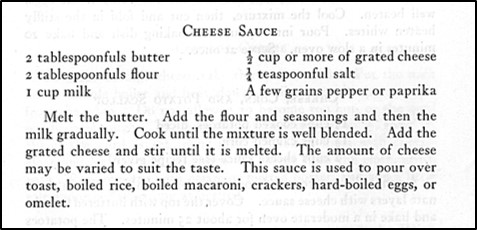
The recipe calls for Cheese Sauce. Here is the Cheese Sauce recipe.

Recipe for Cheese Sause
Source: House Arts for Home and School by Anna M. Cooley and Wilhelmina H. Spohr (1920)

Ever make a recipe that turned out well, but that required some interpretation and tweaks along the way? Well, this was one of those recipes.

The first decision I needed to make was what kind of canned corn should I use – whole kernel or cream style? I have a vague sense that canned cream-style corn has been around longer than the whole kernel (though I’m not sure), so I went with cream style. I had two cans of corn – 8.25 ounce can and a 14.75 can. The small one contained a little less corn than called for in the recipe; the large on a little more. (The recipe called for 1 1/2 cups of corn.) I decided to go with the small can even though it only contained a little more than 1-cup of corn.

Next I needed to figure out issues related to the Cheese Sauce. The Cheese, Corn, and Potato Scallop recipe called for 2 cups Cheese Sauce, however, when summing the amounts in the list of ingredients in the Cheese Sauce recipe, it was clear that it made less than two cups. The Cheese Sauce recipe called for 1/2 cup of grated cheese, but it did indicate that more could be used. I decided to use 1 cup of cheese so I’d have approximately the correct amount of sauce.  All was good.

But, once I’d prepared the Cheese Sauce, I realized that 1 1/2 cups of diced potatoes didn’t seem like very many potatoes given the amount of sauce that I had, so I decided to peel, dice, and cook an additional potato. This gave me about another cup of diced potatoes, so I now had a total of 2 1/2 cups. (If I’d used whole-kernel corn, perhaps the amount of sauce would not have seemed to excessive – not sure.)

When I assembled the ingredients, I just stirred the corn and cooked, diced potatoes into the Cheese Sauce rather than layering; and, then poured into the casserole dish to finish cooking.

Whew, this recipe required lots of interpretation. Sometimes the recipes that look the simplest end up being the trickiest. This recipe required lots of little adjustments, but the final dish turned out well.

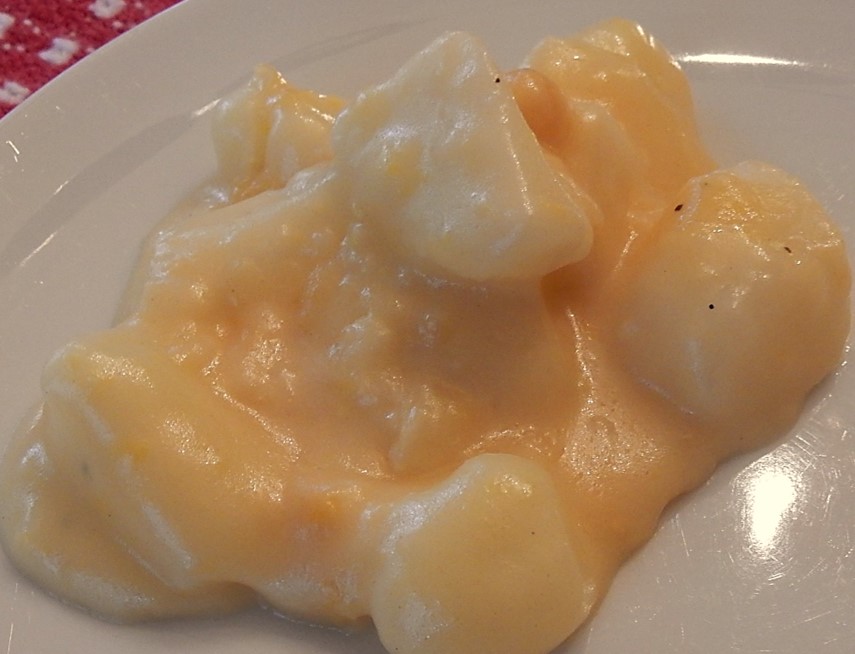
Cheese, Corn, and Potato Scallop on Plate

I combined the two old recipes into one. Here is the updated recipe for modern cooks:

Cheese, Corn, and Potato Scallop

  • Servings: 4 - 6
  • Difficulty: moderate
  • Print

2 tablespoons butter

2 tablespoons flour

1/4 teaspoon salt

dash pepper

1 cup milk

1 cup cheese (I used cheddar cheese.)

2 1/2 cups cooked potatoes, diced

1 – 1 1/2 cups canned corn (I used a small – 8.25 ounce can – of cream-style corn, which is a little over 1 cup of corn.)

Preheat oven to 400° F. In a saucepan , melt butter using medium heat; then stir in the flour, salt, and pepper. Gradually, add the milk while stirring constantly. Add cheese, and continue stirring until the cheese melts and the sauce thickens. Add corn and potatoes, and reheat until hot. Pour into a casserole dish and put in oven; bake for 25 minutes or until the top is lightly browned and the sauce bubbly.

http://www.ahundredyearsago.com

Store Bread in a Bread Box

Drawing of a bread box
Household Arts for Home and School, Vol. 2 (1920)

Images sometimes jog memories of things that have been totally forgotten. I recently was browsing through a hundred-year-old home economics textbook and came across a drawing of a bread box. Suddenly memories of my parents stainless steel bread box came flooding back. And, then I remembered my Aunt’s white plastic bread box that had flower decals on it. . . . and our neighbor’s wooden roll-top bread box. Back then almost everyone had a bread box. Today, I don’t think any of my friends have one.

I’ve never owned a bread box, and just put plastic-wrapped loaves of bread on the kitchen counter. Are bread boxes just an old-fashioned way of storing bread, or do they help maintain quality?

Here’s what the old home economics textbook had to say:

Bread may be made ever so carefully, but if it is not properly cared for may not be palatable. After they have been cooled the loaves should be put into a clean tin bread box (Fig. 133). Before each baking the bread box should be washed thoroughly, scalded, and aired. Scraps of bread should never be allowed to accumulate, and under no circumstances should bread be allowed to mold in the box. Mold sometimes occurs when bread is wrapped in a cloth or when a cloth is used to line the box. Clean white paper makes a better lining.

Household Arts for Home and School (Vol. 2) (1920) by Anna M. Cooley and Wilhelmina H. Spohr

Old-fashioned Rice Griddle Cakes (Rice Pancakes)

Three Rice Griddle Cakes on PlateI can accurately estimate how much my family will eat when I make some foods, but I’ve never been able to figure out how much rice they will eat at a meal. Which means that I often end up with left-over rice that I’m not quite sure how to use.

So I was thrilled when I recently came across a hundred-year-old recipe for Rice Griddle Cakes which called for left-over cooked rice.  The recipe was easy to make. The Rice Griddle Cakes were delicious and tasted very similar to typical pancakes, but they were more textured because of the addition of the cooked rice.

Here’s the original recipe:

Recipe for Rice Griddle Cakes
Source: The Cook Book of Left-Overs (1920) by The More Nurses in Training Movement

Here’s the recipe updated for modern cooks:

Rice Griddle Cakes (Rice Pancakes)

  • Servings: 4 - 6
  • Difficulty: easy
  • Print

2 cups flour

1 teaspoon sugar

1/2 teaspoon salt

1 1/2 teaspoons baking powder

1 egg

1 cup milk (a little more may be needed)

2 cups cold cooked rice

Put flour, sugar, salt, baking powder, egg, and 1 cup milk in a mixing bowl, beat until smooth. Stir in rice. If the batter is too thick, add additional milk. Heat a lightly greased griddle to a medium temperature, then pour or scoop batter onto the hot surface to make individual pancakes.  Cook until the top surface is hot and bubbly, and then flip and cook other side.
http://www.ahundredyearsago.com