Warm weather is finally here, and I’m ready to sit on the porch with tea and a snack. So when I saw a hundred-year-old recipe for Nut Squares that said, “Very nice for afternoon tea,” I knew that I needed to try the recipe.
The Nut Squares were tasty and chock-full of nuts with a crispy crust and a chewy middle. The one downside is that the crust had a tendency to crack and break when I cut the cookies into bars.
Here’s the original recipe:
Source: Ladies’ Union Cook Book (Concord Junction, MA, 1921)
I was surprised that the recipe did not call for any butter or shortening – though the cookies still had a nice texture. Perhaps the top crust may have had less tendency to break and crumble off the bars if the recipe had inclued butter or shortening.
Preheat oven to 375° F. Put eggs in mixing bowl and beat. Add sugar, flour, and baking powder; beat until smooth. Pour mixture into a greased 9 X 13 inch baking pan. Bake until set and the top is light brown (about 25 – 30 minutes). Remove from oven. When partially cool cut into squares or 1 X 2 inch bars.
Source: The Boston Cooking-School Cook Book (1921 Edition)
When I saw an advertisement for King Arthur Flour in the back of the 1921 edition of The Boston Cooking-School Cook Book, I wondered how long it has been around. According to Wikipedia, the King Arthur Flour Company was founded in 1790 in Boston.
When I make scrambled eggs I typically break the eggs into a bowl, add a little milk, salt, and pepper, and then beat the eggs until they are smooth and frothy, but I was intrigued by a hundred-year-old recipe for Scrambled Eggs, Country Style, and decided to give it a try. The recipe was extremely easy, and similar to how I make scrambled eggs when camping.
I broke the eggs directly into the skillet and let the egg whites begin to turn white; then I broke the yolks and began mixing the eggs while they cooked. This resulted in bigger chunks of the egg white in the scrambled eggs – but they were tasty.
Using medium heat, melt butter in skillet. Break the eggs into the skillet, and cook until the eggs are partially set with the egg whites beginning to coagulate; then break the yolks and stir and fold the eggs until they are completely cooked. Sprinkle with salt and pepper to season.
A hundred years ago people thought about the nutritional value of vegetables differently than they do today.
Vegetables
Vegetables may be divided into two great classes:
Coarse or fibrous vegetables, comprising roots, tubers, stems, bulbs, and leaves.
The finer or fruity vegetables, as tomato, squash, pumpkin, green peas, corn, immature beans (shelled), cucumbers, melons, etc.
Vegetables are characterized by their large amount of cellulose; and as water enters largely into their composition, they are by no means the most nutritious diet. Food, however, in order to supply perfectly the needs of the vital economy, must contain water, and indigestible as well as nutritive elements. vegetables are therefore dietetically of great value, as they furnish large quantities of organic fluids, and are rich in those mineral elements which are necessary for maintaining the alkalinity of the blood, and for the repair of the bony structures.
Perhaps no food is more generally used by rich and poor alike in making up their daily fill of fare; yet how often the vegetable is spoiled in cooking! In the first place, the portion of the vegetable next to the skin contains the greater quantity of mineral matter and flavoring substances. Hence all thin-skinned vegetables such as carrots, oyster plant, etc. should be scraped. Others should be pared as thinly as possible.
Vegetables, like all starchy foods, should be put to cook in boiling water, as by the application of hot water, the starch grains are caused to swell and burst, and this give the starch an opportunity to escape through the cellulose.
Whenever possible, vegetables should be cooked the same day they are gathered. If necessary to keep green vegetables for any length of time, do not put them in water, as that will dissolve and destroy some of their juices. Lay them in a cool, dark place. A stone floor is best. Old vegetables should be immersed in cold water for an hour or more just before cooking, to make them more tender.
Young, tender vegetables, as lettuce, tomatoes, water cress, etc., served in the uncooked state, are valuable for the water and the potash salts they contain also for the stimulating effect they have on the appetite.
The Science of Food and Cookery (1921) by H.S. Anderson
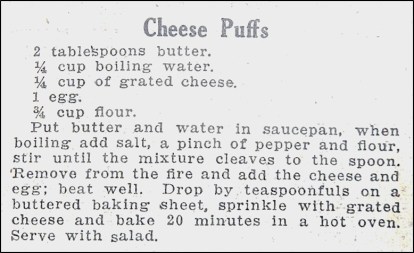
When I think of Cheese Puffs, I think of a cheesy snack that’s in the snack aisle at the supermarket, so I was surprised to see a hundred-year-old recipe for cheese puffs. These Cheese Puffs are a delightful cheesy tidbit that can be eaten as a snack or a part of a meal.
The old recipe recommends serving the Cheese Puffs with a salad, which is what I did. Cheese Puffs and a salad are just right for a light lunch.
Here’s the original recipe:
Source: Mrs. Scott’s Seasonal Cook Books (The North American Newspaper, Philadelphia, Winter, 1921)
1/4 cup grated cheese (I used cheddar cheese.) + additional grated cheese to garnish
1 egg
Preheat oven to 400° F. Put butter and water in a large sauce pan; bring to a boil. Stir in salt, pepper, and flour. Remove from heat, and add 1/4 cup grated cheese and egg; stir until thoroughly mixed.
Place on a greased baking sheet. Sprinkle with addiitonal grated cheese. Put in oven and bake 20 minutes or until lightly browned. If desired, serve with a salad.
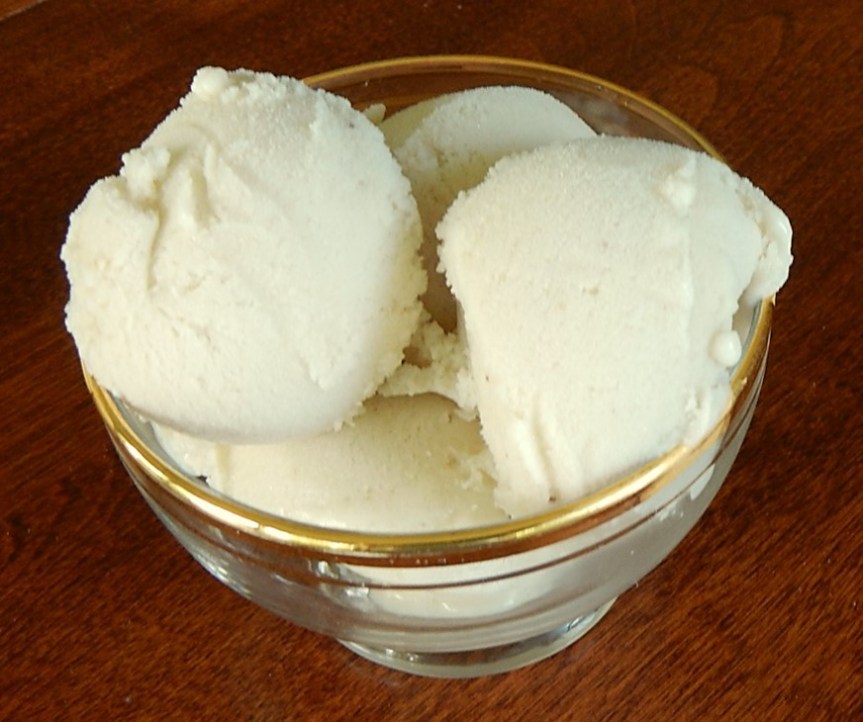
Here’s how a 1921 magazine article described the different types of ice cream:
Classes of Ice Cream
There are three distinct classes of Ice Cream: The Philadelphia, which is supposed to be made of heavy cream; the French, which is made with eggs on a soft custard foundation; and the so-called American, which is made on the foundation of a thin white sauce. All three classes are made in New York, and in every other large city, but we have never heard that any special recipe for ice cream is peculiar to New York. The less expensive form of cream, in that and every other city, are those based on a thin white sauce, sweetened sauce, sweetened, flavored, and frozen.
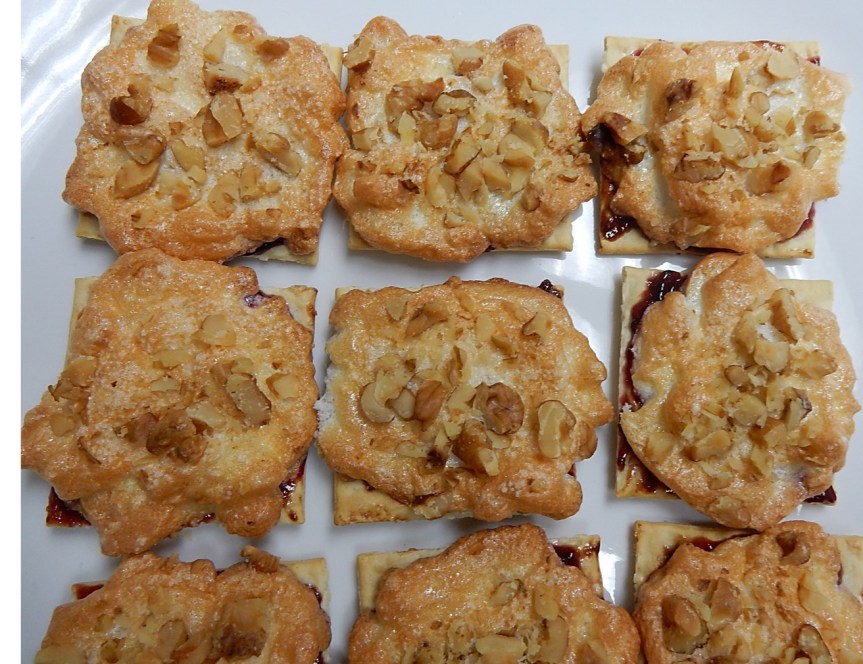
Marguerites are something of a culinary Marie Celeste, if you ask me. You’ll find them in recipe books from the teens, the 20s, the 30s, even the early 40s–and then they’re gone. They vanish without a trace . . . But The Joy of Cooking doesn’t mention them. Neither does Betty Crocker. By 1960, the day of the Marguerite had passed.
I can see why they’ve vanished from modern recipe books. The Marguerites had a nondescript taste and aren’t nearly as sweet as many modern snacks; yet at the same time, I liked them and they were a surprisingly satisfying snack.
Marguerites are fun to make and made a nice presentation. The salt on the crackers was noticeable in the finished product, which was both salty and sweet.
Will I make Marguerites again? I’m not sure – yet a piece of me thinks that I might. They’re an easy snack to whip up, and eating just a couple really did take the edge off my late afternoon hunger.
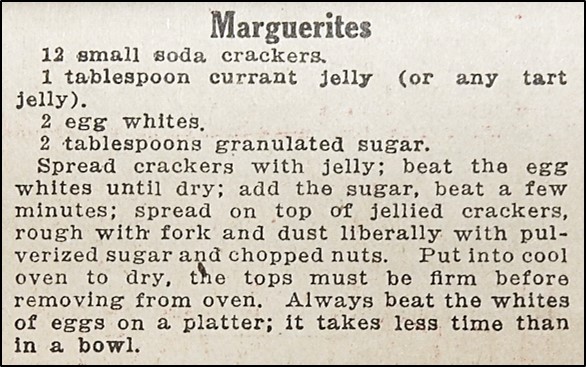
Here’s the original recipe:
Source: Mrs. Scott’s Seasonal Cook Books (The North American Newspaper, Philadelphia, Winter, 1921)
The 1 tablespoon of jelly called for in this recipe was not nearly enough since each cracker needed to be spread with the jelly, When I updated the recipe, I didn’t list an amount, I just indicated that currant (or other tart) jelly was needed to make this recipe.
Pulverized sugar is an old term for powdered sugar.
Preheat oven to 325° F. Put egg whites in bowl and beat until stiff. Add granulated sugar, and beat a little more to get the sugar evenly distributed in the egg whites. Set aside.
Put crackers on a baking sheet. Spread currant (or other tart) jelly on each cracker. Put approximately a tablespoonful of the beaten egg white on top of each jellied cracker; gently spread using a fork, and then sprinkle with powdered sugar and chopped nuts.
Place in oven and bake until the beaten egg whites are lightly browned (about 15 minutes).


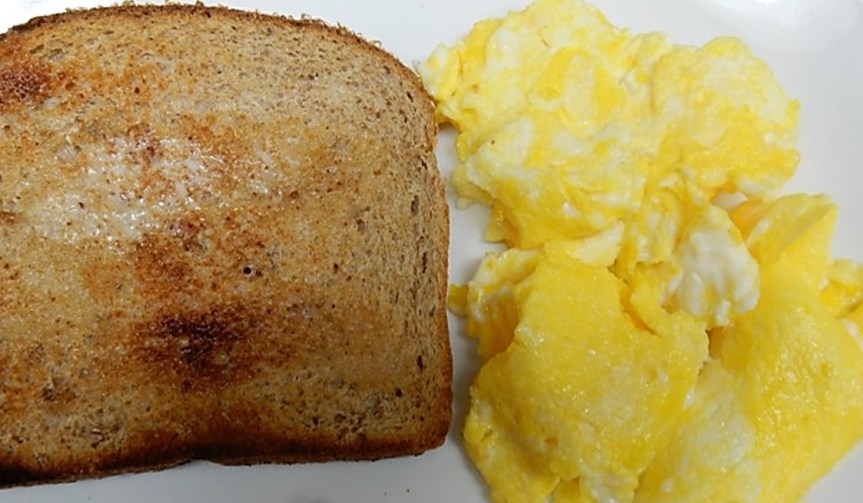 When I make scrambled eggs I typically break the eggs into a bowl, add a little milk, salt, and pepper, and then beat the eggs until they are smooth and frothy, but I was intrigued by a hundred-year-old recipe for Scrambled Eggs, Country Style, and decided to give it a try. The recipe was extremely easy, and similar to how I make scrambled eggs when camping.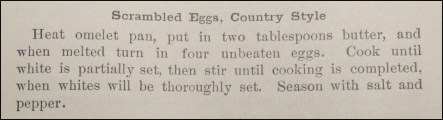
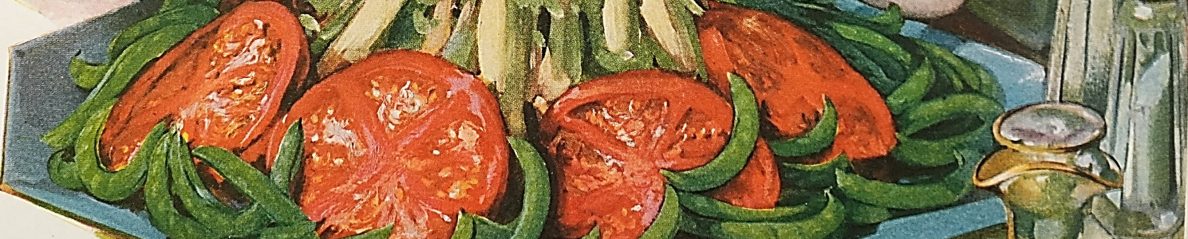
 A hundred years ago people thought about the nutritional value of vegetables differently than they do today.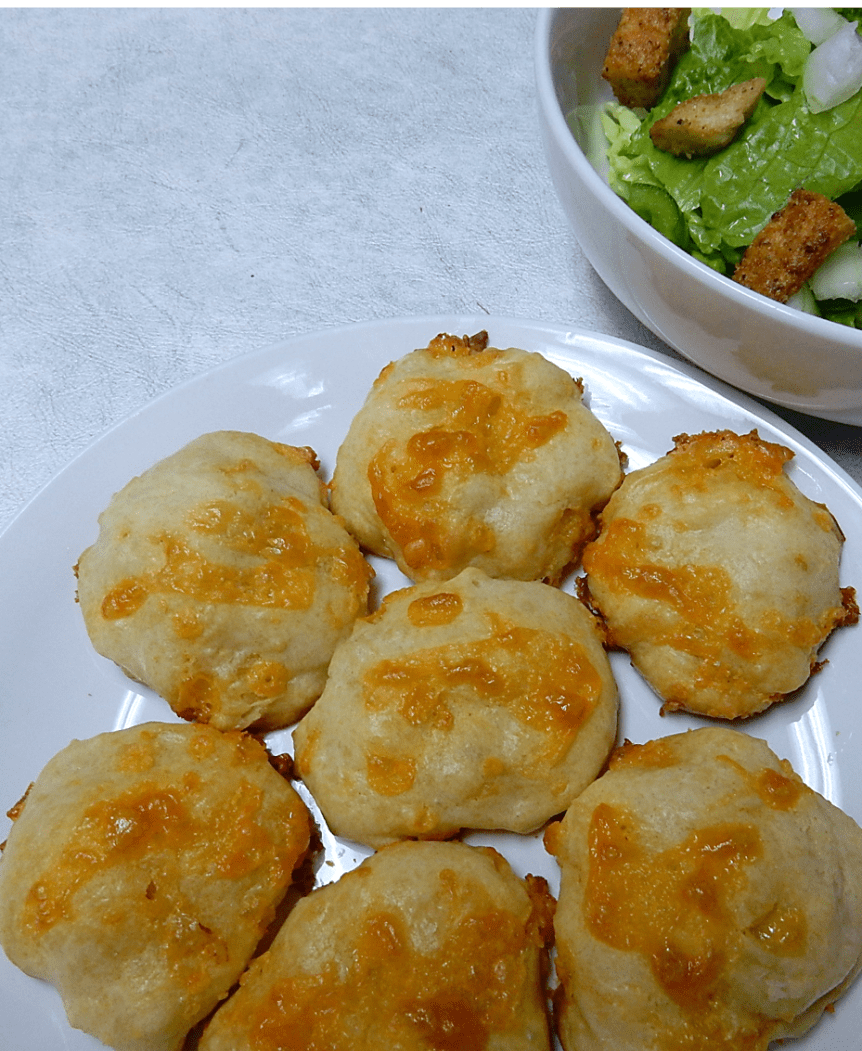
 Here’s how a 1921 magazine article described the different types of ice cream: