Who would have guessed that marshmallow creme has been around for at least a hundred years?

Who would have guessed that marshmallow creme has been around for at least a hundred years?

I was recently browsing through a hundred-year-old cookbook, and came across a recipe for Fried Bananas with Crumbs, and decided to give it with a try. The recipe said that the Fried Bananas could be served with Lemon Sauce, so I also made the sauce.
I wasn’t quite sure what to expect, but the Fried Bananas with Crumbs and Lemon Sauce were surprisingly tasty. The Fried Bananas were crispy on the outside, and the Lemon Sauce added a bright, sunny, sweet-sour flavor.
Here’s the original recipe:

Six bananas seemed like a lot, so I divided the recipe in half when I made it.
I garnished the Fried Bananas with lemon slices, but I just couldn’t bring myself to follow the directions in the old cookbook and also garnish them with parsley. But, who knows, maybe the bananas would have looked better if I’d also used parsley.
Both Sherry Sauce and Lemon Sauce sounded good. Unfortunately, Lowney’s Cook Book, the cookbook that I got the Fried Bananas recipe out of, did not have a recipe for Sherry Sauce; but it did contain a recipe for Lemon Sauce, so the decision about which sauce to make was easy. I made Lemon Sauce.

The Lemon Sauce recipe also looked like it would make a lot of sauce, so I divided it into half.
Here are the recipes updated for modern cooks:
Fried Bananas in Crumbs
3 bananas
salt and pepper
juice of 1/2 lemon
1/2 cup flour
1 egg, beaten
1/2 cup fine plain breadcrumbs (I put 1 bread slice, that I tore into several pieces, into the blender to make the breadcrumbs.)
shortening or vegetable oil
lemon pieces or slices (for garnish, if desired)
parsley (for garnish, if desired)
Place flour on a plate or in a small bowl, and place the bread crumbs on another plate or small bowl. Put the beaten egg in a small bowl.
Peel bananas; cut into half both lengthwise and crosswise. Sprinkle with salt and pepper, and lemon juice. Roll in the flour, then in the egg, and finally in the bread crumbs.
Heat about 1/2 inch of shortening or vegetable oil in a skillet, then put the breaded banana pieces in the hot shortening or oil. Fry until lightly browned on the bottom, then gently turn to brown the other side. When browned, remove bananas from the skillet. Drain on paper towels, then serve with Lemon Sauce. If desired, garnish with lemon pieces or slices and parsley.
Lemon Sauce
1 teaspoon cornstarch
1/2 cup sugar
1 cup water
juice of 1/2 lemon
grated rind of 1/2 lemon
3/4 tablespoon butter
Mix the sugar and cornstarch together in a saucepan. Stir in the water, and heat using medium heat until the mixture boils. Reduce heat and simmer until the mixture thickens (about 10-20 minutes). Remove from heat and stir in the lemon juice, grated lemon rind, and butter. Serve hot.

Most days I have cereal for breakfast. On week-ends, I may have a large breakfast with eggs, bacon, and toast. After looking at this list of 1921 suggested breakfast menus (with and without meat), I’m realizing that both my meatless breakfasts and my breakfasts with meat are relatively small by 1921 standards. To use 1921 terminology, I generally eat a “dainty” breakfast.
It fascinating how much variation there can be from one recipe to the next. Three years ago I posted a recipe for Onion Souffle which called for chopped onions, bread crumbs, and egg. The mixture was cooked in individual ramekins. That recipe was good (at least that’s what I wrote at the time), but not memorable. I recently came across another hundred-year-old Onion Souffle recipe that was very different from the other one, so I decided to compare the two recipes. The second recipe called for pureed onion, and was a savory custard.
I can’t tell a lie-
I somehow forgot that I’d previously made an Onion Souffle recipe for this blog until I got ready to write this post. I’d already made the 1921 recipe, and had taken photos of it. When I loaded the photo into my computer and attempted to save it, my computer indicated that I had another photo with the same name. I did a search of A Hundred Years Ago posts for Onion Souffle, and a 2018 post immediately popped up.
Oops! I’d previously done an Onion Souffle post – though I have no memory of it. (It clearly was not a memorable dish).
Who would have guessed that the food I’m inadvertently make twice would be a quirky food like Onion Souffle? Apparently, at some subliminal level, Onion Souffle recipes appeal to me. Strange . . .
In any case, the “new” Onion Souffle recipe turned out well. The savory custard was light and smooth – and had a delightful onion flavor that was just right (and not too strong). I think that this Onion Souffle recipe will be a bit more memorable that the last one.
Here’s the original recipe:

Here’s the recipe updated for modern cooks:
6 medium onions
2 tablespoons butter, melted
3 tablespoons flour
1/2 teaspoon salt
3 eggs beaten
1/2 cup hot milk (I heated the milk in the microwave.)
Preheat oven to 350° F. Peel and quarter onions. Put onions in a saucepan, cover with water. Put on stove and bring to a boil Reduce heat and simmer until onions are tender (about 15 minutes). Remove from heat and drain. Puree onions. (I used a Foley mill to puree the onions; though a food processor or blender could also be used.) There should be approximately 1 cup of pureed onion.
In the meantime, combine butter, flour, and salt in a mixing bowl. Add, eggs and beat until smooth. While beating, slowly add the milk. Then add the onion puree and stir quickly to combine. Put in a 1-quart casserole dish. Set the dish in a pan of hot water and place in the oven. Bake 30-45 minutes or until the souffle is set.
I never thought much about how many vegetables to serve at a meal until I read recommendations in a hundred-year-old home economics textbook, but my first thought was “the more the better.” That’s not exactly what the old book said:
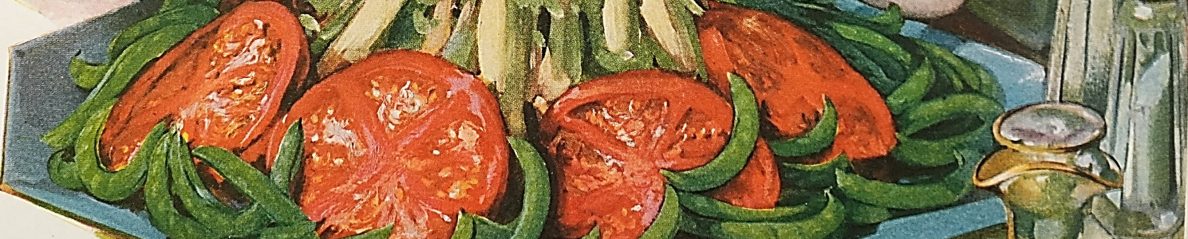
Too many vegetables should not be served at dinner; the general rule of serving two is a good one to follow. Lettuce is usually served with any salad and would make the third. In choosing the two, it is better to select one starch and one green vegetable; the two being pleasing in taste when eaten together.
Elementary Home Economics (1921) by Mary Lockwood Matthews
I recently came across a nice vegetarian recipe in a hundred-year-old cookbook. Macaroni and Green Peas can be served as either an entree or a side dish. The dish is vegetarian (not vegan, since cream coats the macaroni and peas). The cream adds flavor and richness to the dish.

The source of this recipe, The New Cookery cookbook, contains nutrition information for each recipe. This is the only hundred-year-old cookbook that I’ve ever seen with this much information.
This recipe didn’t make very much- and according to the nutrition information – the entire recipe only contains 604 calories. The old cookbook indicated that the serving size was 4 ounces which seems small for this type of dish. In my opinion, if this recipe was made as the main dish, there would be enough for 1 generous serving. If it was served as a side dish, it would make enough for 2 servings.
Here’s the recipe updated for modern cooks:
1/2 cup macaroni
1/2 cup green peas (fresh, frozen, or canned) – I used frozen peas. I put them in boiling water until they were hot, then removed from heat and drained.
1/2 cup light cream
1/2 teaspoon salt
Heat water in a saucepan to boiling; add the macaroni and cook 7-9 minutes until al dente. Remove from the heat and drain. Add a little cold water, then drain again. Add cream, peas, and salt; return to stove. Using medium heat, bring to a boil; reduce heat and simmer 5-10 minutes until the cream thickens into a sauce while stirring occasionally. Remove from heat and serve.

Today there are so many types of incredible mixers: mixers with dough hooks, mixers with meat grinders and juicers, hand mixers, immersion blenders. . .
A hundred years ago mixers were a little simpler. According to a 1921 advertisement, a Roberts Lightning Mixer beats everything.