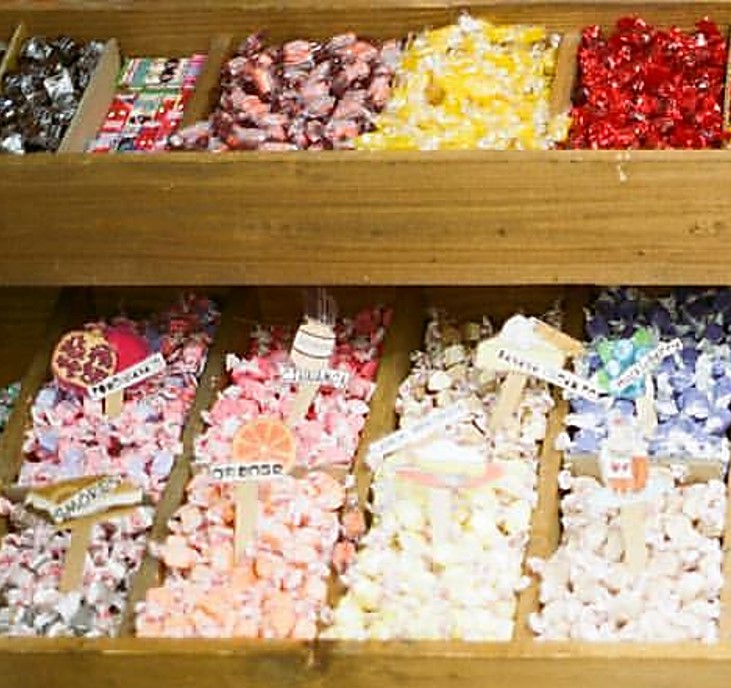
When my children were younger, I always worried that they would get sick from eating too much candy after trick or treating. I wondered – how much candy is too much? And, should I be firm and ration the candy they’d collected? . . . or was it okay if I let them binge? Here’s what a hundred-year-old home economics textbook says:
Small children are better without candy, but it may be used by older persons if it is eaten in reasonable amounts. Candy is more easily digested at the end of a meal than between meals. Candy contains a large proportion of sugar, and sugar when eaten alone is irritating to the digestive organs.
Elementary Home Economics (1921) by Mary Lockwood Edwards
I’m always looking for looking for nice breakfast foods, so decided to try a hundred-year-old recipe for Jelly Omelet. For the omelet, the eggs are separated and the whiten beaten, which results in a light and fluffy omelet. I’ve seen many recipes in old cookbooks that call for beating the egg whites when making an omelet, and I’ve previously made several of them – and they always turn out wonderfully. By comparison modern omelets seem heavy. Modern recipes seldom call for beating egg whites. I can’t figure out why the older method of making omelets seems to have largely been lost over time.
To make a Jelly Omelet, the cooked eggs are spread with jelly prior to folding to make the omelet. I used currant jelly – though other jams, jellies, or marmalades could be used. The sweet tartness of the currant jelly was a nice complement to the eggs.
This recipe is a keeper, and I anticipate that I’ll make it again. I have lots of jellies that I made last summer, and this is a tasty way to use some of the jelly.
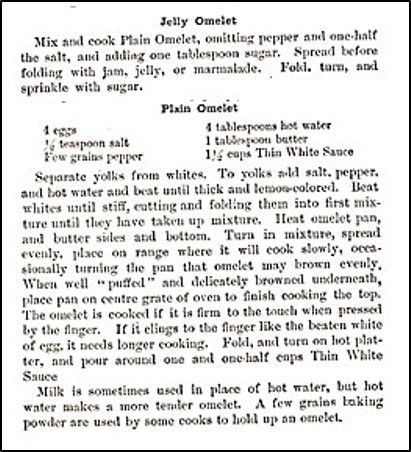
Here is the original recipe:
Source: The Boston Cooking-School Cook Book (1921 Edition)
additional sugar to sprinkle on top of omelet (optional)
Preheat oven to 375° F. Place egg whites in a bowl, and beat the egg whites until they form stiff peaks. Set aside.
In another bowl, whisk the egg yolks, then stir in the salt, sugar, hot water, and melted butter. Fold in the beaten egg whites.
Heat a large oven-proof skillet (or use an omelet pan) on the top of the stove using medium-low heat. (If needed to prevent sticking, liberally grease the skillet before heating.) Pour the egg mixture into skillet, and gently cook for 1 minute. Turn the pan 90° to help ensure that the omelet cooks evenly, and gently cook for another minute. Then move the skillet to the oven, and bake for about 8 – 10 minutes or until the egg mixture is set. Remove from oven, and loosen the edges of the omelet from the skillet with a knife or spatula, then turn onto a plate. Thickly spread jam, jelly, or marmalade onto one half of the omelet, and then fold in half. If desired, sprinkle sugar on top of the omelet. Serve immediately.
A hundred years ago people believed that food should be well-chewed before swallowing, and that eating food too rapidly was not healthy. Here is what it said in a 1921 book:
Hasty Eating
Digestion begins in the mouth. But when food is improperly masticated, it enters the stomach with only slight alteration. The ptyalin of saliva is not present in sufficient quantity, under such conditions to produce any effect on the preliminary digestion of starches, with the result that the food passes through the duodenum practically unchanged, and in coarse particles, where it is likely to produce irritation. One authority says:
“Although much of the mechanical preparation and mixing of foods is of a necessity done in the stomach, some of it may advantageously be done in the mouth. The stomach should not be required to perform the function of the gizzard of a fowl.” –Human Foods, page 227.
Hasty eating, or bolting of food, is a fruitful cause of over-eating. The food does not remain in the mouth long enough under this condition, to give the satisfaction that it gives when thoroughly masticated; so, in an effort to satisfy the craving for food, more is taken than the body requires. This habit leads, moreover, to the taking of too large a quantity in too short a time, which serves to paralyze, as it were, the nerve impulses that communicate with the brain, and as a result the important message “Enough” does not reach the brain until an excess of food has been consumed.
When farinaceous foods (breads, cereals, potato, etc.) are well chewed and intimately mixed with saliva, they are more efficiently digested, and go farther, less food being required than when not well digested. Bread made from the entire grain requires more mastication before it can be swallowed than does spongy white bread, and itself promotes good digestion. Dry foods, which induce mastication should have a prominent place in the history.
The Science of Food and Cookery (1921) by H.S. Anderson
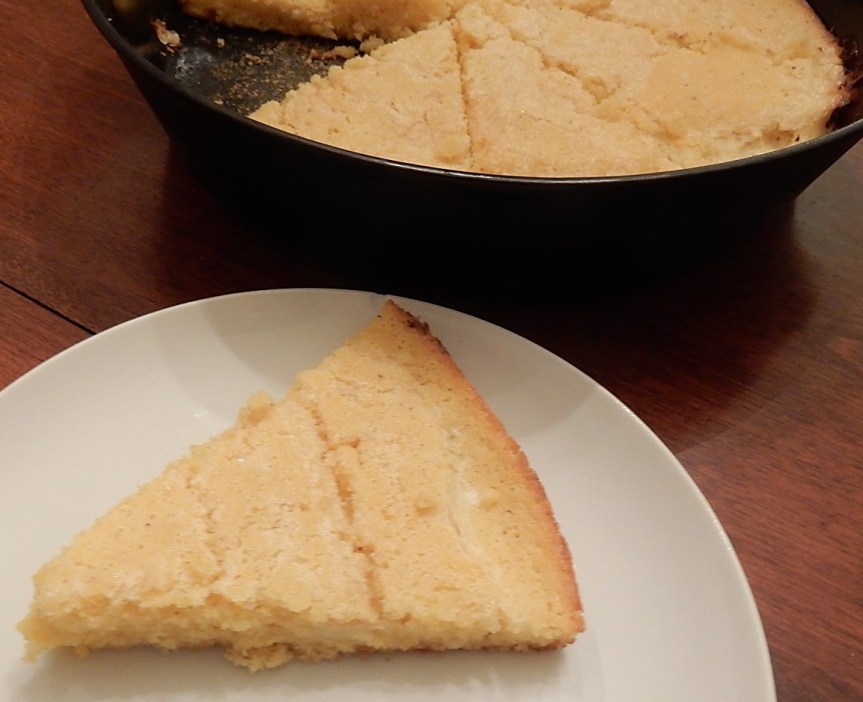
I was intrigued by a recipe for Spider Cornbread in a hundred-year-old cookbook. What an unusual name! After doing a little research, I discovered that Spider Cornbread is a regional food that is eaten in New English and some other sections of the U.S.
Spider Cornbread has a creamy middle layer that is made by pouring milk on top of the batter after the has been poured into the skillet that will be used to cook the cornbread.
The verdict: The Spider Cornbread was tasty, though the creamy layer wasn’t very thick. I baked the Spider Cornbread in a 12-inch cast iron skillet. If I made it again, I’d use a slightly smaller skillet – maybe a 10-inch skillet. This would result in a thicker cornbread and a thicker creamy layer.
Here is the original recipe:
Source: The New Dr. Price Cook Book (1921) published by the Price Baking Powder Factory
Is “cornbread”, one word or two? I think that it’s one word, but see that the old recipe makes it two words – corn bread. Maybe the two word version is an older way of writing cornbread.
When I made this recipe, I reduced the salt by a small amount, and used 3/4 teaspoon rather than the 1 teaspoon called for in the original recipe.
Preheat oven to 400° F. Grease a 10 – 12 inch cast iron skillet; with the shortening; then put skillet into oven while it is preheating.
In the meantime, put egg in mixing bowl and beat; add 1 cup milk and beat. Add sugar cornmeal, flour, salt, and baking powder; beat to combine. Remove skillet from oven and pour batter into it. Pour the remaining 3/4 cup of milk on top of the batter, but do not stir. Return skillet to oven, and bake for approximately 25 minutes. When a wooden pick inserted in the center comes out clean, the cornbread is done. Removed from oven and cut into triangles.
I am intrigued by this 1921 advertisement. The 1920’s were a time of rapid change, and schools were becoming larger with some even having school lunch rooms or cafeterias. However, I’m uncertain that it can be considered progress when more and more school lunch rooms were selling Lowney’s Almond Milk Chocolate Bars.
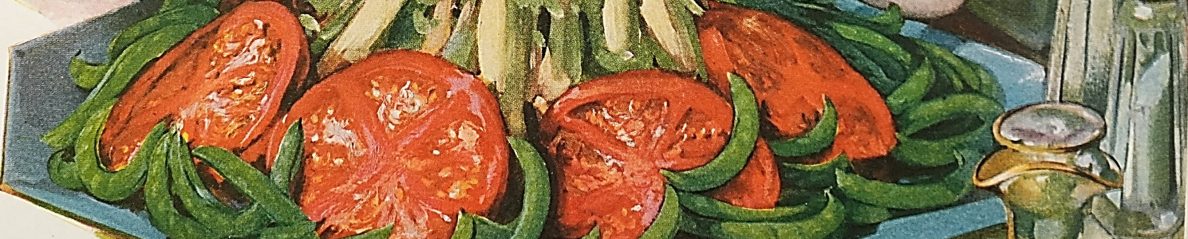
I always enjoy Waldorf Salad, so was intrigued by recipe for Apple and Celery Salad in a hundred-year-old cookbook. It seemed very similar to Waldorf Salad – but with fewer ingredients (just apples and celery). I wondered, would I miss the nuts and raisins in the typical Waldorf Salad?
The verdict- Apple and Celery Salad was nice, but I prefer Waldorf Salad with the added crunchiness and sweetness of the nuts and raisins.
Here’s the original recipe:
Source: The New Cookery (1921) by Lenna Frances Cooper
I went with the mayonnaise option when I made this recipe, and I did not garnish with lettuce. (Exactly how do you garnish with lettuce?) I also did not peel the apples. To be totally honest, I somehow failed to notice that the apples were supposed to be peeled until I started writing this post. When I made this recipe, I was in a hurry and just glanced at the recipe, and thought that this would be an easy recipe because it was Waldorf Salad minus half the ingredients. I should have read it more carefully. The salad would be different (and less colorful) if the apples had been peeled.
And I also failed to notice that I was supposed to marinate the apple pieces in lemon juice – but we ate the salad soon after I made it, so the apples didn’t discolor. (I think that coating them with mayonnaise also slows discoloration).
I used just enough mayonnaise to coat the celery and apple pieces (about 1/2 – 2/3 cup). I previously made the Golden Salad Dressing recipe that is listed in this recipe when I made another recipe from this cookbook: Pineapple and Strawberry Salad with Golden Dressing. Golden Salad Dressing recipe can be found in that post.
I’m now realizing that I barely made the original recipe for Apple and Celery Salad – and am fascinated that I somehow failed to do so many things quite right with such a simple recipe. I guess it’s a lesson learned about carefully reading directions even for the easiest recipes. That said, the recipe turned out well, so the updated recipe for modern cooks is based on how I made it..
Here’s what a 1921 cookbook had to say about how to substitute various sweets for sugar in recipes:
As substitutes for sugar for cooking purposes, corn sirup, molasses, glucose, maple sugar and sirup, and also honey come in for their share of usefulness. The question arises in the mind of many a housewife as to how much of these diluted sugars should be substituted in customary recipes. For this reason, the following facts may be of interest.
Corn sirup and maple sirup are not so sweet as sugar, and when used to replace it, should be increased from one half to two thirds. For instance, if a recipe calls for 1 cup of sugar, use as substitute 1 1/2 to 1/2/3 cups of sirup. In this case, allowance must be made for the increase in liquid. Every cup of sirup furnishes 1/4 cup of liquid; there for every cup of sirup that is substituted for sugar, reduce the original amount of liquid in the recipe 1/4 cup. Unless such allowance is made for the liquid that the sirup adds, an extra amount of flour is needed to obtain the necessary thickness to the batter, and a poor product is likely to result.
In using molasses and brown sugar, no change need to be made so far as amounts for sweetening purposes are concerned, because what these lack in sweetness is largely made up in flavor. However, the same allowance must be made for the liquid as when sirup is used. Glucose is best when used with part sugar, say 1/3 sugar to 2/3 glucose by measure. When used thus, it is suitable for canning purposes, also for making of sauces, etc.
Honey, one of the most staple sweetenings in the world, and probably the longest used, as not been in very common use for cooking purposes. Its sweetening power is about the same as that of sugar, and it should be used in the same proportions as white sugar, except that one fourth less of liquid should be used in a recipe with honey than with sugar. Honey is best adapted for table use; and for this purpose, it had better replace white sugar entirely.
The Science of Food and Cookery (1921) by H. S. Anderson
The substitution amounts probably haven’t changed across the years – but the spelling has. “Sirup” is now often spelled “syrup,” and “sweetenings” are now “sweeteners.” There sugar substitution recommendations in the old cookbook for both “corn sirup” and “glucose.” I’ve always thought that corn syrup and glucose were the same thing, but apparently they are different.
 When my children were younger, I always worried that they would get sick from eating too much candy after trick or treating. I wondered – how much candy is too much? And, should I be firm and ration the candy they’d collected? . . . or was it okay if I let them binge? Here’s what a hundred-year-old home economics textbook says: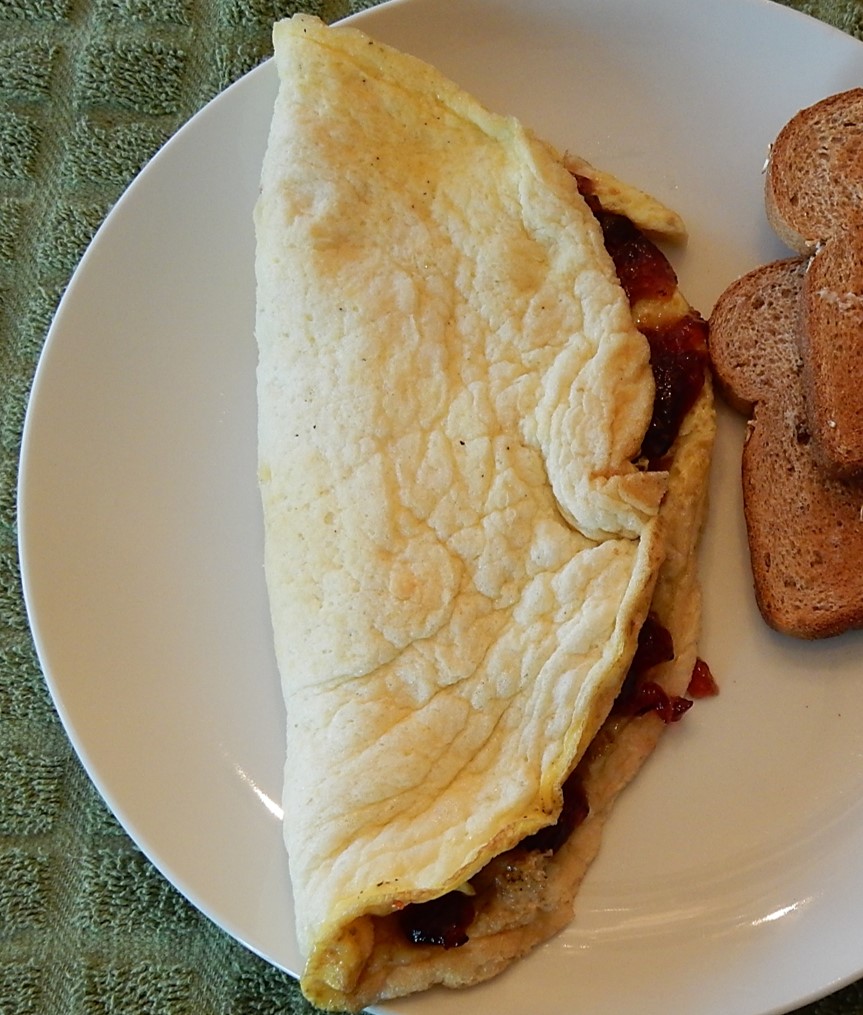
 A hundred years ago people believed that food should be well-chewed before swallowing, and that eating food too rapidly was not healthy. Here is what it said in a 1921 book:
 I was intrigued by a recipe for Spider Cornbread in a hundred-year-old cookbook. What an unusual name! After doing a little research, I discovered that Spider Cornbread is a regional food that is eaten in New English and some other sections of the U.S.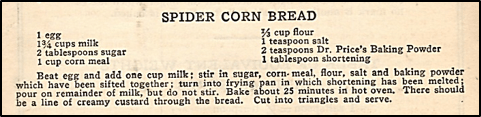


 Here’s what a 1921 cookbook had to say about how to substitute various sweets for sugar in recipes: