The “Feeding the Family” Club

pot roast slices, potatoes, and carrots on plateA hundred years ago, a group of women in Long Beach California belonged to a “Feeding the Family” club. It was organized by the local public schools. There were many similar clubs throughout the U.S. at that time. Here is what a 1921 magazine article said about the Long Beach group:

“Feeding the Family” Club

Women are waking up to the fact that upon their shoulders rests the responsibility of having a healthier nation. Too many people are dying of avoidable diseases. Rich foods have taken more toll of life than war and pestilence, dieticians tell us. More and more stress is being placed upon diet – not for the sick only, but for those in good health, that they may preserve it. By diet we mean the proper combinations of foods and the scientific uses of vitamins, starches, proteins and acids.  What we need is more than a reading acquaintance with those subjects.

A certain group of women in Long Beach , Calif. have decided that the acquisition of knowledge concerning food properties is the only way to better living for their families. They have grouped together under the name of the “Feeding the Family” Club, and under the leadership of the head of the department of domestic science of the public schools, they meet on Wednesday evening each week for two hours to learn how to prepare healthful, nourishing meals for the average family.

There sixteen women in the group, representing fifty-six persons, most of whom are children in school. Think what it means to those children to have mothers who are vitally interested in seeing them grow up to be strong, virile men and women. “Knowledge makes Power” aye, the knowledge of the mothers of today makes for the powerful citizens of tomorrow.

American Cookery (November, 1921)
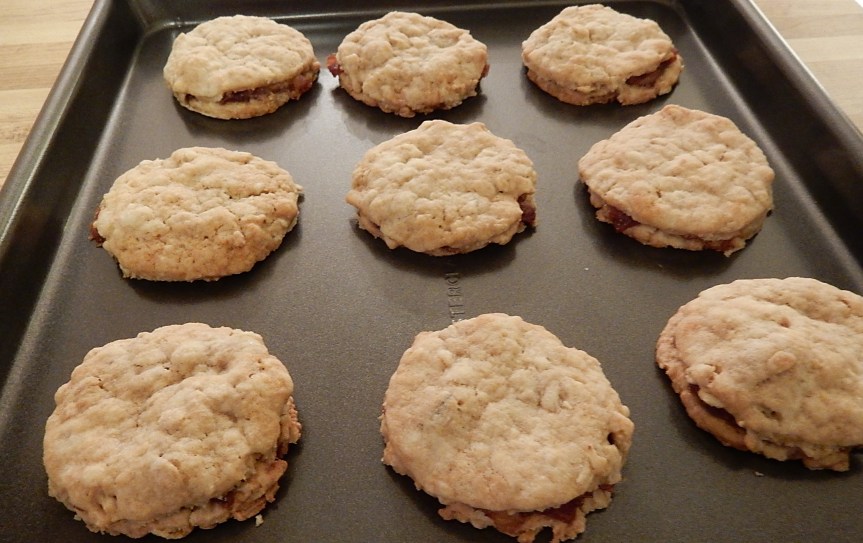
Old-fashioned Trilbies (Date-Filled Cookies)

Trilbies (Date-filled Cookies) on baking sheet

My holiday cookie baking has begun. Today I made a hundred-year-old recipe for Trilbies. They are a lovely date-filled cookie that brings back warm memories of day gone by.

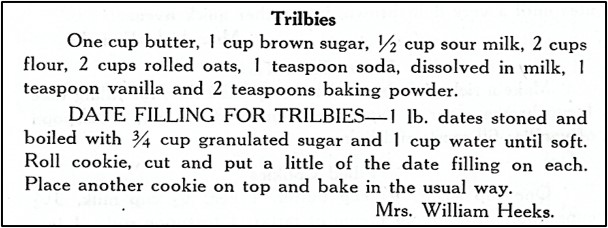
Here’s the original recipe:

recipe of Trilbies Cookies
Source: Ladies’ Union Cook Book compiled by the Ladies of the West Concord Union Church, Concord Junction, Massachusetts (1921}

A hundred years ago recipes sometimes called for sour milk. Back then much milk was not pasteurized and it soured after a few days. This sour milk was sometimes used in recipes. Today milk can be soured by adding a little vinegar to it.

Here’s the recipe updated for modern cooks:

Trilbies (Data-Filled Cookies)

  • Servings: Approximately 40 Cookies
  • Difficulty: moderate
  • Print

Cookies

1/2 cup sour milk (Make milk sour by adding 1 1/2 teaspoons of vinegar to the milk)

1 cup butter, softened

1 cup brown sugar

2 cups flour

2 cups rolled oats (old-fashioned oatmeal)

1 teaspoon baking soda

2 teaspoons baking powder

1 teaspoon vanilla

Preheat oven to 400° F. Put the milk in a cup or small bowl. Stir in the vinegar to sour the milk. Set aside.

In a mixing bowl, cream butter and brown sugar. Stir in the sour milk, baking soda, baking powder, and vanilla. Then add the flour and rolled oats; stir until combined. On well-floured surface, roll out dough to 1/8 inch thickness. Cut into circles using a cookie cutter or small glass. (The cookie cutter I used was 2 inches in diameter.)  Place half the circles on greased baking sheets.  Place a heaping teaspoon of date filling (see recipe below) on each circle and spread to the edges of the cookies; put a second cookie on top of each date-filling topped cookie. Bake 10-12 minutes or until lightly browned.

Date-Filling

1 pound chopped dates

3/4 cup sugar

1 cup water

Put the chopped dates, sugar, and water into a saucepan and stir to mix; put on medium heat and bring to a boil. Reduce heat and boil gently until the dates are soft and the filling a nice consistency for the cookie filling (5-10 minutes). Cool slightly before using as a filling.

http://www.ahundredyearsago.com

Steamed Ginger Pudding with Vanilla Sauce

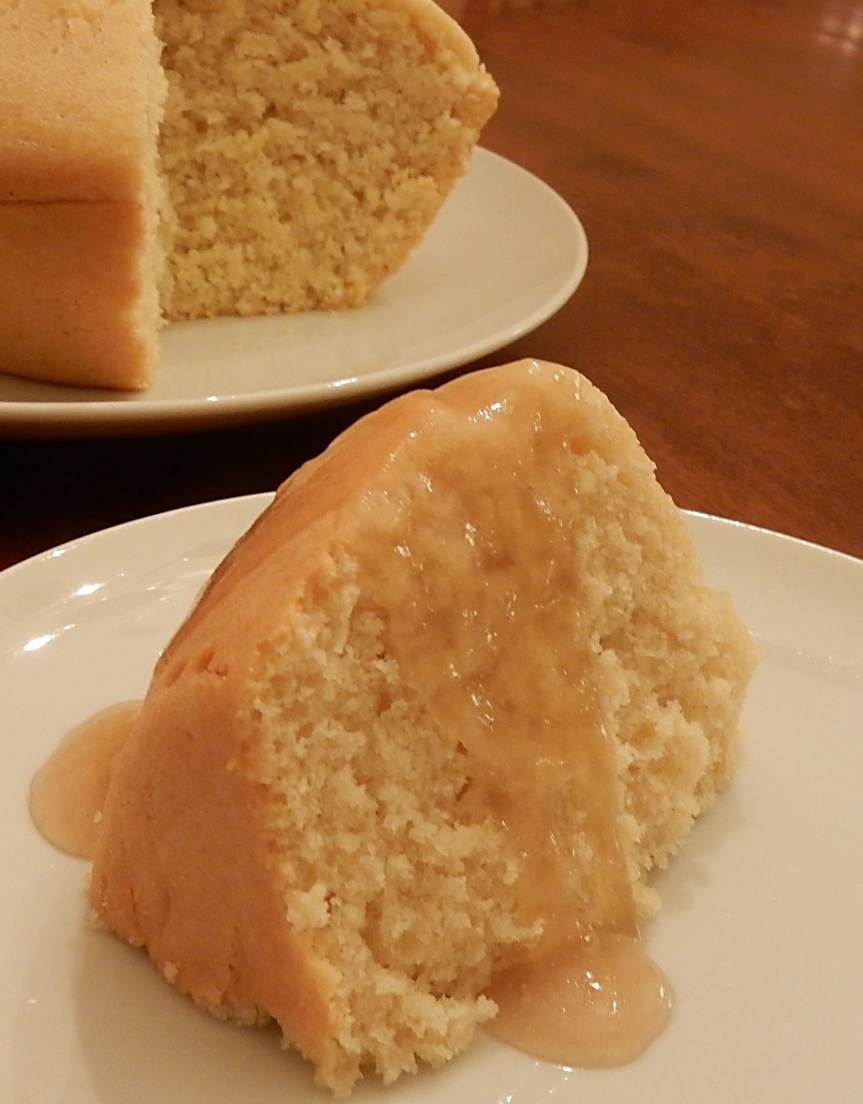
Slice of Steamed Ginger Pudding on Plaste

Steamed puddings and small holiday gatherings just seem to go together. So each year, as the holidays approach, I look at the steamed pudding recipes in hundred-year-old cookbooks and find one to try. Steamed puddings served with a sweet sauce were much more popular back then than they are now.

Steamed puddings typically require several hours of steaming – and often are considered too time consuming (and energy consuming) to be worth making. But back in the days when homes had wood or coal cook stoves that were always lit, steamed pudding were considered easy. The large pot with water that the molded pudding was put into could be put on the back burner of the stove. The cook could then move on to other activities, and come back several hours later and the pudding would be done.

This year the steamed pudding recipe that intrigued me was one for Ginger Pudding, so I decided to give it a try. It was lovely when served warm with Vanilla Sauce. The pudding texture was lovely, and the sweet warmth of the ginger created a taste treat.

Here’s the original recipe:

Recipe for Ginger Pudding
Source: Boston Cooking-School Cook Book (1921 Edition)

Here’s the recipe for the Vanilla Sauce:

Recipe for Vanilla Sauce
Source: Boston Cooking-School Cook Book (1921 Edition)

And, here’s the Lemon Sauce II recipe (and not the Lemon Sauce I or the Lemon Sauce III recipe) that the Vanilla Sauce recipe refers to:

Recipe for Lemon Sauce
Source: Boston Cooking-School Cook Book (1921 Edition)

It always seems a little odd how old cookbooks often refer cooks to multiple recipes scattered throughout the cookbook rather than just placing the entire recipe in the correct format in one spot – but I guess that it saved a little space (though, in my opinion, it tends to make the original recipe that I was trying to make a bit more confusing).

Here’s the recipe updated for modern cooks:

Steamed Ginger Pudding

  • Servings: 5 - 7
  • Difficulty: moderate
  • Print

Steamed Ginger Pudding

1/3 cup butter, softened

1/2 cup sugar

1egg

1 cup milk

3 1/2 teaspoons baking powder

1/4 teaspoon salt

2 teaspoons powdered ginger

2 1/4 cups flour

Put the butter in a bowl and then cream; gradually add the sugar while continuing to beat. Add egg and beat; then add the milk, baking powder, salt, ginger, and flour. Beat until smooth. Pour the batter into a greased pudding mold, cover, and steam for two hours. Remove from the steaming water, wait a few minutes, then remove from mold. Serve warm with Vanilla Sauce. (This pudding is also excellent cold without the Vanilla Sauce.)

*Notes: I used a 2 liter mold, but had some extra space at the top. One slightly smaller could be used. Historically coffee cans were often used as molds.  Cooks Info describes how to steam a pudding (or follow the directions that come with the mold).

Vanilla Sauce

1/2 cup sugar

1 cup boiling water

1 tablespoon cornstarch or 1 1/2 tablespoons flour

2 tablespoons butter

1 teaspoon vanilla

Dash salt

Mix the sugar and cornstarch in a sauce pan; add the water gradually while stirring constantly using medium heat. Bring to a boil, then reduce heat and continue to boil for 5 minutes. Remove from heat and stir in the butter, vanilla, and salt. Serve warm; may be reheated.

http://www.ahundredyearsago.com

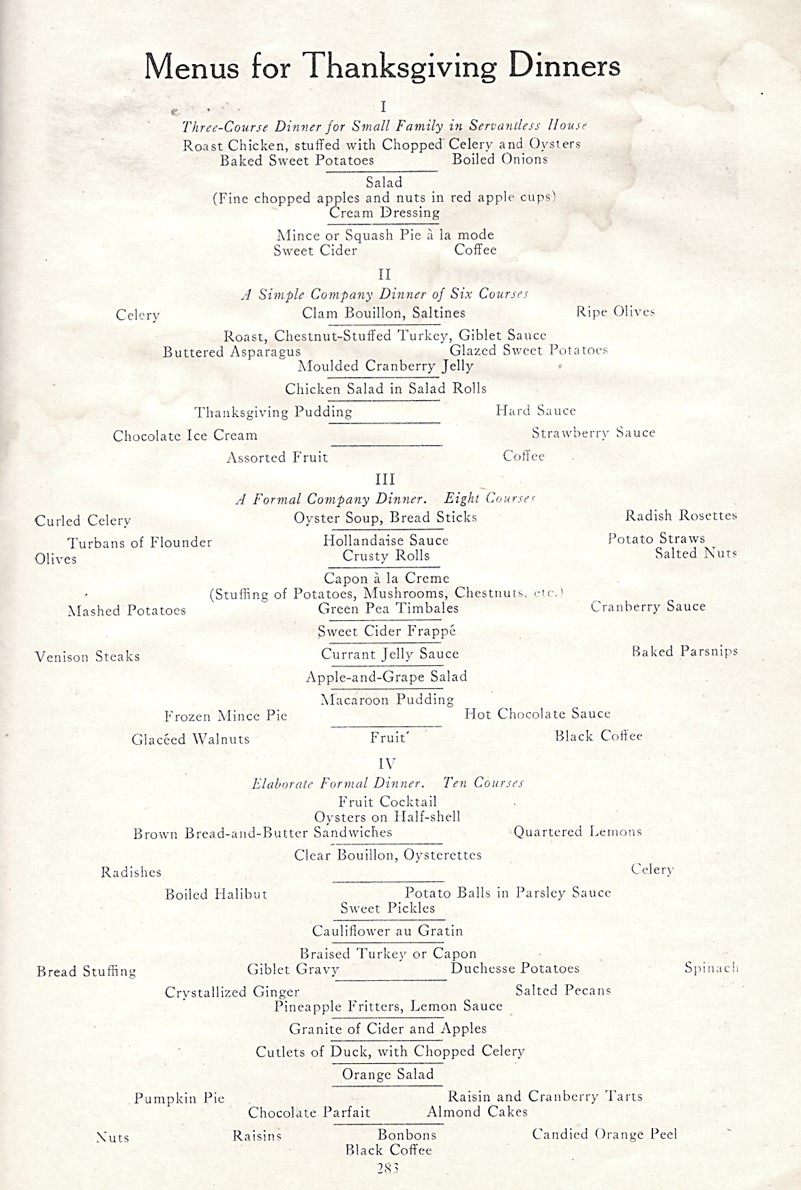
1921 Thanksgiving Menus

1921 Thanksgiving Menus
Source: American Cookery (November, 1921)

The November, 1921 issue of American Cookery provided four menu options for Thanksgiving meals:

  • Three course dinner for small family in a servantless house
  • A simple company dinner of six courses
  • A formal company dinner. Eight courses
  • Elaborate formal dinner. Ten courses

My Thanksgiving meals clearly lean toward the three course option (though with turkey instead of chicken) – but if I could get in a time machine and go back a hundred years, I’d head to a house serving the ten course meal.

HAPPY THANKSGIVING

Old-fashioned Glazed Sweet Potatoes

Glazed Sweet Potatoes

Sweet potatoes are a holiday classic, so I was pleased to find a hundred-year-old recipe for Glazed Sweet Potatoes. The sweet potatoes are glazed with a sugar sauce and baked until tender. The glaze is made with white sugar (not the brown sugar or maple syrup that is more typically used today). The Glazed Sweet Potatoes were tender and sweet, but they were not immersed in a thick sauce – rather (as the recipe title says) they had a sugar glaze.

Here’s the original recipe:

Recipe for Glazed Sweet Potatoes
Source: The New Cookery (1921) by Lenna Frances Cooper

The old recipe called for boiling the sweet potatoes for 10 minutes to make it easy to slip the skins off them, however, the skins  didn’t come off very easily. I don’t think that they were boiled for quite long enough, so when I updated the recipe, I indicated that they should be boiled by 15 minutes.

Here’s the recipe updated for modern cooks:

Glazed Sweet Potatoes

  • Servings: 9 - 12
  • Difficulty: moderate
  • Print

6 medium sweet potatoes

1 teaspoon salt

water

3/4 cup sugar

1/3 cup water

1 1/2 tablespoons butter

Wash sweet potatoes and then place in a Dutch oven or other large pan. Cover with water and add the salt to the water; bring to a boil using high heat. Reduce heat and simmer for 15 minutes. Remove from heat and let cool enough to handle. Remove skins from the sweet potatoes. They should slip off easily. Then cut the sweet potatoes in half lengthwise and arrange in a large rectangular casserole dish.

In the meantime, preheat oven to 375° F.  And, make the sauce that will be used to glaze the sweet potatoes by putting the sugar and water in a saucepan; stir. Using medium heat, bring to a boil while continuing to stir. Boil for 3 minutes then remove from heat and stir butter into the sauce.

Using a basting brush, spread sugar syrup on the arranged sweet potato halves. Put in oven and bake until tender and the syrup begins to brown (about 30 – 40 minutes). While baking, baste several times with the syrup.

http://www.ahundredyearsago.com

1921 Description of High-Quality Pie Crusts

Slice of Lemon Apple Pie

Here’s how a 1921 home economics textbook describes a high-quality pie:

A pie should have a light, flaky, tender crust that is thoroughly baked. Pie crust must be chewed thoroughly, since even the best is hard to digest. It is easier to make tender pie crust from pastry flour because that contains less gluten and more starch than bread flour. Bread flour may be used, however. Many kinds of fat are used in pie crust, such as lard, butter, vegetable fats and oils. Fat make the crust “short” and flaky, and is often called “shortening.” The crust is made tender by careful handling, and by folding and rolling several times so that air is folded into the dough. This air, and the steam formed from the water used in the mixture, expand the dough during baking and make the pie crust light.

Elementary Home Economics (1921) by Mary Lockwood Matthews