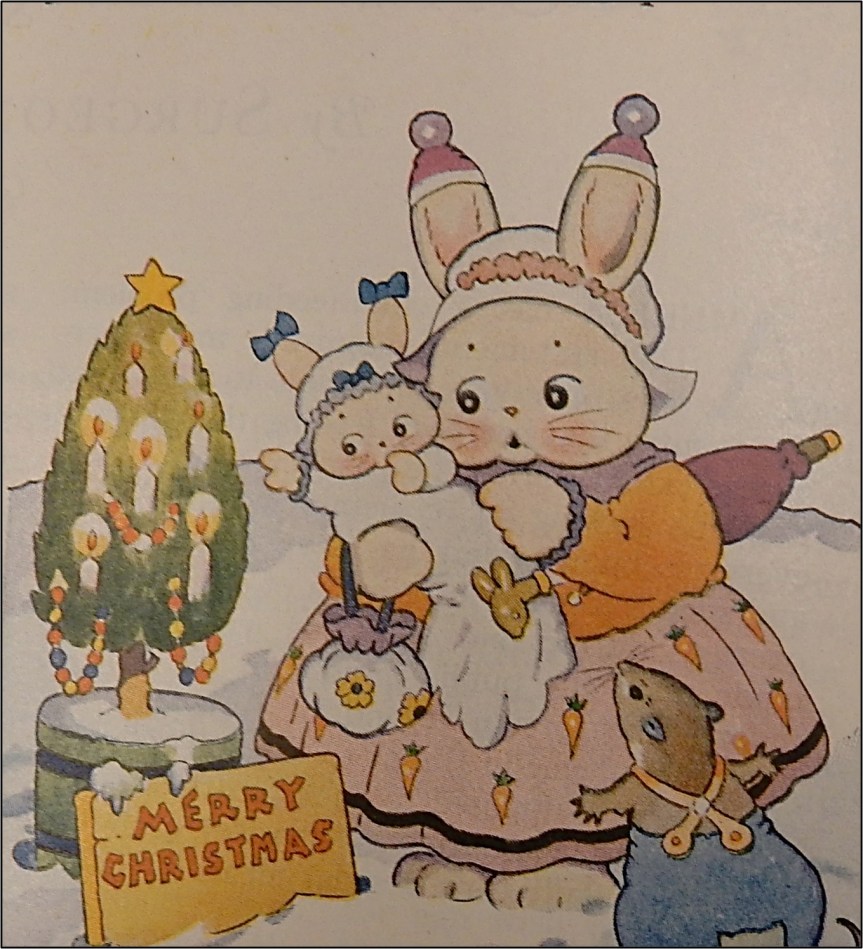
The December, 1921 issue of Ladies Home Journal had several “little forest people” drawings that could be cut out. and used as Christmas decoration or for holiday table place cards. Here’s one I thought you might enjoy.
MERRY CHRISTIMAS

The December, 1921 issue of Ladies Home Journal had several “little forest people” drawings that could be cut out. and used as Christmas decoration or for holiday table place cards. Here’s one I thought you might enjoy.
MERRY CHRISTIMAS

People often ask me if I ever have cooking disasters when making hundred-year-old recipes. And, I usually say, “No, that’s very rare. I like some recipes better than others, but most recipes turn out fine. A few I really like and they become part of my regular recipe repertoire, and I make them many times.”
But today’s post is an exception – I made a hundred-year-old recipe for Glace Nuts that was a disaster. Let me explain.

I wasn’t quire sure about using a pin to dip the nuts in the syrup as described in the old recipe, but I had some fairly long pins so decided to give it a try. (Did they use hat pins a hundred years ago when making Glace Nuts?)
First, I put the ingredients a saucepan and brought the mixture to a boil. I regularly checked the temperature with a cooking thermometer – 240° F. . . . 264° F . . . 285 ° F . . . 296° F. I decided that it was time to get some waxed paper (it probably was similar to oiled paper) out to put the nuts on after I dipped them in the sugar syrup.. I put pieces of waxed paper on several plates, and then looked at the boiling syrup – oh dear, it was brown. I turned off the heat and grabbed the candy thermometer. – 320°. Maybe the syrup was only slightly discolored.
I put some cold water in the sink and lowered the saucepan into it for a few seconds. Then I put some water in the microwave to heat. When it was hot, I poured it into a shallow pan, and then set the saucepan with the syrup in it. I inserted a pin in a walnut and carefully dipped it into the syrup; then I removed the sugar-coated walnut, and laid it on the waxed paper. I repeated the process with four more nuts – as the syrup rapidly began to thicken and then harden in the pan. Clearly not watching the cooking syrup closely enough and letting it reach a temperature of 320° was causing problems. I also noticed that the dipped nuts were sticking to the waxed paper.
I decided to make a fresh batch of the sugar syrup. Sugar doesn’t cost much. It would only take a few minutes to make the syrup, – and I’d watch it like a hawk to ensure that I took it off the stove at exactly 310°.
Twenty minutes later I had a another batch of the sugary liquid. I put it in cold water then, then set the saucepan in some hot water. And, I inserted a pin in a nut and began dipping once again.
One nut. . two. . . three. . . four. . . five nuts. . . the syrup again began to get very thick. I inserted a pin in the sixth nut, and immersed it into the syrup. The rapidly thickening syrup began to pull the nut off the pin. I instinctively reached with my hand to grab the nut before it fell off the pin – and my middle finger and thumb slipped into the hot sticky syrup. OUCH! I’m burned!
Dang it! My fingers hurt – but then I smiled. I always seem to have a minor crisis or disaster during the mad rush in the days before Christmas. This apparently is my disaster this year.
I do not recommend this recipe – and since I don’t recommend it, I not going to update it for modern cooks.

A hundred years ago home economics textbooks sometimes had “Christmas Lessons” where the students learned how to make candy. One book recognized that “small children are better without candy. . . ” before moving on to describing how to make candy.
This lesson reminds me of another lesson that I did a post on several years ago. That lesson was on making candy gift boxes.
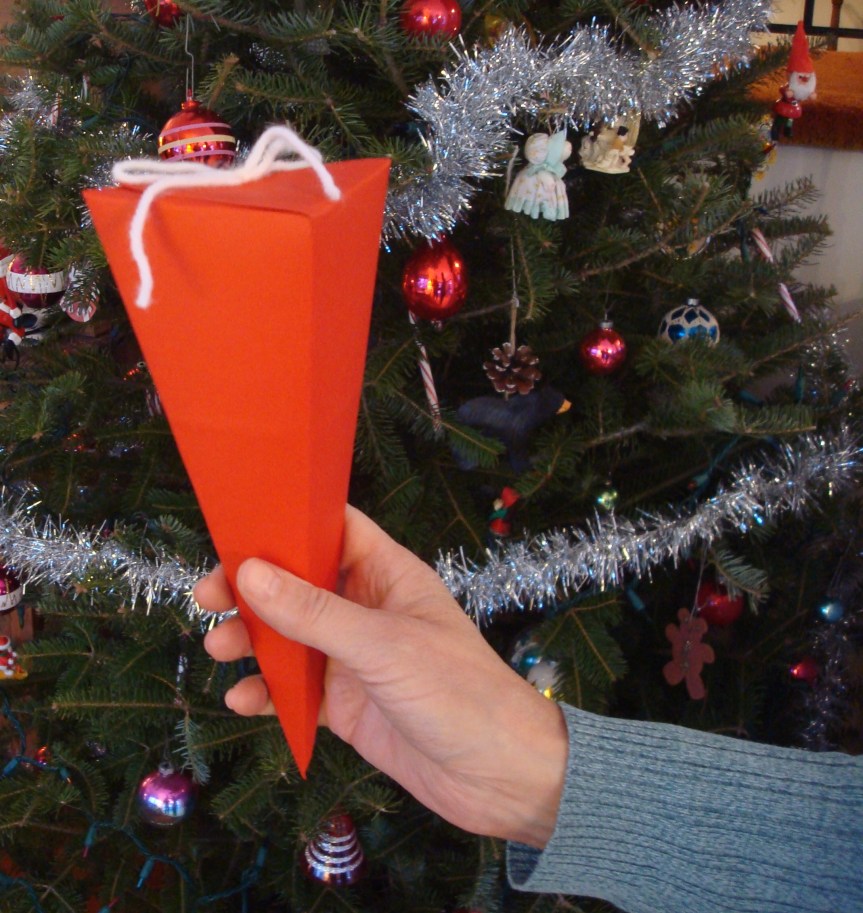
How to Make a Triangular Candy (Gift) Box
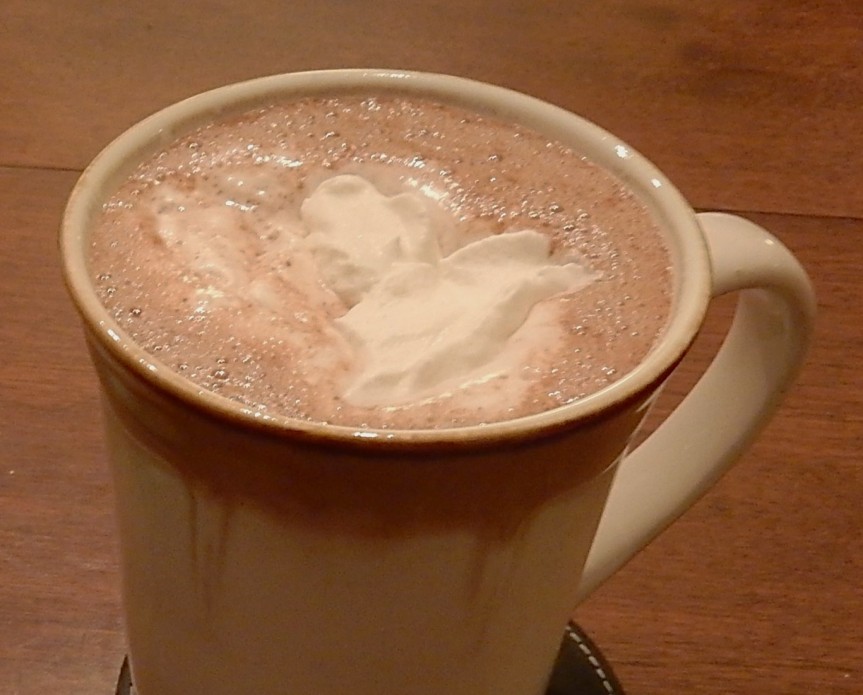
Sometimes recipe names change across the years, but the recipe is classic – and works just as well today as it did a hundred years ago. An example, of this is a recipe for French Chocolate that I found in a hundred year old cookbook. French Chocolate is hot chocolate with coffee and brandy.
A steamy cup of French Chocolate topped with whipped cream is the perfect warmer-upper on cold winter days.
Here’s the original recipe:

A Dover egg beater is a rotary egg beater. Maybe they still sell them, but I haven’t seen one in years, so I whisked the French Chocolate to make it foamy.
I’m always fascinated when I see alcohol in recipes in 1921 cookbooks, since this was during prohibition. I’m not quite sure where cooks were supposed to find the brandy that the recipe called for.
Here’s the recipe updated for modern cooks:
3 cups milk
1/4 cup ground coffee
2 tablespoons sugar
2 squares unsweetened chocolate, melted
1/2 cup hot water
1/8 teaspoon salt
2 tablespoons brandy
whipped cream
Put the milk and ground coffee in a saucepan; stir to combine. Using medium heat, heat while stirring constantly until the milk mixture is scalded, and hot and steamy, Remove from the heat and strain to remove coffee grounds.
In the meantime, put the sugar, melted unsweetened chocolate, and water in another saucepan; stir to combine. Using medium heat bring to a boil while stirring constantly; then reduce heat and continue boiling and stirring for 2 minutes.
Gradually, add the strained milk and coffee mixture to the chocolate mixture while stirring. If needed, reheat until very hot, then remove from heat. Stir in salt and brandy. Beat with beaters or a whisk for a few seconds to make foamy. Pour into cups, and top with whipped cream.
 A hundred years ago, a group of women in Long Beach California belonged to a “Feeding the Family” club. It was organized by the local public schools. There were many similar clubs throughout the U.S. at that time. Here is what a 1921 magazine article said about the Long Beach group:
“Feeding the Family” Club
Women are waking up to the fact that upon their shoulders rests the responsibility of having a healthier nation. Too many people are dying of avoidable diseases. Rich foods have taken more toll of life than war and pestilence, dieticians tell us. More and more stress is being placed upon diet – not for the sick only, but for those in good health, that they may preserve it. By diet we mean the proper combinations of foods and the scientific uses of vitamins, starches, proteins and acids. What we need is more than a reading acquaintance with those subjects.
A certain group of women in Long Beach , Calif. have decided that the acquisition of knowledge concerning food properties is the only way to better living for their families. They have grouped together under the name of the “Feeding the Family” Club, and under the leadership of the head of the department of domestic science of the public schools, they meet on Wednesday evening each week for two hours to learn how to prepare healthful, nourishing meals for the average family.
There sixteen women in the group, representing fifty-six persons, most of whom are children in school. Think what it means to those children to have mothers who are vitally interested in seeing them grow up to be strong, virile men and women. “Knowledge makes Power” aye, the knowledge of the mothers of today makes for the powerful citizens of tomorrow.
American Cookery (November, 1921)
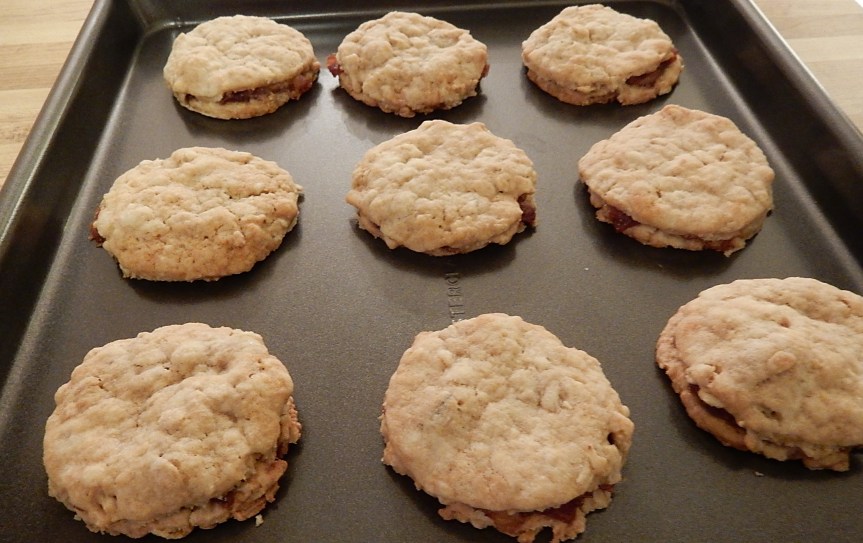
My holiday cookie baking has begun. Today I made a hundred-year-old recipe for Trilbies. They are a lovely date-filled cookie that brings back warm memories of day gone by.
Here’s the original recipe:
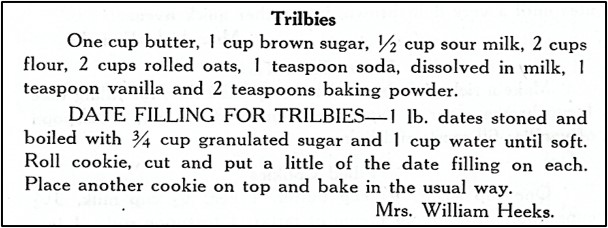
A hundred years ago recipes sometimes called for sour milk. Back then much milk was not pasteurized and it soured after a few days. This sour milk was sometimes used in recipes. Today milk can be soured by adding a little vinegar to it.
Here’s the recipe updated for modern cooks:
Cookies 1/2 cup sour milk (Make milk sour by adding 1 1/2 teaspoons of vinegar to the milk) 1 cup butter, softened 1 cup brown sugar 2 cups flour 2 cups rolled oats (old-fashioned oatmeal) 1 teaspoon baking soda 2 teaspoons baking powder 1 teaspoon vanilla Preheat oven to 400° F. Put the milk in a cup or small bowl. Stir in the vinegar to sour the milk. Set aside. In a mixing bowl, cream butter and brown sugar. Stir in the sour milk, baking soda, baking powder, and vanilla. Then add the flour and rolled oats; stir until combined. On well-floured surface, roll out dough to 1/8 inch thickness. Cut into circles using a cookie cutter or small glass. (The cookie cutter I used was 2 inches in diameter.) Place half the circles on greased baking sheets. Place a heaping teaspoon of date filling (see recipe below) on each circle and spread to the edges of the cookies; put a second cookie on top of each date-filling topped cookie. Bake 10-12 minutes or until lightly browned. Date-Filling 1 pound chopped dates 3/4 cup sugar 1 cup water Put the chopped dates, sugar, and water into a saucepan and stir to mix; put on medium heat and bring to a boil. Reduce heat and boil gently until the dates are soft and the filling a nice consistency for the cookie filling (5-10 minutes). Cool slightly before using as a filling. http://www.ahundredyearsago.comTrilbies (Data-Filled Cookies)

My holiday baking has begun! I bought some Baker’s Chocolate last week. Then yesterday I came across this ad for Baker’s Chocolate in a 1921 cookbook – and am in awe that this product has been around for more than 240 years (241 years to be exact).
