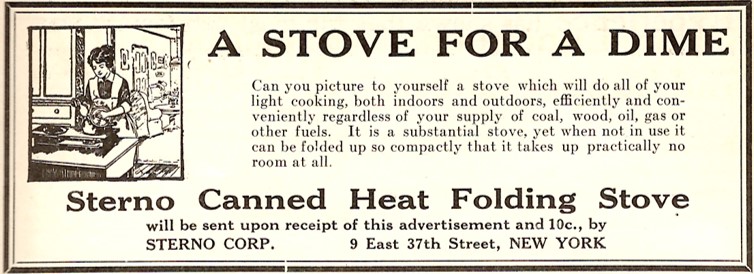
Sometimes hundred-year-old advertisements befuddle me. Even though money was worth a lot more in 1922, how can the company afford to send these folding stoves to people who send them 10 cents?

Sometimes hundred-year-old advertisements befuddle me. Even though money was worth a lot more in 1922, how can the company afford to send these folding stoves to people who send them 10 cents?
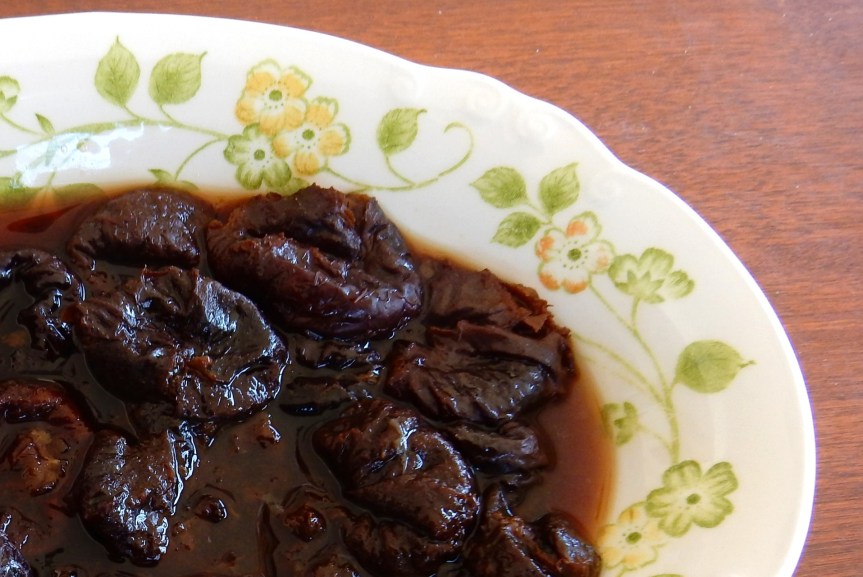
Stewed prunes are delicious, so when I saw a hundred-year-old recipe for Cinnamon Prunes, I decided to give it a try. The recipe called for adding both stick cinnamon and lemon or orange slices to prunes and water, and then stewing. The Cinnamon Prunes were tasty with a sunny citrus undertone and a hint of cinnamon. The recipe’s a keeper. I’ll definitely make it again.
Here’s the original recipe:
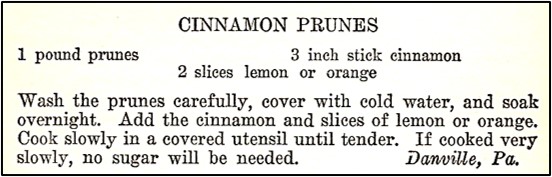
When I was flipping through a hundred-year-old recipe book published by Good Housekeeping, I was intrigued by this recipe – and then when I saw that the recipe author was from Danville, Pennsylvania, I just knew that I needed to make it. I grew up about 20 miles from Danville – and I seldom see recipes from this area of central Pennsylvania in hundred-year-old cookbooks. The cookbook doesn’t give the author’s name – and maybe it’s a stretch – but could my ancestors have known the author?
When I made this recipe I skipped the overnight soaking of the prunes. I have vague memories of prunes being very dry years ago – and that they needed to be soaked for a long time before cooking; however, modern prunes are generally moist, and just heating them with a little water is sufficient to get prunes that are nice and soft.
Here’s the recipe updated for modern cooks:
1 pound (16 ounces) prunes
water
1 stick (approximately 3 in.) stick cinnamon
2 lemon or orange slices (I used lemon slices.)
Put prunes in a saucepan and cover with water; add stick cinnamon and lemon or orange slices. Using medium-high heat, bring to a boil, then reduce heat and simmer for 15 minutes. Can be served warm or cold.
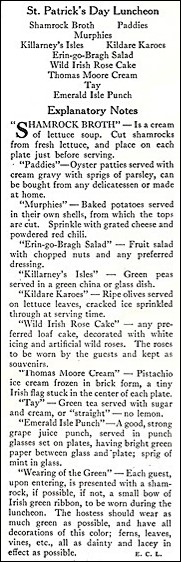
Happy St. Patrick’s Day
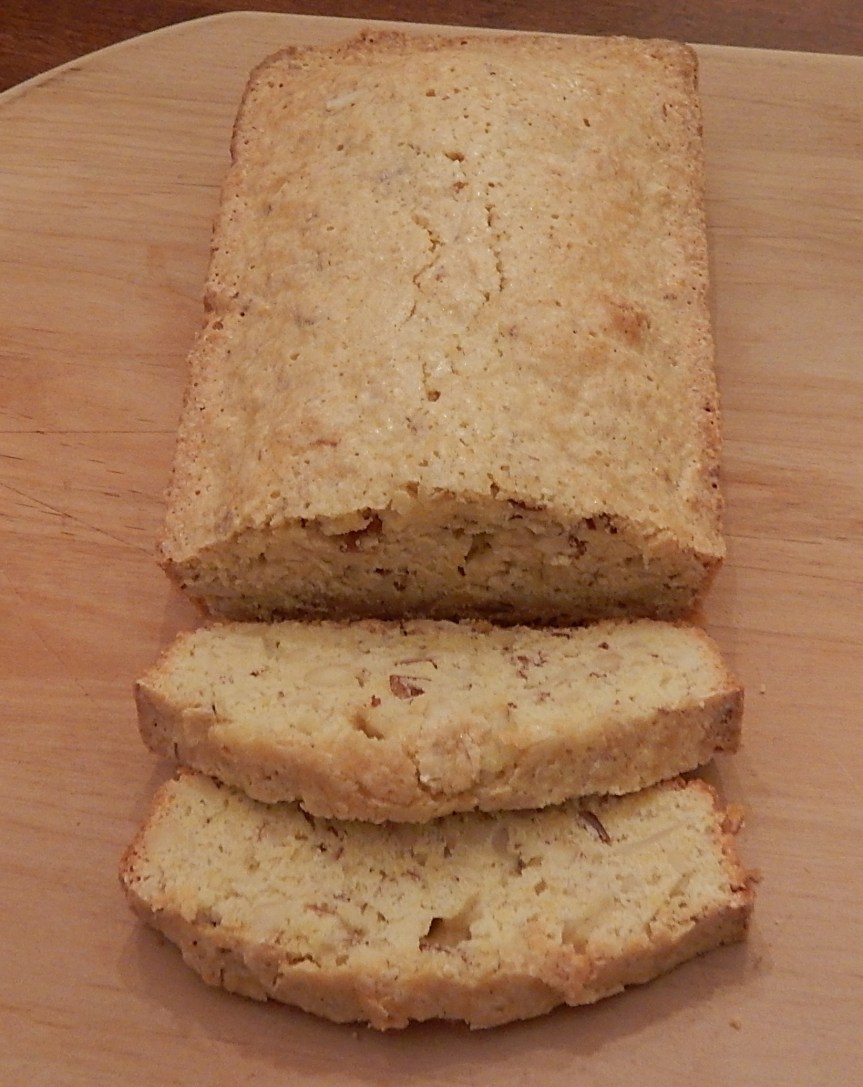
Loaf cakes are easy to make – and a nice size for our small family, so when I saw a hundred-year-old recipe for Almond Loaf, I decided to give it a try. I was also intrigued that the old recipe did not call for any baking powder or baking soda – nor it call for any fat. Instead of leavening, beaten egg whites cause the Almond Loaf to rise a small amount.
The recipe made a small loaf cake that was only about two and a half inches thick. Each slice of the Almond Loaf had just the right amount of sweetness, was chockful of chopped almonds, and was lovely with coffee. The slices reminded me a little of biscotti – though it was much softer. Is there such a thing as a soft biscotti?
Here’s the original recipe:
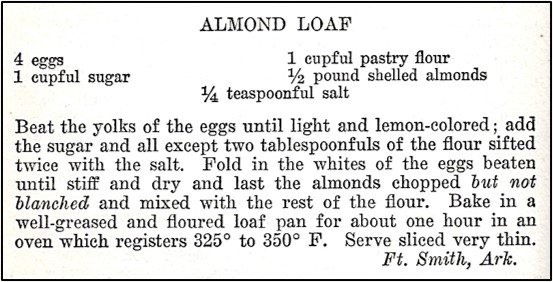
I don’t know where to get unblanched almonds so I just bought a bag of sliced almonds at the store. I then coarsely chopped the sliced almonds to use in this loaf. I also didn’t have pastry flour, so I used all-purpose flour, which worked well.
Here’s the recipe updated for modern cooks:
4 eggs, separated
1 cup sugar
1 cup pastry or all-purpose flour
1/4 teaspoon salt
1 cup almonds (I used sliced almonds that I coarsely chopped.)
Preheat oven to 335° F. Put egg whites in a mixing bowl, and beat until the whites are stiff. Set aside.
Put egg yolks in a mixing bowl; beat until smooth. Add sugar, all the flour except for 2 tablespoons, and salt; stir until combined. The mixture will be very dry and crumbly. Fold in the beaten egg whites and the remaining 2 tablespoons of flour. Gently stir until combined, then stir in the chopped almonds. Put the mixture in a loaf pan that has been greased and floured. Bake until the loaf is lightly browned, and an inserted wood pick comes out clean (approximately 1 hour).

Here’s what a hundred-year-old magazine said about when to eat:
When to Eat
Do not eat between meals. East regularly, but when not hungry, eat sparingly.
Do not eat after violent exercise.
Do not eat when excited or fatigued.
East sparingly on hot days.
Do not eat within three hours of retiring.
Do not exercise violently, or sleep after a meal.
Eat regularly at specified times. This accustoms the stomach to receive food at these times, and encourages proper digestion.
Do not overeat; rather undereat, and leave the table unsatisfied than risk the danger that attends overeating.
Animals seldom eat when ill. Instinct is a good judge.
A normal, healthy person should be hungry at meal times. But if not hungry eat only a piece of fruit to retain the normal rhythm. A day fast often gives the digestive system a much needed rest. A short walk, before breakfast, helps digestion, and aids bowel movement.
American Cookery (August – September, 1922)

While browsing through a hundred-year-old cookbook, I came across a recipe for Open Cheese and Bacon Sandwiches, and decided to give it a try. I was intrigued because this toasted bacon and cheese sandwich recipe called for a topping made of soft cheese (I used pureed cottage cheese) and eggs, plus a little ketchup, paprika and cayenne red pepper which gave the topping a bit of a zing. The cheese and the bacon worked well together, and made a delightful sandwich that was a nice change from the typical grilled cheese and bacon sandwich.
Here’s the original recipe:

I decided to use cottage cheese when I made this recipe since it would have been readily available a hundred years ago. I put it through my Foley mill to make it smooth.
I’m not exactly sure what the old cookbook is referring to when it calls for table sauce, but when I made this recipe, based on the previous suggestions of some readers, I decided to use ketchup.
I skipped the salt since the bacon and cheese already contained salt, and I didn’t want an overly salty sandwich. I cooked the bacon until it was lightly crisped before assembling the sandwich since I thought that it would be too greasy if I put the bacon on top of the cheese without cooking it. I put the sandwich under the broiler to cook.
Here’s the recipe updated for modern cooks:
8 – 12 slices of bacon (cut in half) (If the slices are wide use 8 slices, if narrow use 12.)
3 eggs, beaten
12 ounces soft cheese (cottage cheese, chevre, feta, Brie, ricotta, etc.), grated or pureed ( I used cottage cheese, and put it through a Foley mill to make smooth.)
1 1/2 teaspoon ketchup
1/2 teaspoon paprika
dash cayenne (red) pepper
8 slices bread
Put the bacon in a skillet; arrange so that each piece is flat. Using medium heat, cook until lightly crisped, while turning frequently. While cooking, periodically press the pieces with a spatula or back of a spoon to flatten and make thinner. When lightly crisped, remove from the heat and drain on paper towel towels.
In the meantime, put eggs, soft cheese, ketchup paprika, and cayenne pepper in a bowl; stir to combine.
Put the bread slices on a baking sheet, and put under the broiler until lightly browned. Remove from oven/broiler, and flip. Spoon the cheese and egg mixture on the bread, and spread to the edges of each slice. Top with 2 – 3 slices of cooked bacon, and put back under the broiler until the cheese is melted and the bread is lightly browned. Remove from oven/broiler and serve.
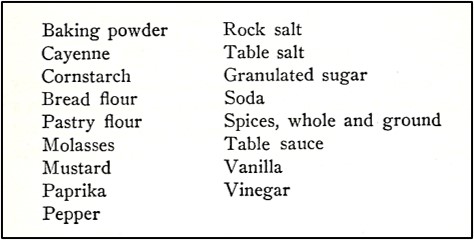
Oh dear – I only have 14 of the 17 pantry essentials that people usually kept on hand a hundred years ago – no pastry flour, rock salt, table sauce. What the heck is table sauce?