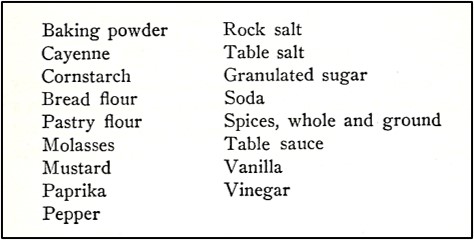
Oh dear – I only have 14 of the 17 pantry essentials that people usually kept on hand a hundred years ago – no pastry flour, rock salt, table sauce. What the heck is table sauce?

Oh dear – I only have 14 of the 17 pantry essentials that people usually kept on hand a hundred years ago – no pastry flour, rock salt, table sauce. What the heck is table sauce?

When I was a child growing up in Pennsylvania, Fasnacht Day (the day before Ash Wednesday) was always a day when we ate doughnuts. Fasnacht Day was supposed to be a day to eat indulgent foods before the beginning of Lent – and doughnuts with their sugar and fat were considered the ultimate in indulgent foods. It is also known as Fat Tuesday or Shrove Tuesday.
Some churches in Pennsylvania made doughnuts on Fasnacht Day as a fundraiser, and students at my school who attended those churches took orders for the doughnuts, and then brought the them to school on Fasnacht Day. I always looked forward to buying (and eating) those incredible doughnuts.
Now, every year as Lent approaches, I remember those sweet, flavorful, light, yet slightly chewy, doughnuts of my childhood (they are nothing like modern cake-like doughnuts), and think that I should try making doughnuts, but I never actually did – until this year. I came across a hundred-year-old recipe for Raised Doughnuts and decided it was time to give doughnut-making a try.
It took me about six hours from start to finish to make the doughnuts since I had to let the dough rise three times – but it was worth it. The doughnuts were just like I’d remembered (and my husband kept saying, “These are a lot better than store-bought doughnuts”).

And, here’s the coffee cake foundation recipe:
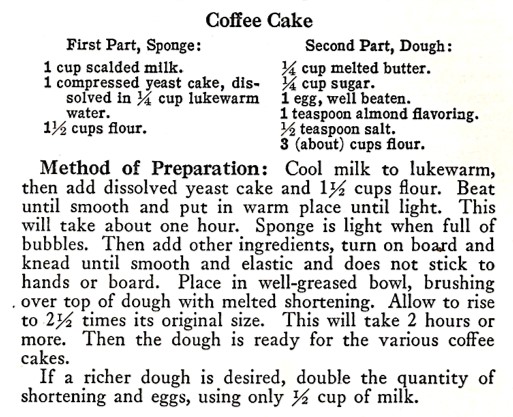
Here’s the recipe updated for modern cooks:
1 cup milk
1 packet (0.25 ounce) active dry yeast
1/4 cup lukewarm (110 – 115° F.) water
1 1/2 cups flour + approximately 3 cups flour
1/4 cup butter melted + a small amount of additonal melted butter to brush on top of dough
1/4 cup sugar
1 egg, beaten
1 teaspoon almond extract
1/2 teaspoon salt
fat or cooking oil (I used shortening.)
powdered sugar
Put the milk in a saucepan, and scald (180-185° F.) using medium heat. Remove from heat and cool until lukewarm (110-115° F.). In the meantime, dissolve the yeast in the lukewarm water.
Put the 1 1/2 cups flour, lukewarm scalded milk, and dissolved yeast in a mixing bowl, and beat until smooth. Cover and put in a warm spot until the mixture is light and spongy (about 1 hour). Add the melted butter, sugar, egg, almond extract and salt. Gradually add approximately 3 cups flour until the dough reaches a consistency where it can be handled. Turn onto a floured surface and knead until the dough is smooth and elastic (about 10 minutes). Put in a large greased bowl, brush top with melted butter, cover and place in a warm spot until the dough is about 2 1/2 times its original size (about 2 hours).
Put dough on a lightly floured surface and roll dough to 1/4 inch thick, and cut doughnuts with a doughnut cutter. (If thicker doughnuts are desired, don’t roll quite so thin.) Put the cut doughnuts on a baking sheet, and let rise until light and doubled in size (about 45 minutes).
Heat 3 – 4 inches of fat or cooking oil in a deep fat fryer or kettle to 350 – 375° F. Drop doughnuts (a few at a time) into the hot fat or oil. Turn as they rise to the surface. Gently turn and fry 2-3 minutes or until golden brown. Remove from fat and drain on paper towels.
Put powdered sugar in a bag. (I used a brown paper lunch bag.) While the doughnuts are still warm, put one doughnut at a time in the bag and gently shake to coat with the sugar.
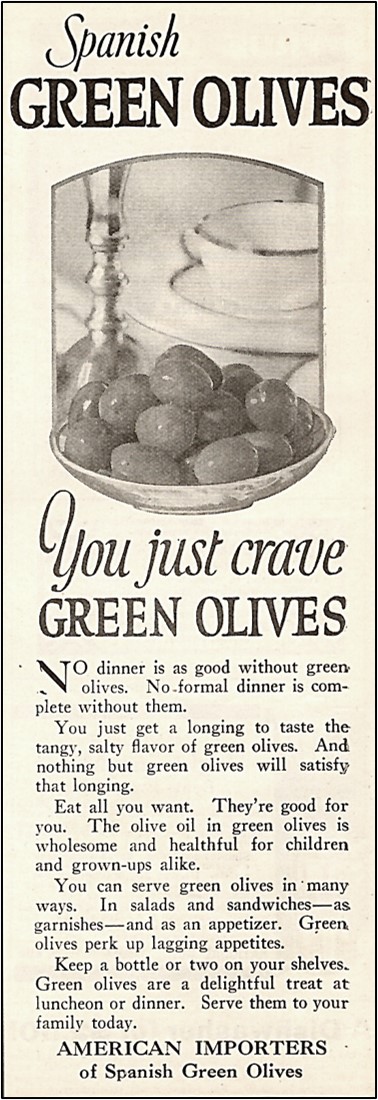
Who would have guessed that Spanish green olives have been imported into the United States for at least a hundred year? And, who would have guessed that there was a trade association promoting those imported olives?

I seldom buy canned salmon, yet when I recently flipped through a hundred-year-old cookbook, a recipe for Salmon Croquettes caught my eye. It brought back warm memories of eating various canned salmon dishes when I was a child. Long story short, I bought a can of salmon the next time I went to the store, and soon was making Salmon Coquettes. The crispy croquettes only took a few minutes to make and were a tasty comfort food.
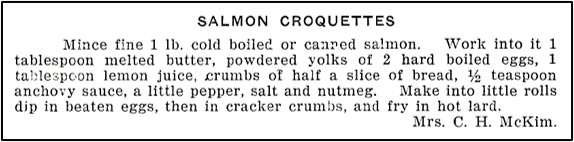
Here’s the recipe updated for modern cooks:
1 can salmon (14.75 oz.), flaked
1 tablespoon, butter, melted
2 hard-boiled egg yolks, mashed
1 tablespoon lemon juice
1/2 slice bread, torn into small pieces to make crumbs
1/2 teaspoon anchovy sauce
dashes of salt, pepper, and nutmeg
1 egg, beaten
approximately 3/4 cup cracker crumbs (I put saltine crackers in a Ziplock bag and rolled with a rolling pin to make crumbs.)
lard, shortening, or cooking oil
Put salmon into a mixing bowl. Add melted butter, mashed hard-boiled egg yolks, lemon juice, bread crumbs, anchovy sauce, salt, pepper, and nutmeg. Shape into small balls about 1 1/2 inches in diameter. (If the mixture is too juicy to make balls, add additional bread crumbs.)
Put the beaten egg in a bowl. In another bowl put the cracker crumbs. Roll the salmon balls in the egg and then in the cracker crumbs.
Put lard, shortening, or cooking oil in skillet and heat until hot using medium heat. (It should be about 1/2 inch deep.) Add salmon balls. When the bottom of the balls have lightly browned (about 1 1/2 – 2 minutes), gently roll to brown the other sides. Remove from skillet and drain on paper towels, then serve.

How come recipes are sometimes a success, and other times a failure? Here’s what it said in a hundred-year-old magazine.
Ten percent of every culinary success is common sense and a good recipe. The other ninety — ah, there is the mystery!
American Cookery (March, 1922)

Canapes made using bread as the base were a popular appetizer a hundred years ago. I was intrigued by a recipe for Grated Cheese Canapes in a 1922 cookbook. Rounds of thin-sliced bread were spread with mustard then topped with grated cheese and chopped olives. The tangy mustard combined nicely with the slight saltiness of the cheese and olives to make a lovely hors d’oeuvre.
Here’s the original recipe:
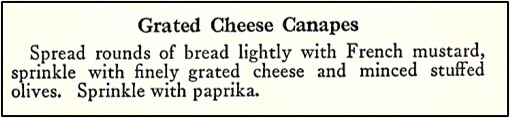
A hundred years ago did the term “French mustard” refer to a yellow mustard or a dijon-style mustard? I googled it discovered that French’s Mustard was introduced at the 1904 St. Louis World’s Fair – but that is a brand and not exactly a type of mustard. In the end, I decided to use a dijon-style mustard, but am not sure that was commonly available in the United States in 1922.
Here’s the updated recipe for modern cooks:
6 slices of thinly sliced bread (assumes 2 rounds per slice) (I used white bread.)
approximately 2 tablespoons French mustard (I used a Dijon mustard.)
approximately 3/4 cup finely grated cheese (I used cheddar cheese.)
approximately 1/2 cup stuffed olives, finely chopped
paprika
Cut the bread into rounds that are 2 – 2 1/2 inches in diameter. Thinly spread French mustard on the rounds. Top with grated cheese and chopped olives; sprinkle with paprika.

Who were “New Women” a hundred years ago? — flappers,?
A hundred-year-old church cookbook from Alpena, Michigan had a different definltion. This fun poem was at the beginning of the Desserts and Puddings chapter. Alpena is on Lake Huron in northeastern Michigan.
