Direct Election of Senators and Other Boring (or Not So Boring) Topics

15-year-old Helena wrote a hundred years ago today:

Wednesday, January 25, 1911. Oh what did I do today? About the same things as I do on other days. I’m sure it wasn’t so very much. Just the same old routine with no breaks.

Local Front Page News  a 100 Years Ago:

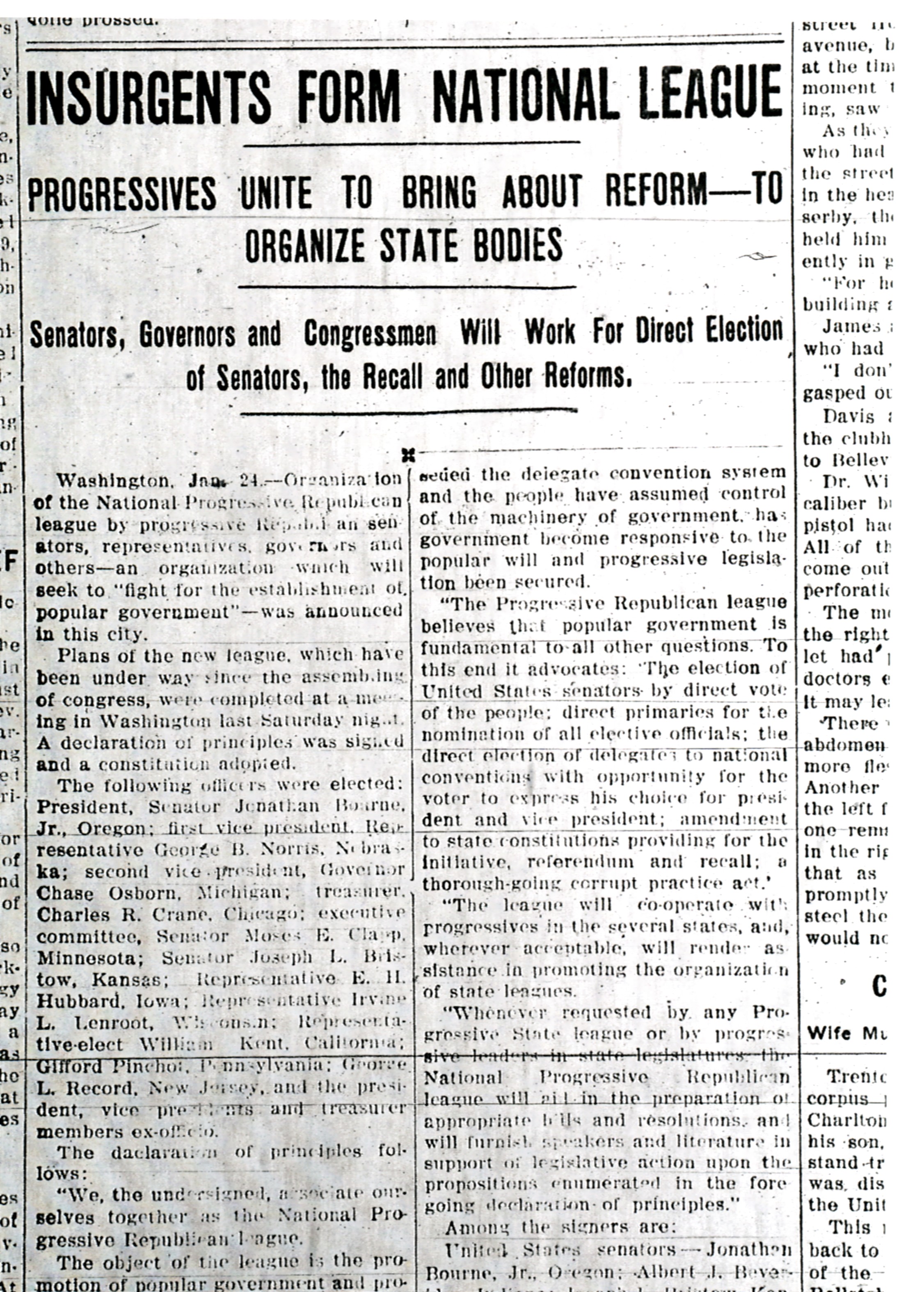
INSURGENTS FORM NATIONAL LEAGUE

PROGRESSIVES UNITE TO BRING ABOUT REFORM–TO ORGANIZE STATE BODIES

Senators, Governors and Congressmen Will Work For Direct Election of Senators, the Recall and Other Reforms

Milton Evening Standard, January 24, 1911
 

Her middle-aged granddaughter’s comments 100 years later:

My gut feeling is that if my 15-year-old grandmother read this headline that she yawned, and moved on to the next article. Hey, she was already yawning from boredom—why would articles about complex national issues pique the interest of a rural teen? But maybe, just maybe,  her teacher at McEwensville High School pulled topics of national importance into his lessons–and she might have had a basic understanding of the issue.

A hundred years ago US senators were not elected by popular vote. Instead they were elected by state legislators. In 1911 muckrakers argued that the system led to corruption and that industrialists and robber barons had undue influence in selecting senators.  (The 17th Amendment, which was adopted in 1913, instituted the direct election of senators.)  

Many social issues and governance issues were bubbling in the public conscience in 1911. Two other amendments were also adopted during the 1910s–the 16th in 1913 (it gave the federal government the right to collect income taxes) and the 19th in 1919 (prohibition). And, in 1920 the 20th amendment gave women the right to vote. I can picture high school students debating the pros and cons of prohibition and women’s suffrage.  Did Grandma take a stand on either issue?

Mud!

15-year-old Helena wrote a hundred years ago today:

Tuesday, January 24, 1911. It’s getting so terrible muddy. Wish it would snow. I love to take sleigh rides. Don’t get many though. I feel rather sleepy just now. Will soon be asleep.

Her middle-aged granddaughter’s comments 100 years later:

I tend to think that winter weather was historically very harsh in central Pennsylvania.  But the diary entries indicate that many days were above freezing during January 1911. In more recent years the temperature typically is below freezing at night but above freezing during the daylight hours. And, there are almost constant freezing and thawing cycles. I suppose the weather patterns were similar  in 1911.

 Mud was a huge problem a hundred years ago. The roads both in McEwensville, as well as in the outlying rural areas, were not yet paved in 1911. According to George Wesner in his History of McEwensville , there was even a boardwalk that went from McEwensville  across Warrior Run Creek to a train station which was about half a mile north of town.

 The route was muddy at times and dusty at times . . .To alleviate the situation an elevated boardwalk was built from the station to the old bridge (which crossed the creek at right angles not diagonally) and from there parallel with the highway to the borough line.

George Wesner

The McEwensville railroad station is long gone, but this photo was taken near the location of the old station and looks toward town. It's difficult to envision where the boardwalk once was.

Buckwheat Pancakes (Griddle Cakes)

15-year-old Helena wrote a hundred years ago today:

Monday, January 23, 1911. Here’s Monday, another school day. It’s so hard to get up awful early, when you feel nice and sleepy.

Her middle-aged grand-daughter’s comments 100 years later:

Sometimes I wish that Grandma provided more detail when she wrote. For example, I wonder what Grandma ate for breakfast.  I imagine that it was similar to what I ate two generations later when I was growing up on another farm near McEwensville—but I might be totally wrong.

Buckwheat Griddle Cakes with Current Conserve

In January we generally ate pancakes (griddle cakes) for breakfast. We often ate pancakes made from a mix, but occasionally had the more traditional buckwheat griddle cakes that I envision would have been eaten when Grandma was young.  After the pancakes were cooked I’d put maple syrup or jam on mine—but my father always put old-fashioned liverwurst on his. We only had pancakes when liverwurst was available, and that was only during the winter months when my family or a neighbor butchered a hog.

___________________

I love to go to flea markets in central Pennsylvania with my father—

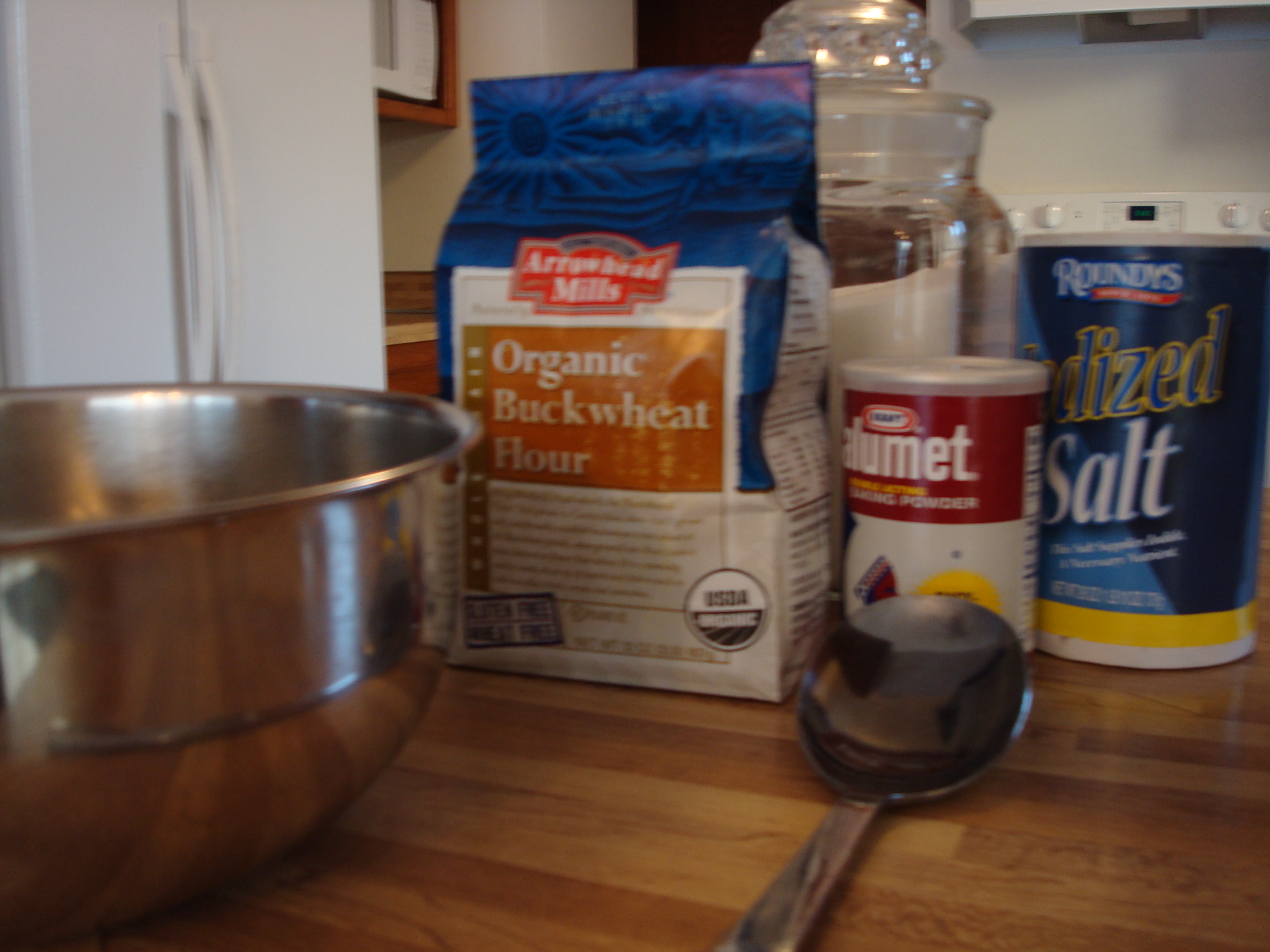
One find was a promotional cookbook published by KC Baking Powder in 1911 that contains a recipe for Buckwheat Griddle Cakes. I decided to make the recipe to see if they were like the buckwheat cakes I remembered.

 KC Buckwheat Griddle Cakes

1 cup buckwheat flour

1 tablespoonful sugar

3 level teaspoons baking powder

1 ¼ cups cold water

1/3 teaspoonsful salt

Sift together, three times, the flour, sugar, salt, and baking powder*; stir the water in all at once and bake immediately on a hot well-oiled griddle. Buckwheat flour calls for a generous measure of baking powder. Part milk may be used to mix the cakes but water give quite as good results.

 The Cook’s Book: KC Baking Powder (1911)

*I just stirred the ingredients together and didn’t sift anything. I’m not sure why old-time cookbook authors were obsessed with sifting.

 I was surprised how few ingredients there were, but from looking through the cookbook I realized that most recipes a hundred years ago had very few ingredients. I guess that since people cooked from scratch every day that they gravitated toward simple recipes.

After I’d cooked the griddle cakes—I poured some maple syrup on them and took a bite. They were very good though the robust taste of the buckwheat was a prominent undertone.

I then remembered that I had a jar of homemade current conserve  that a friend of my daughter’s had given me. (An aside–I think that it’s really cool how some young people care enough about what they eat to revive traditional cooking and food preservation).  I spooned a little conserve on the griddle cakes and took a bite—and the taste was awesome. The tartness of the conserve wonderfully complemented the robustness of the griddle cakes—and I almost felt like I had drifted back to Grandma’s day.

Old Ice Cream Freezer Advertisement

15-year-old Helena wrote a hundred years ago today:

Sunday, January 22, 1911. Went to Sunday school and church this morning. Made ice cream. That is my sister made it and I assisted. I got the ice. Besse and Curt came out this evening. Just when Ruth and I were having a little spat all to ourselves.

Advertisement in the July 1910 issue of National Food Magazine.

 Her middle-aged grand-daughter’s comments 100 years later:

Grandma’s oldest sister Besse was married to Curt Hester, a butcher in Watsontown. My father can remember Curt and Besse working in the butcher shop

Today we think of ice cream as a warm weather food—but I guess in the days before refrigeration that maybe it was a cold weather food. It would have been easier to get the ice needed to make ice cream during the winter months.

I wonder what Grandma and her sister Ruth had a ‘spat’ was about.  Maybe Grandma wanted to make the ice cream rather than assist .

Where did Grandma get the ice?  Warrior Run Creek flows near the house, so maybe she gathered frozen chunks that were near the creek bank. .  . or maybe there was ice on the cattle watering troughs . . . or maybe had they set pans and buckets filled with water out to freeze the previous day . . .

No Smallpox–Just Reading, Moping, and Doing Nothing

15-year-old Helena wrote a hundred years ago today:

Saturday, January 21, 1911. Spent most of the day in reading and moping around doing nothing. Mother is reading tonight, while I make my entry, but she doesn’t know what I’m writing, for she has her back turned.

Local Front Page News Exactly 100 Years Ago Today:

More Smallpox: Three More Cases Have Broken Out In Montour County

Two at Mausdale and One at Washingtonville: All Are Traced to Lumber Camp

Milton Evening Standard, January 21, 1911 

 Her middle-aged granddaughter’s comments 100 years later:

When I dug into the old 1911 Milton Evening Standard  microfilms at the Milton Public Library, I was shocked to discover that smallpox still occurred in central Pennsylvania a  hundred years ago. This means that there was smallpox less than fifty years before my birth. I had thought that the smallpox vaccine had wiped the disease out much earlier.  But, even though the victims lived only 15-20 miles from Grandma’s home, it  apparently was a world away from Grandma’s concerns when she wrote this diary entry. (Sometimes the slower pace of 1911 sounds wonderful, but there have been some very positive changes in the last 100 years!!)

Grandma probably wrote this entry sitting in a house illuminated with at least two gas lanterns—since it appears that she and her mother weren’t sitting close together. Maybe Grandma was huddled over the table in the kitchen but could see her mother sitting in the living room through a doorway.  Why did she mention that she won’t want her mother to know what she is writing? There’s nothing very earth-shaking here—except maybe yesterday’s spelling fiasco.

How Do You Spell ‘Man’?

15-year-old Helena wrote a hundred years ago today:

Friday, January 20, 1911: Brought home some maps I drew at school last year. They were very excellent specimen’s of drawing, so I thought it would be worthwhile to save them and exhibit them to my friends if I ever have an reason to. Perhaps I shall not. Missed the word (man) in spelling. Now looked surprised, anyone else might have missed it too under the same circumstances.

Her middle-aged grand-daughter’s comments 100 years later:

Recent Photo of McEwensville High School

It was just one of those days with a high point and a low spot. Today’s five sentence diary entry gives lots of hints about Grandma:

  • She’s proud of her drawing ability (or at least her map-making skills).
  • She wants to share her successes with friends, but seems to hold back and feel uncertain about how they’ll react. Grandma so wants affirmation that the maps are good but fears that maybe her friends wouldn’t think the maps were as cool as she thinks they are—and then she’d feel bad.
  •  And, I guess she wasn’t much of a speller. (That trait seems to have carried down to my generation–though I can definitely spell man.)  Was there a spelling bee?—Maybe it was supposed to be a fun way to end the week on Friday afternoon.  Did Grandma really mean that she misspelled the word “man”? What were the circumstances? Was she horsing around with friends instead of paying attention? . . . Daydreaming? Did she feel humiliated when the class laughed? . . . or did she enjoy the attention? 

A Birthday Tradition

15-year-old Helena Muffly wrote exactly 100 years ago today:

Thursday, January 19, 1911: Pulled Miss Muffly’s ears first thing this morning, whether she liked it or not. Bout all I can do to fish up enough things to knock down. My life has reached an uneventful state or period with all its calm ripples. I almost forgot, I got a new pair of rubbers today which I needed very bad.

Her middle-aged granddaughter’s comments 100 years later: 

I’m guessing that Miss Muffly refers to Grandma’s sister Ruth. And, that January 19 was Ruth’s birthday. According to the 1900 Ruth was born in January 1892, so this must have been her 19th birthday. Grandma probably woke Ruth by pulling her ears.

When I was a child my parents told me that in the old days people used to pull the birthday person’s ear lobes one time for each year, but that I shouldn’t pull ears since it might damage the person’s hearing (which, of course, gave me the idea that it might be fun to pull ears—but that is another story).