1911 Books That Have Stood the Test of Time

15-year-old Helena wrote a hundred years ago today:

Wednesday, January 18, 1911: Got a book out of the library at school today, which I’ll have to manage to read pretty soon, as soon as I get time.

Her middle-aged grand-daughter’s comments 100 years later:

Tuesday, January 18, 2010:  Goodreads lists 180 books published in 1911 that are still in print. These probably were not the most popular books at the time, but rather they are the books that have endured –and whose message apparently continues to resonate a hundred years later.

Fourteen books on the list that I recognized the title or author of are listed below.

1. Peter Pan by J.M. Barrie (Barrie published the children’s story in 1911–he’d written the play a few years earlier.)

All children, except one, grow up.

First line of Peter Pan

2. Ethan Frome by Edith Wharton

3.  Riders of the Purple Sage by Zane Grey

4. My First Summer in the Sierra by John Muir

5. The Door in the Wall by H.G. Wells

6. The Scarlet Plague by Jack London

7. Under Western Eyes by Joseph Conrad          

8. Jennie Gerhardt by Theodore Dreiser

9. The Quest of the Golden Fleece by W.E.B. DuBois

10. The Sea Fairies by L. Frank Baum

11.The Montessori Method by Marie Montessori

12. Roget International Thesaurus by Peter Mark Roget

13. The Principles of Scientific Management by Frederick Taylor

14. The Official Handbook for Boys by The Boys Scouts of America

The books cover the gamut, but they give an indication of some of the key issues of 1911–social norms (Wharton), civil rights (Dubois), good management (Taylor’s famous–or perhaps infamous–time-motion studies measured how long it took factory workers to complete various tasks with the goal of increasing efficiency), early childhood education (Montessori), revolutionary movements (Conrad), and the environment (Muir).  It’s amazing how some of the issues haven’t really changed much in 100 years–while in other cases the whole paradigm has shifted.


Winter Activities

15-year-old Helena Muffly wrote exactly 100 years ago today

Tuesday, January 17, 1911. Miss Stout was over this evening, wanted me to go skating or else sliding with her down on the creek with the rest of the gang. I choose to stay at home, and there I remained, and here I am at the present time.

News From Exactly 100 Years Ago Today

Woodrow Wilson was inaugurated as governor of New Jersey on January 17, 1911. Prior to becoming governor he was the president of Princeton University. He was elected president of the United States less than two years later in November 1913.

Her middle-aged granddaughter’s comments 100 years later

Monday, January 17, 2010. It must have gotten colder and snowed since the entry three days ago when the diary reported that it was raining. Warrior Run Creek flows through the edge of the Muffly farm. I’m surprised that the creek froze enough to skate on. Maybe they somehow flooded nearby land to create a homemade skating rink.

Recent photo of Warrior Run Creek (though taken at a different time of year). The old Muffly barn is in the background.

Grandma’s friend, Carrie Stout, lived on a farm about half way between McEwensville and the Muffly farm. (See Setting page for map and photo.)

Soon I’ll Turn Into A Recluse

 15-year-old Helena wrote a hundred years ago today:

Monday, January 16, 1911: How the days do fly, half-a month gone already. Can hardly realize it, but I have to. I just do wish something would occur to break the same old terrible routine of mine. But it’s always ditto. I’ll soon turn into a recluse, or perhaps something worse, if something won’t happen.

Her middle-aged grand-daughter’s reflection 100 years later.

January 16, 2010. Hmm . . . I wonder if Grandma often said throughout her life that she might become a recluse?

When I’ve asked people who knew Grandma what they remember, several said that she became somewhat reclusive in her later years. They even used those exact words.

Is this entry a prediction of the future? . . . or did Grandma’s concerns lead people to draw that conclusion? . . . Maybe it was a little of both.

My memory is that Grandma was very elderly—but I don’t think of her as a recluse. She lived in a little brick bungalow on a rural road.  She didn’t know how to drive, and was dependent on relatives for transportation.

After my grandfather died my uncle always brought Grandma to church. And, after church and Sunday school, our family always took her home. We often took her to McDonald’s for lunch before taking her home .

Back then the closest McDonald’s was in Montoursville—about 20 miles from McEwensville—so it was a nice Sunday drive. Everyone in our neck of the woods was thrilled that city restaurants were finally coming to rural Pennsylvania—and felt incredibly cool and urbane to be eating at McDonalds.

Yikes—how could we have been brainwashed by the media enough to believe that French fries and hamburgers were better than the home-produced foods we normally ate?  (I can’t believe that my memory is right—but I think you could buy a hamburger for 25 cents in the mid-1960s). But at least we considered McDonald’s food to be a Sunday treat—not something to wolf down on a regular basis. In any case, it was a nice outing with Grandma.

Some of my strongest memories of Grandma are of  those Sundays–and of her, my brother, and me squeezed into the back seat of my parent’s Dodge Monaco. Some weeks Grandma was very quiet and just endured my brother’s and my pushes and shoves —but other weeks she talked about making pickles . . . or gardening . . . or whatever.

Cold, Dark, January Nights

15-year-old Helena Muffly wrote exactly 100 years ago today:

Sunday, January 15, 1911: Hardly remember what I did today. This evening I accompanied my lofty sister up to Oakes.

Her middle-aged granddaughter’s comments 100 years later: 

Grandma had two sisters. Besse  and Ruth.  Besse was the oldest and already married by the time Grandma began keeping this diary. Ruth was 3 years older than Grandma and still lived at home—so this entry must be referring to Ruth. I wonder why Grandma refers to Ruth as lofty?

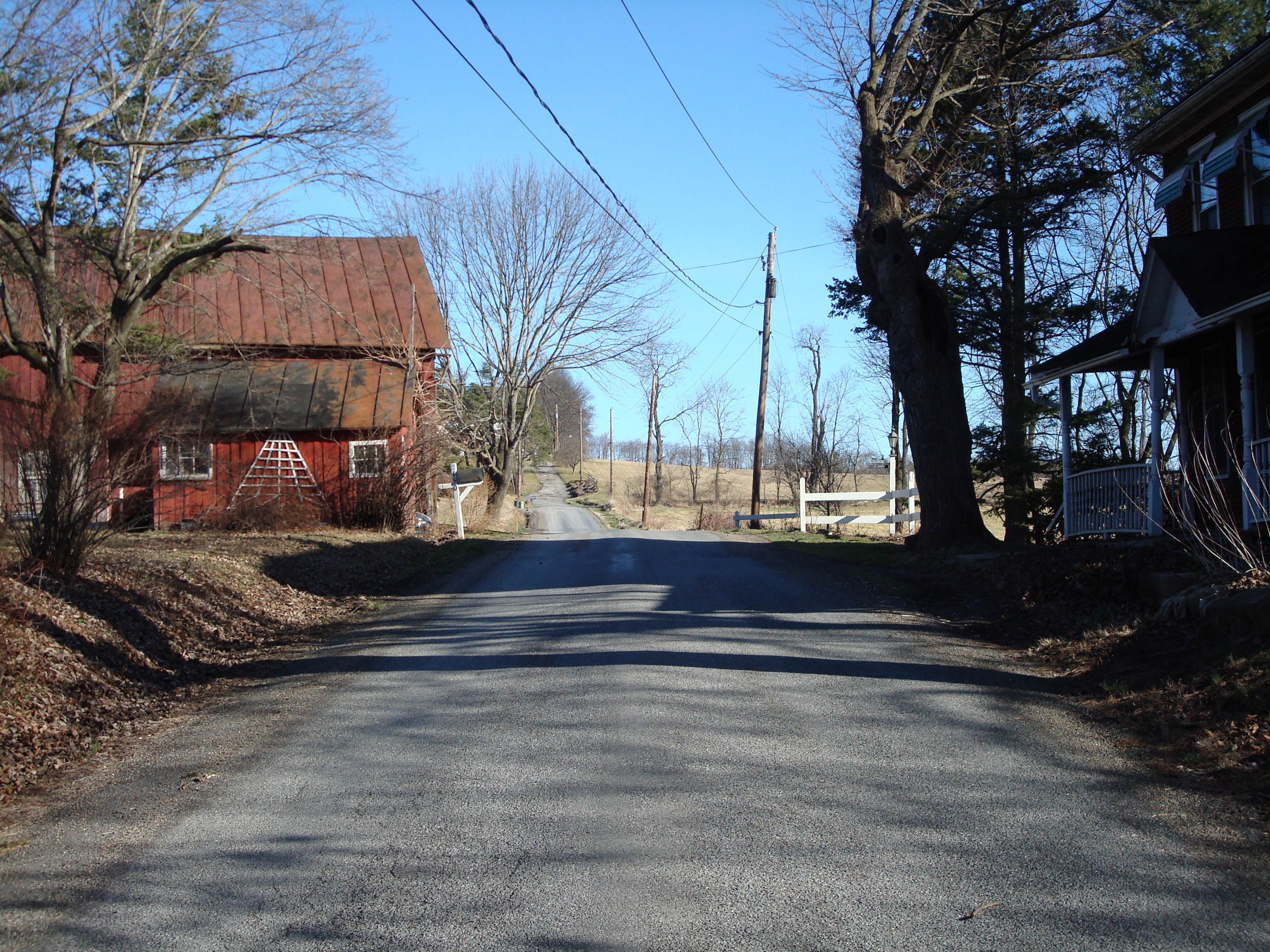
Grandma would have walked down this road past another neighbor's farm to get to Oakes--except imagine that it is dark and very cold.

The Oakes family lived on a farm that was located about a mile from where Grandma lived.  Grandma and Ruth would have gone down the road that went past their farm in the opposite direction from the way they headed when going to McEwensville.

I don’t like to go out after dark on cold, dark January nights.  Grandma and Ruth would have gone up a hill and then turned into a lane to get to the Oakes home.  Did they walk to Oakes—or did they ride in a carriage or wagon? Was there a full moon? Did they take a lantern?

The Weather Today

15-year-old Helena Muffly wrote exactly 100 years ago today:

Saturday, January 14, 1911. Here’s to another monotonous day. It rained instead of snowing. I like things to come in some kind of order, but things won’t always come as you would want them to.

Her middle-aged granddaughter’s comments 100 years later: 

Weather Underground forecast for McEwensville for today, January 14, 2011:

Low: 11; High: 29; partly cloudy

Tweet ‘Tweeting’ in 1911

15-year-old Helena Muffly wrote exactly 100 years ago today:

Friday,  January 13, 1911: Jakie, that’s my teacher had a siege of moving our seats today. I didn’t get mine moved, although I expected to be. It really was a wonder that I didn’t. Some wonderful things happen in this every day world.

Local newspaper article exactly 100 years ago today: 

Article in January 13, 1911 issue of the Milton Evening Standard

Miss Helen Wesner, Miss Jennie E. Guinn, and Howard Guinn spent Wednesday evening at the home of Clem Baylor.

 Her middle-aged granddaughter’s comments 100 years later: 

A hundred years ago people also wanted to keep their friends informed about what they were doing. The tweets of that day were brief items in the local newspaper.  A fun evening that a friend of Grandma’s had is mentioned in the Milton Evening Standard exactly a hundred years ago today. You’ll meet Helen Wesner—Grandma calls her Tweet— in the diary in a few weeks. Tweet or one of the other people mentioned in the paper must have given the information to the McEwensville reporter for inclusion.

I remember when I was a child that when we had out-of-town guests my mother would always inform the Watsontown reporter of the Milton paper. At the time small town newspapers that included minor social happenings were seen as being really backwards and old-fashioned, but perhaps tweeting–either in the newspaper or electronically– is really back to the future.

No Multiple Choice Tests

15-year-old Helena Muffly wrote exactly 100 years ago today: 

Thursday,  January 12, 1911: Finished taking examinations today for this month. I don’t believe I made very good marks. It seems to me as if I am going backwards every month instead of going forward.

Her middle-aged granddaughter’s comments 100 years later: 

It’s hard to envision schools without the ubiquitous multiple choice and true/false tests, but the examinations that Grandma took WERE NOT multiple choice tests. Multiple choice items were invented in 1915. And the exams probably did not include true/false, matching or fill in the blank items. All of these question types were popularized during the 1920s by educational psychologists who promoted the concept of scientific testing.

Grandma’s exams probably included arithmetic tests that contained math problems which students copied off the blackboard. Portions of the exam were probably oral since mental math was valued prior to the development of calculators.

The examinations that Grandma took probably included recitations and oral responses. For example, a student might be required to recite a poem that he or she memorized. Or the teacher may ask a student questions about material that has been covered in class.

Discussion tests gave students the opportunity for free, organized, and individualized expression on the topics involved.

Martin Stormzand

In other subjects there probably were essay or ‘discussion’ tests. Sometimes students were directed to merely outline their response rather than write a polished essay.