January 11, 1911: Missing entry (Diary resumes on January 12)
Her middle-aged granddaughter’s comments 100 years later:
The diary entries resume tomorrow. Yeah!!
Since a diary author doesn’t really write the diary for others to read many years later, sometimes it is difficult to understand the context of diary entries.
Also, Grandma was about 40 years younger than me when she began this diary. How might the age differences frame how I interpret what she wrote? Grandma’s diary entries and my reflections and comments are not parallel. Grandma was a teen jotting down her thoughts—I’m a mother with adult children reflecting on what a 15-year-old said a hundred years previously.
To help me make sense of the diary I have several questions that I hope to answer as I work my way through the entries—one day at a time.
Who are the main people in the diary (“the characters”) and what are their stories?
How does the diary author portray events, relationships, and herself?
Does anything in the diary help me better understand myself?
Can I learn anything about the slower lifestyle of 100 years ago that is still relevant today?
January 10, 1911: Missing entry (Diary resumes on January 12)
Her middle-aged granddaughter’s comments 100 years later:
I’ll give you a little more contextual information today since there is no diary entry.
In 1911 many families had a few general reference books–one such book generally was the Almanac and another was the Compendium of Every Day Wants: A Thousand and One Facts. The book contained information that ranged from grammar rules, to sample civil marriage forms, to recipes, explanations of who is responsible for runaway horses, and treatments for medical emergencies.
Nature demands that we oby her laws, and it is much easier and much less expensive to try, by proper care of ourselves, to retain good heatlh than it is to cure many ailments which come from abusing our bodies.
Compendium of Every Day Wants: A Thousand and One Facts
The chapter on How to Preserve Health had the following tips:
Be regular; have a certain time to go to bed and a certain time to get up–it is not the amount of sleep, but the regularity which the mind and body need.
Eat nothing but plain food; be temperate in all things.
Take plenty of outdoor exercise.
Keep clean inside and out–bath often the entire body; drink plenty of good, fresh water.
Don’t be afraid of work, but do not worry about it; it is not work, but worry that kills.
Keep the mind free from evil thoughts.
Follow an honest calling.
Live within your means.
If the above is heeded, much suffering will be saved and few doctors will be needed.
Compendium of Every Day Wants: A Thousand and One Facts
January 9, 1911: Missing entry (Diary resumes on January 12)
Her middle-aged granddaughter’s comments 100 years later:
In 1911 the nation was focused on rural deterioration, and the perceived breakdown of rural institutions. Rural youth were flooding into the nation’s cities, and they were often unprepared for urban life.
Recent view of barn on farm where Grandma grew up.
President Theodore Roosevelt had appointed the Country Life Commission in 1908 to figure out ways to improve rural life. The idea was that rural youth would stay on the farm if the young men learned how to use scientific agricultural principals, and the young women learned how to make rural homes comfortable and attractive.
The Country Life Commission Report (as well as several other related reports) were published in 1911.
The repair of country life will come in those forms which give value to the things in the open country. The community must move and breathe in joy and enthusiasm of the country. The celebrations must be of country matters, not those of the city.
W. H. Wilson (1911)
George Wesner in his 1976 History of McEwensville described two-day long Farmers’ Institutes that were regularly held at the McEwensville Community Hall in the early part of the twentieth century. He wrote that “usually some outstanding farmers or professors from Penn State were speakers.”
In the years following the release of the Country Life Report home economists demonstrated the latest cooking and food preservation techniques at meetings attended by rural women and girls, They also taught the principles of interior design.
The Country Life Movement encouraged the support of local fairs. The fairs provided opportunities for people to socialize. Produce and livestock competitions provided opportunities for farmers to demonstrate to others the benefits of using scientific agricultural methods.
The Country Life Movement also encouraged the revitalization of rural churches.
The church must provide directly some modern equivalent for the husking, apple bee, quilting and singing schools of the old days.
W. H. Wilson (1911)
The Country Life Movement also believed that a rural fraternal organization called the Grange had great potential to improve rural living.
At its best the Grange has a unifying power in the country community . . . Especially in the community in which religious people cannot come to agreement in religious matters, the Grange infuses a spirit of unions among them through the discussion of every day interests and the social pleasures which it furnishes.
W.H. Wilson (1911)
The Country Life Commission asserted that education was needed to prepare students for life in their community and that it was important to provide an education that would be meaningful in a rural context. The Commission encouraged development of vocational agriculture programs, including school farms, that could provide the context for learning.
Today some people believe that there is a need for a new Country Life Movement to once again revitalize rural America. However, others argue that the Country Life Movement was an attempt by elite outsiders to control rural areas—and that the Country Life Commission created a consumer culture in rural locales when rural residents were encouraged to decorate their homes with the latest styles and use processed foods in recipes.
Grandma lived her entire life in within a 5 mile radius of McEwensville. Did the Country Life Movement help encourage her—and Raymond Swartz, her classmate and future spouse—to stay in rural central Pennsylvania? Who knows?—Though it can be said with near certainty that the implementation of policies recommended by the Country Life Commission affected Grandma’s life.
January 10, 1911: Missing entry (Diary resumes on January 12)
Her middle-aged granddaughter’s comments 100 years later:
Times were different in 1911. It was before Prohibition, patent medicines containing opium could be purchased without a prescription, and women could not vote. Neither World War I nor World War II had yet occurred.
The unemployment rate 6.2%. Only 3% of the people in the United States had a college degree.
The suffragettes were organizing and marching for their rights—though it would be another 9 years before women won the right to vote.
William Taft was president. He is generally remembered for getting stuck in the White House bath tub. But, he also brought about positive changes by signing anti-trust legislation and breaking up monopolies.
1911 was a heady time. Corporate greed, led by the robber barons had created many problems and inequities. Muckrakers–in today’s world they’d probably be called investigative reporters–used their pens to highlight the many problems and horrors that may have been caused by monopolies. And, the Standard Oil monopoly was finally broken up in 1911. (In history books this is generally seen as one of the key events in 1911).
Hatchet-wielding temperance advocate Carrie Nation died on July 9, 1911, but many women’s clubs across the nation continued her efforts–though the law that enacted prohibition wasn’t passed until 1919.
Carrie Nation
Workers had few rights in 1911. Federal child labor laws would not be passed until 1918. Grandma lived in the agricultural portion of Northumberland County–but the far end of the county contained some of the largest anthracite coal mines in the US. Those mines–as well as other industries, but the mines were some of the most notorious–relied upon cheap child labor to do some of the jobs. Muckrakers and photographers were highlighting the horrors of the practice.
In March 1911 a fire at the Triangle Shirtwaist Factory in New York City killed 146 garment workers because the doors had been locked to keep the workers from leaving early. This led to laws requiring better factory safety standards.
A few years before 1911 Upton Sinclair wrote The Jungle, which highlighted the horrible conditions in the Chicago meat-packing plants, and the unsafe, adulterated foods coming out of the plants.
In 1911 people were furious about chemically-laden foods and demanding safe, pure food that did not contain chemical preservatives or unfit materials. In July 1911 the use saccharin was banned by the US Department of Agriculture. (The decision would be reversed in 1912).
Did these national issues affect Grandma? Or as a teen in rural Pennsylvania did she have little overt awareness of the bigger picture?
Saturday, January 7, 1911: Missing entry: Diary resumes on January 12
Her middle-aged granddaughter’s comments 100 years later:
Since there is again no diary entry today, I thought that it might be fun to see if McEwensville was ever mentioned in the New York Times. I searched the paper’sdata base and found two news articles with a McEwensville connection.
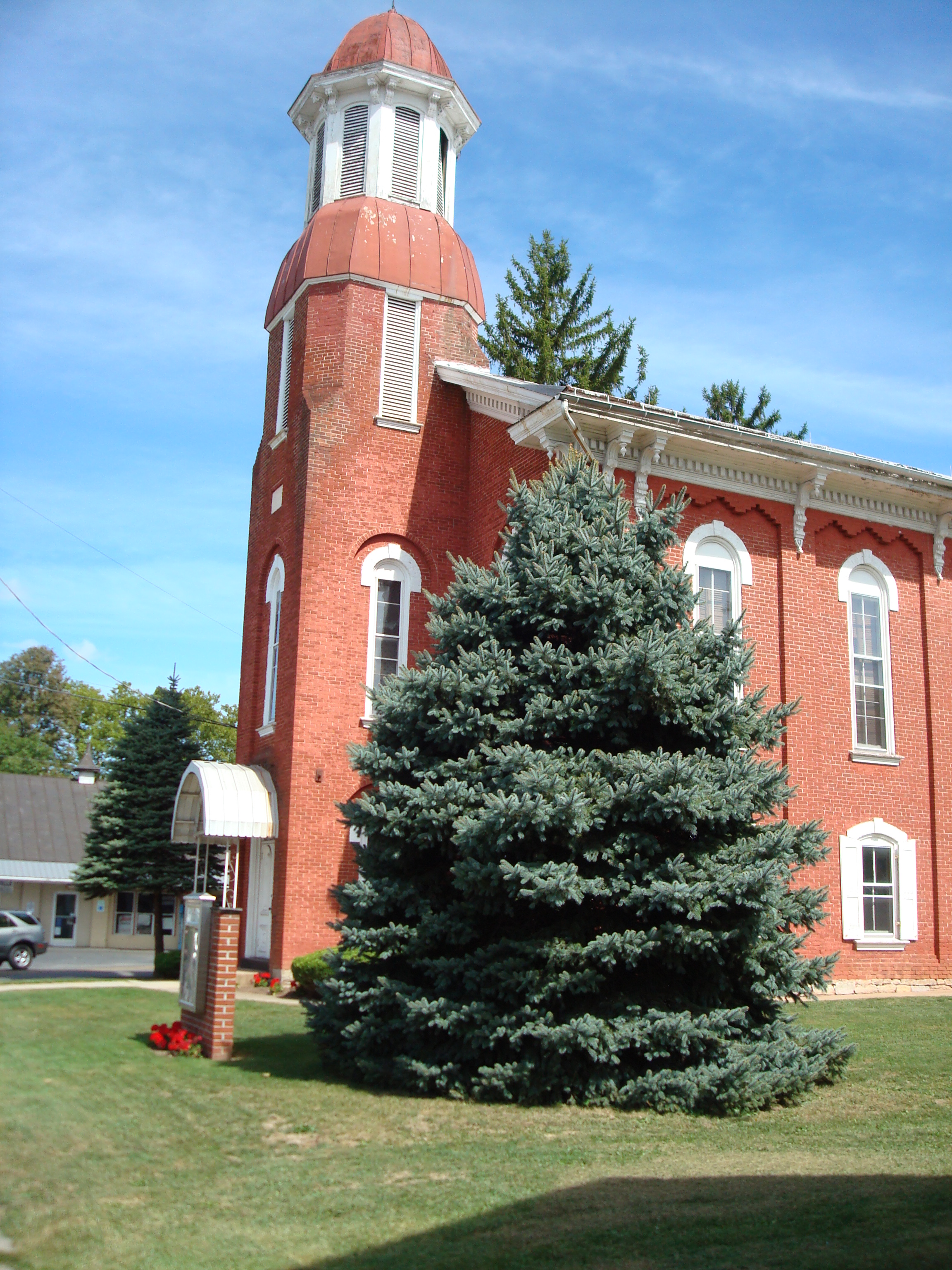
Recent photo of the McEwensville United Church of Christ (Reformed Church)
According to the September 11, 1885, New York Times:
A CLERGYMAN DROWNED
The Rev. J. K. Millett, of McEwensville, was drowned in the river at Watsontown yesterday. He was out in a boat with a young girl named Culp, and by some means the boat was upset. Miss Culp succeeded in saving her life by clinging to the boat, but Mr. Millet, although a good swimmer, went under. He was about 46 years old.
McEwensville was again mentioned in the New York Times on May 2, 1942:
BURROWES, TRACK ACE, IS LOST TO PRINCETON
Edward Burrowes Jr., 21, star Princeton University middle distance runner, was in a satisfactory condition at the university infirmary tonight after physicians found he had punctured a lung in a dressing room accident at Franklin Field, Philadelphia, last Saturday following the Penn Relays. . . Burrowes entered the infirmary last night complaining of a slight pain in his chest. He said he had slipped on the wet floor of the Franklin Field dressing room and had fallen on a sharp-handled comb. Burrowes is a member of the junior class and lives in McEwensville, Pennsylvania. He holds the I.C. 4-A half-mile championship and university records in the 440-year and half-mile runs.
Grandma grew up on a farm outside of McEwensville. She kept her diary between 1911 and 1914—about midway between McEwensville’s two moments of fame in the New York Times.
Friday, January 6, 1911: Missing entry: Diary resumes on January 12
Her middle-aged granddaughter’s comments 100 years later:
Since there is no diary entry again today, I’ll tell you a little about the high school that Grandma attended.
Grandma attended McEwensville High School. The school building is next to the cemetery at the edge of McEwensville. She generally walked the mile and a half or so from her home to school.
Recent photo of the building that once housed McEwensville High School.
The high school contained only one classroom and it was located on the second floor of the school building—the elementary class was on the first floor. It was a three-year classical high school where students learned Latin, poetry, literature, history, and arithmetic.
In 1911 Rachel Oakes—a friend of Grandma and her sister Ruth—was the elementary teacher.
After they graduated from McEwensville High School some students continued their education by taking a fourth year of high school at Milton or Watsontown. For example, my grandfather went to Milton High School after he graduated from McEwensville.
Milton had a more comprehensive curriculum than McEwensville—and included business courses and other classes that would more directly prepare students for a career.
The last high school class to graduate from McEwensville High School was in 1921. The high school closed because it had few students since most students in the area wanted to attend a comprehensive high school for all four years.
Twenty or so years after my grandmother wrote her diary, my father attended the school. At that time it was an elementary school. One teacher taught grades 1-4 in the room on the first floor. Another teacher taught grades 4-8 in a classroom on the second floor.
After the school completely closed in the late 1950s, the building was converted into a fire station. But the fire station is now gone, and in recent years the building has sat vacant and abandoned.
My friends have expressed surprise that my grandmother attended high school. In the early 1900s about half of the children in the United States ended their school careers with an 8th grade education or less.
However, according to Benjamin Andrews in a 1911 book he wrote about girls’ education, there were more female high school graduates in the early 1900s than male because men could easily get jobs without a degree. A key role of high schools at that time was to prepare students to become teachers.
I don’t know why Grandma’s parents decided to send her to high school. I don’t think that she ever became a teacher.
Thursday, January 5, 1911: Missing entry: Diary resumes on January 12
Her middle-aged granddaughter’s comments 100 years later:
Since there is no diary entry again today, I’ll tell you a little more about what I’ve learned about McEwensville.
There is a sign at the edge of town which says that McEwensville used to be called Pine Grove. I can’t remember the town ever having another name, but I thought maybe it had a different name when Grandma was young. But according to George Wesner’s History of McEwensville the name change occurred much earlier.
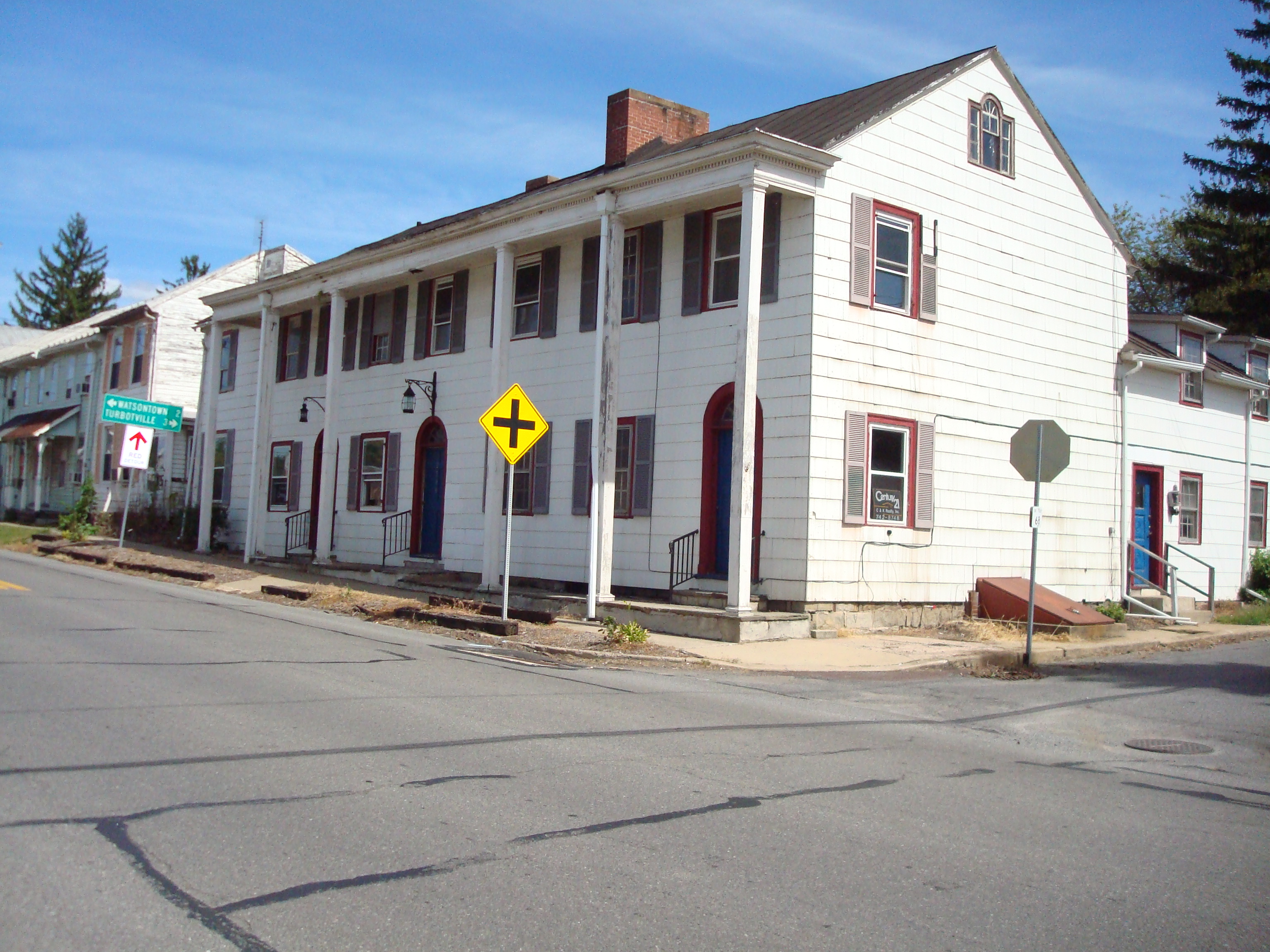
The building that once housed Alex McEwen's tavern.
The town was originally called Pine Grove, but there was a problem because another town in Pennsylvania had the same name. So the residents decided that the town needed a name change.
A War of 1812 veteran named Alex McEwen owned a tavern in the hamlet. One evening a number of guests were at the tavern. Alex was a fantastic host and the probably well-lubricated guests were having a wonderful time. The town name issue popped up. It was suggested that the town should be named after Alex—and it has been McEwensville ever since.