How to Make Popcorn in a Frying Pan

16-year-old Helena Muffly wrote exactly 100 years ago today: 

Saturday, November 25, 1911: Just exactly one month yet. I must begin to be good and oh so nice. I was terrible busy this forenoon. This afternoon I studied a bit and popped some popcorn. My first attempt resulted in half or about a third of the contents jumping out of the pan, but the next time I was more successful.

Her middle-aged granddaughter’s comments 100 years later:

Hmm, I wonder how the popping corn managed to jump out of the pan.  People used to pop corn in a heavy frying pan, but they generally put a cover on the pan.

To make popcorn heat vegetable oil in a heavy frying pan until it is hot. Use a medium heat or flame.

Put some popcorn in the pan.  (Use about 1/3 cup for an average sized pan.) Cover pan.

Hold about ½ inch above the burner and shake the pan. You don’t need to shake it rapidly; it’s okay to shake the pan relatively slowly.

Shake until the corn stops popping, and then remove from the heat and open lid.

Over the Hill and Through the Woods to Grandmother’s House We Go

16-year-old Helena Muffly wrote exactly 100 years ago today: 

Friday, November 24, 1911: Instead of having classes all day today we took an hour off and had something more interesting which was reciting and the like. I said a recitation that I said last year. Of course it was recognized at once. I wish we would have something like this every month at least. It relieves the monotony.

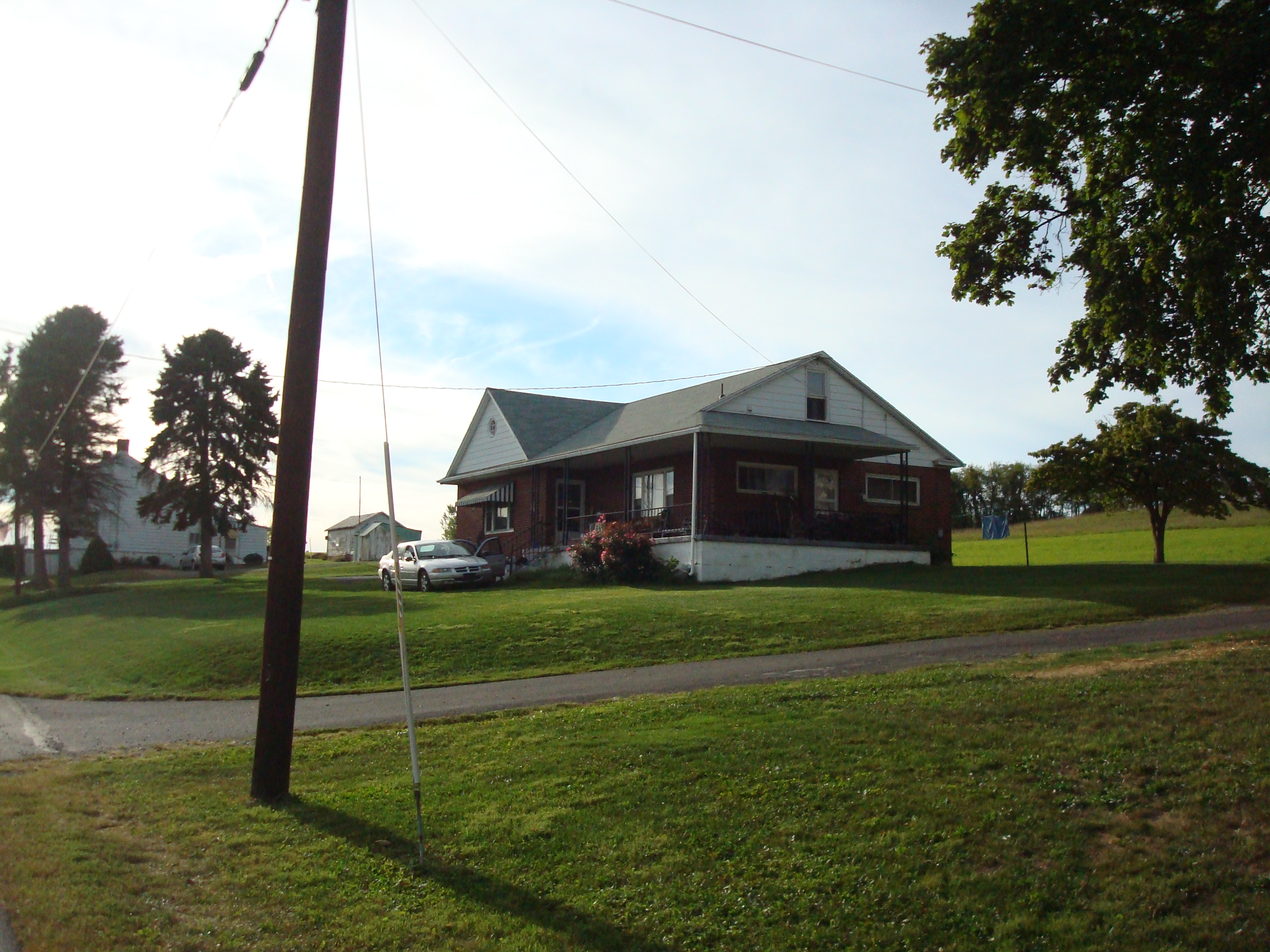
Recent photo of the house that Grandma lived in during her later years. When I was a child I lived on a farm on the other side of the hill from this house.

Her middle-aged granddaughter’s comments 100 years later:

In 1911 Thanksgiving was on the very last day in the month—November 30.

Thanksgiving is a time to spend with family—sharing memories and telling the old family stories. So on this Thanksgiving Day in 2011, I’d like to share my memories of Thanksgiving when I was a child. I’m thinking back to a time about midway between when Grandma kept her diary and now.

Each Thanksgiving, a little after noon, my family piled into our blue Dodge Polara—and Dad drove us the mile or so across the hill to Grandma’s house while my brother and I sang at the top of our lungs:

Over the hill and through the woods

To Grandmother’s house we go.

The horse knows the way to carry the sleigh

Through the white and drifted snow.

Over the hill and through the woods

To Grandmother’s house we go.

For this is Thanksgiving Day.

When we got to Grandma’s house my brother and I rushed inside to see all of our cousins. I told the rest of my Thanksgiving day story in a previous post.  Click the link below to read it.

Thanksgiving in the Den

You might also enjoy reading (or re-reading) the memories of other descendents of Grandma.

Stu: Peanut Butter Cookies, Practical Jokes, Farm Cats, Etc.

Anne Marie: Porch Railings, Flowers, Reading, and More Practical Jokes

Eleanor: Brown Butter Macaroni

Carl: Butchering, Sausage, and the Light Plant

Harold:  “Whispering to Myself”

If any of you have memories of Grandma you’d like to share, let me know and I’d be happy to post them.

HAPPY THANKSGIVING!

Fractions in Old Algebra Book

16-year-old Helena Muffly wrote exactly 100 years ago today: 

Thursday, November 23, 1911: Am working at my algebra in the evening so I can make a better mark than I did last month. If it isn’t any better I will be beyond all hope.

 Her middle-aged granddaughter’s comments 100 years later:

In October Grandma struggled mightily with algebra—the topic was least common multiples (L.C.M.) and highest common factors (H.C.F.)—and she ended up getting a 68% on the exam.

I’m not sure what Grandma was working on in November—but in one early 20th century algebra book—Durrell’s School Algebra, the chapter after L.C.M. and H.C.F. was Fractions.

The book says:

In algebra, a fraction is often useful in expressing a general formula

Here are a couple of exercises from the book:

1. If three boys weigh a, b, c pounds respectively, what is their average weight?

2. If sugar is worth a cents a pound, how many pounds can be obtained in exchange for b pounds of butter worth c cents a pound?

3. If coal is worth c dollars a ton, how many tons can be obtained in exchange for f bushels of wheat worth h cents a bushel and for w bushels of corn worth y cents a bushel?

“I don’t know what I know”

16-year-old Helena Muffly wrote exactly 100 years ago today: 

Wednesday, November 22, 1911: Am trying to recover what I do not know that I missed during the month. I am pretty far behind and it is going to take some studying.

Her middle-aged granddaughter’s comments 100 years later:

I love the line Grandma used in this entry—“Am trying to recover what I do not know that I missed during the month.”

It reminds me of the mastery matrix.

The worst quadrant to be in is the one where you don’t know what you don’t know—but at least you are comfortable there in your ignorance.

I think that Grandma was in the most frustrating quadrant. She knew that she didn’t know something—but she couldn’t quite get a handle on what it was.

100 Year Old Ad for Quaker Oatmeal

16-year-old Helena Muffly wrote exactly 100 years ago today: 

Tuesday, November 21, 1911: Nothing doing.

Her middle-aged granddaughter’s comments 100 years later:

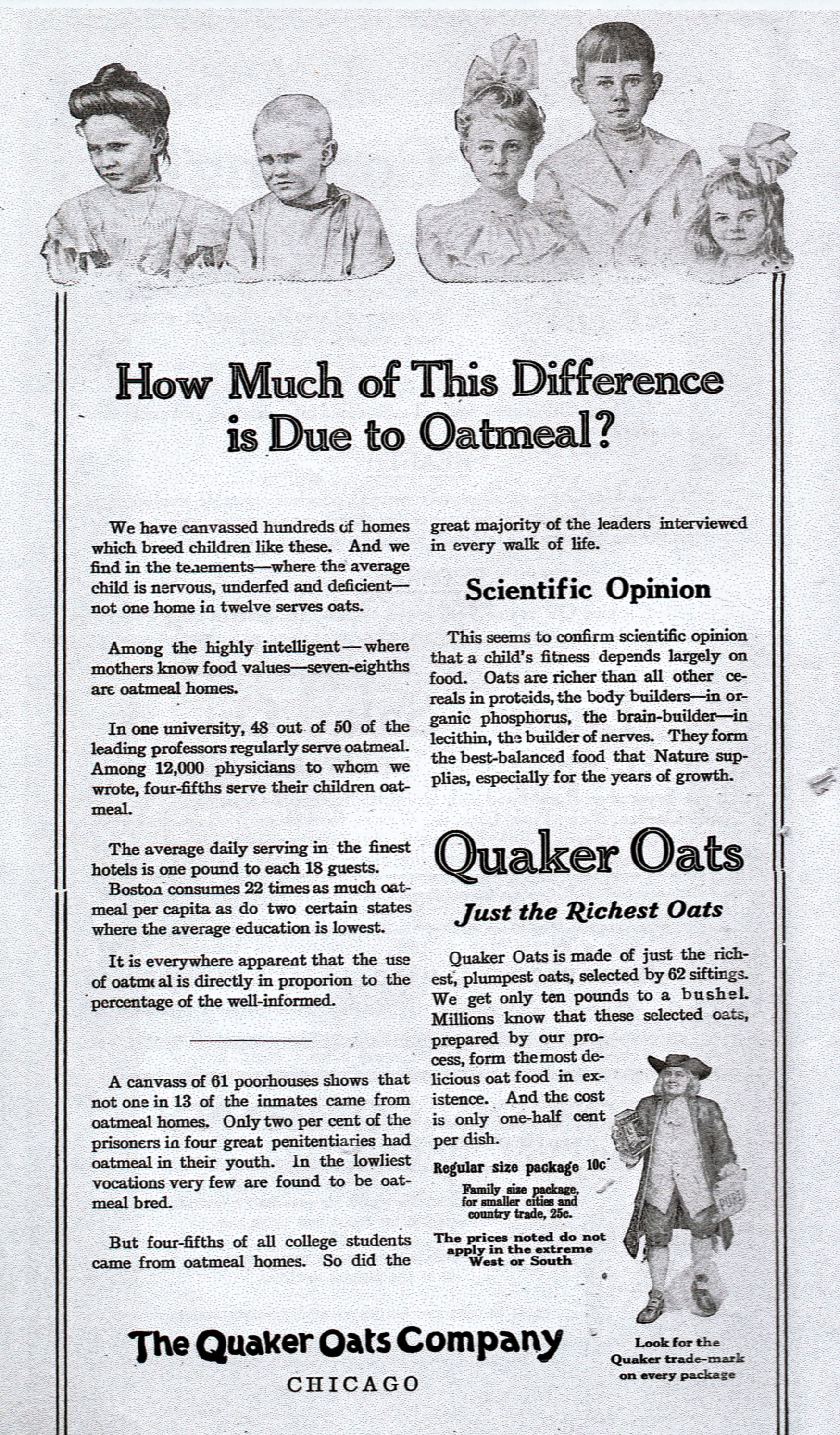
Since Grandma didn’t write much a hundred years ago today, I’ll share an old advertisement for Quaker Oatmeal.

It has lots of mind-boggling “statistics.” I wonder if there were any truth in advertising requirements regarding what types of research was needed to back up the numbers a hundred years ago.

How Much of This Difference is Due to Oatmeal?

We have canvassed hundreds of homes which breed children like these. And we find in the tenements—where the average child is nervous, underfed and deficient—not one home in twelve serves oats.

Among the highly intelligent—where mothers know food values—seven-eighths are oatmeal homes.

In one university, 48 out of 50 of the leading professors regularly serve oatmeal. Among 12, 000 physicians to whom we wrote, fourth-fifths serve their children oatmeal.

The average daily serving in the finest hotels is one pound to each 28 guests.

Boston consumes 22 times as much oatmeal per capita as do two certain states where the average education is lowest.

It is everywhere apparent that the use of oatmeal is directly in proportion to the percentage of the well-informed.

A canvass of 61 poorhouses shows that not one in 13 of the inmates came from oatmeal homes. Only two per cent of the prisons in four great penitentiaries had oatmeal in their youth. In the lowliest vocations very few are found to be oatmeal bred.

But four-fifths of all college students came from oatmeal homes. So did the great majority of the leaders interviewed in every walk of Life.

Scientific Opinion

This seems to confirm scientific opinion that a child’s fitness depends largely on food. Oats are richer than all other cereals in proteids, the body builders—in organic phosphorous, the brain –builder—in lecithin, the builder of nerves. They form the best-balanced food that Nature supplies, especially for the years of growth.

Quaker Oats

Just the Richest Oats

Quaker Oats is made of just the richest, plumpest oats, selected by 62 siftings. We get only ten pounds to a bushel. Millions know that these selected oats, prepared by our process, form the most delicious oat food in existences. And the cost is only one-half cent per dish.

Regular size package 10 cents.

Family size package, for smaller cities and country trade, 25 cents.

The prices noted do not apply in the extreme West or South.

Look for the Quaker trade-mark on every package.

The Quaker Oats Company

Chicago

National Foods Magazine (December 1910)

An Outlandish Fib

16-year-old Helena Muffly wrote exactly 100 years ago today: 

Monday, November 20, 1911:We got a good joke off on Carrie at school today. It was a most outlandish fib she told, and oh so shocking.

Recent photo of the school that Grandma and Carrie attended.

Her middle-aged granddaughter’s comments 100 years later:

Hmm. . . what was the story behind this entry? Carrie Stout was a friend of Grandma’s. I can’t quite figure out a probable relationship between a fib and the others (the class?) somehow playing a joke on Carrie.

Maybe Carrrie lied about homework? . . .but what would be the follow-up joke?

Or maybe she lied about why she was late getting to school? . . . and then the class . . .did what??

I might as well quit guessing. Some things are just impossible to figure out a hundred years later.

Book Review: Hester Morley’s Promise

16-year-old Helena Muffly wrote exactly 100 years ago today: 

Sunday, November 19, 1911: Went to Sunday School this afternoon. Wore my new hat and coat. I’ve just finished reading a book tonight, I can call it that for it is about half past eleven. Hester Molly’s Promise was the name; most too sad to be really interesting.

Her middle-aged granddaughter’s comments 100 years later:

Hester Morley’s Promise by Hesba Stratton was published in 1873. It is available online and can be downloaded from the Internet Archive.

This novel tells the story of two women (Hester and Miss Walden) in a small town in England who love the same man—a young minister named Carl.

As a 16-year-old Grandma probably enjoyed the romance–though she obviously didn’t like the lack of a “happy forever after” ending.

The book also examined how pettiness and self-interest of church members can pull a church apart.  This may have resonated with Grandma since the church that she attended was shuttered within 10-years of the time that she kept this diary.

Grandma probably also took away something about extra-marital affairs. I was surprised that books from that long ago dealt with this topic, and found it interesting that the novel suggested that an affair doesn’t affect just the people who are involved in it, but also their families and communities.

Hester’s father was a bitter, broken, 50-year-old man named John Morley. Hester’s mother died when she was young, and John then married a woman 14-years his junior named Rose.

About 10 years prior to the beginning of the book, Rose was not satisfied with her marriage and had an affair. When John found out about the affair, he threw Rose out—but never could get over his anger and his life spiraled downward.

The young minister Carl got drawn into all of the messiness as the ongoing repercussions of the ancient affair played out. Intertwined in this story was the story of  two woman who loved Carl–and one had the power to destroy his future in the town if he didn’t reciprocate her advances.

Carl chose Hester, and Miss Walden set out to destroy him.  She spread nasty rumors about Carl, and he was soon asked to leave the church for heresy.

In many ways this book seems very dated—yet I still enjoyed reading it. It gave me a better understanding of how sin, redemption, love, and relationships were viewed a hundred plus years ago.