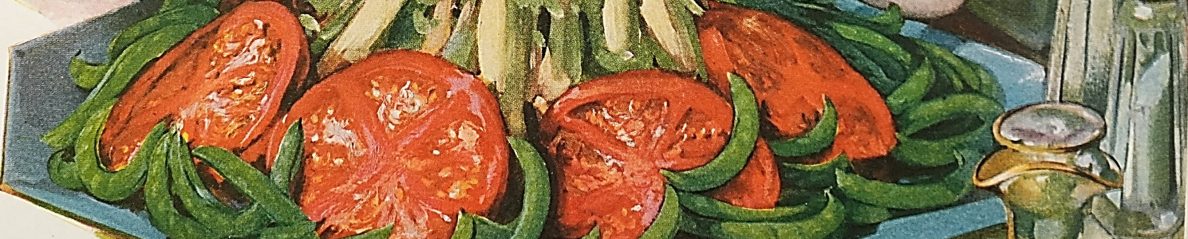
 Similarly to now, people worried about their weight a hundred years ago. A 1923 cookbook, The Calorie Cook Book, contains lots of menus and recipes for people who wanted to lose weight. The book contained menus for a week for each season of the year. Here is the Sunday Spring Reducing Menu.
Category: Other
“What will we have for dinner?”

A hundred-year-old home economics textbook had a short section on planning meals:
The Planning of Meals
“What will we have for dinner?” Nearly every day in the year the average home hears this question. Sometimes the query comes very close to the meal hour and means that time is too short to prepare certain foods. This haste frequently means a hurried telephone call or a trip to the nearest store and the purchase of such materials as can be made ready very quickly for the approaching meal. This method is costly in time, energy, money and disposition, and should give place to a better plan. In a very smoothly running household there is a more or less definite and regular time for giving thought to the food question, resulting in a written meal plan and the making of order lists. Meals should be planned at least one day in advance, and very frequently it is advantageous to plan for several days. This results in better food, in less confusion, worry and waste, in lessened work, in a smaller cost, and in greater satisfaction to all persons in the household.
Economics of the Family by C.W. Taber and Ruth A. Wardall (1923)
I’m intrigued by the concerns and suggestions. In some ways the advice seems on the mark and in other ways it feels very dated. We don’t call the store to order groceries. (I actually was surprised that the textbook authors apparently expected most families to have telephones in 1923.) But we do plan menus, shop for ingredients, and try to keep the cost of food down.
Old-fashioned Rye Griddle Cakes

Do you ever decide to make a recipe because you want to use up an ingredient that is in your cupboards? Well, this is one of those times for me. I wanted to use up a bag of rye flour that has been lingering in my kitchen for too long, so when I saw a recipe for Rye Griddle Cakes in a hundred-year-old cookbook I decided to give it a try.
When I selected the recipe, I didn’t have particularly high expectations, but I was very pleasantly surprised. The Rye Griddle Cakes (or pancakes to use more modern terminology) were absolutely wonderful. They were hearty and lovely with maple syrup. They don’t taste like rye bread, since rye bread often has additional flavorings like caraway or anise – but rather have a milder flavor. And, as an added bonus, the only flour this recipe calls for is rye flour, so it is a gluten free recipe. [2/18/23 update: My original post contained incorrect information. Readers who commented on this post noted that rye flour contains gluten – so this is not a gluten free recipe.]
Here’s the original recipe:

I am not sure why the egg is beaten until light, then combined with the milk before adding to the other ingredients. Maybe the recipe author was beating everything by hand. When I made this recipe, I just put all of the ingredients in a mixing bowl and then beat with an electric mixer.
Here’s the recipe updated for modern cooks:
Rye Griddle Cakes
1 1/2 cups rye flour
2 teaspoons baking powder
1/2 teaspoon salt
1 teaspoon sugar
1 egg
1 1/2 cups milk
Put all ingredients in a mixing bowl; beat until combined.
Heat a lightly greased griddle to a medium temperature, then pour or scoop batter onto the hot surface to make individual griddlecakes. Cook on one side, then flip and cook other side.
1923 Home Economics Texbook Discussion Questions
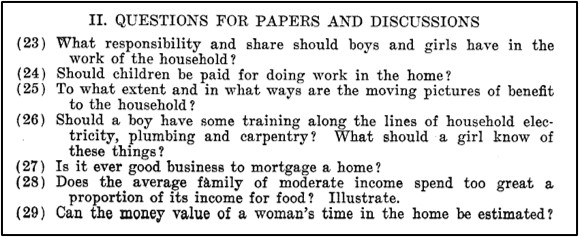
I’ve been reading a 1923 home economics textbook. It’s fascinating to see the questions for papers and discussion in the book. Some of the questions we still ponder today. (Should children be paid for doing work in the home?) Others are too gender-based for comfort. (Should a boy have some training along the lines of household electricity, plumbing, and carpentry? What should a girl know of these things?)
Old-fashioned Lettuce Washer
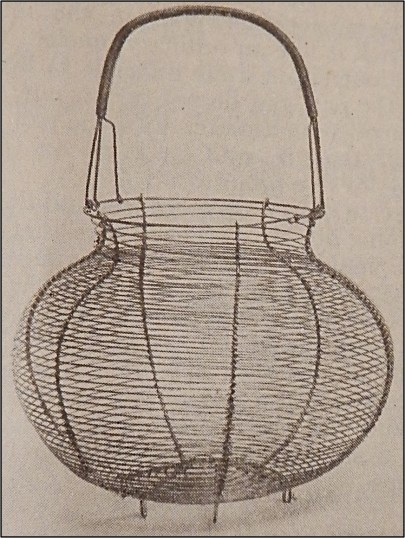
It’s fun to see old-time kitchen gadgets. Here’s what a hundred-year-old magazine said about a lettuce washer featured in an article titled, The Newest Kitchen Utensils:
Lettuce Washer
There are few things more distasteful than a plate of lettuce or romaine or chicory which, no matter how carefully it has been selected, examined or washed, has been so imperfectly dried that the dressing is weakened almost to tastelessness by the water still remaining on the leaves. Yet this happens even in the most carefully administered households, for it is a difficult thing to dry salad plants well without breaking their delicate, tender leaves. This implement, which is a familiar object in all French kitchens, is a salad washer and dryer. The green leaves are rinsed and placed in it, then it is dipped several times in a pan of cold water, and finally it is hung in a cool place where it may drip uninterruptedly. If time presses it may be swung back and forth a few times and all superfluous water will be expelled. Place the basket close to the ice to crisp the salad until serving time.
Ladies Home Journal (March, 1923)
Hundred-Year-Old Tip to Prevent Pots from Boiling Over
 When I boil potatoes, beans, or other vegetables, I often have issues with the water boiling over. Here’s a household hint in a hundred-year-old cookbook about how to prevent a pan from boiling over:
To Keep the Lid on a Boiling Pot – A teaspoonful of butter dropped into the water in which you are boiling dry beans, or other starchy vegetables will stop the annoyance of having the lid on the pot jump off, as it will otherwise do. The butter acts the same as oil on troubled waters and keeps it calm and manageable.
Cook Book (Published by Bethany Shrine Patrol No. 1, Rochester N.Y., 1923)
1923 Tables for Calculating Food Portions for a Large Group

Old community and organization cookbooks provide a wealth of information – and I’m never quite sure what I’ll find when I start leafing through one. For example, I’d never considered how much butter, meat, or coffee was needed when having a large church supper, so it was helpful to find information about the amounts needed of page 37 of a hundred-year-old cookbook published by the Michigan Grand Chapter of the Eastern Star.
I was even more amazed when I flipped to page 81 of the same cookbook and found a table showing the amounts of various foods needed to serve 50 people.
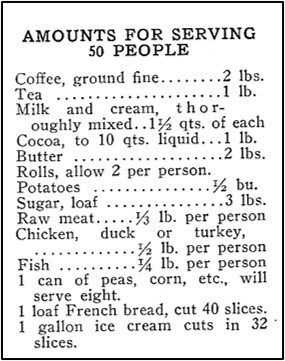
And, I was flabbergasted that some of the recommendations differed across the two pages. For example, for church suppers, a pound of butter will be enough for 48 to 56 servings, so it looks like a pound of butter would be enough for 50 people; but the chart on the amount of food needed for 50 people says that 2 pounds of butter is needed. Similarly, the church supper information says 1 pound of coffee is needed to serve 40 to 50 people, but the other table indicates that 2 pounds are needed to serve 50 people; however, there is some good news. The information on both pages agree that 1/2 bushel of potatoes are needed to serve 50 people.
