Cauliflower Mousselaine

Cauliflowre Mousselaine

When flipping through a hundred-year-old cookbook I was intrigued by a recipe for Cauliflower Mousselaine, and decided to give it a try.

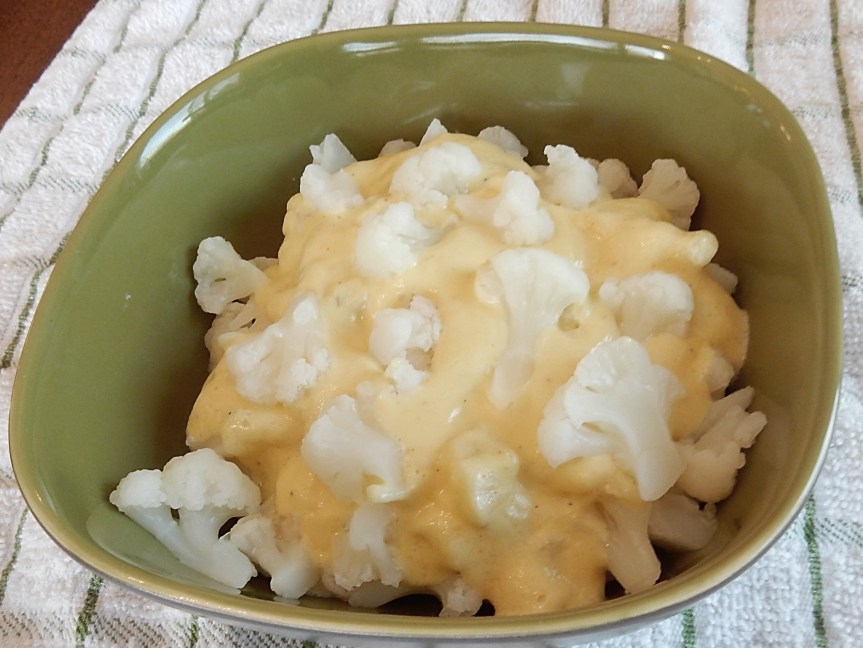
The cauliflower was embedded in a creamy, sunny, lemony sauce with a hint of nutmeg. I was surprised that the lemon in sauce predominated over the cauliflower, but it was delightful. This recipe has gourmet feel to it, and is an unusual flavor combination, but I’d make it again.

Here’s the original recipe:

Recipe for Cauliflower Mousselaine
Source: The Boston Cooking School Cook Book (1923)

Here’s the recipe updated for modern cooks:

Cauliflower Mousselaine

  • Servings: 3 - 5
  • Difficulty: moderate
  • Print

1 head cauliflower, separated into florets (about 3 cups florets)

2 egg yolks, slightly beaten

1/4 cup heavy cream

1/2 teaspoon salt

1/8 teaspoon nutmeg

juice of 1/2 lemon

2 tablespoons butter

Put cauliflower florets in a saucepan, and cover with water. Put on stove, and bring to a boil using high heat, then reduce heat and simmer for 4-6 minutes. Remove from heat and drain. Put in serving bowl.

In the meantime, make the sauce by putting the egg yolks, heavy cream, salt, nutmeg, and lemon juice in a saucepan; stir until thoroughly combined and smooth. Cook, using medium heat, while stirring constantly, until the sauce thickens. Add the butter – a few small pieces at a time – while continuing to stir. When the butter is melted, pour the sauce over the cauliflower.

http://www.ahundredyearsago.com

Hundred-year-old “Revolving Susan”

revolving susan
Source: Household Engineering: Scientific Management in the Home (1923)

A hundred-year-old book on scientific management of homes recommended the use of a “revolving susan.”

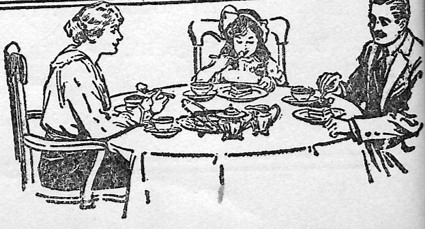
In many cases, where the dining table has a large enough diameter, it is practical to use in the middle of the table a “revolving susan” – or circular glass tray mounted on a revolving stand, which will accommodate butter, relishes, etc.; but its greatest value lies in assisting the host to pass dishes to each person to be served. Set the plate of food on the server, give a slight touch, and it will revolve to the person desired, thus doing away with awkward passing from one to another. Similarly the server may be used for removing the soiled plates, by each person laying their soiled plate in turn on the server, and whirling to the hostess, who will then remove them unobtrusively.

Household Engineering: Scientific Management in the Home by Mrs. Christine Frederick (1923)

First Vegetables Introduced to Babies a Hundred Years Ago

First vegetables for babies
Source: Order of the Eastern Star Relief Fund Cook Book (Michigan Grand Chapter, 1923)

A hundred-year-old cookbook recommended that the best first vegetables for a baby are strained spinach, asparagus, peas, and young carrots. I can’t remember which vegetables were introduced first when my children were young, but the Strong 4 Life site says:

Great first veggies to try:

  • Pureed carrots
  • Pureed squash
  • Pureed broccoli
  • Pureed sweet potatoes
  • Pureed green beans

1923 Spring Reducing Menu

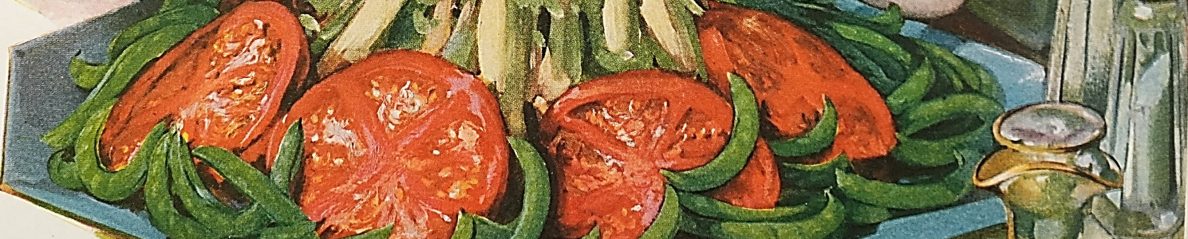
menu Similarly to now, people worried about their weight a hundred years ago. A 1923 cookbook, The Calorie Cook Book, contains lots of menus and recipes for people who wanted to lose weight. The book contained menus for a week for each season of the year.  Here is the Sunday Spring Reducing Menu.

“What will we have for dinner?”


A hundred-year-old home economics textbook had a short section on planning meals:

The Planning of Meals

“What will we have for dinner?” Nearly every day in the year the average home hears this question. Sometimes the query comes very close to the meal hour and means that time is too short to prepare certain foods. This haste frequently means a hurried telephone call or a trip to the nearest store and the purchase of such materials as can be made ready very quickly for the approaching meal. This method is costly in time, energy, money and disposition, and should give place to a better plan. In a very smoothly running household there is a more or less definite and regular time for giving thought to the food question, resulting in a written meal plan and the making of order lists. Meals should be planned at least one day in advance, and very frequently it is advantageous to plan for several days. This results in better food, in less confusion, worry and waste, in lessened work, in a smaller cost, and in greater satisfaction to all persons in the household.

Economics of the Family by C.W. Taber and Ruth A. Wardall (1923)

I’m intrigued by the concerns and suggestions. In some ways the advice seems on the mark and in other ways it feels very dated. We don’t call the store to order groceries. (I actually was surprised that the textbook authors apparently expected most families to have telephones in 1923.) But we do plan menus, shop for ingredients, and try to keep the cost of food down.

Old-fashioned Rye Griddle Cakes

Rye Griddle Cakes on Plate

Do you ever decide to make a recipe because you want to use up an ingredient that is in your cupboards? Well, this is one of those times for me. I wanted to use up a  bag of rye flour that has been lingering in my kitchen for too long, so when I saw a recipe for Rye Griddle Cakes in a hundred-year-old cookbook I decided to give it a try.

When I selected the recipe, I didn’t have particularly high expectations, but I was very pleasantly surprised. The Rye Griddle Cakes (or pancakes to use more modern terminology) were absolutely wonderful. They were hearty and lovely with maple syrup. They don’t taste like rye bread, since rye bread often has additional flavorings like caraway or anise – but rather have a milder flavor. And, as an added bonus, the only flour this recipe calls for is rye flour, so it is a gluten free recipe. [2/18/23 update: My original post contained incorrect information. Readers who commented on this post noted that rye flour contains gluten – so this is not a gluten free recipe.]

Here’s the original recipe:

Recipe for Rye Griddle Cakes
Source: Larkin Housewives’ Cook Book (1923)

I am not sure why the egg is beaten until light, then combined with the milk before adding to the other ingredients. Maybe the recipe author was beating everything by hand. When I made this recipe, I just put all of the ingredients in a mixing bowl and then beat with an electric mixer.

Here’s the recipe updated for modern cooks:

Rye Griddle Cakes

  • Servings: 3 - 4
  • Difficulty: easy
  • Print

1 1/2 cups rye flour

2 teaspoons baking powder

1/2 teaspoon salt

1 teaspoon sugar

1 egg

1 1/2 cups milk

Put all ingredients in a mixing bowl; beat until combined.

Heat a lightly greased griddle to a medium temperature, then pour or scoop batter onto the hot surface to make individual griddlecakes. Cook on one side, then flip and cook other side.

http://www.ahundredyearsago.com

1923 Home Economics Texbook Discussion Questions

List of Questions for Papers and Discussions
Source: Economics of the Family (1023) by C. W. Taber and Ruth A. Wardall

I’ve been reading a 1923 home economics textbook. It’s fascinating to see the questions for papers and discussion in the book. Some of the questions we still ponder today. (Should children be paid for doing work in the home?) Others are too gender-based for comfort. (Should a boy have some training along the lines of household electricity, plumbing, and carpentry? What should a girl know of these things?)