Source: Household Arts for Home and School (Vol. II), 1920
A 1920 home economics textbook contained a running storyabout the activities of a “household arts” class. Here’s some excepts from the section about preparing foods for a Christmas party for younger children at the school:
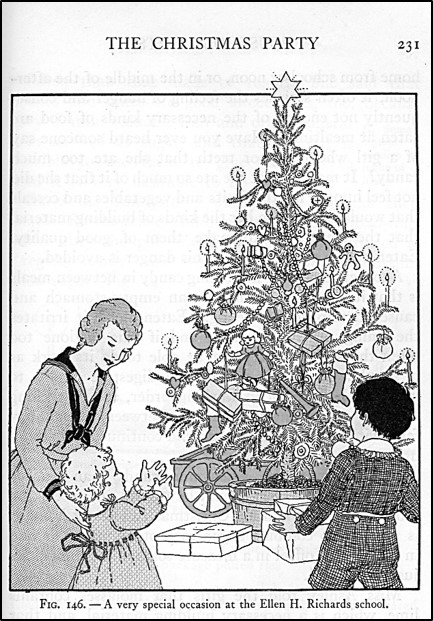
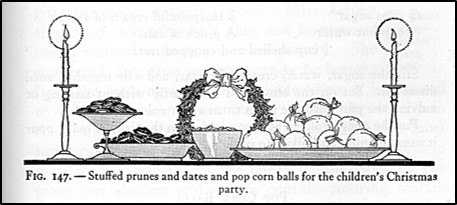
When the Christmas party was planned each of the classes did its share to help. The household arts classes helped to fill the boxes and stockings with homemade candy and tied up many pop corn balls.
The girls enjoyed wrapping their boxes and pop corn balls in bright-colored papers to hang on the tree. Miss Washburn, the art teacher helped the girls make them attractive. Christmas gifts, however small, she said always give more pleasure when special care is given to the wrapping and tying. There was no danger in covering the pop corn balls with colored paper for they were first wrapped in waxed paper.
Household Arts for Home and School (Vol. II) (1920) by Anna M. Cooley and Wilhelmina H. Spohr
Eggnog is one of my favorite holiday drinks, so I decided to make a hundred-year-old eggnog recipe to see how it compared with the modern version. The old recipe made a lovely eggnog that had a hint of vanilla and nutmeg. It was less sweet and thinner than the typical modern eggnog – but, in my opinion, that was a good thing.
Eggnog is considered very festive today, so I was surprised to find the old recipe for it in a 1920 home economics textbook, in a chapter titled “Illness in the Home.” Back then it was common for cookbooks and textbooks to include a chapter on cooking for invalids – and eggnog was considered a nutritious, easy to eat and digest food for someone who was sick.
Here’s the original recipe:
Source: Household Arts for Home and School (Vol. II) (1920) by Anna M. Cooley & Wilhelmina H. Spohr
This recipe makes one fairly small serving. A hundred years ago, it was probably served in an 8-ounce (1 cup) glass.
dash of ground nutmeg (or grate a small amount of whole nutmeg) (optional)
Put egg in a small mixing bowl; beat until smooth. Add sugar, salt, and vanilla; then gradually add the milk while continuing to beat. Strain, and pour into a glass. If desired, sprinkle or grate a little nutmeg on top. Serve at once.
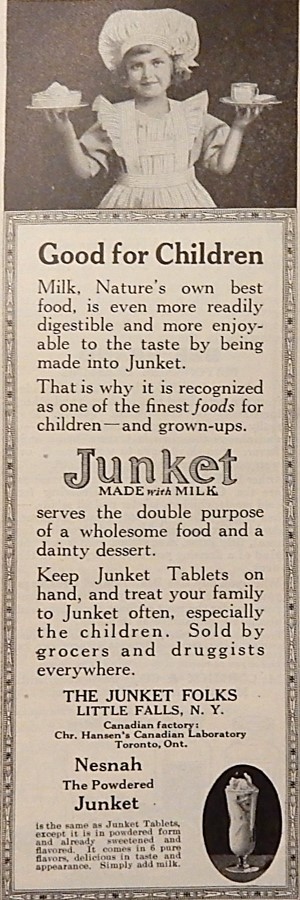
Sometimes hundred-year-old advertisements bring back memories of long forgotten foods. Do they still make junket? I think that it’s still sold, but it’s been so long since I’ve had any that I can barely remember it.
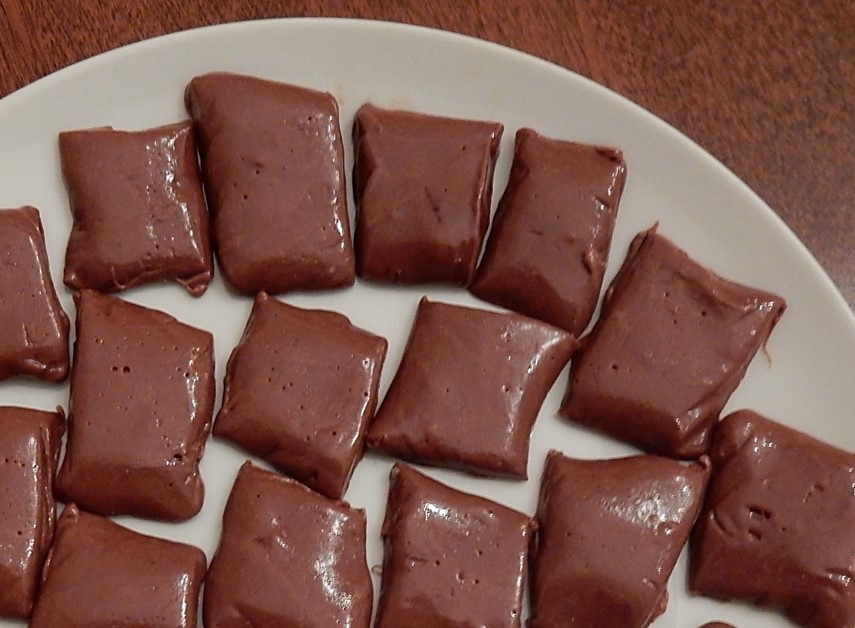
Ever wonder how to make a homemade candy that tastes similar to Tootsie Rolls? Well, I had never even thought about making Tootsie Rolls, but when I made a hundred-year-old candy recipe for Honey and Cocoa Cushions, I was surprised to discover that they tasted very similar to Tootsie Rolls.
Honey is the only sweetener called for in the Honey and Cocoa Cushions recipe, so it may be a tad healthier than many candies (at least that is what I tell myself when I nibble on the candies).
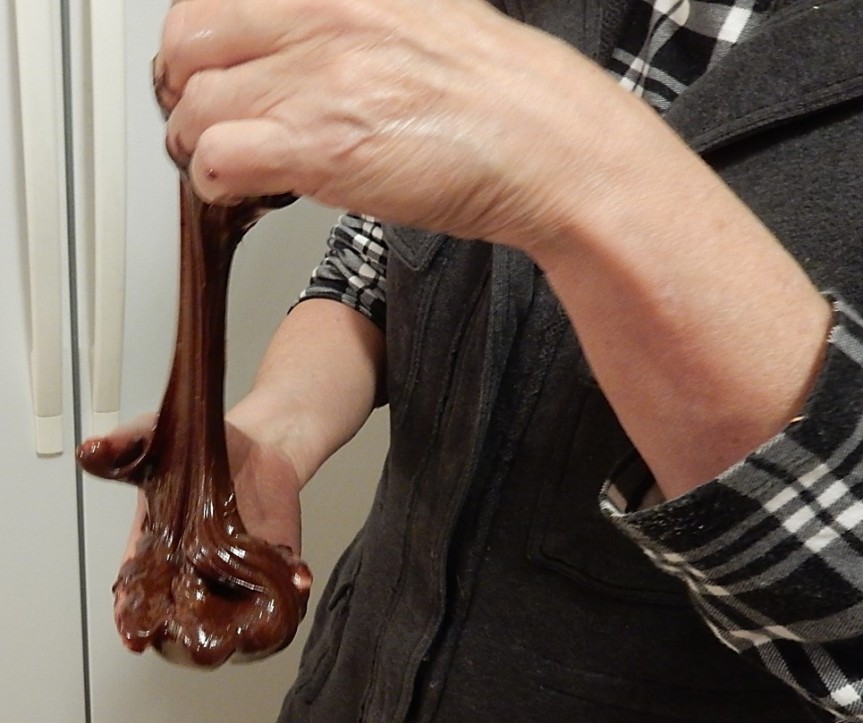
It is tricky getting this candy cooked to exactly the right stage, but similarly to taffy, it needs to be pulled, which can be a fun family activity.
Here’s the original recipe:
Source: Mrs. Scott’s Seasonal Cook Books (The North American Newspaper, Philadelphia, Autumn, 1920)
The ingredients list calls for a pinch of baking soda, though it is never actually mentioned in the directions. I assumed that it was combined with the cocoa and water when the thick paste was made. I generally try to avoid using old-fashioned terms like “pinch” when updating recipes – but couldn’t figure out what other term to use for the small amount of baking soda required in this recipe, so kept the original terminology and used the word “pinch” in the updated recipe.
The original recipe calls for cooking the mixture to the soft ball stage. When I made the recipe, the candy didn’t seem firm enough to pull when cooked to the soft ball stage, so I cooked it to the hard ball stage.
The original recipe also calls for cooking the mixture in an iron frying pan. When I poured 1 cup of honey into my 14-inch cast iron skillet, it barely covered the bottom of the pan, so I ended up doubling the recipe. Another option would be to use a smaller pan that is approximately 8-inches in diameter.
(I doubled this recipe when I made it, and used a full-size cast iron frying pan.)
1 cup honey
1/4 cup cocoa
a pinch of baking soda
1+ tablespoon water
Put the cocoa and baking soda in a small bowl. Add water and stir to make a very thick smooth paste. (A small amount of additional water may need to be added to create the paste.) Set aside.
Put honey in a small cast iron skillet (about 8 inches in diameter). Using low heat, bring to a slow boil. Add the cocoa paste, and continue boiling while stirring constantly. Boil until it reaches the firm-ball stage. The firm-ball stage is when a small amount of the syrup is dropped into cold water. If it can be gathered together to form a firm ball (though malleable when pressed), it is at the right stage—or just use a candy thermometer (255 – 265 degrees F).
Remove from heat and pour onto a buttered platter. Let cool until it is cool enough to be handled. Then butter hands and pull the candy until it becomes cold and glossy (about 5 – 10 minutes). Form long thin strips of the candy and place on waxed paper; then cut with a buttered knife or scissors into pieces approximately 1/2 inch long. If desired, the pieces can be wrapped in squares of waxed paper.
Occasionally I see data in an old book that piques my curiosity – and next thing I know I’m searching for recent comparison data. This is one of those times. According to a hundred-year-old home economics textbook:
We are told that American spend over $200,000,000 a year for factory-made candy.
Household Arts for Home and School (Vol. II) (1920) by Anna M. Cooley and Wilhelmina H. Spohr
Which led me to wonder, how much did the average American spend on candy per year in 1920? According the 1920 U.S. Census, there were 106,000,000 people in the U.S. in 1920, so the average person spent $1.89 dollars per year on candy. According to Dave Manual’s Inflation Calculator, $1 in 1920 would be the equivalent to $12.50 today, so the average person in 1920 ate $23.65 worth of candy in today’s dollars over the course of a year.
This led to my next question, How much candy do American’s eat today? I found data for how much they spent on Halloween candy (but not for the entire year) -so the overall amount would be more. The data were for 2019, which I’m assuming is about the same as 2020.
According to the National Retail Federation’s annual survey conducted by Prosper Insights & Analytics, U.S. consumers are expected to spend $2.6 billion on candy or more than $25 on average.
So the bottom line this at in Americans are spending more on candy today than they did a hundred years ago. In 1920, if the spending was adjusted for inflation, they spent an average of $23.65; today, just for Halloween, they spend more than $25.00 per year.
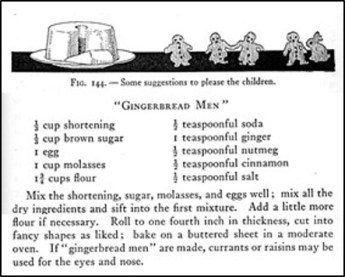
Making cut-out cookies is one of my favorite holiday traditions, so I was thrilled to see a recipe in a hundred-year-old home economics textbook for Gingerbread Men.
These delightful molasses and spice cookies are decorated with raisins or currants, and are a little thicker and chewier than some gingerbread cookies. They’d be lovely on a holiday cookie tray.
Here is the original recipe:
Source: Household Arts for Home and School (Vol. II) by Anna M. Cooley and Wilhelmina H. Spohr (1920)
The caption under the illustration in the old textbook says, “Some suggestions to please the children.” Today Gingerbread Men often are topped with lots of colorful icing, and very sweet. Would children in 2020 be pleased by Gingerbread Men decorated with only raisins or currants? My gut feeling is that many today wouldn’t fully appreciate this old-time flavorful, healthier option – and would miss the icing. Which is a pity. The Gingerbread Men were wonderful.
Preheat oven to 375° F. Put shortening, brown sugar, egg, and molasses in mixing bowl; mix together. Add baking soda, ginger, nutmeg, cinnamon, salt, and flour; stir to combine. Roll to 1/4 inch thickness. (If too sticky to roll, add more flour.) Cut into shapes using a Gingerbread Man cookie cutter. Put on prepared baking sheet. Raisins or currants may be used for eyes, mouth, and buttons. (Cut raisins into several pieces if they are too large.) Bake for 8 – 10 minutes, or until the cookies are set. Remove from oven, allow to cool for 1-2 minutes, then transfer to cooling rack.
Food is expensive today – and it was expensive a hundred years ago. Here is what someone a hundred years ago said about how they minimized their food costs:
We save on food costs. Twenty-five percent of the known incomes, allows $660 a year for food. I allow $540 or $45 a month, for a family of four. It means a very plain table. It means, too, that food costs are lessened by our flock of 12 to 15 chickens which returns 50% above its yearly cost, and by a garden from which I can vegetables and fruits. We pay in labor for part of our food – caring for the garden and the chickens.
From an article titled “Getting the Most Out of Your Dollar,” (Good Housekeeping; May, 1920)
 Eggnog is one of my favorite holiday drinks, so I decided to make a hundred-year-old eggnog recipe to see how it compared with the modern version. The old recipe made a lovely eggnog that had a hint of vanilla and nutmeg. It was less sweet and thinner than the typical modern eggnog – but, in my opinion, that was a good thing.

 Occasionally I see data in an old book that piques my curiosity – and next thing I know I’m searching for recent comparison data. This is one of those times. According to a hundred-year-old home economics textbook: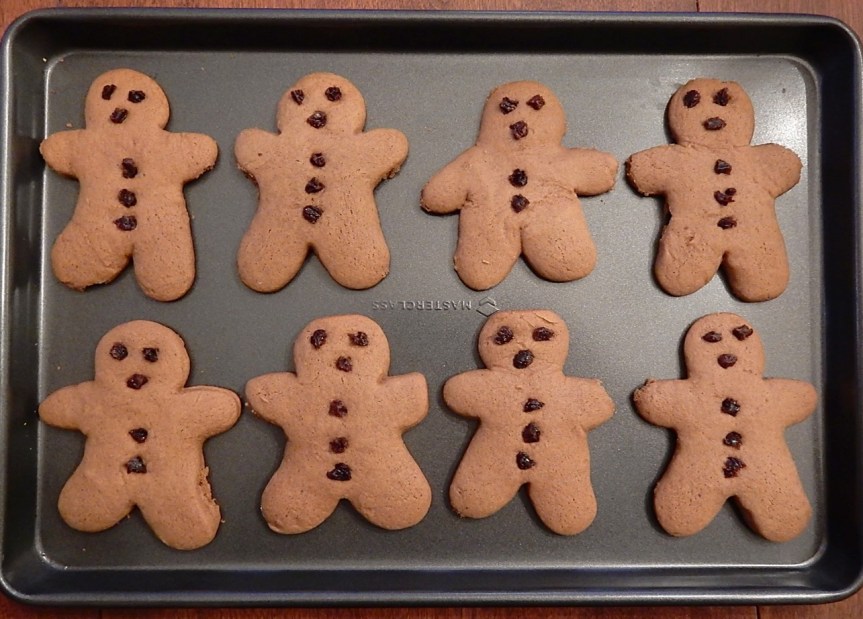
 Food is expensive today – and it was expensive a hundred years ago. Here is what someone a hundred years ago said about how they minimized their food costs: