Hundred-Year-Old Table Covering Descriptions

set table
Source: The New Butterick Cook Book (1924)

Here’s how a hundred-year-old cookbook describes table clothes and other table coverings:

Table Coverings

The table-cloth is the form of table covering most frequently used, and if in an exquisite texture it may be considered the most formal type of cover. The table-cloth should always be laid over a silence cloth, which is usually of felt or a double-faced cotton material made expressly for this purpose. The silence cloth should drop over the edges of the table several inches. Many prefer to fold it at the corners and pin it underneath the table. The silence cloth prevent noise, protects the table and improves the appearance of the linen.

The table-cloth must be laid with great exactness. The center lengthwise crease should fall exactly in the middle of the table and extend over the sides and ends of the table until its edges just escape the seats of the chairs. For breakfast, luncheon or supper, a smaller cloth may be used, simply covering the top of the table or falling a few inches over the edge. Great care must always be taken that the threads of the cloth are parallel to the diameter of a round table, or parallel to the edges of a square or rectangular table. A table seldom presents as restful and interesting a picture when the cloth is placed diagonally as when it is placed with the treads running parallel to the edges of the table.

The small table-cloth, or the cloth used on informal occasions, does not need to be the snowy white linen used for the formal dinner.  Nothing is more satisfactory or pleasing than beautiful unbleached cloths with possibly a simple line design in color along the edges.

Doilies for each place are also used instead of the table-cloth and silence cloth, and are most satisfactory not only for their ease in laundering but for their appearance when correctly arranged on a well-polished table top. . .

Runners are another type of covering used on the bare table. These may be made of linen, or of the various cotton materials sold for such use. The runner is used for the informal meal.

Paper coverings are being used more and more for very informal occasions and may be secured in a very usable quality and size.

The New Butterick Cook Book (1924)

In the old cookbook, “table-cloth” was always hyphenated. I guess its an example of how words have changed across the years.

Old-Fashioned Raisin Custard

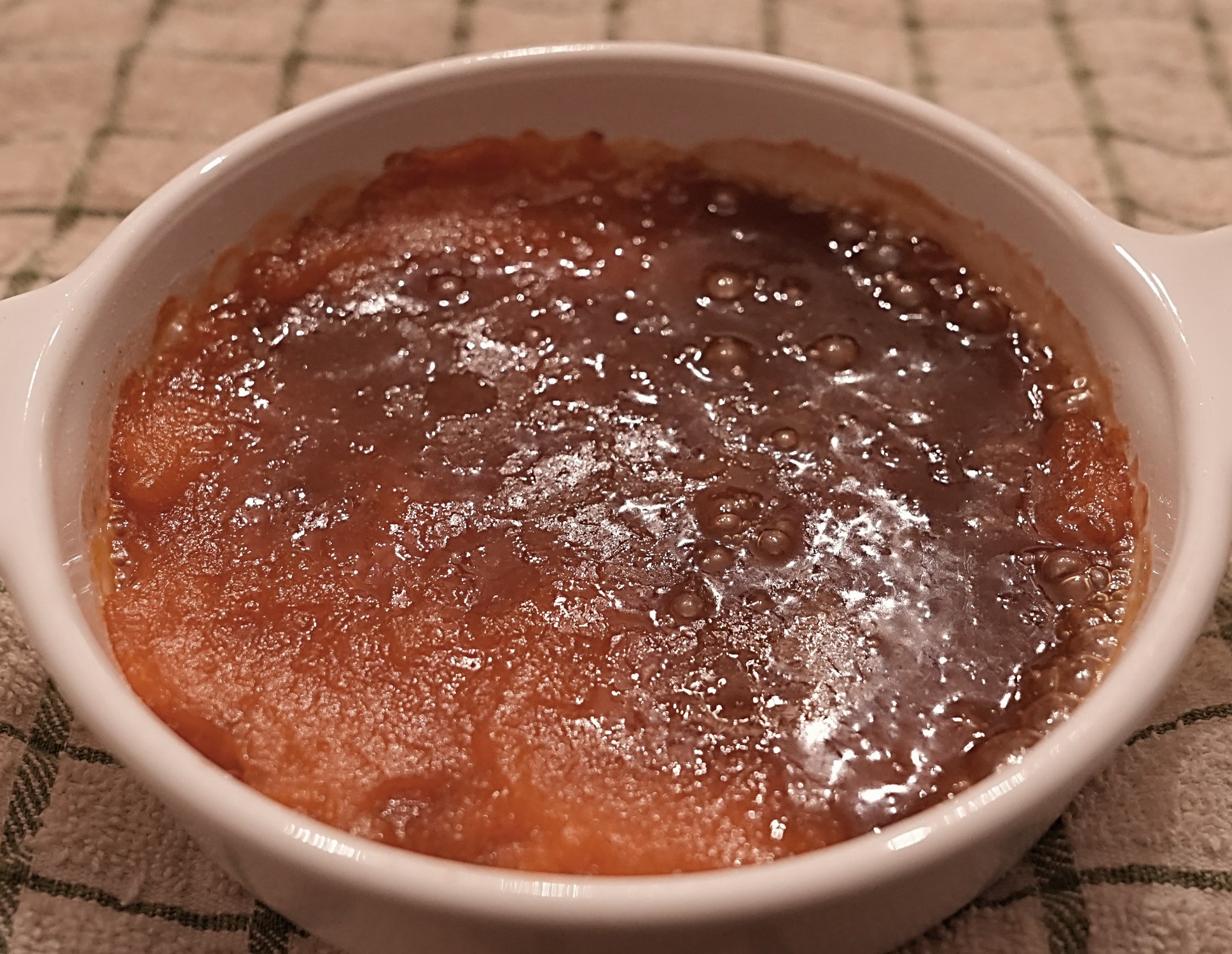
Raisin Custard

I love old-fashioned baked custards so decided to try a hundred-year-old recipe for Raisin Custard. The raisins are on the bottom of the custard. I want to say that they sank to the bottom, but I think that the recipe author intended for there to be plain custard on the top and a raisin-custard mixture on the bottom.

The Raisin Custard was very delicate, but the recipe didn’t call for any sugar, so the custard was not sweet (though the raisins added a bit of sweetness when I got to the bottom).

Here’s the original recipe:

recipe for Raisin Custard
Modern Priscilla Cook Book (1924)

Here’s the recipe updated for modern cooks:

Raisin Custard

  • Servings: 4 - 6
  • Difficulty: moderate
  • Print

2 eggs

2 cups milk

1/4 teaspoon salt

1/2 teaspoon nutmeg

2/3 cup raisins, coarsely chopped

Preheat oven to 325° F. Put eggs in mixing bowl and beat until smooth. Add milk, salt, and nutmeg; beat until thoroughly combined. Pour mixture into custard cups. Place the custard cups in a pan with hot water that comes to about an inch below the top of the cups ( 4 – 6 custard cups will be needed. The number of custard cups needed will vary depending upon the size of the custard cups.) Bake for 60-90 minutes or until a knife inserted in center of the custard comes out clean.  May be served warm or cold.

http://www.ahundredyearsago.com

1924 Directions for Cooking Hot Cereals

Table About Cooking Hot Cereals
Source: Low Cost Cooking by Florence Nesbitt (1924)

Here’s some excerpts from a hundred-year-old cookbook  about how to cook hot cereals:

Cooking Breakfast Cereals

Cereals are made from hard grains and contain much starch, so require long cooking to make them easily digested. Do not be deceived by directions on the box which say that the contents can be cooked in 15 or 20 minutes. This is never long enough to cook thoroughly and make them fit food for young children.

When the coal range is used, a very convenient way to cook the cereal is to start it cooking at supper time and leave closely covered on the back of the range all night. In the morning it will be found to be well done.

All of the cereals named above may be served hot as mush with cream or milk with or without sugar. Mush may also be served with syrup instead of milk. Cornmeal mush is much liked in this way.

Low Cost Cooking by Florence Nesbitt (1924)

Old-Fashioned Hot Slaw with Sour Cream Sauce

Hot slaw with sour cream dressing

When browsing through a hundred-year-old magazine, I came across a recipe for Hot Slaw with Sour Cream Sauce, and decided to give it a try.

The Hot Slaw was mild,  rich, and creamy. The recipe called for only 1 tablespoon of vinegar (and no sugar), so the flavors were much more nuanced than many modern slaws.

Here’s the original recipe:

Recipe for Hot Slaw with Sour Cream Dressing
Source: American Cookery (October, 1924)

Here’s the recipe updated for modern cooks:

Hot Slaw with Sour Cream Sauce

  • Servings: 5 - 7
  • Difficulty: moderate
  • Print

1 head of cabbage (approximately 2 pounds; The cabbage should be firm and white.)

2 teaspoons salt

4 tablespoons butter

1 tablespoon flour

1 tablespoon water

1 cup sour cream

1 tablespoon tarragon vinegar or apple cider vinegar (I used apple cider vinegar.)

Grate or finely shred the cabbage. Stir the salt into the cabbage. Let sit for 30 minutes, then drain and rinse. Press to squeeze out excess water.

In a skillet or large saucepan, melt the butter. Stir in the cabbage. (Do not add water.) Cover and cook over low heat for 10 minutes. Several times remove lid and stir to keep the cabbage from scorching, then replace lid. (The idea is to stir enough to prevent scorching, but to keep the steam in as much as possible as the cabbage cooks.) Cook for 10 minutes.

In the meantime, stir water into the flour to make a thick paste. Then stir in the sour cream. Stir the sour cream mixture into the hot cabbage, and cook for 1-2  additional minutes while stirring. Stir in the vinegar and serve.

http://www.ahundredyearsago.com

Tasty Asparagus (Asparagus and Onions) Recipe


Tasty Asparagus (Asparagus and Onions) in BowlSome recipes in old cookbooks have the strangest titles. For example, I recently came across a hundred-year-old recipe for Tasty Asparagus. In one way the title was very descriptive – it clearly says that the asparagus is tasty. However, in another way, the description is very inadequate. How is the asparagus prepared? What are the main ingredients?  I tend to skip over recipes with titles like this, but was intrigued when I saw that this was a recipe for asparagus and onions, and decided to give it a try.

I agree with the recipe author. Tasty Asparagus is tasty. Asparagus and onions make a really nice combination. And, it was quick and easy to make. This recipe is a keeper.

Here’s the original recipe:

Recipe for Tasty Asparagus (Asparagus and Onions)
Source: Modern Priscilla Cook Book (1924)

By today’s standards, cooking asparagus for half an hour is excessive, so when I updated the recipe I reduced the cooking time substantively. For the cooking oil, I used olive oil. I’m not sure why the old recipe calls for adding the water used to cook the asparagus to the asparagus and onion mixture. I drained some of the excess liquid off before serving.

Here’s the recipe updated for modern cooks:

Tasty Asparagus (Asparagus and Onions

  • Servings: 6
  • Difficulty: easy
  • Print

1 bunch asparagus

2 medium onions, sliced

3 tablespoons olive oil

Trim off the woody ends of the asparagus, and then cut into 1-inch pieces. Put in saucepan, and add about an inch of water. Bring to a boil using high heat, then reduce heat and simmer for 4 minutes. Remove from heat. Drain, but save 1 cup of the water used to cook the asparagus.

In the meantime, put the olive oil in a skillet. Heat oil using medium heat, then add the sliced onions. Cook until the onions are transparent, then add the cooked asparagus pieces and 1-cup of the water in which the asparagus was cooked. Bring to a boil using medium heat, then reduce heat and simmer for 3 minutes. Remove from heat and serve.

http://www.ahundredyearsago.com

Heat Lemons to Get More Juice

lemon

The household hints section of a hundred-year-old cookbook had the following suggestions for getting more juice from a lemon:

  • A lemon will yield nearly double the quantity of juice otherwise obtainable if it is heated thoroughly before squeezing.

  • Lemons held in hot water yield more juice than otherwise.

The New Home Cook Book, 1924 Edition (Published by the Illinois State Register, Springfield, IL)