Cooking with edible flowers is a fun and playful way to change a mundane dish into a really special, beautiful dish that is a work of art.
I planted nasturtiums this year for the first time in many years. The reason I planted them is because I saw a recipe in a hundred-year-old cookbook for a green bean salad that called for nasturtiums. I’ve been anxiously waiting for the nasturtiums to bloom, and, finally, they are blooming and I was able to make the recipe.
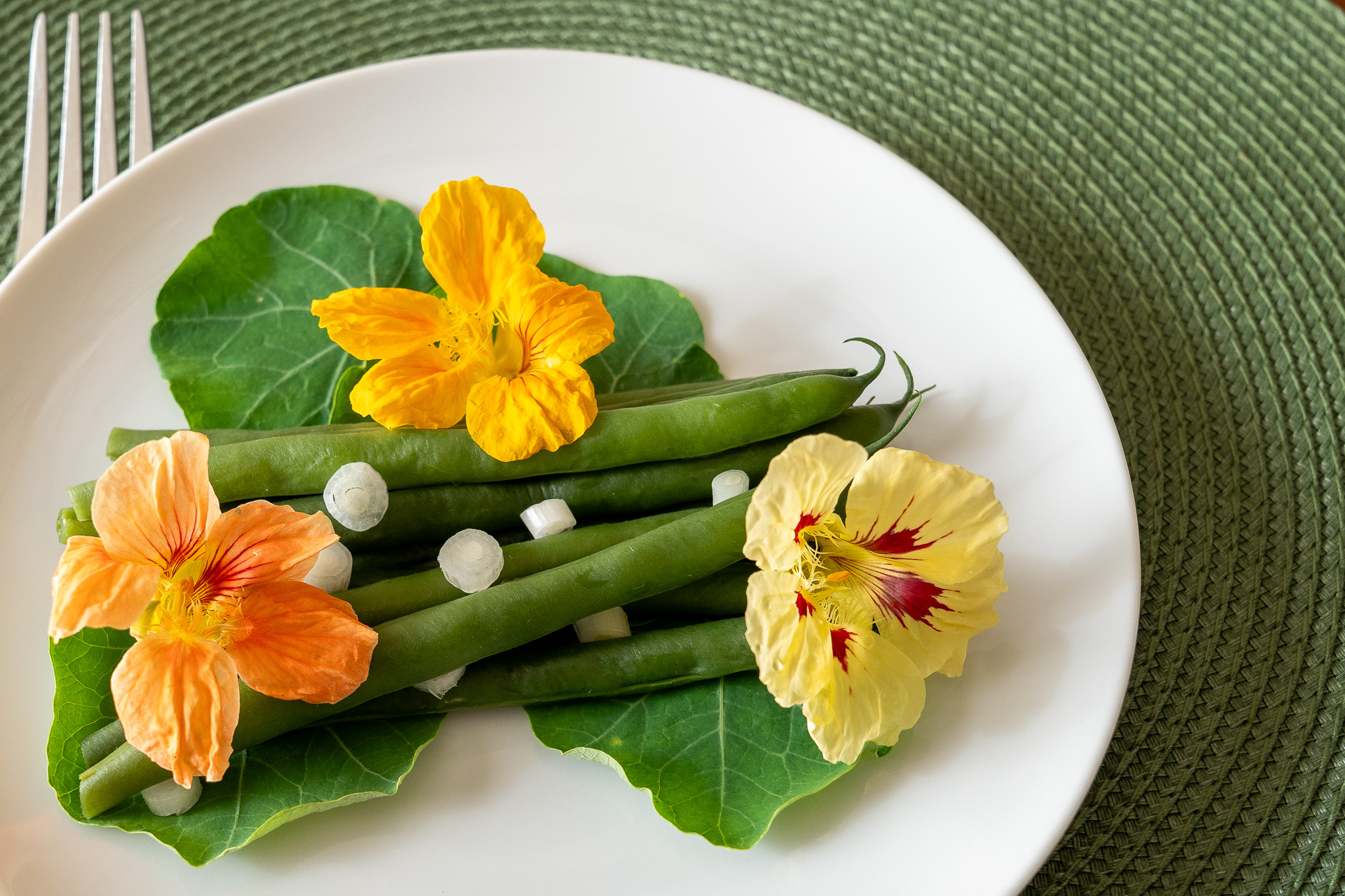
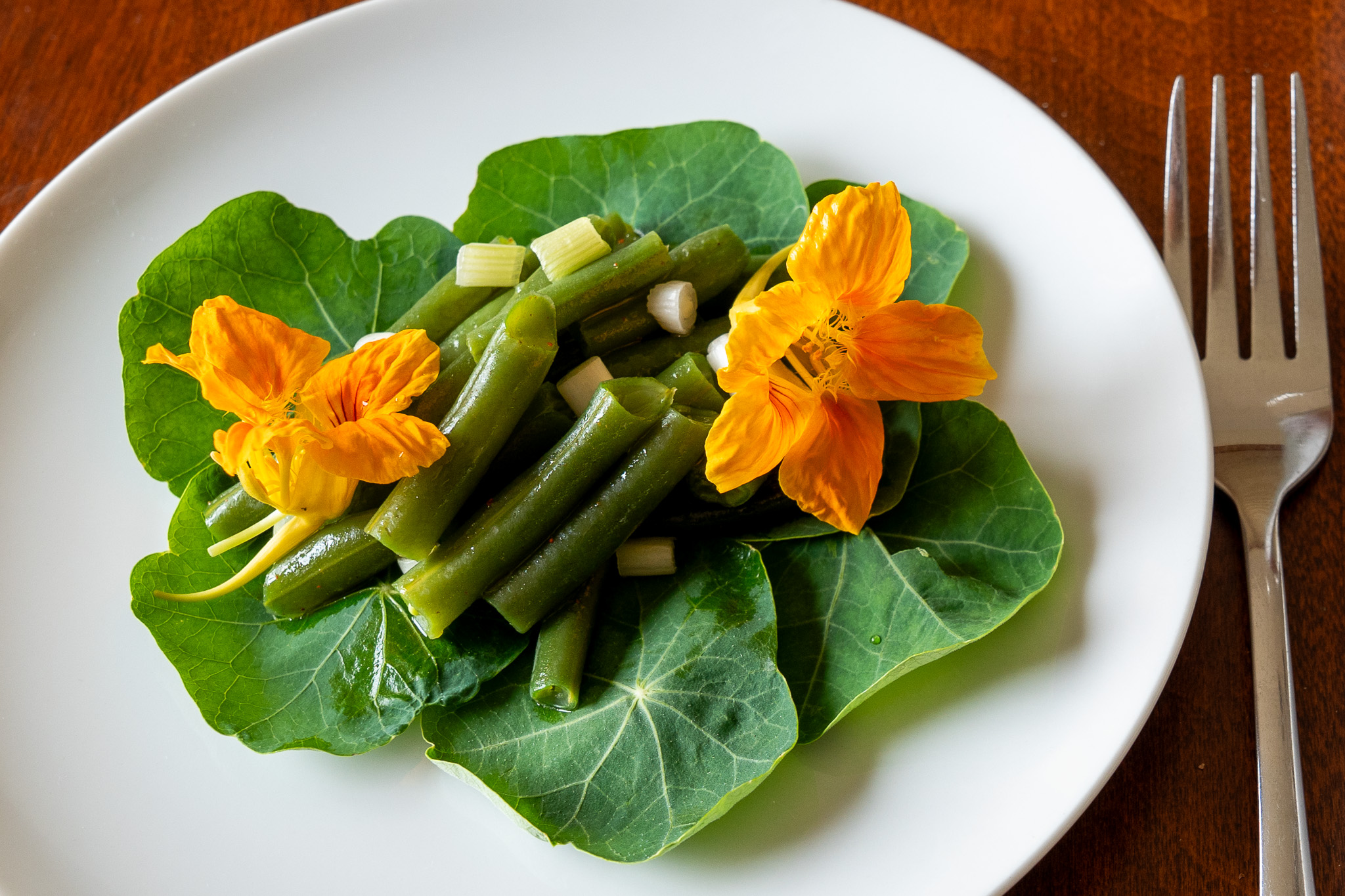
The Green Bean Salad (with Nasturtiums) was easy to make and tasty, and made a lovely presentation. The green beans are arranged on top of nasturtium leaves. Green onion slices are then sprinkled on top of the green beans, and the salad is garnished with nasturtium flowers. The green beans were lightly coated with a lovely vinaigrette dressing, and the nasturtium leaves have a nuanced sweetness, and mild peppery kick.
I made this salad twice. The first time I snapped the beans into short pieces, which is how I think cooks a hundred years ago would have made the salad. It looked lovely, but then I thought about how green beans often are left whole today, and decided to also make it that way. The salad with the unsnapped beans also looked great, and had a more modern look. (As you can see, I was having fun with this recipe.)
Here is the original recipe:
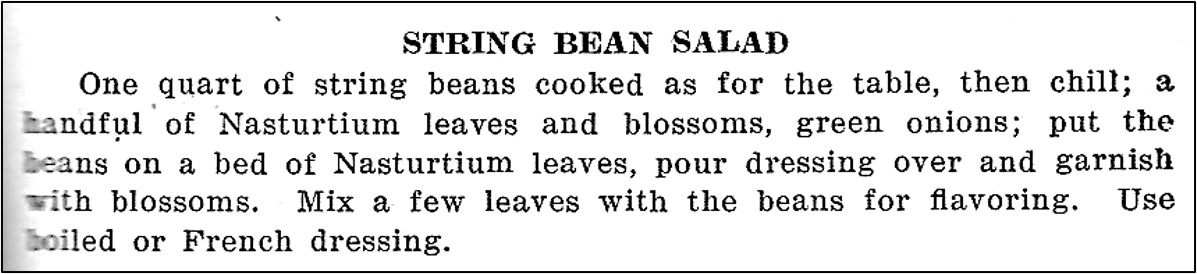
The original recipe was called String Bean Salad. Today we often refer to string beans as green beans (and they generally don’t even have strings anymore), so when I updated the recipe, I called it Green Bean Salad. I also included “with nasturtiums” in the recipe title since that is a unique part of this recipe.
I individually plated each serving, but the salad could be put in a serving bowl.
The old recipe called for serving the salad with French Dressing. A hundred years ago, French Dressing was a vinaigrette dressing, and quite different from the commercial, orange-colored French dressing that is common today. There was no recipe for French Dressing in the cookbook that contained the salad recipe, so I used a French Dressing recipe that was in another 1926 cookbook:
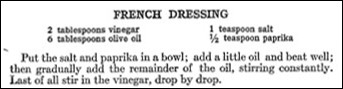
The French Dressing made more dressing than I needed so I halved the recipe.
Here’s the recipe updated for modern cooks:
Green Bean Salad (with Nasturtiums)
1 quart (about 1 pound) green beans
4 small green onions, thinly sliced
approximately 1 cup nasturtium leaves
nasturtium flowers (for garnish)
Step 1. Trim green beans. If desired, snap the beans (or they can be left whole). Lightly steam or boil the beans for about 5 minutes, then chill until cold.
Step 2. Pour French Dressing over the beans (see recipe below), and gently stir to coat beans with the dressing. (If desired, mix a few nasturtium leaves with the beans). If there is excess dressing on the beans, drain the beans to remove it.
Step 3. Arrange nasturtium leaves on individual serving plates (or they can be arranged in a serving bowl). Top with the green beans that have been coated with French Dressing.
Step 4. Sprinkle the sliced green onions over the green beans.
Step 5. Garnish with nasturtium flowers.
French Dressing (Vinaigrette Dressing)
1/2 teaspoon salt
1/4 teaspoon paprika
3 tablespoons olive oil
1 tablespoon vinegar
Step 1. Put the salt and paprika in a small bowl.
Step 2. Gradually add the olive oil while stirring constantly.
Step 3. Then slowly add the vinegar, a small amount at a time, while continuing to stir.

What a lovely presentation, in both versions.
Thank you – the salads did turn out nicely. Edible flowers can really dress up a salad.
The salad certainly looks good. I have always had an issue with eating flowers from the garden. Maybe one day I’ll take a bite out of one.
I agree! Have never eaten a flowering plant!
You should give them a try. Nasturtium flowers do not have a weird taste -if anything, they are are fairly bland.
Interesting! I’ve been planting nasturtiums for the past few years (I remember my mother planting them in window boxes). A friend has mentioned several times that they are edible, but I haven’t tried them. And we referred to green beans as ‘snaps’. Also: creamed potatoes (not mashed), garden peas (not green peas) and butter beans (not lima beans). As you can guess, I grew up in the country!
Nasturtium leaves have a peppery taste. The flowers have a bit of the peppery taste and sweetness at the same time.
That’s a good description of what nasturtium leaves and flowers taste like. When I made this salad, I thought that the flowers might be more peppery than what they actually were.
Thanks. Isn’t it hard to describe a taste to someone who has never had it before?
It is hard! I know that I often struggle to write good descriptions of what the foods I made taste like.
Wanting to make this recipe was the impetus for me raising nasturtiums; but, similarly to you, I have really enjoyed having them in my flower garden. They bring back warm memories of when my mother used to plant them.
Love your list of vegetables that have several names.
This sounds excellent. I love the pepperiness of nasturtiums (but oh woe, I have none in the garden this year!). In the past I have also pickled the seeds as sort of poor man’s capers. They were OK, but it’s not something I’ve bothered to do again since.
Now that you mention it – I also saw a recipe in an old cookbook for pickling nasturtium seeds. I’m going to pass on making that recipe (and I didn’t raise nearly enough nasturtiums to get enough seeds to make it worthwhile pickling them).
A good decision!
It’s fun to think of the edible flowers being used a hundred years ago! I grow nasturtiums because I love their peppery leaves and the flowers really decorate the plate beautifully. Bring on the green beans, which I usually still call string beans!
This is the first time I’ve ever used flowers to decorate a plate; but, as you said, they decorate a plate beautifully, and I plan to use them in the future.
I tend to use the term “string beans” to generically refer to both green beans and wax beans – but my sense is that others only use it to refer to green beans.
I think you are right. When I was growing up, they were string beans or wax beans if they were yellow.
I cannot hear or see nasturtiums without thinking about the movie Silver Streak and the scene with the flowers.
You’ve piqued my curiosity. I’ve never seen the movie, but now want to watch it.
That’s the most beautiful salad I’ve ever seen!!
Thank you! I had fun making it.
Indeed, this is a work of art! This makes me so hungry!!!!
Nasturtium flowers add a wonderful splash of color to salads and other dishes.
What a beautiful salad! It is beautiful as a flower arrangement.
Thanks! The salad made a beautiful presentation.
I find that both your presentations are beautiful and very modern-looking. Either of them could definitely be on a restaurant menu. It’s nice to see nasturtiums making a comeback. One of our favourite restaurants has a large kitchen garden containing (among many other things) nasturtiums. They have such a lovely flavour.
It’s awesome that the restaurant’s garden includes nasturtiums. I’ve eaten at restaurants with their own kitchen garden, but I don’t think any of those gardens ever included edible flowers.
The plate is so pretty , I think I would have a little bit of trouble messing it up to eat!😁
French dressing was so different back then compared to today’s French dressing!!
I find it fascinating that French dressing has changed so much over the years. I even did a post on this a few years ago: Several Hundred-Year-Old French Dressing Recipes. Shortly before I did that post, I read a newspaper article saying that the U.S. government had recently deregulated French dressing. It really surprised me that the ingredients in French dressing were regulated for many years, and led me to write that post.
Wow! The salad is a work of art and sounds like it would be delicious! You had a lot of patience to wait for some nasturtiums to grow and your patience was definitely rewarded. 🙂 I appreciate all the research and gardening you do in order to create modern versions of old favorites and forgotten treasures.
Sometimes I select a recipe just a day or two before I post it; other times, like with this recipe, I identify it months ahead.