The number of cars in the U.S. rapidly increased during the 1920’s. By 1926, almost half of the households owned a car, and people were enjoying the freedom that it provided. A popular leisure activity was to have a motor car picnic. People packed elaborate meals into picnic hampers, and then drove to scenic spots for a picnic.
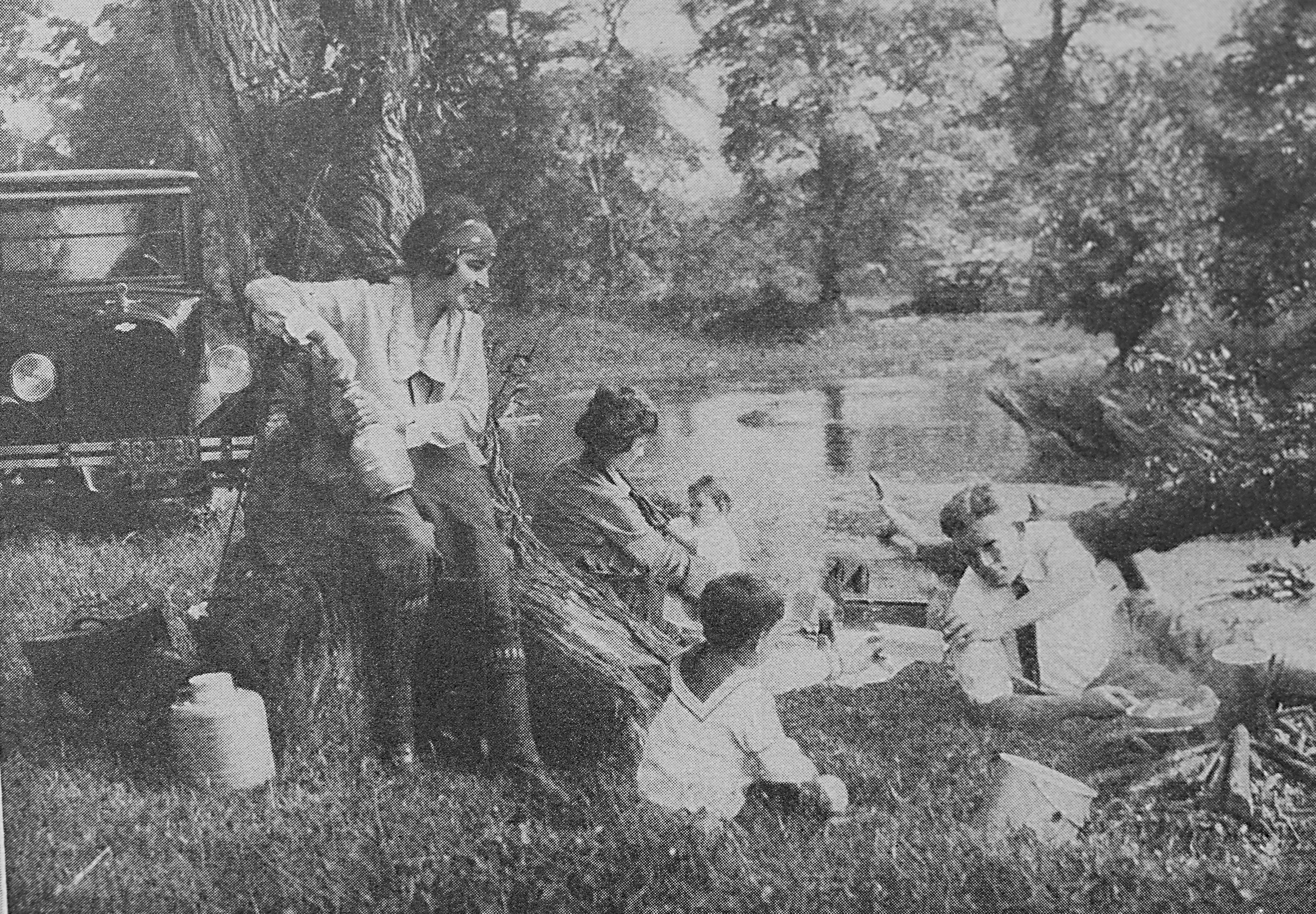
Motor car picnics were the latest fad at the time. I recently was surprised to see information about them in two different 1926 magazines. American Cookery had a menu for a motor car lunch basket, and Good Housekeeping had an article about equipment needed for picnics that contained a photo of a family enjoying a picnic with an auto in the background.
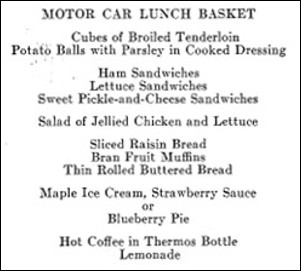
When I read the menu for the motor car lunch basket, I felt exhausted. It must have taken a lot of work for the cook to prepare all the food and other items needed for the picnic.

That is a lot of food and packaging it up for transport for the family of five shown in the photo. Our picnics when I was a child consisted of bologna and cheese sandwiches on white bread packed back into the bread bag. Koolaid in a 1/2 gallon cooler and carrot sticks. Cookies if mother had baked any. On the rare occasion there was a bag of potato chips. And we were a family of six.
Ah – Koolaid. That was an important part of picnics back in the day. Our family picnics were closer to what your family did than to the old-time “motor car” picnics.
I have photos of my grandparents and their car out in the woods. They would have started dating in the early 1920’s, and some with my mom and dad. Growing up in the mountains of PA, we even went on midweek picnics, but by that time, everyone had at least one car.
Similarly to you, I have good memories of picnics in the woods in Pennsylvania. I especially remember the time that we planned to have a Sunday picnic at Shikellamy State Park which is near Sunbury and overlooks the confluence of the West and North branches of the Susquehanna River. Mom covered a picnic table with a tablecloth and started unpacking the food, while Dad went out to the overlook to look at the view. He came back and urgently said, “We’ve got to get home. There’s rain clouds out there, and I have 2 loads of hay setting out. I’ve got to get them in the barn.”
We ended up packing the food back into the car without eating it, and headed home. I remember being annoyed that day, but it makes a good story now.
Predicting the weather is very different today. I don’t know how we got along back in the day.
That’s a lot of car owners at such an early date! I just looked up UK household car ownership in 1926: 3- 4% only. I’m interested in how that ice cream was transported. Thermos? It looks a lot of trouble, that picnic. I hope the flies and mosquitos didn’t move in!
Not sure why the percentage of families with cars was so different across the two countries. I don’t know much about the history of automobiles, but were there Model T Fords in the UK? I think that they were first produced in about 1910, and were considered very affordable, which led many families in the U.S. to buy one.
It was Austin, Morris and Ford for the ordinary family, and Rolls Royce and Bentley for the rich. But even work-horse cars were not considered as a household essential by many. It was buses for local, and trains for longer journeys.
Our discussion makes me want to learn more the history of the adoption of automobiles as the main type of transportation in the U.S. I know that there used to be lots of passenger trains and trolleys in the U.S., but that by sometime prior to the mid-20th century most no longer existed. (There still are a few passenger trains between several major cities.) My sense is that buses remained fairly popular a little longer than trains in the U.S.
Trains are still well-used, but sadly, an expensive option. Bus fares here have just been pegged at £2 maximum($2.66) which is great, but rural areas like ours are badly served. Commuting to work , in towns anyway, is generally by public transport for most people. Many Londoners, like my son and family, only use the car at weekends. Public car-share schemes develop apace.
Similarly to the U.K., in major cities in the U.S., many people use public transit. But, in suburbs, smaller cities and towns, and rural areas, most people are dependent upon cars for transportation.
The same problems everywhere ….
I liked the photo that illustrated the picnic. I have great memories of car trips and stopping at a roadside park to eat a lunch Mother had packed. Thank goodness she did not make that kind of lunch on the menu!
I also have good memories of stopping at roadside parks to eat when I was a child.
We occasionally take food with us to eat for lunch when we travel (just things like crackers, cheese, apples, cookies). t doesn’t seem like many people do that anymore.
There’s another picnic photo that was in the July, 1926 issue of Good Housekeeping. It’s not about motor car picnics, but it’s still fun.
https://ahundredyearsago.wordpress.com/wp-content/uploads/2026/12/boat-picnic-fleschmans-yeast-7-1926.jpg
Oooh! On the lake or river in a row boat. Interesting that she is in a sweater and hat, and he is in a shirt with sleeves rolled up!
We figured we were eating high with fried chicken and potato salad…Kool-Aid and ice tea…Also pickles!
Definitely pickles – it’s not a picnic without them.
Wow, that’s some menu! I’m exhausted just reading it!
I’m also exhausted just reading it. A picnic with a menu even close to that one would be a major event.
Not very restful, that’s for sure.
Yes, you’re right! That would have been a lot of work! We enjoy picnics but much simpler (and on foot, too). 😊
In my opinion, simpler is definitely the way to go when it comes to picnics.
Now that was a picnic with something for everybody!
There are lots of options!