

When I was recently browsing through the recipes in a hundred-year-old cookbook I saw a recipe for Oatmeal Sticks and was intrigued. Breadsticks are a nice addition to a meal, and I thought that Oatmeal Sticks might be a nice change of pace. When I read the recipe, I was surprised that flour was the main ingredient and that the recipe called for a relatively small amount of oatmeal, but decided to proceed anyway and give it a try. Many breadstick recipes call for yeast, while this recipe was in a cookbook published by the Rumford Baking Powder Company so it called for the use of baking powder.
The Oatmeal Sticks were very rustic and had an artisan look. They were tasty but denser than the typical breadstick and had the texture of a quick bread. I could not tell that the baked Oatmeal Sticks actually contained oatmeal, though it may have contributed to the texture.
Here’s the original recipe:
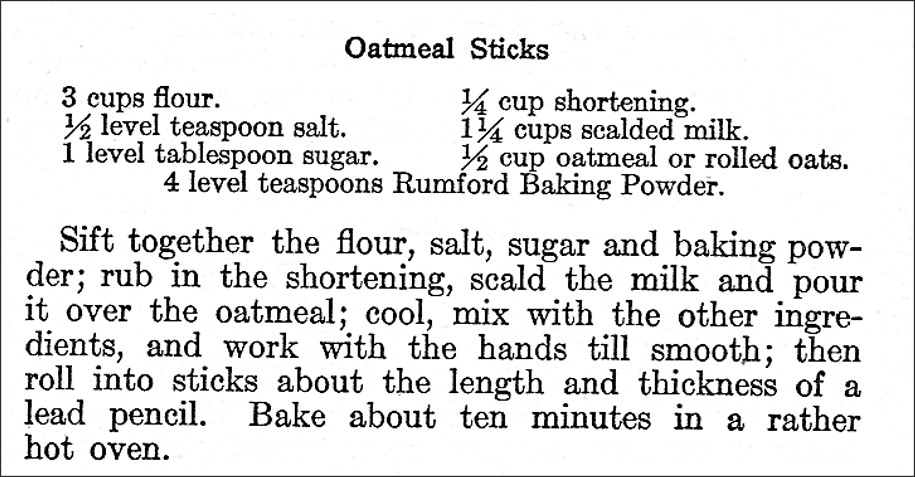
It took me substantive time to shape the Oatmeal Sticks, and even though I tried to do it very carefully, they were not as smooth as the typical bread stick (which I will again attribute to the use of baking powder rather than yeast).
Here’s the recipe updated for modern cooks:
Oatmeal Sticks
1 1/4 cups milk
1/2 cup oatmeal (I used quick 1-minute oatmeal.)
3 cups flour
1/2 teaspoon salt
1 tablespoon sugar
4 teaspoons baking powder
1/4 cup shortening
Preheat oven to 425◦ F. Using medium heat, bring milk to a boil, then stir in the oatmeal and turn off heat.
In the meantime, in a mixing bowl combine the flour, salt, sugar, and baking powder, then cut in the shortening. Add the cooked oatmeal and mix until all the ingredients are combined, then put on a prepared surface and knead for a few minutes until the mixture is smooth. Roll into sticks about the length and diameter of a pencil. Place on baking sheets (space about 1 1/2 inches apart). Cover dough that has not yet been made into sticks as well as the sticks that have been shaped while working to prevent them from drying out. Put in oven and bake until lightly browned (about 10 minutes).

Wonderful 100-year-old recipe, Sheryl. Interesting because the words have changed. A “rather hot oven” and “lead pencil” stood out to me. And I was glad you mentioned that they came from a Rumford cookbook because it explains the large amount of baking powder and lack of yeast, as you mentioned.
It is fascinating how things are worded differently now from a hundred years ago. Over the fourteen years that I’ve been doing this blog I’ve seen major changes in how cookbooks describe oven temperatures. When I started the blog in 2011, a hundred years ago was 1911 and most people back then cooked on wood or coal stoves, so cookbooks said things like “hot oven” or “low fire.” By 1925, many people had electric or gas stoves, and some cookbooks listed oven temperatures while others still used the older terminology and left it up to the cook to figure out exactly what a “rather hot oven” and other terms meant.
How very interesting, Sheryl. This gave me a smile, thank you.
As one that cannot have wheat flour, I am often surprised when I look at a recipe such as yours and find out it does have flour in it.
I also was surprised by the name of this recipe in the old cookbook. The name seems like a misnomer, and that it should not be called “Oatmeal Sticks” when the main ingredient is wheat flour. Maybe a better name would be “Quick Breadsticks” or “Baking Powder Bread Sticks.”
That sounds interesting–no wonder it caught your eye.
I had fun making this recipe.
I’m curious. That seems a lot of baking powder proportionally, did it have a taste in the finished product?
It did not have an overwhelming baking powder taste. The taste was different from a yeast bread, but seemed fairly typical of the taste of other quick breads. The recipe calls for 3 cups of flour (plus 1/2 cup of oatmeal) which apparently is enough to handle 4 teaspoons of baking powder.
I wonder if using traditional oats might have changed things? Instant oats were not around 100 years ago, so … you never know.
cheers
sherry
You might be right. I looked at the original recipe again, and I see that it calls for “oatmeal or rolled oats.” I’m not sure how they differentiated between the two a hundred years ago, but today I think that rolled oats refers to old-fashioned oatmeal that was made by flattening the grains using a roller. If I’d used old-fashioned oatmeal the flakes might have maintained their shape and texture and been noticeable in the finished product.
I buy a whole wheat bread that has flakes of oatmeal on the top – though I think that the oatmeal is just sprinkled on the bread after it is formed into loaves. I’m not sure if the oatmeal flakes would be apparent if they were stirred into the dough.
I think you are right about the rolled oats, Sheryl. I eat rolled oats that take a bit of time to cook and the cereal tastes like oatmeal. (My preference is steel cut, but it is hit or miss to get it around here). Randy eats quick 1 minute oatmeal, which does not have near the taste, flavor or texture.
Hot oatmeal made using old-fashioned rolled oats definitely has a less-smooth texture than oatmeal made with quick 1-minute oatmeal. (And, steel-cut oatmeal has its own wonderfully unique texture.)
Interesting recipe.
I find this recipe (and many other old recipes) fascinating.
Yes. I have some of my Grandma’s recipes. I found one that was headcheese from butchering pigs. I don’t think I will ever use it.
At our house, similar names often get used; thus just call it scrapple and you might like it.
hahahahahahaha
Sorry. As one who worked butchering animals, in my youth, I can say I wouldn’t eat either one willingly.
I am one who believes that a dog deserves some feast too.
Interesting. I wonder if you could use almond flour with this recipe.
hmm. . . I don’t know. I have never used almond flour and do not know how easily it could be substituted. If you happen to make this recipe using almond flour, I (as well as readers of this blog) would love to know how it turned out.
Seeing them in your photo makes me wish I had them and a pizza dip!
They’d be lovely with a pizza dip.
I wonder if old fashioned oats or steel cut oats would make a difference? And if you made used oat flour if they would hold up or work at all? Not enough to give it a try you understand just wondering? lol
When did they start making oat flakes?
If I made this recipe again, I would try using old-fashioned oatmeal. In hindsight, I think that it probably was what was used a hundred years ago. I’m not sure but if old-fashioned oatmeal was used, the flakes of oatmeal may also have maintained the distinct shape and texture in the baked breadsticks.
The recipe probably would need to be adapted if steel cut oatmeal was used. The original recipe just says that the milk should be scalded and poured over the oatmeal. My sense is that steel cut oatmeal would not get soft enough to work in a recipe using this process.
Your comment piqued my interest regarding the history of oatmeal. According to Britannica, Quaker Oats “introduced quick (1922) and instant (1966) oats as convenience foods, and it sold the first flavored oatmeal, maple and brown sugar, in 1970.”
Well the “quick” oats would have been around for the the 100 year mark….but I am thinking your right on Old fashioned would be the way to go.
I’m delighted in your sharing of these recipes. I would have thought more oatmeal than flour back in the time period!