I used think that I have too many dishes, but then I can across a list in a 1919 book, and realized (at least by the standards of a hundred years ago), that I may not own enough dishes.
With regard to table equipment, the number of individual dishes is controlled by the size of the family, and the kind of service desired. Most housewives would choose dainty service and good style, and would prefer to have convenient dishes in adequate number and appropriate silver, even if less expensive china , and silver and glass is chosen. For such a standard, which is strongly recommended, buy twice as many of all individual dishes, glasses, and silver, as the number in the family. This makes possible entertaining with much less worry and work, and relieves one of the feeling of not having enough. It is certainly a reasonable standard to choose china, glass, and silver which is not expensive to replace and is, therefore, not a source of anxiety to the housewife.
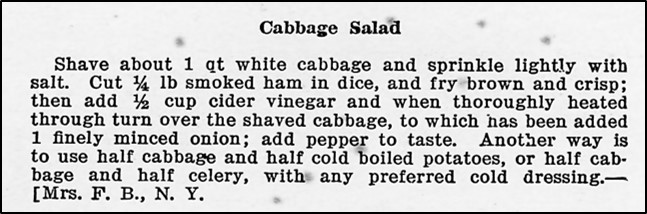
Sometimes coleslaw with its typical sugary, mayonnaise-based dressing can seem like a bit much. I recently came a hundred-year-old dressing for Cabbage Salad with Ham that calls for simply dressing it with warm vinegar. The simplicity of the dressing really brings out the flavor of this salad.
Here is the original recipe:
Source: The Old Reliable Farm and Home Cook Book (1919)
1 quart (4 cups) cabbage, grated (about 1 medium cabbage)
1 medium onion, finely minced
1/4 cup ham, diced
1/2 cup apple cider vinegar
1/4 teaspoon salt
1/4 teaspoon pepper
Combine grated cabbage and minced onion in a bowl. Set aside
Sauté diced ham in a skillet using medium heat until lightly browned. Stir in vinegar, salt, and pepper; heat until hot. Pour heated vinegar over cabbage and onion; stir to combine. Serve.
Does anyone like school lunches? I hear both parents and their children complain about them. According to my local school district’s website, today’s high school menu is:
Menu – October 24, 2019
Main: Italian Entree Choice Grill: Grilled Chicken Sandwich Salad: Italian Entree Choice
Smart Sides: Caesar Salad, Celery Sticks
But, is it worse than school lunches a hundred years? Somehow I just can’t imagine students today getting excited about Jellied Salmon.
When I make a pie, I sprinkle any remaining pastry scraps with cinnamon and sugar, and then bake until light browned. These scraps are good, but I found a hundred-year-old recipe for Almond Strips that takes it to the next level.
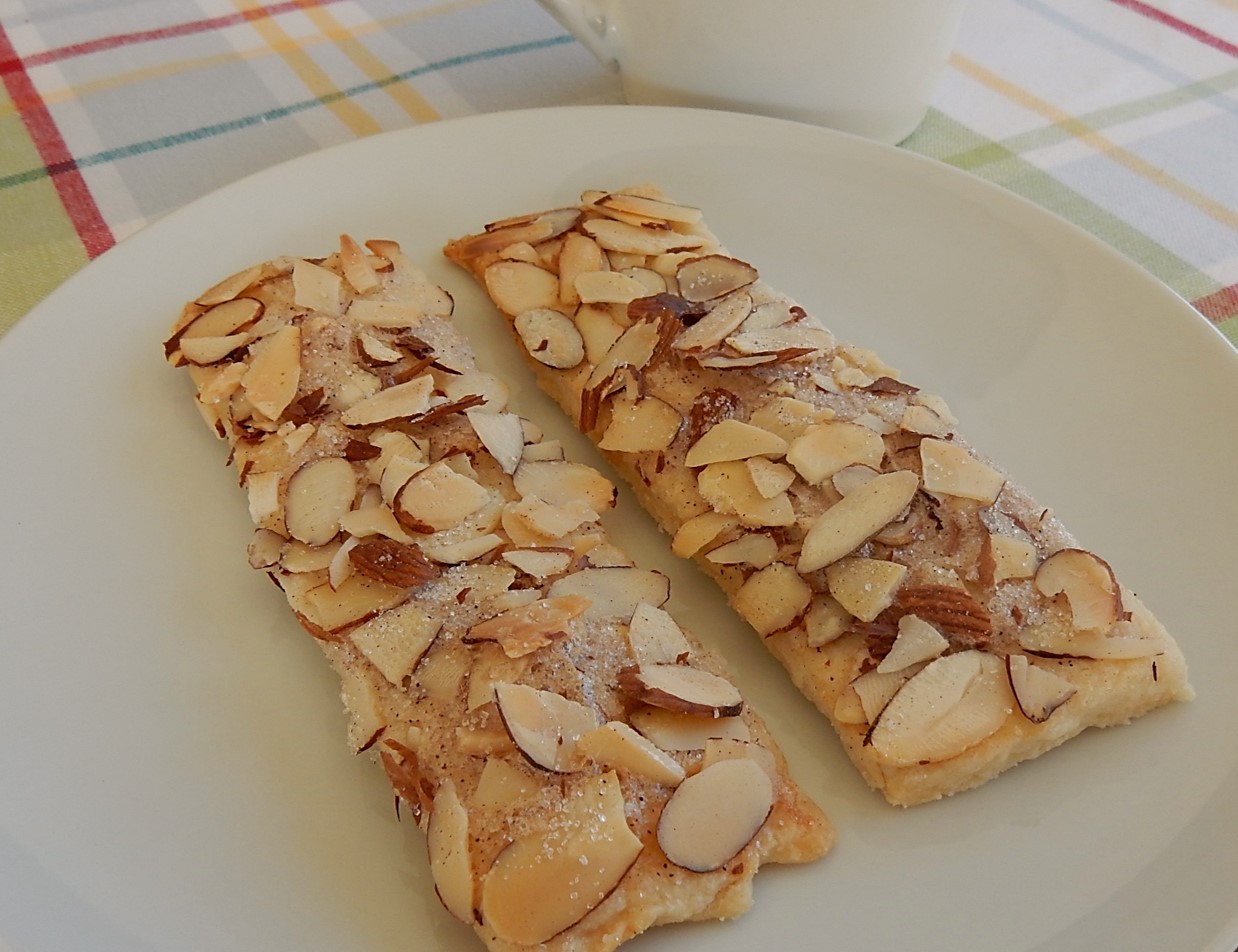
Almond Strips are bars of baked pastry dough topped with cinnamon, sugar, and almond slices. These bars are a great way to use those pastry scraps – yet are so pretty and tasty that they can be served without apology.
Here is the original recipe:
Source: Recipes for Everyday by Janet McKenzie Hill (1919)
pie pastry for a 1-shell pie (or use scraps of pastry dough left-over after making a pie crust)
1 egg white
Put sugar and cinnamon in a small bowl; stir to combine. Then add almond slices; stir. Set aside.
Preheat oven to 425° F. Roll pie pastry into a rectangle 1/4-inch thick. Cut into strips 2 inches X 4 inches. Place strips on a greased cookie sheet. Brush with egg white and sprinkle with sugar/cinnamon/almond mixture. Make sure the sugar and almonds are distributed evenly across the bars. Press lightly. Bake for approximately 10 -15 minutes (or until lightly browned).
Source: Source: Stickney & Poor advertisement, American Cookery (November, 1919)
Making a toast can be nerve-racking. And, it’s always especially stressful to decide what to say. It may be a little out of date, but here is some hundred-year-old advice:
Toasts for Dinner Occasions
Since much of the enjoyment of good toasts comes from clever local allusions, it would be difficult to make specific suggestions for dinners in general. Almost any subject, if well handled, will stimulate a good response. Such topics of current interest as the coal strike and the “wet” and “dry” issues, treated with humor and without political bias, furnish unfailing springs of interest.
Local practices and happenings, covert and complimentary allusions to the guest of honor, or to the business or profession of other prominent guests will be in order.
Each Fall I buy a Delicata squash and roast it, but until I came across a hundred-year-old Delicata squash recipe, I never gave any thought to other ways that it might be prepared. It was fun to try a “new” way of serving this old-time squash.
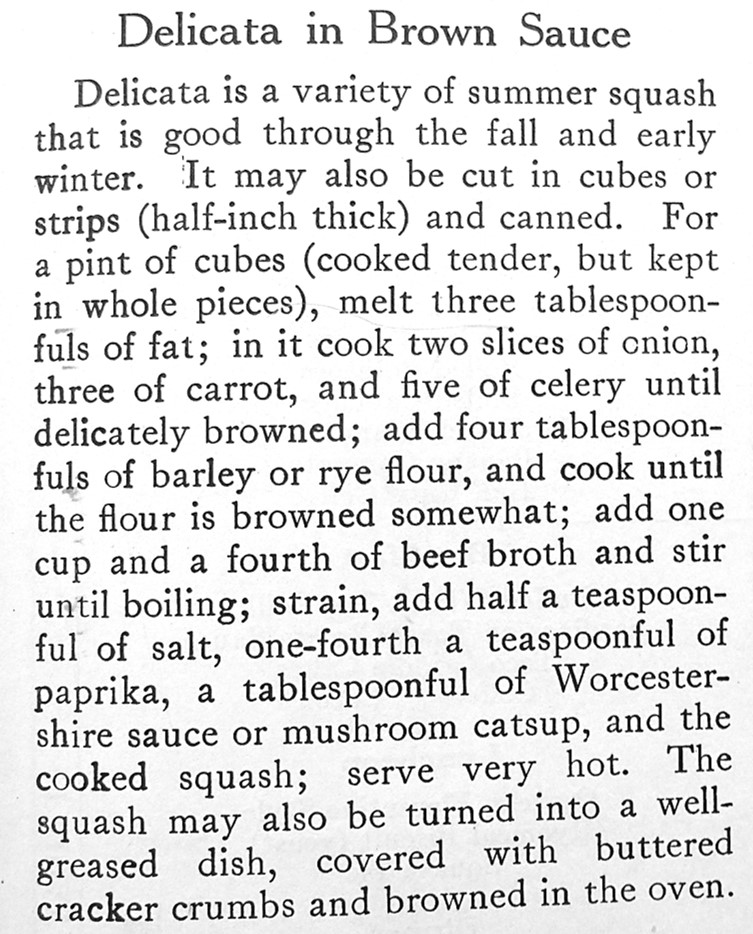
The century-old recipe was for Delicata Squash in Brown Sauce. The recipe called for cubed squash that is served in a delightful classic brown sauce.
Here is the original recipe:
Source: American Cookery (January, 1919)
I made several adaptions and assumptions when making this recipe. I used fresh Delicata squash rather than canned. And, I used butter rather than “fat.”
I was a bit foggy about what was meant by three slices of carrot and five of celery. Does the recipe really mean just a few small pieces of sliced carrot and celery – or was it referring to larger chunks? I made the assumption that the recipe was calling for one carrot and two stalks of celery – but this may not be what the recipe writer intended.
And, have you ever heard of mushroom ketchup? Since I didn’t have any idea what it was, I went with the Worcestershire sauce option.
4 tablespoons rye or barley flour (I used rye flour.)
1 1/4 cups beef broth
1/2 teaspoon salt
1/4 teaspoon paprika
1 tablespoon Worcestershire sauce
Peel squash, halve and remove seeds and membranes; then cut into 1-inch cubes. Place in a saucepan and cover with water. Put on the stove and bring to a boil using high heat; then reduce heat and simmer until tender (about 15 minutes). Remove from heat and drain.
In the meantime, melt butter in a skillet. Add onion, carrot and celery; sauté until tender using medium heat. Stir in the flour, and continue stirring until the flour just begins to brown. Gradually add beef broth while stirring constantly; continue stirring until the mixture comes to a boil. Remove from heat and strain; reserve the strained sauce. (If desired, the cooked vegetables may be served separately; otherwise discard.) Return the strained sauce to the saucepan; stir in salt, paprika, and Worcestershire sauce. Reheat until hot.
To serve, place cooked squash in serving dish. Pour brown sauce over the squash.
Advertising is supposed to convince people that they should buy a product. Sometimes an ad that apparently worked well a hundred years ago doesn’t work quite as well today.
If I wanted to promote salt, I won’t say “white as hoar-frost on pumpkins.” Is it just me, or do others not know what “hoar-frost” is? Of course, I could google the term – but by then I’ve lost all interest in buying the product.
And, would an ad today promote the “sanitary package”?