Old-Fashioned Harlequin Salad

The iconic novel jazz age novel, The Great Gatsby, was published in 1925. Here’s a description of the foods served at one of Gatsby’s parties:

On buffet tables, garnished with glistening hors­ d’œuvres, spiced baked hams crowded against salads of harlequin designs and pastry pigs and turkeys be­witched to a dark gold. In the main hall a bar with a real brass rail was set up, and stocked with gins and liquors and with cordials so long forgotten that most of his female guests were too young to know one from an­other (Chapter 3).

There apparently were a variety of salads that had “harlequin designs.” I knew that “harlequin” can mean a masked comic character who wears bright clothes, but I was uncertain of the meaning of the word in this context, so I looked it up. According the Cambridge Dictionary, another definition of harlequin is, “fancifully varied in color, decoration, etc.”

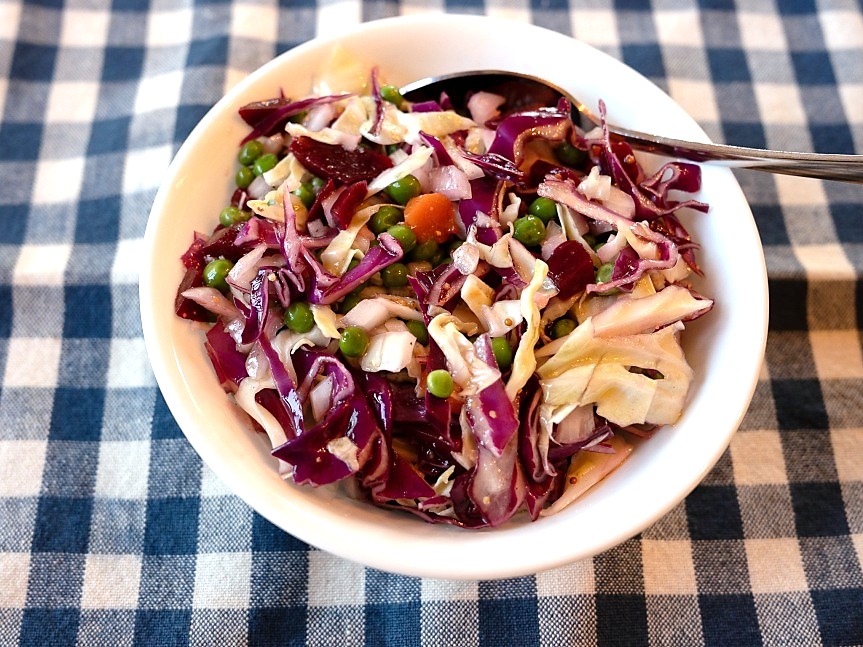
“Salads of harlequin designs” sounds beautiful, so when I came across a recipe in a hundred-year-old cookbook for Harlequin Salad, I just had to give it a try. The tasty, colorful, vibrant salad contained shredded red and green cabbage, chopped beets and carrots, peas, and onion in a vinaigrette dressing.

Here’s the original recipe:

Harlequin Salad recipe
Source: Rumford Complete Cookbook (1925)

The recipe called for French peas. I assumed this referred to green peas. It also called for white cabbage. I assume this is another name for the typical green cabbage.

I mixed all the ingredients together since the recipe said that “the effect is better if they are mixed,” though I’m intrigued by the possibility of creating an incredible harlequin design by arranging in “heaps.”

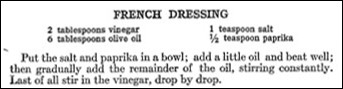
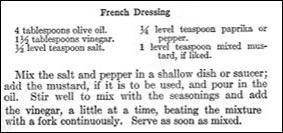
Here is the recipe for French Dressing that was in the same cookbook that contained the Harlequin Salad recipe:

French Dressing Recipe
Source: Rumford Complete Cook Book (1925)

Both the salad recipe and the salad dressing recipe called for salt and pepper (or paprika). I only put the seasonings in the dressing, and used 1/8 teaspoon of pepper and 1/8 teaspoon of paprika (as well as 1/3 teaspoon salt).

And, here’s the recipe updated for modern cooks:

Harlequin Salad

  • Servings: 5-7
  • Difficulty: moderate
  • Print

1 cup red cabbage, finely shredded

1 cup green cabbage, finely shredded

1 cup onions, chopped

1 cup green peas (I used frozen peas that had been thawed.)

1/2 cup cooked beets, coarsely chopped (cool before layering in jar)

1/2 cup cooked carrots, coarsely chopped (cool before layering in jar)

dressing (see below)

Put all ingredients (except dressing) in a bowl and lightly toss to mix. Gently stir in the dressing, then chill for at least an hour.

Dressing

1/3 teaspoon salt

1/8 teaspoon pepper

1/8 teaspoon paprika

1 teaspoon prepared mustard

4 tablespoons olive oil

1 1/2 tablespoons vinegar

Put the salt, pepper, paprika, and mustard in a small bowl; stir to combine. Add the olive oil and stir until mixed. Slowly add the vinegar, a little at a time, while stirring continuously with a fork.

http://www.ahundredyearsago.com

Old-Fashioned String Bean Salad (Green Bean and Radish Salad)

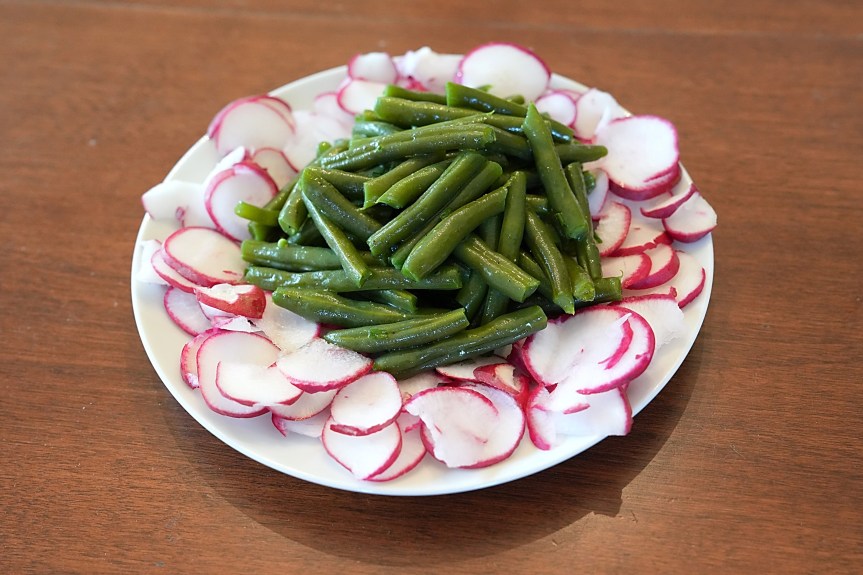
I bought some lovely green beans at the farmers’ market. When I got home, I started looking through my hundred-year-old cookbooks for a good green bean recipe. I found a recipe for String Bean Salad and decided to give it a try. It was different from any string bean salad recipe I had ever previously seen. The String Bean Salad basically was cold cooked green beans coated with a vinaigrette dressing, and then piled in the center of a plate with thinly sliced radishes arranged in a circle around the beans.

The String Bean Salad (or, as I prefer to call this dish, the Green Bean and Radish Salad) made a lovely, attractive presentation. The light and tangy vinaigrette dressing on the beans worked well with the crisp and slightly peppery sliced radishes to create a delightful, flavorful salad.

Here’s the original recipe:

Recipe for String Bean Salad
Home Makers’ Cooking School Cook Book (1925)

I used green beans when I made this recipe.  I thinly sliced 5 medium radishes (about 1 cup sliced radishes).

And, here is the recipe in the same cookbook for French Dressing:

Recipe for French Dressing
Source: Home Makers’ Cooking School Cook Book (1925)

Since the String Bean Salad recipe only called for two cups of beans, I decided that the French Dressing recipe would make more dressing than I needed, so I halved it. For the oil, I used olive oil; and, for the vinegar, I used apple cider vinegar.

Over the years, I’ve made several hundred-year-old French Dressing recipes. All are very different from the modern bright orange French Dressing that is sold in stores today. This old French Dressing recipe is basically a vinaigrette dressing. When I updated the recipe, I called the dressing a vinaigrette since it seemed like a more accurate description.

Here’s the recipe updated for modern cooks:

String Bean Salad (Green Bean and Radish Salad)

  • Servings: 3 - 4
  • Difficulty: easy
  • Print

2 cups cold cooked green beans (Before cooking, remove ends from beans and break into bite-sized pieces.)

1 teaspoon chopped chives or onion (I used chives.)

Vinaigrette Dressing (See recipe below.)

1 cup thinly sliced radishes (4 – 5 medium radishes)

Put the green beans and chopped chives or onion in a bowl; add the Vinaigrette Dressing, then gently toss to coat the beans with the dressing. Put the beans in the center of a plate and arrange the radishes in a circle around the beans.

Vinaigrette Dressing

2 tablespoons olive oil

1 tablespoon apple cider vinegar

1/4 teaspoon salt

1/8 teaspoon pepper

Put all the ingredients in a small bowl, stir quickly to combine using a  small whisk or fork.

http://www.ahundredyearsago.com

Old-Fashioned Lettuce, Cucumber, and Chive Salad

Lettuce, Cucumber, and Chive Salad

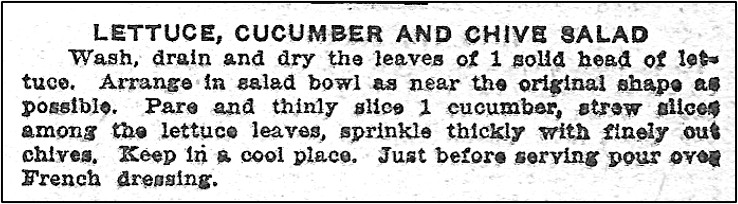
I’m enjoying making various summer salads, so when I saw a recipe in a hundred-year-old cookbook for Lettuce, Cucumber, and Chive salad, I decided to give it a try. The salad had a light vinaigrette-style dressing on it and was lovely.

Here’s the original recipe:

Recipe for Lettuce, Cucumber, and Chive Salad
Source: The Daily Argus-Leader Home Economics and Cook Book, Sioux Falls, South Dakota (1925)

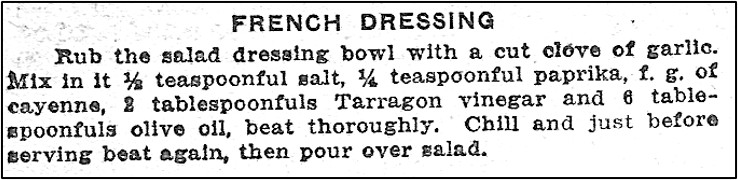
And, here is the original recipe for French Dressing:

Recipe for French Dressing
Source: The Daily Argus-Leader Home Economics and Cook Book, Sioux Falls, South Dakota (1925)

I had a lovely bunch of leaf lettuce that I used to make this recipe. I’m not sure what type of lettuce the recipe author anticipated cooks using, but I did not try very hard to arrange the leaves as near as possible to the original shape. I thought that it was more important to have the lettuce in bite-size pieces than to worry about the shape.

The recipe called for serving this salad with French Dressing. I used a French Dressing recipe that was in the same cookbook as the salad recipe. It is a vinaigrette-style recipe and is quite different from the modern commercially-produced, orange-colored French Dressing. I’ve seen many French Dressing recipes in various hundred-year-old cookbooks over the years, and they have all have been vinaigrettes. I’m not sure when the shift occurred to the orange-colored type of French Dressing.

The French Dressing recipe called for a f.g. of cayenne (red pepper). I have no idea what unit of measure an “f.g.” is, but assumed that it wasn’t calling for much, so I interpreted it to mean a dash.

Here’s the recipe updated for modern cooks:

Lettuce, Cucumber, and Chive Salad

  • Servings: 3 - 4
  • Difficulty: moderate
  • Print

1 head/bunch lettuce

1 cucumber, peeled and thinly slices

3 tablespoons chives, finely chopped

Dressing

1 clove garlic

1/2 teaspoon salt

1/4 teaspoon paprika

dash cayenne (red pepper)

2 tablespoons tarragon vinegar

6 tablespoons olive oil

Wash and dry the lettuce, then tear into pieces and arrange on plates or in a bowl. Put the chopped chives on top of the cucumber slices.  Just before serving, top with the dressing.

To make dressing, cut the garlic clove in half, then rub a small bowl with the cut garlic. Put the salt, paprika, cayenne pepper, tarragon vinegar and olive oil in bowl and stir vigorously to combine.

http://www.ahundredyearsago.com

Old-Fashioned Surprise Salad

Surprise Salad

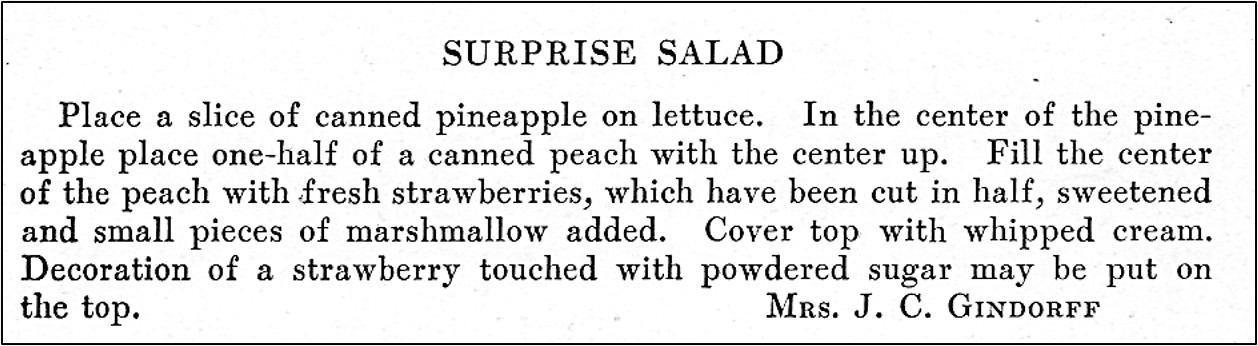
Sometimes recipe titles in old cookbooks do not provide much information about a recipe. For example, I recently came across a recipe for Surprise Salad in a hundred-year-old church cookbook. When I read the recipe, I was surprised to discover (maybe that’s why it’s called Surprise Salad) that it was a fruit salad that called for canned pineapple slices, canned peach halves, and fresh strawberries with marshmallows and a dollop of whipped cream for good measure. The salad is served on lettuce leaves. The ingredients are stacked with a focus on presentation.

I enjoyed the salad (though in some ways- especially if I skipped the lettuce – it seems more like a dessert than a salad). I would make it again. Occasionally, I have friends over and serve a meal based on hundred-year-old recipes. Surprise Salad would be perfect for one of those meals. The ingredients and presentation are different from modern recipes, which could lead to a fun conversation, but I also think that they would enjoy it,

Here’s the original recipe:

Recipe for Surprise Salad
Source: Diamond Jubilee Recipes (Compiled by The Sisters of Saint Joseph, St. Paul, Minnesota, 1925)

I tried dipping the whole strawberries that go on the top in powdered sugar, but I did not like the way it looked so I washed the powdered sugar off the berries.

Here’s the recipe updated for modern cooks:

Surprise Salad

  • Servings: 3
  • Difficulty: moderate
  • Print

1/2 cup strawberries + 3 small strawberries

1 tablespoon sugar

1/4 cup miniature marshmallows, each cut into two pieces

lettuce leaves

3 slices of canned pineapple

3 canned peach halves

1/4 cup whipped cream

Cut the strawberries in half (reserving 3 small strawberries that are left whole). If the berries are large, cut each berry into several pieces. Put the cut berries and cut marshmallows in a small bowl, then add sugar and gently stir to distribute the sugar.  Set aside.

For each serving, arrange lettuce leaves on plate, then put a pineapple slice on the lettuce. Place a peach half (with the center up) in the center of the pineapple slice. Fill the peach cavity with the strawberry and marshmallow mixture. Keep the strawberry/marshmallow mixture as level as possible to make a firm foundation for the whole strawberry that goes on the very top. Top with a spoonful of whipped cream, then garnish with a small whole strawberry.

http://www.ahundredyearsago.com


Winter Salad Suggestions a Hundred Years Ago


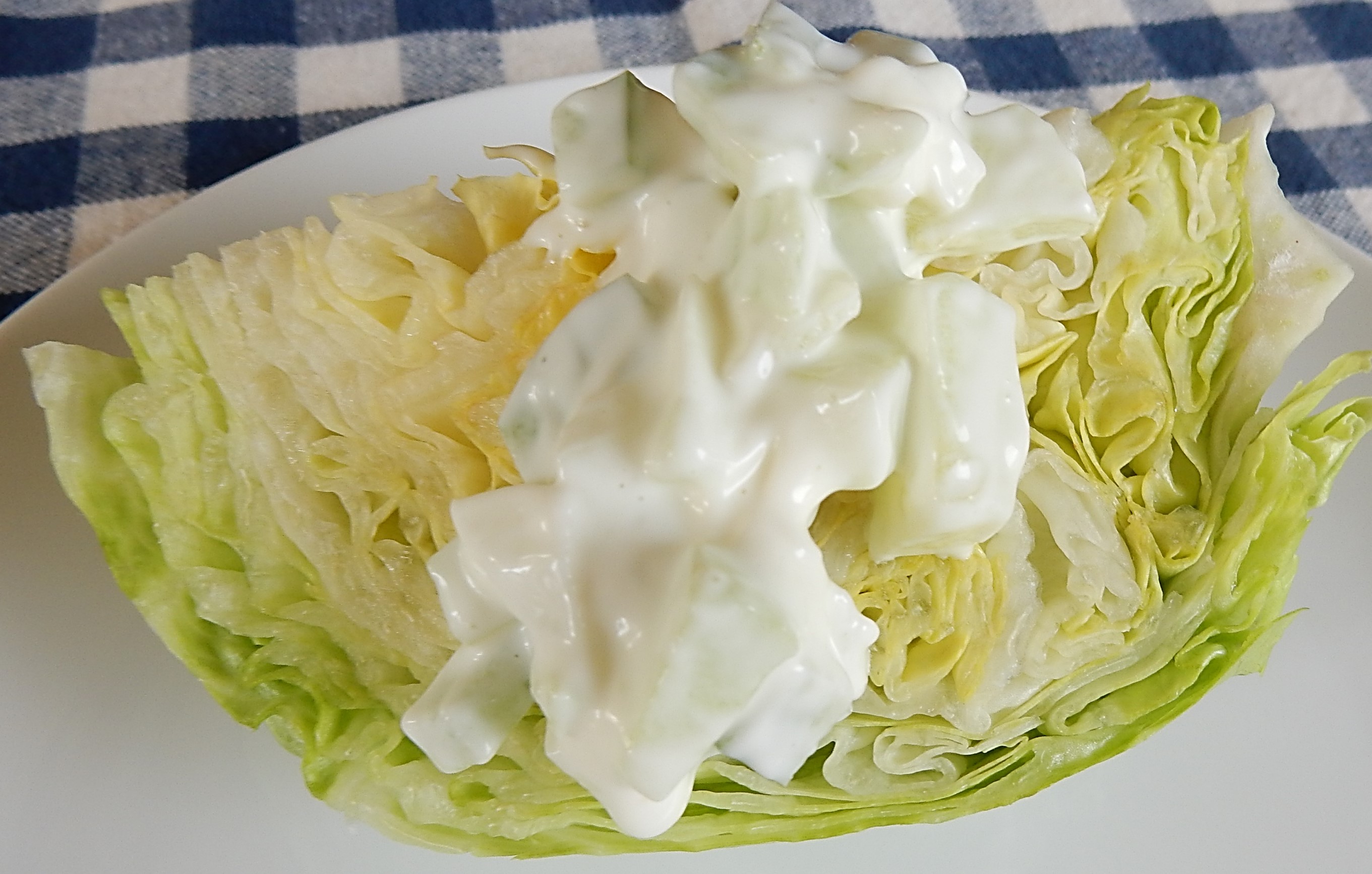
Lettuce with Cucumber Sauce on plateA hundred years ago salad options during the winter months were more limited than they are today. Here is what it said in a 1925 cookbook:

Almost every variety of vegetables and fruits may be made into salads. Eggs are used also, as well as many kinds of fish and meat. Vegetable salads are the most common and should therefore receive first consideration.

Naturally, lettuce heads the list. It is more popular because we can get it when other vegetables are almost unobtainable. The round, close heads are more generally used than the long-leaf variety. Curly lettuce, while pretty, is tougher than either of the other two. Lettuce contains little nutriment, but is rich in mineral salts. . .

In winter, when fresh salad plants are hard to obtain, a tomato jelly or salad made from canned or fresh (cooked) string beans, or even from the remains of baked beans seasoned with parsley and onion juice, is economical and satisfying.

Rumford Complete Cook Book (1925)

Old-Fashioned Hot Slaw with Sour Cream Sauce

Hot slaw with sour cream dressing

When browsing through a hundred-year-old magazine, I came across a recipe for Hot Slaw with Sour Cream Sauce, and decided to give it a try.

The Hot Slaw was mild,  rich, and creamy. The recipe called for only 1 tablespoon of vinegar (and no sugar), so the flavors were much more nuanced than many modern slaws.

Here’s the original recipe:

Recipe for Hot Slaw with Sour Cream Dressing
Source: American Cookery (October, 1924)

Here’s the recipe updated for modern cooks:

Hot Slaw with Sour Cream Sauce

  • Servings: 5 - 7
  • Difficulty: moderate
  • Print

1 head of cabbage (approximately 2 pounds; The cabbage should be firm and white.)

2 teaspoons salt

4 tablespoons butter

1 tablespoon flour

1 tablespoon water

1 cup sour cream

1 tablespoon tarragon vinegar or apple cider vinegar (I used apple cider vinegar.)

Grate or finely shred the cabbage. Stir the salt into the cabbage. Let sit for 30 minutes, then drain and rinse. Press to squeeze out excess water.

In a skillet or large saucepan, melt the butter. Stir in the cabbage. (Do not add water.) Cover and cook over low heat for 10 minutes. Several times remove lid and stir to keep the cabbage from scorching, then replace lid. (The idea is to stir enough to prevent scorching, but to keep the steam in as much as possible as the cabbage cooks.) Cook for 10 minutes.

In the meantime, stir water into the flour to make a thick paste. Then stir in the sour cream. Stir the sour cream mixture into the hot cabbage, and cook for 1-2  additional minutes while stirring. Stir in the vinegar and serve.

http://www.ahundredyearsago.com

Old-Fashioned Banana and Nut Salad

Banana and Nut Salad on plate

I was intrigued by a hundred-year-old recipe for Banana and Nut Salad, so decided to give it a try. This recipe was quick and easy to make. Just quarter a banana and roll in finely chopped nuts. The old recipe said to serve on a lettuce leaf and garnish with mayonnaise.

The Banana and Nut Salad was lovely, but I’d definitely skip the mayonnaise if I made this recipe again.

Here’s the original recipe:

Recipe for Banana and Nut Salad
Source: The New Butterick Cook Book

When I was cutting the bananas lengthwise, I accidently broke one of the banana halves into two – but I was pleasantly surprised how much better the presentation looked with the broken banana half, than with the whole half. So I adapted the recipe to indicate that the banana should be quartered.

I put mayonnaise on the Banana and Nut Salad. I didn’t try boiled dressing, and I didn’t try mixing whipped cream with mayonnaise. It seemed like mixing whipped cream and mayonnaise could potentially ruin some perfectly good whipped cream. However, just using whipped cream with no mayonnaise might be a nice addition.

Here’s the recipe updated for modern cooks:

Banana and Nut Salad

  • Servings: 6 (1/2 banana per serving)
  • Difficulty: easy
  • Print

3 bananas

1/2 cup finely chopped nuts (I used pecans.)

lettuce, optional

1/2 cup mayonnaise, optional

Peel bananas and cut each into two lengthwise, then cut each piece again to quarter. Roll each piece in the finely chopped nuts. If desired, place on lettuce leaves and garnish with mayonnaise.

http://www.ahundredyearsago.com