Old-Fashioned White Layer Cake with Caramel Nut Filling


slice of white cake with caramel nut filling

Layer cakes with a filling between the layers were very popular a hundred years ago. Modern cookbooks often have a few frosting recipes and maybe one or two cake filling recipes at the end of the Cake chapter, but some old cookbooks have so many filling and frosting recipes that they have a separate chapter for them. For example, a 1925 cookbook, the Rumford Complete Cookbook, has a chapter titled Cake Fillings, Frostings, and Icings. There are eleven cake filling recipes including Fig Filling, Maple Filling, Orange and Walnut Filling, Orange and Coconut Filling, Mocha Filling, Marshmallow Filling, Prune Almond Filling, and Caramel Nut Filling.

All the fillings looked either intriguing or tasty, but I only wanted to make one cake, so I had to pick one. Some of the fruit fillings tempted me, but in the end I decided to make Caramel Nut Filling. I thought that a white cake would work well with this filling, so I flipped back to the Cake chapter and found a recipe for White Layer Cake.

After I assembled the cake with the filling in the middle, I iced it with a Buttercream Frosting. There were no Buttercream Frosting recipes in the Rumford Complete Cookbook. I guess that the author assumed that cooks knew how to make it without a recipe.

The cake was excellent. The cake itself was moist, light, and tender with a delicate vanilla flavor. The filling was a lovely fusion of a rich caramel and crunchy nuts. (I used walnuts.)

Here’s the original cake recipe:

Recipe for White Layer Cake
Source: Rumford Complete Cook Book (1925)

The recipe does not specify which type of “flavoring extract” should be used. I used vanilla. The old recipe says to bake the cake for about twenty minutes. I baked the cake at 350° F. and it actually took about 25-30 minutes until a wooden pick inserted in the center came out clean.

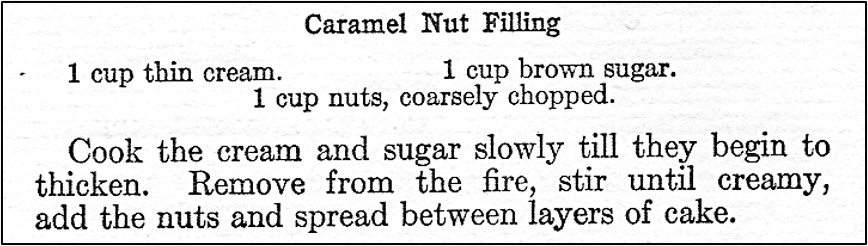
Here’s the original Caramel Nut Filling recipe:
Recipe for Caramel Nut Filling
Source: Rumford Complete Cook Book (1925)

When I read the Caramel Nut Filling recipe, I was not sure what it meant when it said to cook the cream and sugar “till they begin to thicken.” I interpreted it to mean to cook it until it reached the soft ball stage (235° F.). This worked fine, and the filling turned out well.

Here are the recipes updated for modern cooks:

White Layer Cake with Caramel Nut Filling

  • Servings: 10 - 12
  • Difficulty: moderate
  • Print

White Layer Cake

4 egg whites

1/2 cup butter, softened

1 1/2 cups sugar

1/2 cup milk

1 teaspoon vanilla

2 teaspoons baking powder

1/3 teaspoon salt

1 1/2 cups flour

Preheat oven to 350° F. Grease two 9-inch round cake pans; line with waxed paper or parchment paper, then grease again and lightly flour.

Put egg whites into a mixing bowl, and beat until peaks form. Set aside.

Put butter and sugar in a large mixing bowl, then beat to cream. Add milk and vanilla, then add the baking powder, salt, and flour. Beat until well-mixed. Gently fold in the beaten egg whites. Pour half of the batter into each of the two cake pans.

Bake the layers for 25 to 30 minutes or until a wooden pick inserted in center comes out clean. Cool 10 minutes. Remove from pans. Cool the layers before assembling the cake.

Trim cake layers if needed to make even, then put a cake layer on a plate. Spread with the Caramel Nut Filling, and then top with the other layer. If desired, frost the cake. (I used a Buttercream Icing.)

Caramel Nut Filling

1 cup half and half

1 cup brown sugar

1 cup nuts, coarsely chopped (I used walnuts.)

Put the half and half and the brown sugar in a saucepan. Stir to combine, bring to a boil using medium heat. Reduce heat and simmer gently until the mixture reaches the soft ball stage (235° F.). Remove from the heat and stir in the chopped nuts. Spread between the layers of cake.

http://www.ahundredyearsago.com

Old-Fashioned Surprise Salad

Surprise Salad

Sometimes recipe titles in old cookbooks do not provide much information about a recipe. For example, I recently came across a recipe for Surprise Salad in a hundred-year-old church cookbook. When I read the recipe, I was surprised to discover (maybe that’s why it’s called Surprise Salad) that it was a fruit salad that called for canned pineapple slices, canned peach halves, and fresh strawberries with marshmallows and a dollop of whipped cream for good measure. The salad is served on lettuce leaves. The ingredients are stacked with a focus on presentation.

I enjoyed the salad (though in some ways- especially if I skipped the lettuce – it seems more like a dessert than a salad). I would make it again. Occasionally, I have friends over and serve a meal based on hundred-year-old recipes. Surprise Salad would be perfect for one of those meals. The ingredients and presentation are different from modern recipes, which could lead to a fun conversation, but I also think that they would enjoy it,

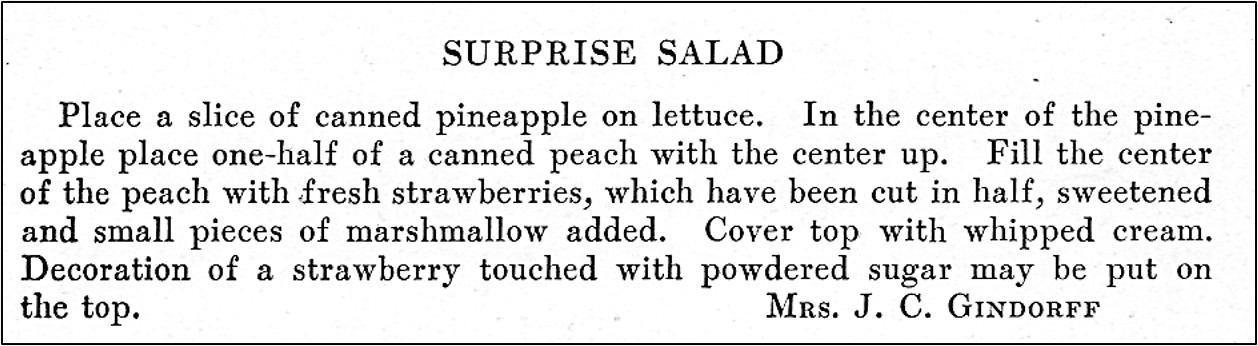
Here’s the original recipe:

Recipe for Surprise Salad
Source: Diamond Jubilee Recipes (Compiled by The Sisters of Saint Joseph, St. Paul, Minnesota, 1925)

I tried dipping the whole strawberries that go on the top in powdered sugar, but I did not like the way it looked so I washed the powdered sugar off the berries.

Here’s the recipe updated for modern cooks:

Surprise Salad

  • Servings: 3
  • Difficulty: moderate
  • Print

1/2 cup strawberries + 3 small strawberries

1 tablespoon sugar

1/4 cup miniature marshmallows, each cut into two pieces

lettuce leaves

3 slices of canned pineapple

3 canned peach halves

1/4 cup whipped cream

Cut the strawberries in half (reserving 3 small strawberries that are left whole). If the berries are large, cut each berry into several pieces. Put the cut berries and cut marshmallows in a small bowl, then add sugar and gently stir to distribute the sugar.  Set aside.

For each serving, arrange lettuce leaves on plate, then put a pineapple slice on the lettuce. Place a peach half (with the center up) in the center of the pineapple slice. Fill the peach cavity with the strawberry and marshmallow mixture. Keep the strawberry/marshmallow mixture as level as possible to make a firm foundation for the whole strawberry that goes on the very top. Top with a spoonful of whipped cream, then garnish with a small whole strawberry.

http://www.ahundredyearsago.com


Old-Fashioned Honey Tea Crackers

honey tea crackers on plate

Want a cross between a cracker and a cookie? If so, I have just the recipe for you. I recently was browsing through a hundred-year-old cooking magazine and came across a recipe for Honey Tea Crackers. The name of the recipe made me salivate, and I was ready to give the it a try. But, when I looked at the recipe a little more, I was a little confused. The recipe called for putting an almond or walnut half on top of each cracker. Crackers don’t generally have nuts on top of them. And, when I thought about it, I realized that most crackers are salty or savory, not sweet.

The more I looked at the recipe, the more I was intrigued I became – and I soon was mixing up a batch of the crackers. Since it seemed unusual to put nuts on crackers, I did not put a nut on top of some of the crackers.

The recipe turned out well, though Honey Tea Crackers are not typical of modern crackers. In addition to honey, the crackers contain allspice as well as some lemon juice and grated lemon rind. The crackers were sweet with the complex undertones of honey and lemon, and a hint of allspice. They have the texture of a cut-out cookie that had been rolled out very thin. I put almonds on some crackers and walnuts on others. Both types of nuts worked well, and I don’t have a preference, but I definitely preferred the crackers that had a nut on top over the plain ones. In hindsight, I wish that had  just followed the old recipe and put a nut on top of all of them.

Here’s the original recipe:

Recipe for Honey Tea Crackers
Source: American Cookery (May, 1925)

I did not dissolve the baking soda prior to adding to the other ingredients, and it worked fine. The mixture, however, seemed very dry, so I added a little more than the 1 teaspoon of water called for in the recipe.

The recipe calls for pricking the crackers “all over.” I was surprised how long it took to prick a lot of crackers, so be sure to allow sufficient time.

Here’s the recipe updated for modern cooks:

Honey Tea Crackers

  • Servings: about 90 crackers
  • Difficulty: moderate
  • Print

3 cups flour

1 teaspoon salt

1 teaspoon allspice

1/4 teaspoon baking soda

3 eggs

grated rind of 1/2 lemon

juice from 1/2 lemon

3 tablespoons honey + 2 tablespoons honey

1 teaspoon water (add more if needed) + 2 tablespoons water

almonds or walnut halves (if desired)

Preheat oven to 350 degrees F.  In a small bowl, mix together 2 tablespoons honey and 2 tablespoons water. Set aside.

Sift together flour, salt, allspice and baking soda. Add eggs, grated lemon rind, lemon juice, 3 tablespoons honey, and 1 teaspoon water; stir to mix. If the dough is too dry, add additional water. On a prepared surface, roll the dough out until it is very thin (1/4 inch or a little less). Cut into circles using a round cutter. (I used a cutter that was 2 inches in diameter.) Put the crackers on a lightly greased baking sheet. Prick all over each cracker with a fork. Brush the crackers with the honey and water mixture. If desired, press an almond or walnut half into the center of each cracker. Put into oven, and bake for 15-20 minutes or until lightly browned.

http://www.ahundredyearsago.com

Old-Fashioned Pound Cake Waffles

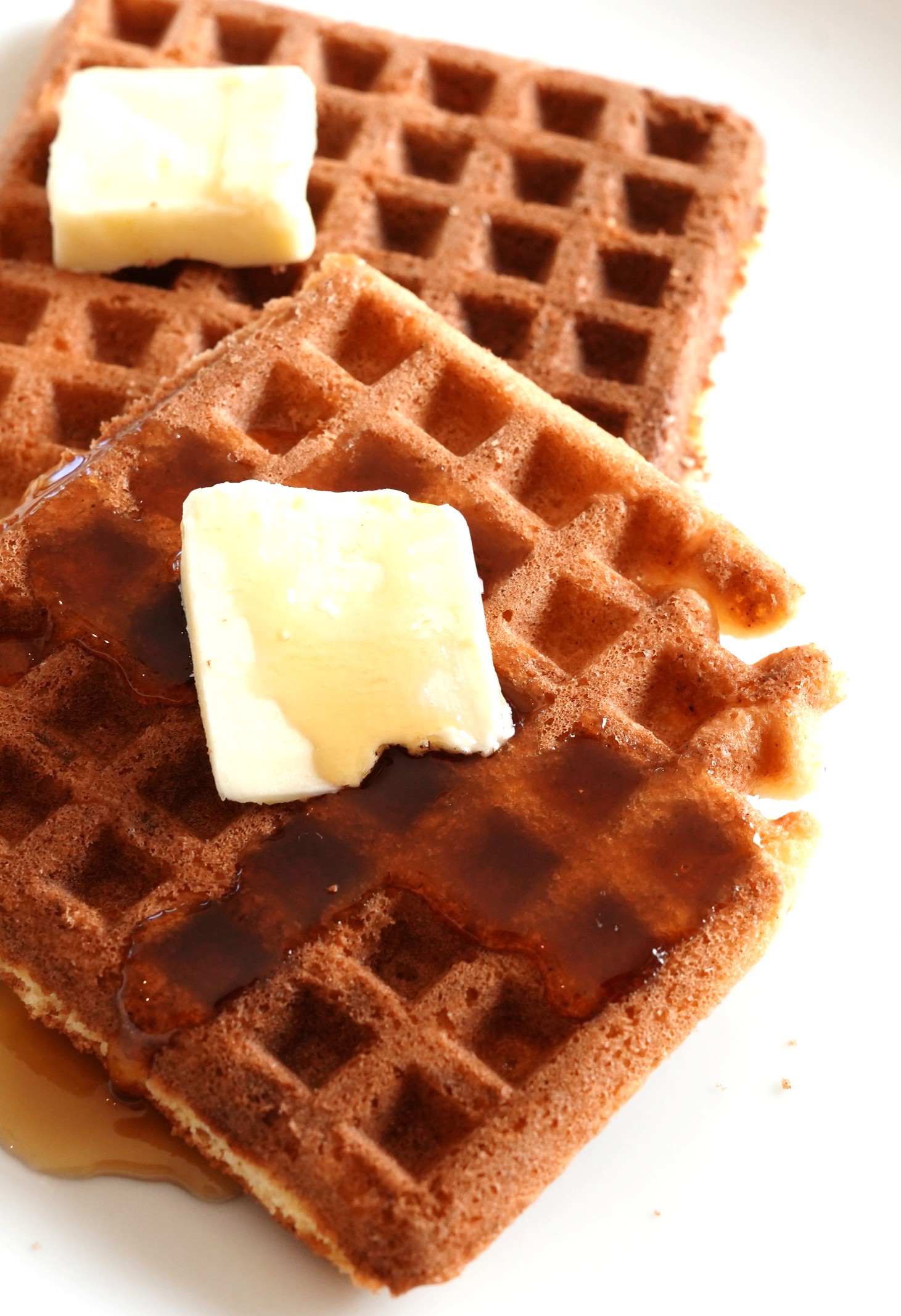
Pound Cake Waffles

When browsing through hundred-year-old cookbooks, I came across a recipe for Pound Cake Waffles. The title intrigued me. The recipe called for lots of butter and sugar, and was very similar to actual Pound Cake recipes. I decided to give it a try. The recipe indicated that either lemon or vanilla flavoring could be used in the recipe. I went with lemon extract.

The waffles were lovely with a sunny lemon flavor that worked nicely with the maple syrup that I put on the waffles.

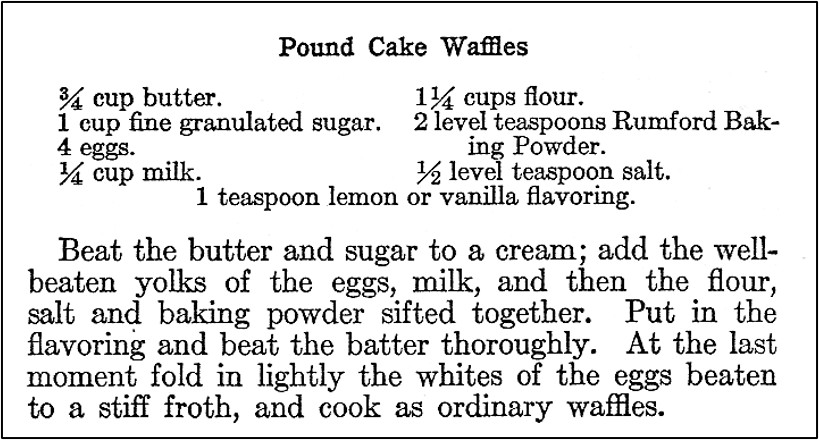
Here’s the original recipe:

Recipe for Pound Cake Waffles
Source: The Rumford Complete Cook Book (1925)

Here’s the recipe updated for modern cooks:

Pound Cake Waffles

  • Servings: 4 - 6
  • Difficulty: moderate
  • Print

3/4 cup butter

1 cup sugar

4 eggs, separated

1/4 cup milk

1 1/4 cups flour

2 teaspoons baking powder

1/2 teaspoon salt

1 teaspoon lemon extract or vanilla (I used lemon extract.)

Beat egg whites, then set aside. Put butter and sugar in a mixing bowl, then beat until creamed. Add the egg yolks and milk, then beat. Add the flour, baking powder, salt, and lemon extract or vanilla; beat until combined. Gently fold in the beaten egg whites. Ladle batter onto a hot waffle iron and cook, following the waffle iron directions.

http://www.ahundredyearsago.com

Old-Fashioned Maraschino Cherry Cake


Slice of Maraschino Cherry Cake on PlateI recently had some friends over and wanted to serve a nice dessert (and, of course, I wanted to make a hundred-year-old recipe), so I pulled out my 1925 recipe books and found a lovely recipe for Maraschino Cherry Cake.
The cake was colorful with cherry fragments throughout that gave it a delightful sweet, yet tart, flavor.

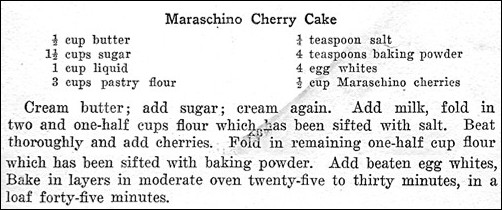
Here’s the original recipe:

Recipe for Maraschino Cherry Cake
Source: The Home Makers’ Cooking School Cook Book (1925)

This recipe calls for 1 cup of liquid. When, I made it, I used 1/4 cup of liquid from a jar of Maraschino cherries and 3/4 cup of milk.

The stores where I shop do not carry pastry flour, so I used all-purpose flour. It worked fine.

When I updated this recipe, I reduced the amount of baking powder from 4 teaspoons to 3 teaspoons. Four teaspoons seems like a lot, and I had a little difficulty with the cake falling. A possible cause is the use of too much baking powder, so I decided to reduce the amount.

Here’s the recipe updated for modern cooks:

Maraschino Cherry Cake

  • Servings: 12-15
  • Difficulty: moderate
  • Print

4 egg whites

1/2 cup butter, softened

1 1/2 cups sugar

1/4 cup liquid from jar of Maraschino cherries

3/4 milk

1/4 teaspoon salt

3 teaspoons baking powder

3 cups pastry (or all-purpose) flour

1/2 cup Maraschino cherries, chopped

Preheat oven to 350◦ F. Beat egg whites until stiff, then set aside.

Put butter and sugar in a mixing bowl, then cream. Stir in Maraschino cherry liquid and milk. Add salt, baking powder, and flour; beat until smooth. Stir in the chopped Maraschino cherries, then fold in the beaten egg whites. Put into prepared pans. A large loaf pan, round layer cake pans, or a rectangular cake pan may be used. Bake until a wooden pick inserted in the center comes out clean (about 35 minutes for cake pans or 45 minutes for a loaf pan).   If desired, ice. (I iced the cake with a buttercream frosting. I substitute liquid from a jar of Maraschino cherries for some of the milk when making the frosting.)

http://www.ahundredyearsago.com

Old-Fashioned Rhubarb Turnovers

Rhubarb Turnovers

Rhubarb is one of my favorite spring foods, so I was pleased to find a hundred-year-old recipe for Rhubarb Turnovers.  The turnovers were lovely.

Here’s the original recipe:

Recipe for Rhubarb Turnovers
Source: American Cookery (1925)

I was intrigued by the idea of using syrup from canned fruit as the topping for the Rhubarb Turnovers, so I used the syrup from a can of peaches canned in heavy syrup. A lemon sauce would also be tasty.

The instructions called for “red strawberry rhubarb.” The rhubarb I used was not particularly red, so the turnovers may not have been as attractive as they would have been if a redder rhubarb had been used, but they still looked nice.

I interpreted the instructions to roll the dough out to “less than 1/2 inch thick” to mean about 1/3 inch thick. I ended up with a few more turnovers than the 12 indicated in the recipe.

Here’s the recipe updated for modern cooks:

Rhubarb Turnovers

  • Servings: Approximately 12 - 15
  • Difficulty: moderate
  • Print

1 cup sugar

1/2 cup water

2 cups rhubarb (cut into 1-inch pieces)

3 cups flour

1 teaspoon salt

5 teaspoons baking powder

1/2 cup butter

1 cup milk

water and sugar

lemon sauce or syrup from any kind of canned fruit (I used syrup from peaches canned in heavy syrup.)

Combine the sugar and 1/2 cup water in a saucepan. Using medium heat bring to a boil, then reduce heat and simmer until the sugar syrup reaches the thread stage (225◦ F.). Add rhubarb pieces and cook until the rhubarb is soft and tender. Remove from heat.

In the meantime, preheat oven to 400◦ F. Sift flour, salt, and baking powder into a mixing bowl; then cut in the butter until the pieces are small (about the size of a peas). Add milk and mix using a fork until dough starts to cling together. Roll the dough on a prepared surface to about 1/3-inch thick. Cut the rolled dough into 4-inch rounds. (I used an inverted champagne coupe glass to cut the rounds.)

Using a slotted spoon, put a tablespoon of the cooked rhubarb in the center of each round. Fold in half. Moisten edges with water and seal by pressing edges with a fork. Put on baking tray, and bake for 18 minutes or until lightly browned. Removed from oven and use a pastry brush to brush with water, and then sprinkle with sugar. Return the turnovers to the oven for an additional  two minutes. Remove from oven.

Serve hot with lemon sauce or the syrup from any kind of canned fruit.

http://www.ahundredyearsago.com

Walnut Grove Potatoes (Scalloped Potatoes and Hard-Boiled Eggs)

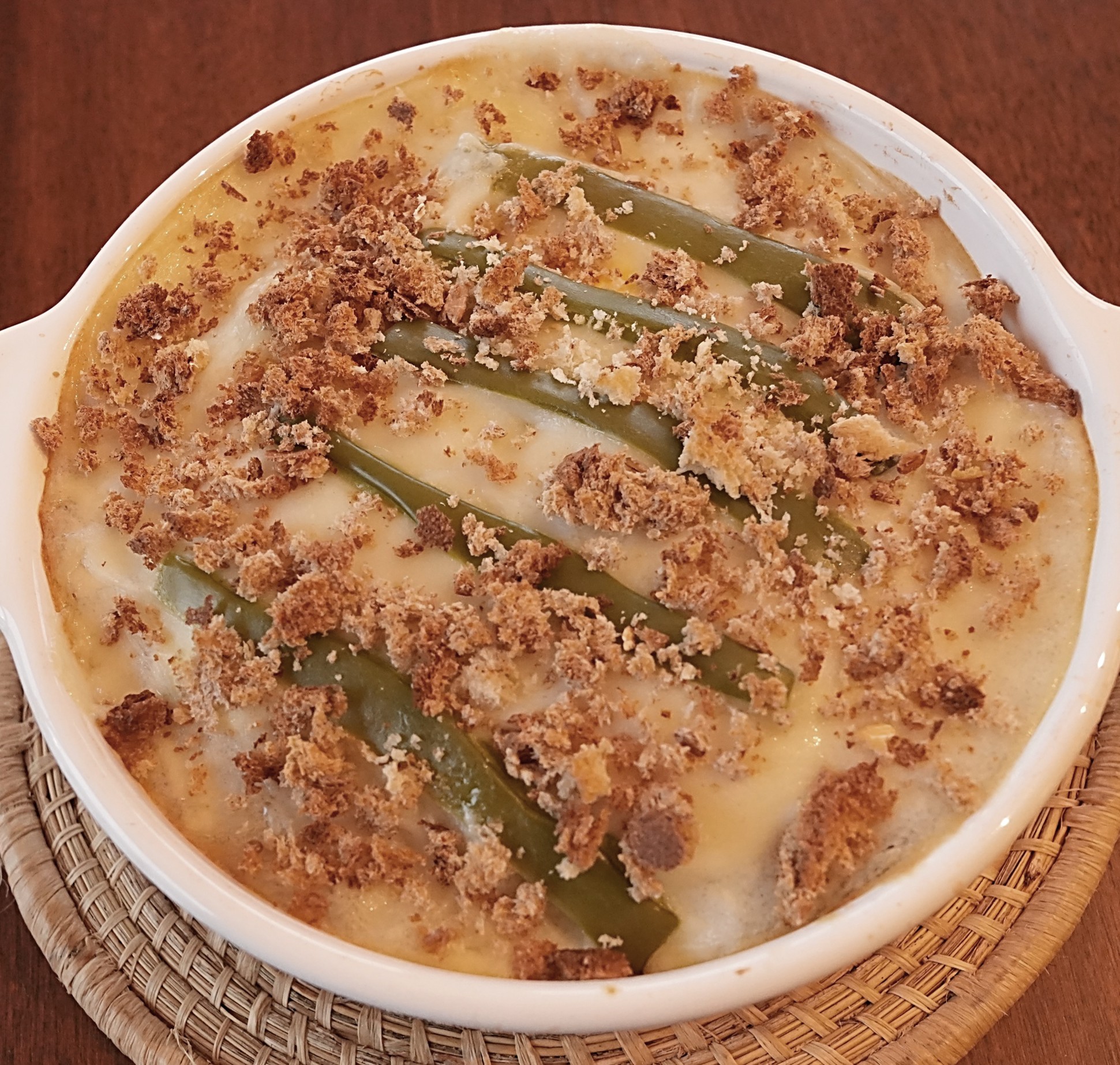
Walnut Grove Potatoes

HAPPY EASTER!

If your household is like mine, you have hard-boiled Easter eggs sitting in the refrigerator and are looking for ways to use them.  I came across a recipe in a hundred-year-old cookbook for Walnut Grove Potatoes, which is a fancy name for Scalloped Potatoes with Hard-Boiled Eggs. It was delightful, and is a great way to use those hard-boiled eggs.

Here’s the original recipe:

Recipe for Walnut Grove Potatoes
Source: Cook Book (Compiled by Women of the Country Club Christian Church, Kansas City, Missouri)

When I made this recipe, I interpreted “cream dressing” to mean white sauce. It did not work very well to put all of the white sauce on the top of the top layer of breadcrumbs, so I changed the recipe to indicate the white sauce should be one of the layers so that it is more evenly distributed.

Here’s the recipe updated for modern cooks:

Walnut Grove Potatoes

  • Servings: 3 - 5
  • Difficulty: moderate
  • Print

3 cups sliced, peeled potatoes (1/4-inch slices)

1 teaspoon salt + 1/2 teaspoon salt

3 hard-boiled eggs, sliced

1 cup coarsely-torn breadcrumbs (tear bread into 1-inch pieces) + 1/8 cup finely-torn breadcrumbs

2 tablespoons butter

2 tablespoons flour

1 1/2 cups milk

approximately 1/3 green pepper, thinly sliced

Preheat oven to 400° F. Put the sliced potatoes in a saucepan and cover with water; add 1 teaspoon salt. Bring to a boil using high heat; reduce and simmer until the potatoes are just barely tender (about 10-12 minutes). Remove from heat and drain.

In the meantime, in another pan, using medium heat, melt butter, then stir in the flour and 1/2 teaspoon salt. Gradually, add the milk while stirring constantly. Continue stirring until the white sauce begins to thicken. Remove from heat.

To assemble: Put 1/3 of the white sauce in the bottom of a casserole dish, add 1/2 of the cooked sliced potatoes, then add a layer composed of 1/2 of the hard-boiled egg slices, and a layer of 1/2 of the coarsely-torn breadcrumbs. Pour a third of the white sauce over the layers. Repeat the layers with the remaining sliced potatoes, hard-boiled egg slices, and coarsely-torn breadcrumbs. Pour the remaining white sauce over the top. Garnish with the green pepper slices and finely torn breadcrumbs. Put in oven and bake until hot and bubbly (about 30 minutes).

http://www.ahundredyearsago.com