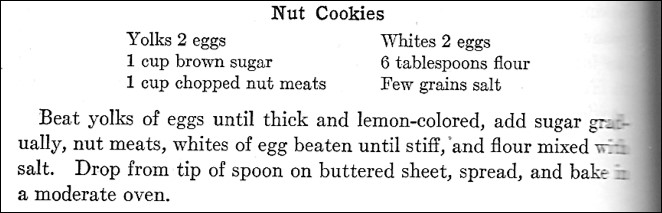
It’s the time of year to make cookies, so I was excited to try a hundred-year-old recipe for Nut Cookies. The cookies are made using egg whites that are stiffly beaten, which results in crispy, light cookies. They have a delightful texture and taste, however, I found them a bit challenging to make. When I made this recipe I used nonstick baking sheets, and had trouble with the cookies sticking to them. I am not sure why.
Here’s the original recipe:
Source: The Boston Cooking-School Cook Book (1923)
Preheat oven to 325° F. Put beat egg whites until stiff. Set aside.
Beat egg yolks until thick and lemon colored. Gradually add sugar, beaten egg whites, and flour mixed with salt. Gently stir in the nut meats. Drop from the tip of teaspoon onto a greased baking sheet to make circles about 3/4 inch in diameter. Bake 8-10 minutes or until the cookies are set and lightly browned.
Note: These cookies may have a tendency to stick to baking sheet.
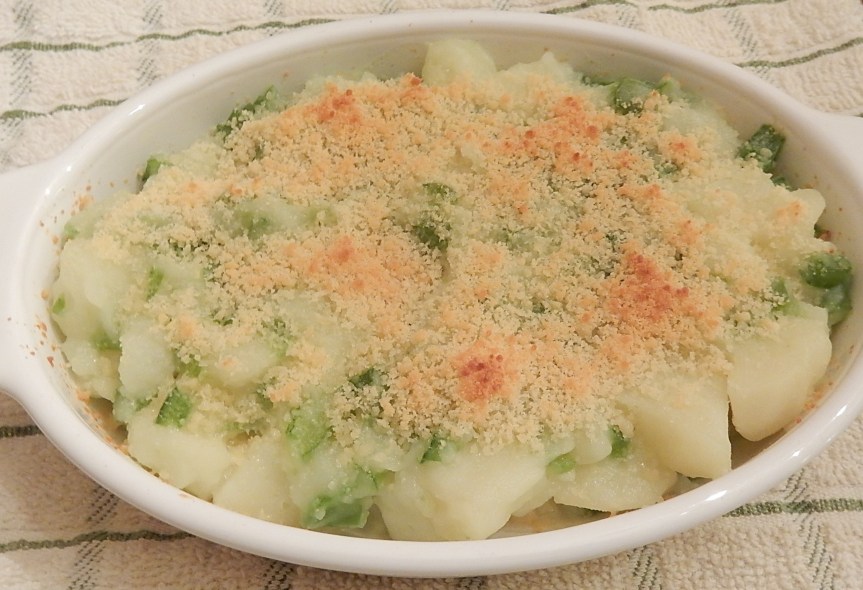
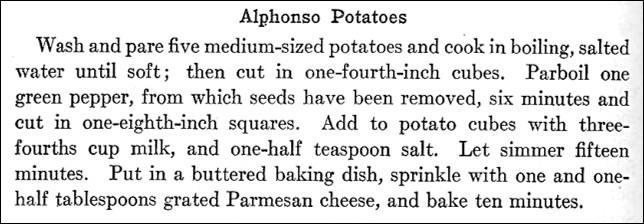
Now that the weather’s getting cold and wintery, potatoes hit the spot. I recently made a hundred-year-old recipe for Alphonso Potatoes which are diced potatoes and green pepper are in a milk sauce, and topped with Parmesan cheese. This dish is very attractive and makes a nice presentation. The green of the pepper and the white of the potatoes made a visually appealing combination. The Parmesan cheese topping added flavor to the dish, and it was very nice.
Here’s the original recipe:
Source: The Boston Cooking-School Cook Book (1923)
When I made the recipe, I cut the potatoes into 1/4 inch cubes prior to cooking. Perhaps cooks a hundred-years-ago often had left-over boiled potatoes that could be diced and used in this recipe, but since I didn’t have any left-over potatoes it seemed easier to just dice them into small pieces prior to cooking. I boiled the diced potatoes for a few minutes and then added the green pepper pieces to the simmering potatoes. It didn’t seem like a separate pan was needed. After the cubed potatoes were soft, I drained them, and then added the milk. I salted the water when cooking the potatoes, but did not add additional salt when I added the milk. I cooked for a few minutes more minutes, while occasionally gently stirring (but it was substantively less than 15 minutes). Some of the milk evaporated, and it began to thicken. I then removed from the heat and put into the casserole dish.
5 medium potatoes, peeled and diced into 1/4 inch cubes
water
1 teaspoon salt + 1/2 teaspoon salt (if desired)
1 medium green pepper, diced into 1/8 inch pieces
3/4 cup milk
1 1/2 tablespoons Parmesan cheese
Preheat oven to 375° F. Put the diced potatoes into a saucepan; cover with water and add 1 teaspoon salt. Bring to a boil using high heat, then reduce heat and simmer for 5 minutes. Add the diced green pepper and simmer for an additional 6 minutes. Remove from the heat, and drain. Pour milk and 1/2 teaspoon salt (if desired) on the drained potatoes and green pepper in the saucepan. Heat using medium heat while stirring gently occasionally (do not cover). Simmer for a few minutes until some of the milk evaporates and the liquid thickens a little. (Use care that the milk and potatoes don’t burn.) Remove from the heat and put into a casserole dish. Sprinkle with the Parmesan cheese. Put in the oven and bake for 10 minutes or until the Parmesan cheese is lightly browned.
I love candied sweet potatoes, but they can be a bit boring, so I decided to look for another way to serve sweet potatoes. I found a recipe for Scalloped Sweet Potatoes and Apples in a hundred-year-old cookbook and decided to give it a try.
The Scalloped Sweet Potatoes and Apples were delightful. Sliced sweet potatoes and apples were embedded in a buttery brown sugar sauce.
I knew this recipe was a winner when my husband said, “You should make this again for Thanksgiving.”
Here’s the original recipe:
Source; The Boston Cooking-School Cook Book (1923)
1 1/2 cups sour apples (Granny Smith, Braeburn, etc.), peeled and thinly sliced
1/2 cup brown sugar
4 tablespoons butter
1 teaspoon salt (if desired, use less)
Put sweet potatoes in a large saucepan and cover with water. Bring to a boil using high heat, then reduce heat and cook until the sweet potatoes are tender when tested by inserting a knife (30-40 minutes). Remove from heat, drain, and cool slightly so the sweet potatoes can be handled. Gently remove the peels from the cooked sweet potatoes, then slice into 1/4 inch pieces.
Preheat oven to 350° F. Put 1/2 of the sliced sweet potatoes into a 1-quart baking dish, then top with 1/2 of the sliced apples. Sprinkle with half of the brown sugar; dot with small pieces of half of the butter and sprinkle with half the salt. Repeat with the remaining ingredients. Put in oven and bake for 1 hour.
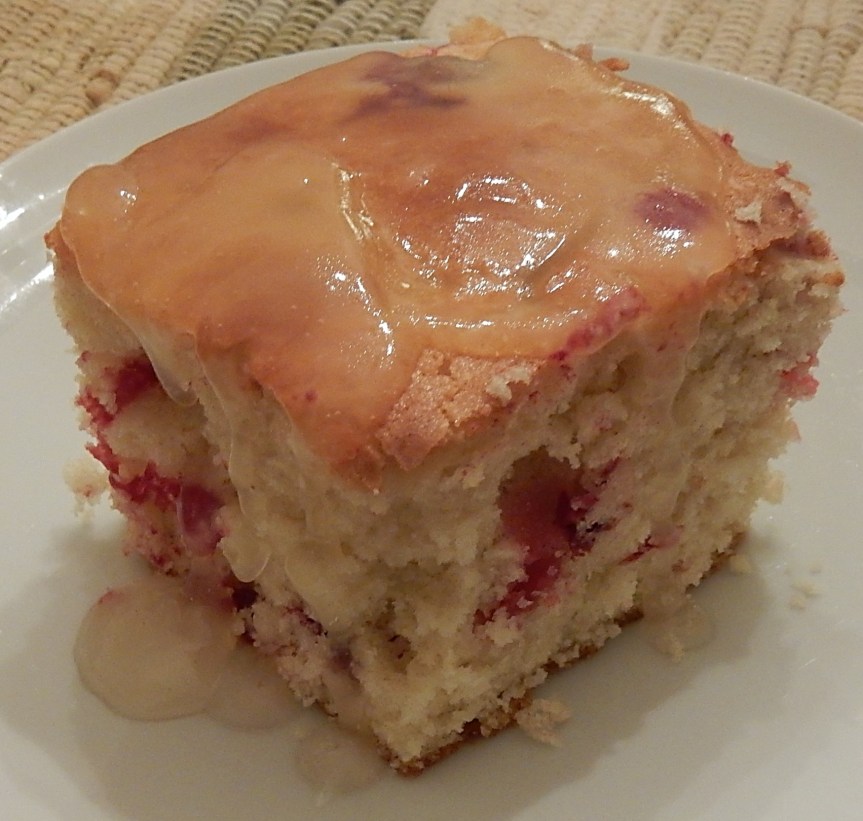
‘Tis the season for cranberries, so when I saw a recipe in a hundred-year-old cookbook for Cranberry Pudding I decided to give it a try. The Cranberry Pudding was delightful. The old-fashioned cake-style pudding was embedded with tart cranberries, and smothered in a lovely vanilla sauce. This recipe is a keeper.
Here’s the recipe updated for modern cooks:
Source: Larkin Housewives’ Cook Book (1923)
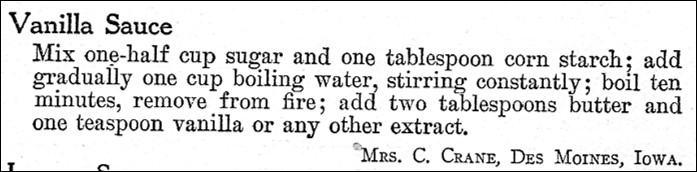
The recipe says to serve with either hard or sweet sauce. Hard sauce of more of a spread than a sauce. I prefer an actual sauce, so decided to go with the sweet sauce. The cookbook that contained the Cranberry Pudding recipe did not have any recipes for Sweet Sauce. However, it did have a recipe for Vanilla Sauce, so I decided to go with that.
Source: Larkin Housewives’ Cook Book (1923)
I didn’t boil the water that I stirred into the mixture because it didn’t seem necessary, since the mixture is heated to make the sauce.
Preheat oven to 350° F. Put the butter, sugar, flour, baking powder, eggs, milk and lemon extract in a mixing bowl. Beat until smooth. Stir in the cranberries. Put in a greased and floured 8″ X 8″ baking pan. Bake 35 – 45 minutes, or until a wooden pick inserted in center comes out clean. Serve warm with Vanilla Sauce.
Vanilla Sauce
1/2 cup sugar
1 tablespoon cornstarch
1 cup water
2 tablespoons butter
1 teaspoon butter
Mix the sugar and cornstarch in a saucepan; add the water gradually while stirring constantly. Bring to a boil using medium heat while continuing to stir, then reduce heat and continue to stir and simmer for 10 minutes (or less if desired thickness is reached sooner). Remove from heat and stir in the butter and vanilla. Serve warm.
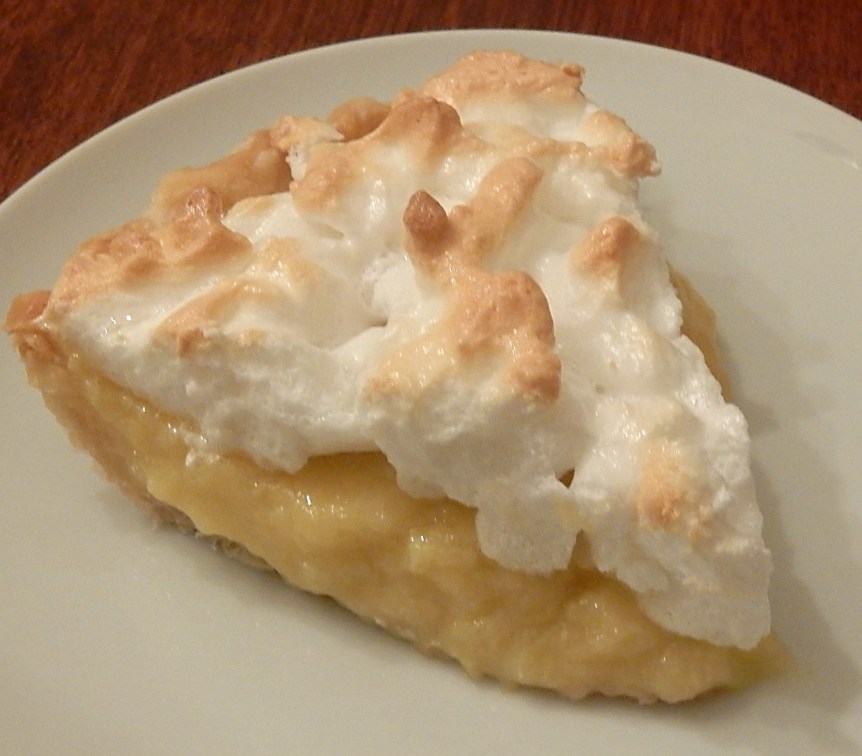
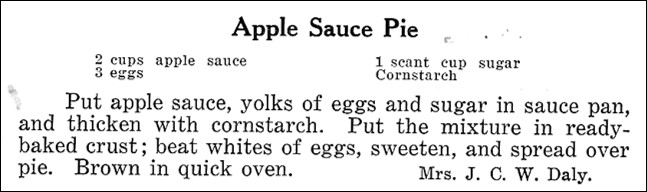
I recently came across a hundred-year-old recipe for Applesauce Pie (with Meringue) and decided to give it a try. It is very different from modern Apple Pie recipes because it doesn’t call for any cinnamon, but rather just allows the natural flavors of the applesauce to shine through. The pie filling is made by combining applesauce, sugar, egg yolks, and cornstarch. The net effect is that the filling has a consistency somewhat similar to the filling in a custard pie. The meringue topping is a nice change of pace. Today, we generally only see meringue toppings on Lemon Pies; a hundred years ago meringue was much more popular and used on a wide variety of pies.
Here’s the original recipe:
Source: General Welfare Guild Cook Book (Beaver Valley General Hospital, New Brighton, PA, 1923)
We generally write applesauce as one word. A hundred years ago, it was written as two words – apple sauce. I’m always intrigued by why these minor changes in how words are written have occurred across the years.
The old recipe doesn’t indicate how much cornstarch should be used. I think that how much is needed is dependent upon how thick the applesauce is. It is very important that the filling is fairly thick so that it doesn’t run all over when the pie is cut. I used homemade applesauce when I made this recipe, and it may have been juicier than some commercial applesauces. When I made this recipe, I first used 2 tablespoons of cornstarch. After I cooked the applesauce mixture, it didn’t seem very thick. So I mixed another tablespoon of cornstarch and a little water in a small bowl, and then added it to the cooked applesauce mixture. I then reheated until it boiled. The pie filling ended up being about the right thickness, but the lack of clarity regarding the amount of cornstarch (and it being a key ingredient in regards to the success of the recipe), made this recipe somewhat challenging to make.
Combine the sugar and cornstarch in a saucepan. Stir in the egg yolks and applesauce. Using medium heat, heat until the mixture thickens and begins to boil. Stir constantly while cooking. Then remove from heat, and spoon into the previously baked pie shell.
Preheat oven to 400° F. To make the meringue, place egg whites in a mixing bowl, and beat the egg whites until they form stiff peaks. Gradually add sugar while continuing to beat. Then spoon on top of the pie and swirl. Bake for 7 – 10 minutes or until the meringue is lightly browned.
Winter squash are an ubiquitous fall vegetable, so I was pleased when a found a hundred-year-old recipe for Squash Pudding. This custard-like pudding is slightly sweet, and has a hint of cinnamon. It reminds me a little of the filling in a pumpkin pie – though the Squash Pudding is not as sweet or spicy as the typical pie filling. I’m not sure whether Squash Pudding is supposed to be a vegetable side dish or a dessert. The original recipe says that it should be served warm, but it is tasty either warm or cold.
Here’s the original recipe:
Source: The Boston Cooking School Cook Book (1923)
Preheat oven to 350° F. Combine all ingredients in a mixing bowl; beat until smooth. Pour into an 8″ X 8″ or similar sized casserole dish. Put in oven and bake until a knife inserted in the center comes out clean (about 1 1/2 to 2 hours). Cool slightly before serving. May also be served cold.
Most of the time when I make recipes for this blog, I select recipes that sound good to me. I don’t generally go for the ones that are very dated and seem strange – but occasionally I’ve intrigued enough by an old recipe that just doesn’t sound like I’d like it, to give it a try. Today is one of those days. I came across a recipe for Pear and Pecan Salad that called for putting chopped pecans on top of canned pear halves (good so far), but then the recipe called for topping it with mayonnaise –and it lost me. But . . . The recipe sounded very easy to make, and I had all the ingredients in my kitchen, so I decided to proceed.
The verdict: I was pleasantly surprised by this recipe. The sweetness of the pears, the crunchiness of the nuts, and the creaminess of the mayonnaise worked well together to create a nice taste sensation.
Here’s the original recipe:
Source: The Calorie Cook Book by Mary Dickerson Donahey (1923)
When I made this recipe I went with the main topping alternative – mayonnaise, and did not try the other options. I also thought that 3 heaping teaspoons (a heaping tablespoon!) of mayonnaise on top of each pear half seemed like a lot, so I reduced the amount to 2 teaspoons per pear half.
Arrange lettuce leaves on two salad plates. Place a pear half on top of the lettuce on each plate. Sprinkle with the chopped pecans, then top each pear half with about 2 teaspoons of mayonnaise.