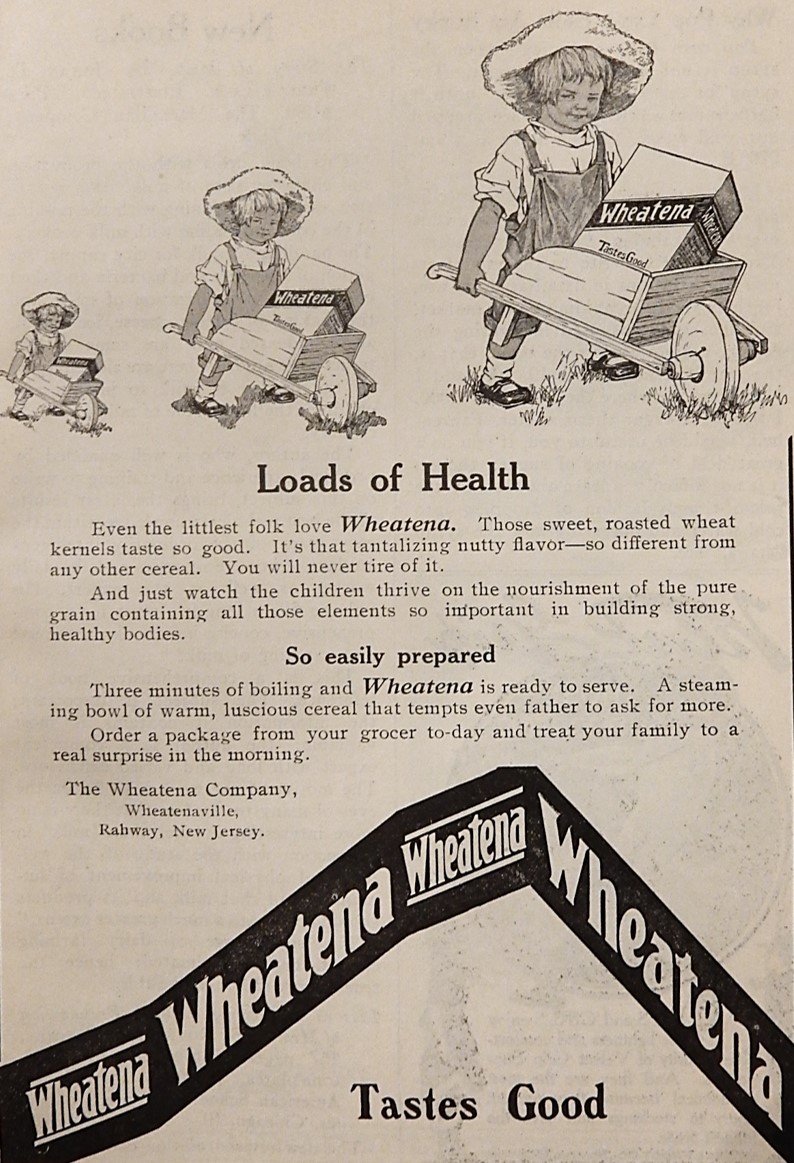
Many cereals come and go over the course of a few years – remember Cinnamon Mini Buns cereal? . . . or Dinersaurs? But a few cereals have been around for more than a hundred years. For example, Wheatena has been produced since the 1880s.
I’ve never actually eaten Wheatena – but this 1919 advertisement makes me want to give this old-time cooked cereal a try. What’s not to like? It has a tantalizing nutty flavor, is nourishing, is easy to prepare, AND it tastes good.
Holiday gatherings when I was a child meant lots of relatives crowded around a table – with all the leaves added, and topped with two or three mismatched tablecloths – in a tiny dining room with floral wallpaper on the walls. The table would almost sag from all the food – turkey or ham (or maybe both), stuffing, mashed potatoes, pickles, creamed vegetables . . . and molded salads or desserts. Back in those days, molded foods that contained gelatin were salads – today, similar food are often considered desserts.
There was always just a bit of drama surrounding the molded salad. They were unmolded shortly before we ate to help ensure that they looked their best. But, there always were questions about how long the mold needed to be dipped in hot water to successfully unmold it. If it wasn’t dipped long enough, the salad might only partially come out (and look like a mess) . . . and if it was dipped too long, it might partially melt (and look like a mess).
So when I recently came across a recipe in the November, 1919 issue of American Cookery for a gelatin and cream salad (or dessert) with nuts, I just had to give it a try. There were just too many memories to pass over it – and just enough risk to make it seem like it a fun, yet slightly challenging recipe to try.
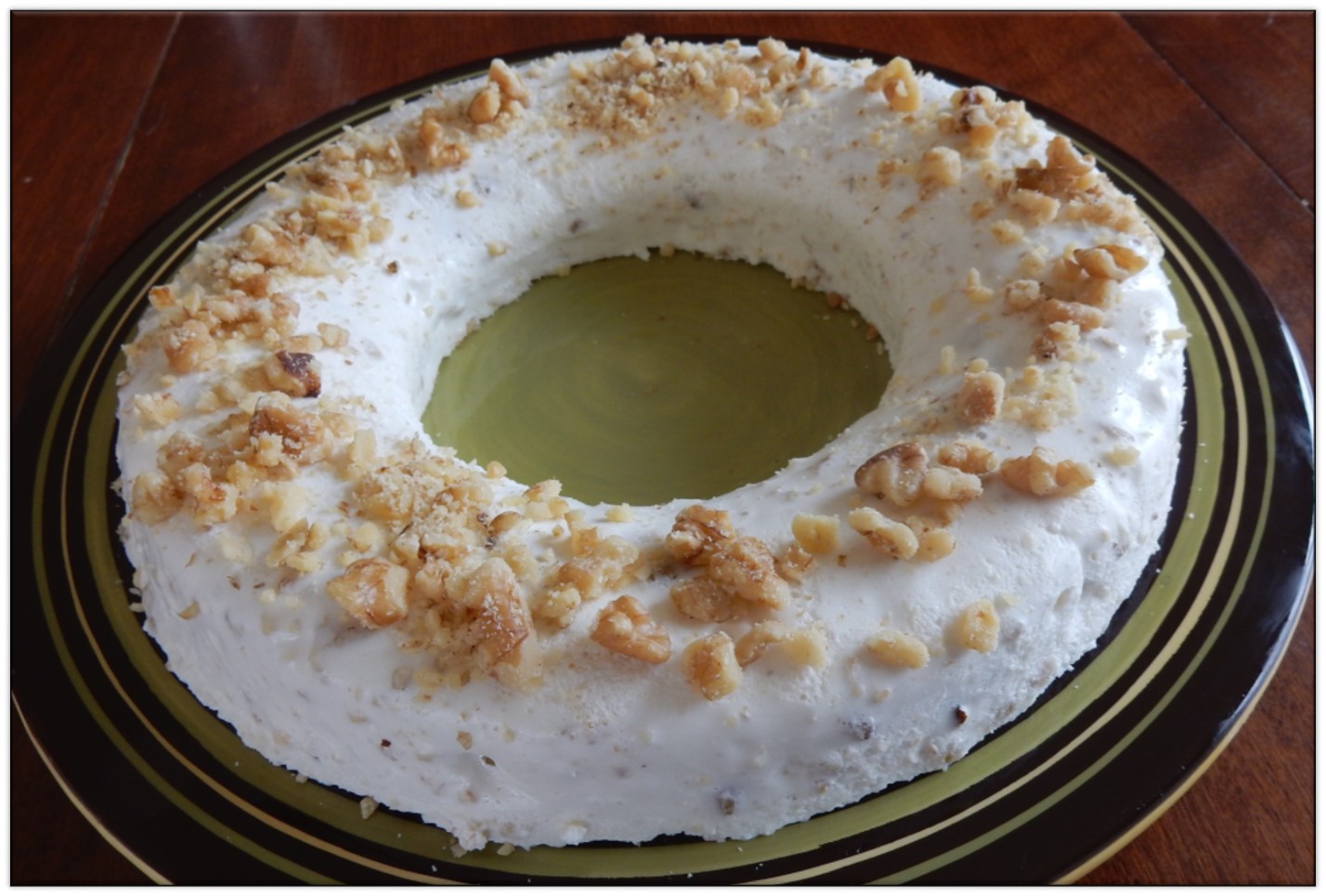
I’m pleased to report that the Nutted Cream recipe was a huge success – and I didn’t have any trouble unmolding it. The creamy salad (or dessert) with embedded nuts had just a hint of sweetness, and was a delightful treat.
In many ways the Nutted Cream seemed surprisingly modern – and if I’d put it in individual cups, instead of the mold, it would be similar to some lovely desserts that I’ve recently had at very nice restaurants.
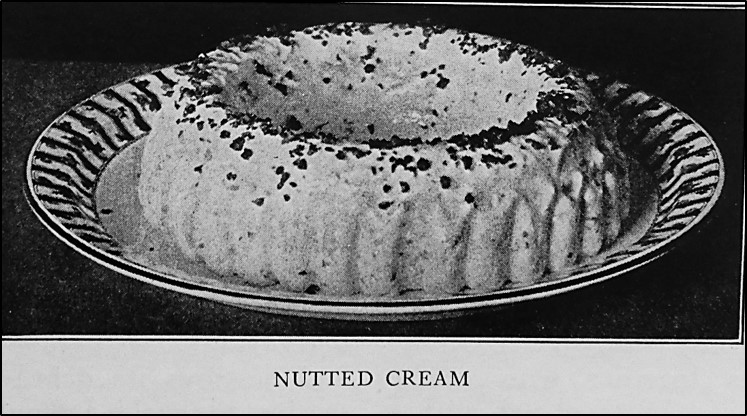
Here’s the original recipe (and a picture!) in the 1919 magazine:
Source: American Cookery (November, 1919)Source: American Cookery (November, 1919)
1/3 cup finely chopped nuts (I used walnuts.) + (if desired) additional nuts for garnishing
Put the cold water in a small bowl and sprinkle the gelatin on top of the water. Let sit until softened (about 2 minutes). Add hot water, then place the small bowl in a pan that contains hot water. Stir the gelatin mixture until dissolved. Remove small bowl from the pan. Set aside.
Put the whipping in a mixing bowl and beat until stiff peaks form. Gradually add the powdered sugar while continuing to beat, then gently stir in the walnuts. Set aside.
Set the bowl with the gelatin mixture in a pan that contains cold water and ice cubes. Stir the gelatin mixture until it begins to thicken. Then gently fold the gelatin mixture into the whipped cream mixture.
Spoon whipped cream mixture into an 8-cup mold. Chill in the refrigerator until firm (at least two hours).
To serve, quickly dip the mold in hot water, then gently slide the Nutted Cream onto serving plate. If desired, garnish with additional chopped nuts.
When I make chocolate icing it often is tasty, but isn’t as smooth and glossy as I’d like. Well, I think that I’ve found the cause, as well as the solution, in a 1919 magazine article.
Why Chocolate Icing Loses Its Gloss
If a chocolate icing is beaten too much before spreading, the gloss will be lost. It should be spread while it is yet a little “runny,” so that it flows of itself to a great extent over the surface of the cake. Sometimes if a knife-blade, dipped into hot water is used to smooth the icing, it will restore the gloss.
Old-fashioned carrot pie is a delightful fall pie. It is very similar to pumpkin pie – but a little lighter and sweeter.
Here’s the original hundred-year-old recipe:
Source: Good Housekeeping (February, 1919)
Two medium, “grocery-store” style, long, slender carrots are not nearly large enough to make 1 – 1 1/4 cups pureed carrot. The recipe must be calling for the large, thick relatively short carrots that home gardeners often raise. When I made the recipe, I used a 1-pound bag of carrots, and ended up with about the right amount of pureed carrot.
Peel and slice carrots. Put carrot slices in a saucepan and just barely cover with water. Using high heat bring to a boil, then reduce heat, and simmer until carrots are tender (approximately 20 – 25 minutes). Remove from heat and drain; then press through a sieve or puree (I used a Foley mill.) Measure the pureed carrot. There should be approximately 1 – 1 1/4 cups.
Preheat oven to 425° F. Combine all ingredients (except pie shell) in a mixing bowl; beat until smooth. Pour into pie crust. Bake 15 minutes; then reduce heat to 350°. Continue baking (about 50-60 minutes) until a knife inserted in the center of the pie comes out clean.
I used think that I have too many dishes, but then I can across a list in a 1919 book, and realized (at least by the standards of a hundred years ago), that I may not own enough dishes.
With regard to table equipment, the number of individual dishes is controlled by the size of the family, and the kind of service desired. Most housewives would choose dainty service and good style, and would prefer to have convenient dishes in adequate number and appropriate silver, even if less expensive china , and silver and glass is chosen. For such a standard, which is strongly recommended, buy twice as many of all individual dishes, glasses, and silver, as the number in the family. This makes possible entertaining with much less worry and work, and relieves one of the feeling of not having enough. It is certainly a reasonable standard to choose china, glass, and silver which is not expensive to replace and is, therefore, not a source of anxiety to the housewife.
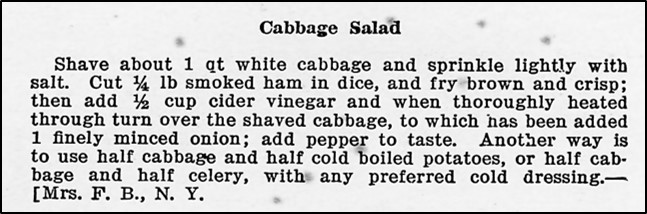
Sometimes coleslaw with its typical sugary, mayonnaise-based dressing can seem like a bit much. I recently came a hundred-year-old dressing for Cabbage Salad with Ham that calls for simply dressing it with warm vinegar. The simplicity of the dressing really brings out the flavor of this salad.
Here is the original recipe:
Source: The Old Reliable Farm and Home Cook Book (1919)
1 quart (4 cups) cabbage, grated (about 1 medium cabbage)
1 medium onion, finely minced
1/4 cup ham, diced
1/2 cup apple cider vinegar
1/4 teaspoon salt
1/4 teaspoon pepper
Combine grated cabbage and minced onion in a bowl. Set aside
Sauté diced ham in a skillet using medium heat until lightly browned. Stir in vinegar, salt, and pepper; heat until hot. Pour heated vinegar over cabbage and onion; stir to combine. Serve.
Does anyone like school lunches? I hear both parents and their children complain about them. According to my local school district’s website, today’s high school menu is:
Menu – October 24, 2019
Main: Italian Entree Choice Grill: Grilled Chicken Sandwich Salad: Italian Entree Choice
Smart Sides: Caesar Salad, Celery Sticks
But, is it worse than school lunches a hundred years? Somehow I just can’t imagine students today getting excited about Jellied Salmon.