A popular 2020 New Year’s resolution is to eat better – and salads often top the list of “good” foods. People have been making similar resolutions for at least a hundred years. There is a poem near the front of the January, 1920 issue of American Cookery that is an ode to salads. Salads clearly were seen as a treat for epicureans. I think the poem also suggests that salads are healthy – though I’m not sure.
“Receipt” is an archaic term for recipe that was sometimes used a hundred years ago.
Tapioca can be used to make some wonderful old-fashioned desserts. We’re all familiar with tapioca pudding, but there are also some other fun recipes that call for tapioca in hundred-year-old cookbooks and magazines. I recently was intrigued by an old recipe for Coffee and Tapioca Trifle (Coffee Tapioca Pudding), and decided to give it a try.
Anyone who likes both coffee and tapioca will enjoy this dessert. Since the Coffee and Tapioca Trifle is made using coffee rather than milk, it was lighter than many tapioca desserts. It was delightfully refreshing, and had just the right amount of sweetness.
Source: American Cookery (June/July, 1919)Source: American Cookery (June/July, 1919)
I used small pearl tapioca when I made the recipe.
Here is the recipe updated for modern cooks:
Coffee and Tapioca Trifle (Coffee Tapioca Pudding)
Soak tapioca in room temperature water overnight. Drain.
Heat coffee (preferably in double boiler) until warm, add drained tapioca. Cover, turn heat to very low and cook until mixture thickens, and the tapioca pearls have plumped and are tender (5 – 45 minutes) depending upon the brand of tapioca used. Stir occasionally. (It will boil over very easily—and also has a tendency to burn on the pan bottom if care is not used). Stir in the sugar, and cook just a bit longer to allow the sugar to dissolve. Remove from heat, and put in serving dishes. Chill at least 3 hours before serving. Serve with whipped cream.
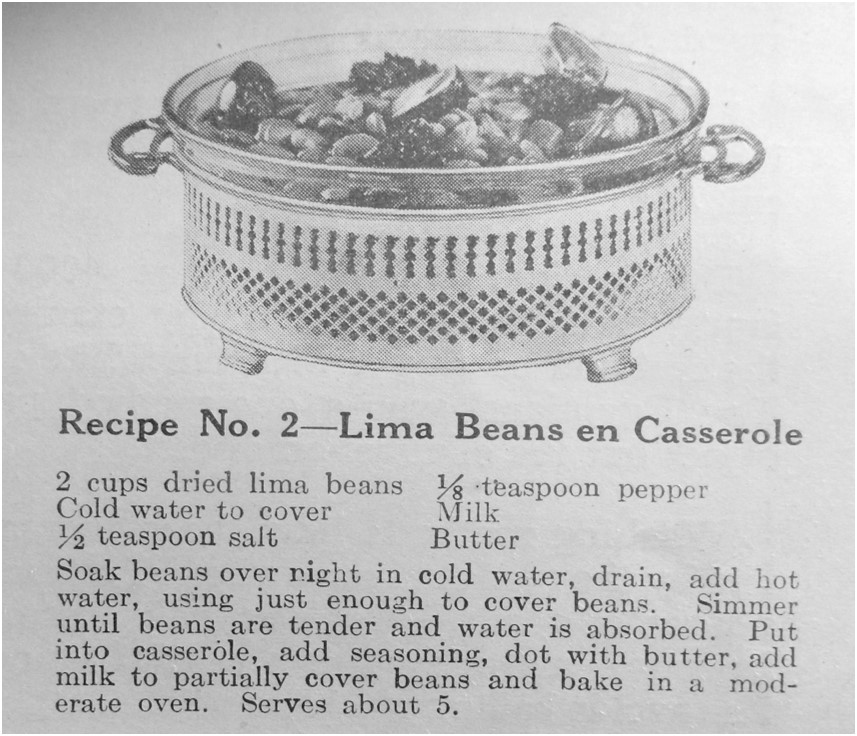
Christmas dinner is a time for tradition; a time when we often make the foods that our mothers and grandmothers once prepared. Often these dishes bring back warm food memories; other times they bring back less warm memories of foods that might be family traditions, but weren’t personal favorites. Well, I had the latter reaction when I saw a photo and recipe in a hundred-year-old magazine for Lima Beans en Casserole (Baked Lima Beans).
Source: Advertisement by the California Lima Bean Growers Association in Good Housekeeping; December, 1919)
Memories flooded back of this lima bean dish that my mother made every Christmas. I usually managed to avoid eating it during the holiday festivities – but I always had to eat it during the week following Christmas when my mother served the left-overs (and there always seemed to be lots of left-over lima beans).
Each year, I hopefully suggested that maybe we didn’t need to make Baked Lima Beans; and every year, my suggestion would be vetoed by my father (which seemed very strange because he didn’t generally get involved in menu planning). But he always insisted that it wouldn’t be Christmas without lima beans.
When I saw the old recipe for Lima Beans en Casserole (Baked Lima Beans), I just had to give it a try. Was it really the bland tasteless dish of my memories, or was it a food worthy of the Christmas dinner table?
I’m pleased to say that Lima Beans en Casserole tasted like I remember, but in a much better way. Across the years (and as my taste buds have matured), Lima Beans en Casserole have morphed into a tasty comfort food that has the added bonus of being a great source of fiber and protein.
Rinse the lima beans, put in a bowl and cover with water (water should be about 1-inch about the top of the beans); then cover bowl, and soak overnight. Drain beans, then put in a sauce pan, and cover with hot water. Bring to a boil using high heat, then reduce to very low heat and cover pan. Gently simmer until the beans are tender and the water absorbed (about 1- 1 1/2 hours).
Preheat oven to 350° F. Remove from heat, and put beans in a large casserole dish (1 1/2 quart). Dot with butter.
In the meantime, put the milk in a bowl, and stir in the salt and pepper. Gently add the milk mixture to partially cover the beans. (Add additional milk if needed). Put in oven and bake until hot and bubbly, and the top is just beginning to brown. Remove from oven and serve.
Only six more days until Christmas – and shoppers are rushing to complete their holiday shopping. A hundred years ago shoppers were also purchasing last minute gifts. Judging by the advertising old magazines, waffle irons were a popular gift in 1919.
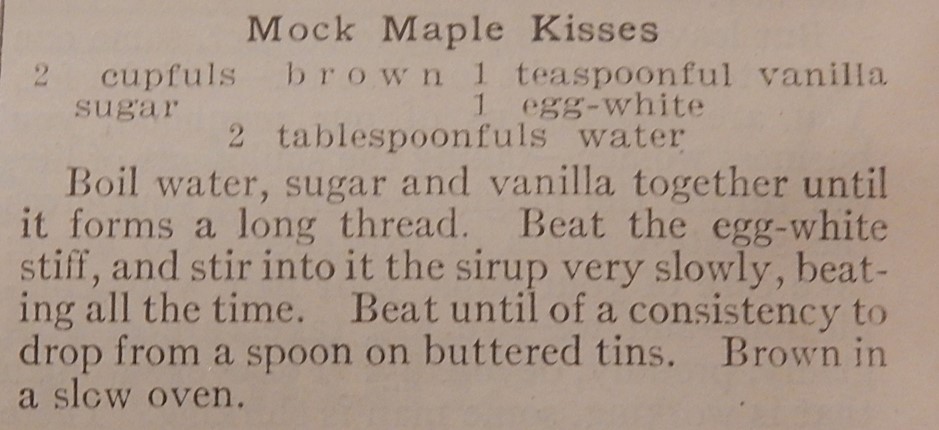
I always try to make a wide variety of holiday cookies, including a gluten-free option. Meringue cookies are a personal favorite, so I was pleased to find a hundred-year-old recipe for Mock Maple Kisses. They are a light and airy meringue cookie. When I bite into them, they take me back to a summer evening, and remind of marshmallows delicately toasted over a campfire.
Here is the original recipe:
Source: Good Housekeeping (December, 1919)
I found this recipe to be a little challenging. Since very little liquid is called for, the boiled brown sugar mixture quickly moves past the “thread’ stage to the “soft ball” stage. I added a little additional water to get the temperature and stage right. But, the meringues ended up not having the classic “kiss” shape.
Put sugar, water, and vanilla in a sauce pan; stir, and then using medium-low heat, bring to a boil. Reduce heat, and cook until the mixture reaches the “thread” stage (223° – 234° F.). Since there is very little liquid, the mixture will reach this stage very quickly after it comes to a boil. A little additional water may need to be added if the mixture inadvertently moves beyond the “thread” stage.) Remove from heat.
In the meantime, preheat oven to 250° F. Put the egg white into a mixing bowl and beat with an electric beater until stiff peaks form. Slowly add the sugar sauce, one tablespoon at a time, while continuing to beat. Drop by rounded teaspoons two inches apart on greased baking sheet lined with parchment paper. Bake for 35-45 minutes or until the kisses can easily be removed from the parchment paper.
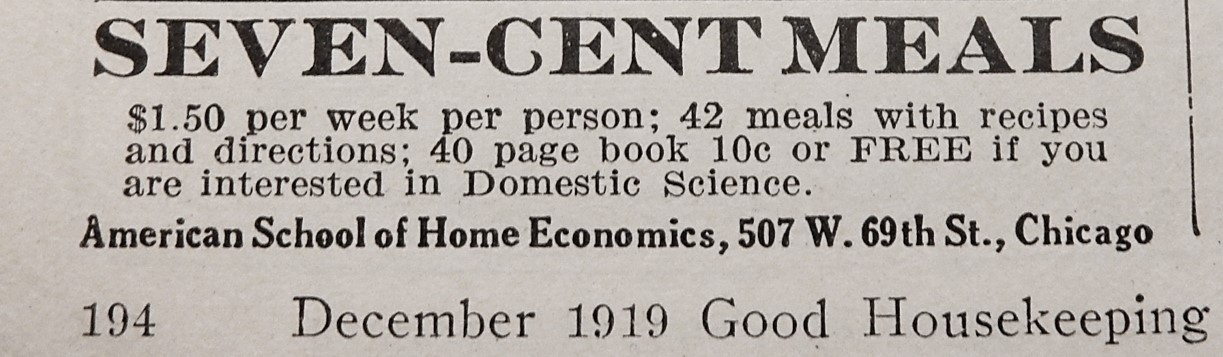
Holiday meals can be expensive to prepare, so I’m always looking for budget-friendly recipes and meals that I can use to keep my food expenditures in check. A classified ad in a hundred-year-old issue of Good Housekeeping offers a solution – serve meals that only cost seven cents. I’d be willing to pay a dime to learn how to make seven-cent meals (or I might even consider telling a white lie and claiming that I’m interested in Domestic Science so that I can get the book for free).