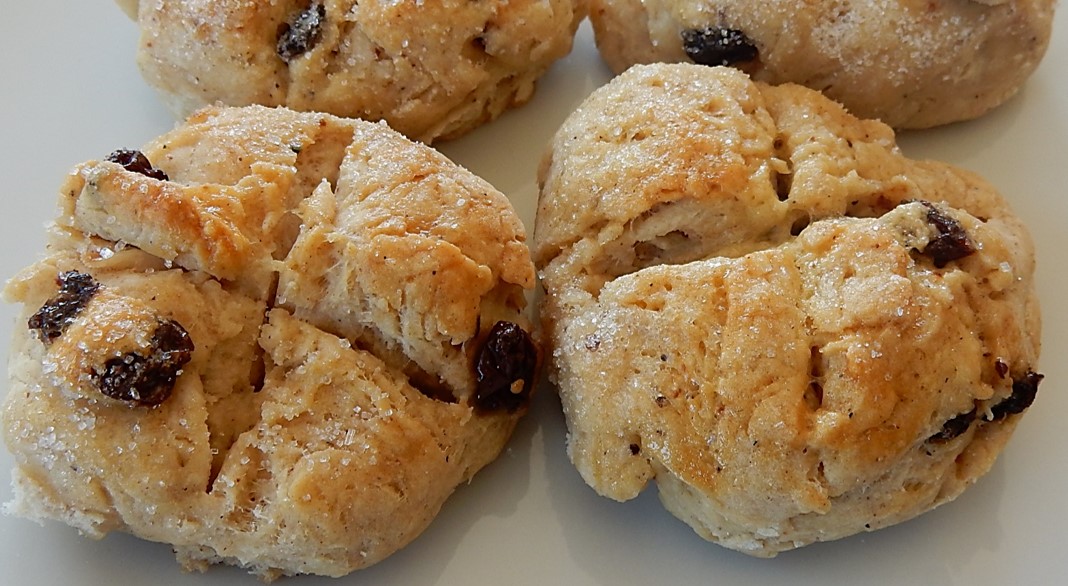
Hot Cross Buns are a traditional Easter bread. Historically these sweet, spicy buns with lots of embedded currants (or raisins) were a treat as Lent came to a close, and dietary restrictions ended. Bakers have been making Hot Cross Buns for at least a hundred years, and probably much longer. There’s even an old Mother Goose nursery rhyme about them:
Hot-cross buns!Hot-cross buns!One a penny, two a penny,Hot-cross buns!If you have no daughters,Give them to your sons;One a penny, two a penny,Hot-cross buns!
Hot Cross Buns are obviously a food that has had a special place in the hearts of people for many years. So when I came across a recipe for Hot Cross Buns in a 1920 magazine, I decided to give it a try.
Most modern Hot Cross Bun recipes call for either making the cross on top of the buns with icing after they are baked, or making a cross using a flour and water paste prior to baking. The old recipe instead called for scoring the dough with a knife prior to baking to create the crosses on the balls of dough.
Here’s the original recipe:
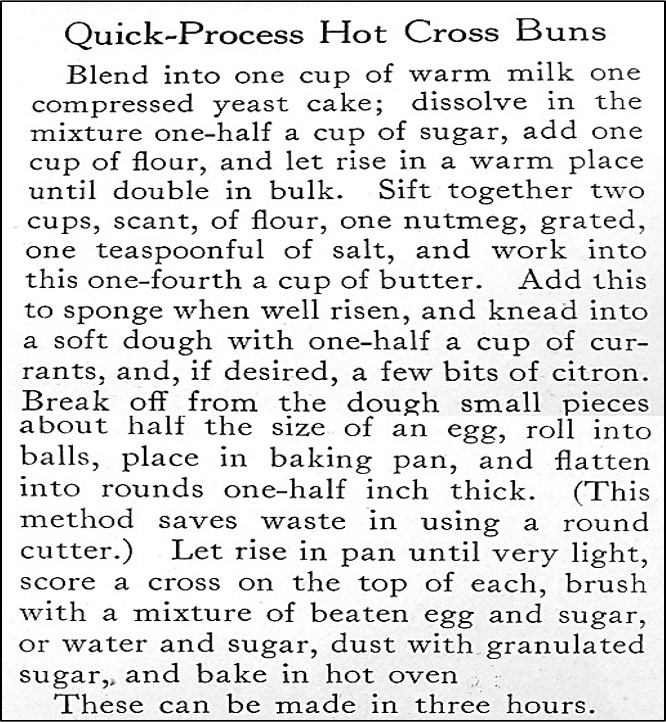
The old recipe called for using a compressed yeast cake; I used an envelope of active dry yeast.
The buns were made by first creating a “sponge” with the milk, yeast, sugar, and a little of the flour. This was allowed to rise; then the additional flour and additional ingredients were added before kneading. The dough was then shaped into balls, and the balls of dough were allowed to rise before baking. When I made this recipe, the sponge rose nicely; the balls of dough, not so well. Perhaps I did not place the dough in a warm enough spot – or maybe the ratio of yeast to flour wasn’t quite right, or maybe there was some other issue.
The verdict: The buns were tasty, but not as light as most modern Hot Cross Buns. This may be because of the problems I had with getting the dough to rise properly. If I made Hot Cross Buns again, I’d probably just go with a more modern recipe.
Here’s the recipe updated for modern cooks:
Hot Cross Buns
1 cup warm milk (108-110° F)
1 envelope active dry yeast
1/2 cup sugar
1 cup flour + 2 cups flour (scant) (Either all-purpose flour or bread flour may be used)
2 teaspoons ground nutmeg (or 1 whole nutmeg, grated)
1/2 teaspoon salt
1/4 cup butter, softened
1/2 cup currants (raisins may be substituted for currants)
1/8 cup citron (optional) (I didn’t use citron.)
1 egg, beaten (1/4 cup water may be substituted for the egg) (I used an egg.)
1 tablespoon sugar + additional sugar to sprinkle on top
In a large bowl dissolve the yeast and sugar in the warm milk; add flour and beat until smooth. Cover, and then let this “sponge” rise in a warm place until doubled in size (about 1 hour).
In the meantime, in another bowl, combine the remaining 2 cups flour (scant), nutmeg, and salt. Add butter, and stir to combine. Then add the sponge and stir to combine. Place on a floured surface and knead until smooth (about 5 minutes). Near the end of the kneading process, sprinkle currants on the bread dough- about one-fourth at a time – and knead into the dough.
Break off pieces of the dough, each about half the size of an egg, and roll into balls; flatten to about 1/2 inch thick. Put the balls in a greased baking pan(s) (2 9-inch round pans or 1 9 X 13″ rectangular pan). The flattened balls should be about 1/2-inch apart. Cover with a towel and let rise in a warm spot until doubled in size (about 1 hour). Then use a knife to score a cross on the top of each ball of dough.
In a small bowl stir together the beaten egg and 1 tablespoon sugar; then brush the mixture on top of the unbaked buns. Sprinkle with additional sugar.
Preheat oven to 350° F. Put the baking pan(s) with the buns in oven, and bake 30 minutes (or until lightly browned).