When I cook foods in the oven, the first thing that I think about is: What temperature should I use?
Modern recipes indicate the temperature setting. A hundred years ago, recipes might say that a “medium” oven or a “hot” oven should be used, but the exact temperature was left up to the cook. .
In 1920, many cooks still used wood or coal stoves which had their own unique challenges when it came to maintaining a constant temperature; but, more modern electric and gas stoves were becoming more common – though they may not yet have had a temperature control. However, cooking thermometers were available.
But, a hundred years ago the idea of regulating the oven temperature was still a new concept, and home economists were trying to figure out the best temperature to use when making various foods. For example, home economists at the Good Housekeeping Institute, which was affiliated with Good Housekeeping magazine, did experiments to compare how foods turned out when different oven temperatures were used. Here are some excerpts:
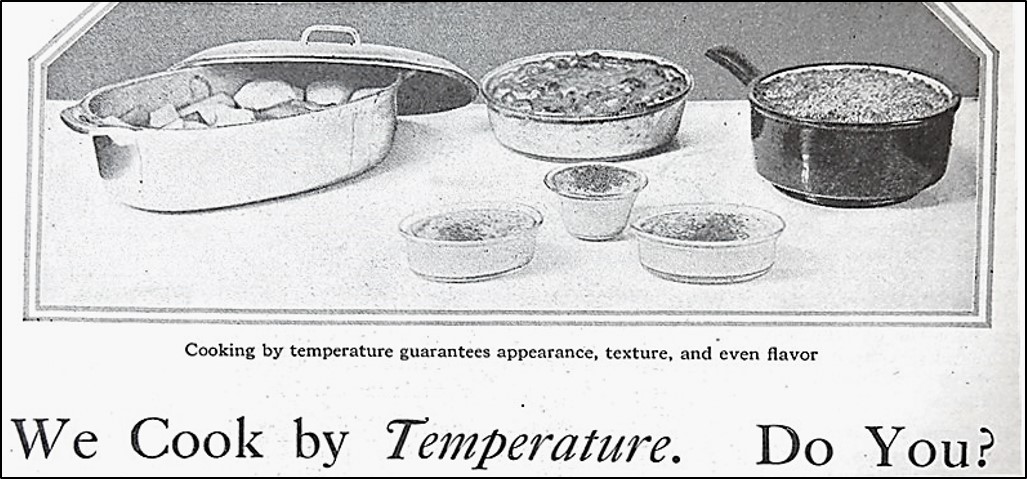
We Cook by Temperature. Do You?
From time to time this department has published articles on the cooking of foods by temperature. In our testing work here in the Institute, we have used these findings constantly, and each time become more and more enthusiastic over the uniformity and perfection of the results. We realize more each time the great importance which the correct temperature bears to the production of good cookery results.
Just a word in regard to the use of a thermometer in baking. The thermometer should be placed as near the center of the oven as is convenient, and on the shelf, if possible, where the bulk of the baking is to be done. If your range has a very even distribution of heat, this precaution will not be so necessary. If several dishes are to be placed in the oven at one time, it is advisable to try the pans in the oven before it is heated so that the thermometer in a position which will best suit the necessary arrangement. The thermometer should be placed in the oven while it is cold, preferably and thus allowed to heat gradually as the oven heats.
The experiments made to determine the best temperature for the baking of scalloped dishes proved most interesting. It is necessary that this kind of dish shall look well, because it is intended to be served at the table in the dish in which it is baked. So it was appearance that we looked for at first in determining the best temperature. But much to our surprise, we found a marked difference in the flavor as well, even though the dish was made in exactly the same way, when cooked at different temperatures. For the comparative test to determine the baking temperature for scalloped dishes, Delmonico Potatoes were made. Into a greased baking-dish were placed alternately layers of diced, cooked potatoes, and well-seasoned cheese sauce. The top of the dish was covered with thin slices of cheese. Dishes prepared thus were baked at 350° F., 400° F., 450° F., and 500° F. Another dish was placed at the very bottom of the broiler oven of a gas range and allowed to brown beneath the broiler flame.
The time required for browning at the different temperatures varied. At 350° F., twenty-seven minutes did not produce a very satisfactory brown, and the sauce “bubbled” badly, giving the dish a very unsightly appearance. Twenty minutes at 400° F. gave slightly better results, and fifteen minutes at 450° F. showed still greater improvement in appearance and flavor, but the dish cooked at 500° F. for twelve minutes proved without a doubt that this was the very best temperature of all. The sauce bubbled very slightly about the edges but did not give so unsightly an appearance to the dish as the lower temperatures had produced. The browning was good, but the perfection in seasoning and taste was the biggest determining factor. It was, indeed, supreme. The flavors seemed to be perfectly and thoroughly blended.
The dish baked beneath the broiler flame required only ten minutes for the browning. The result was very pretty to look at, because no bubbling had taken place, and the browning was even and delicate, but the flavors were not at all blended, so this method was immediately ruled out as not at all desirable.
Good Housekeeping (April, 1920)