Got Stale Bread? Make Toast

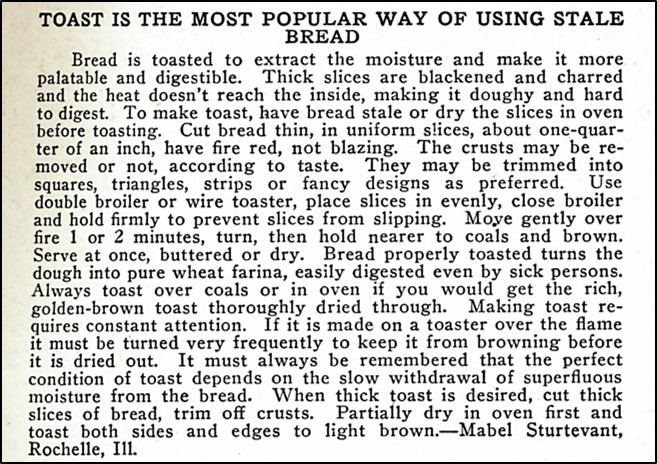
2 slices of toastThere’s nothing quite like freshly baked bread – but unfortunately it doesn’t stay fresh very long and I sometimes end up with bread that is a bit stale. No problem – a hundred-year-old cookbook recommends using stale bread to make toast.

description of making toast out of stale bread
Source; The Cook Book of Left-Overs (1920) compiled by the More Nurses in Training Movement

Whew, this sounds complicated. Maybe I’ll just use my electric toaster. Hopefully it won’t remove the “superfluous moisture” too quickly.

Old-fashioned Asparagus and Chicken Soup

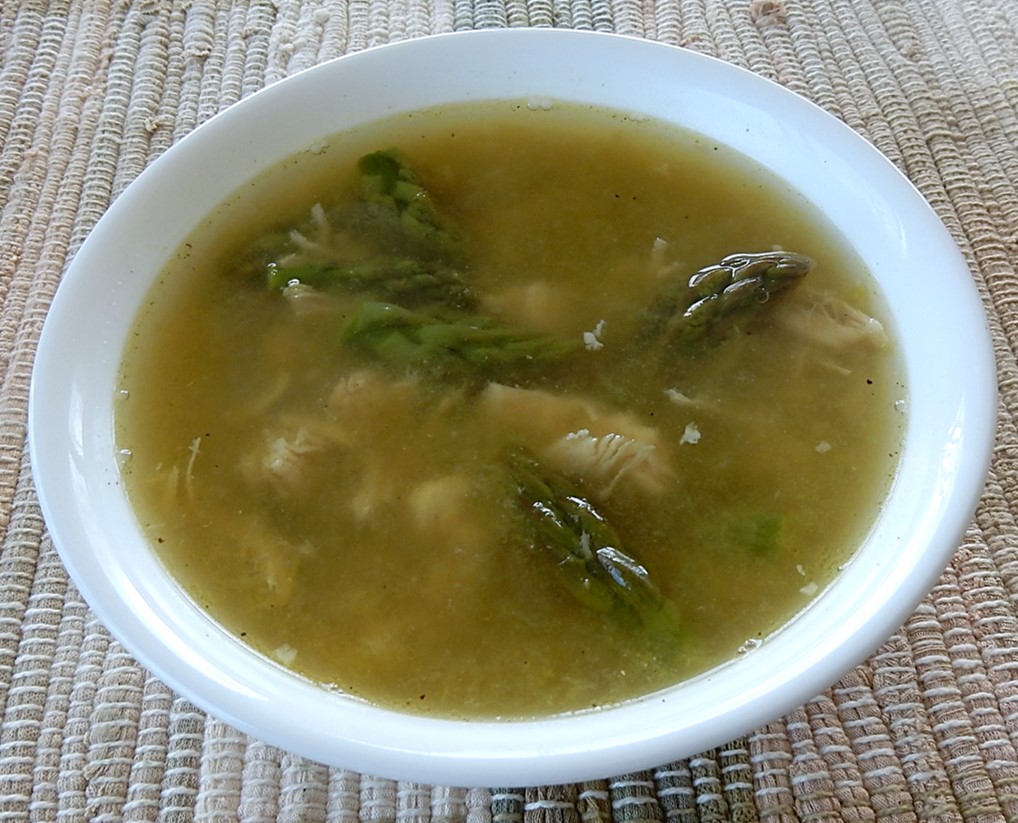
Bowl of Asparagus and Chicken Soup

Sometimes I think of soup as a winter dish, but I’m discovering that there are also some wonderful soups that feature Spring vegetables. I recently came across a hundred-year-old recipe for Asparagus and Chicken Soup. Chicken and asparagus tips are embedded in a delightful light asparagus-flavored broth that has a very nuanced peppery taste.

The Asparagus and Chicken Soup seemed very modern (and I never would have guessed that the recipe was a hundred years old if I hadn’t known that I’d found it in a 1920 magazine). It reminded me a bit of some of the lovely chicken miso soups that I’ve eaten in Asian restaurants.

Here is the original recipe:

Recipe for Asparagus and Chicken Soup
Source: American Cookery (May, 1920)

The recipe called for three teaspoons of salt, which seemed like a lot, so I only used one teaspoon of it. I didn’t serve the soup with croutons or Royal Custard, and must admit that I didn’t even know what Royal Custard was until I googled it, and discovered that, according to The Spruce Eats, Royale Custard (Eierstich) is an egg custard and a popular soup garnish in Germany. It sounds lovely, and if I make this soup again, I may have to also make some Royale Custard.

Here is the recipe updated for modern cooks:

Asparagus and Chicken Soup

  • Servings: 4 - 5
  • Difficulty: moderate
  • Print

6 cups water

2 pounds chicken parts (I used boneless chicken breast.)

2 bunches asparagus (about 2 pounds)

1 teaspoon salt

1/2 teaspoon pepper

1/4 teaspoon celery salt

Put water and chicken in a large saucepan or Dutch oven. Bring to a boil using high heat, then reduce heat and simmer for 2 hours.

In the meantime, cut the tips off the asparagus stalks and set aside. Cut the reminder of the stalks into 1-inch pieces. After the 2 hours, add the asparagus pieces to the water and chicken, and simmer for an additional 1/2 hour. Remove from heat, and remove the chicken. Cut and shred the chicken into small pieces. Strain the liquid and asparagus pieces.

Put the cooked asparagus pieces through a sieve to extract the juice and puree the asparagus. (A ricer or Foley mill can be used.)

Return broth, shredded chicken, and asparagus puree to the saucepan or Dutch oven, then add the salt, pepper, and celery salt. Heat until hot, then add asparagus tips, cook for an additional 5 minutes or until the asparagus tips are tender, then serve.

http://www.ahundredyearsago.com

1920 Egg Preservation Method Advertisement

Advertisement showing eggs in stoneware crocks
Source: Good Housekeeping (April, 1920)

Chickens generally lay more eggs at some times of the year than others. Historically there was a plethora of eggs during the Spring, and they could be purchased very inexpensively – and eggs were much scarcer and more costly during the winter months.

As a result, people often preserved eggs using the water glass method. They mixed water and water glass (hydrated lime) together in large stoneware crocks or jars. Eggs were then placed in the liquid to preserve them.

According to a 1920 advertisement by the Stoneware Manufacturers Association (who would have guessed that there was a Stoneware Manufacturers Association) which represented the manufacturers of the crocks:

Eggs properly preserved in stoneware jars will keep fresh as the day they were laid for 8 to 12 months. 

When I googled water glass eggs, I discovered that some people still use this method to preserve eggs. For example, Homesteading Family and Timber Creek Farmer each have posts about how to use the water glass method.

Sour Cream Pie with Dates


slice of sour cream pie with dates on plateWhen I came across a hundred-year-old recipe for Sour Cream Pie with Dates, I decided to give it a try. This rich, custard-style pie has lots of embedded date pieces; and is a unique combination of old-fashioned goodness, and a sophisticated blend of sweet and sour.

Here is the original recipe:

Recipe for Sour Cream Pie with Dates
Source: Good Housekeeping’s Book of Recipes and Household Discoveries

And, here is the recipe updated for modern cooks:

Sour Cream Pie with Dates

  • Servings: 5 -7
  • Difficulty: moderate
  • Print

1 cup sour cream

1 cup sugar

1 egg

1 teaspoon flour

1/4 teaspoon salt

1 cup dates, chopped

8-inch (small) double-crust pie shell

Preheat oven to 425 degrees. Put sour cream, sugar, egg, flour, and salt in a mixing bowl; beat until smooth. Stir in dates. Place in pastry-lined pie pan. Cover with top crust. Seal and crimp. Cut slits in top crust (or poke top crust several times with a fork). If desired, brush with a small amount of milk; sprinkle with sugar. Bake in oven for 10 minutes; then reduce heat to 350 degrees. Bake an additional 30 to 40 minutes or until crust is browned and filling has set.

http://www.ahundredyearsago.com

1920 Food Cost Comparison

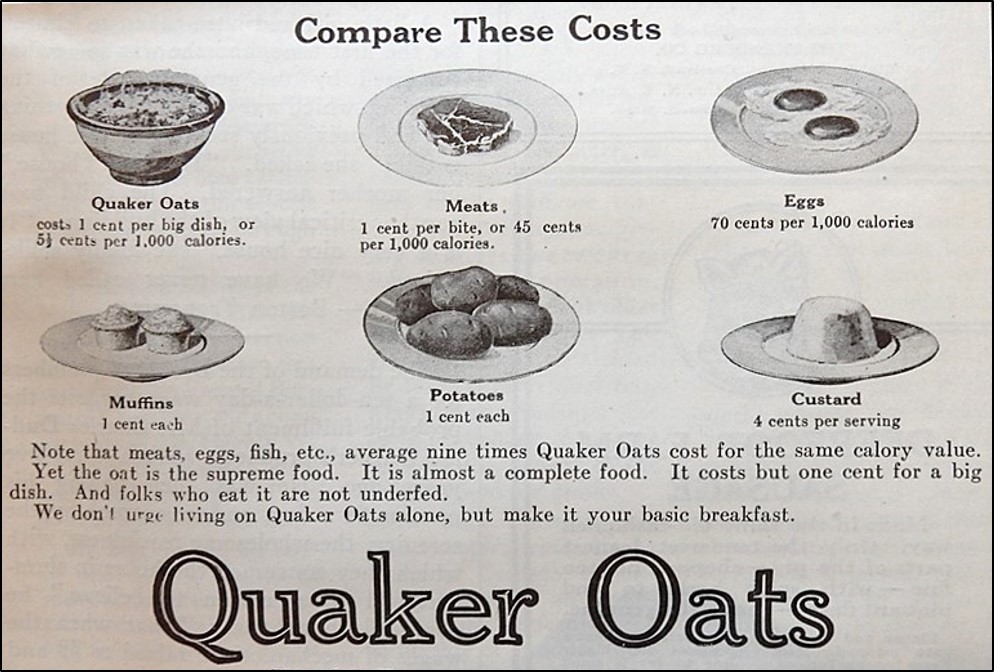
Several foods (Quaker Oats, meats, eggs, muffins, potatoes, custard) with a cost comparison beneath them
Source: From a Quaker Oats advertisement, American Cookery, January, 1920

Food is expensive today. A hundred years ago people also worried about the high price of food. A 1920 Quaker Oats advertisement compared the costs of different foods, and (of course) determined that Quaker Oats was an inexpensive source of calories. Somehow I don’t think that the relationship between calories and cost would be featured in an advertisement today . . . but on second thought, maybe it still works. Not sure.

Old-fashioned Coleslaw Recipe

Some foods memories are associated specific events. Others are much more scattered. For me, Coleslaw is one of those food where I have scattered memories – some wonderful; others not so great.

I have rich memories of eating Coleslaw at family reunions, at church potlucks, and at home. Some renditions had a light vinegar dressing; others had rich mayonnaise dressings. Occasionally the coleslaw had a hint of pepper or contained celery seed. And, sometimes there were additional ingredients – chopped onion, apple, or green and red pepper.

But I also associate coleslaw with fast food joints – often with a runny mayonnaise-based dressing.

Suffice it to say that I have mixed feelings about Coleslaw. But, I had a cabbage in the refrigerator so when I saw a hundred-year-old recipe for Coleslaw in a home economics textbook I decided to give it a try. The Coleslaw dressing had a very mild flavor with just a hint of sugar and vinegar, which allowed the flavor of the cabbage itself to shine. That said, I prefer Coleslaw dressings with a more pronounced sweet-sour flavor, so I probably won’t make this recipe again.

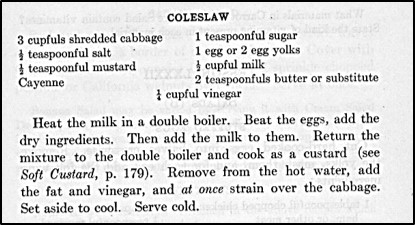
recipe for cole slaw
Source: School and Home Cooking by Carlotta C. Greer (1920)

This process for making this recipe is similar to the method used to make custard. I got this recipe from a home economics textbook. The author seeks to build upon skills learned in previous lessons. So she often referred back to previous recipes that used similar processes – in this case to a recipe for soft custard. I previously posted the hundred-year-old soft custard recipe.

Here’s the recipe updated for modern cooks:

Coleslaw

  • Servings: 5-6
  • Difficulty: moderate
  • Print

3 cups shredded/grated cabbage

1 egg or 2 egg yolks (I used a whole egg.)

1/2 teaspoon salt

1/2 teaspoon dry mustard

dash cayenne (red) pepper

1 teaspoon sugar

1/2 cup milk

2 teaspoon butter, melted

1/4 cup apple cider vinegar

Put egg (or egg yolks), salt, mustard, cayenne (red) pepper, and sugar in a small mixing bowl; beat until combined. Set aside.

Put the milk in a heavy sauce pan (use a double boiler if available); then heat using medium heat. Stir constantly until the milk just barely begins to bubble, then remove from the heat.

Place a small amount (approximately 1 – 2 tablespoons) of hot milk into bowl with the egg mixture, stir quickly. Add this mixture to the hot milk and stir. (This helps prevent the egg from coagulating when the egg is introduced to the hot liquid.)  Return to stove and cook, using medium heat while stirring constantly until the mixture just begins to thicken or coat a spoon. Remove from heat; stir in butter and vinegar Strain and then pour over the shredded cabbage. Chill at least 3 hours before serving. Stir before serving.

http://www.ahundredyearsago.com

Do You Waste Food At Your House? A 1920 Perspective

sliced turkey, mashed potatoes and other leftoversAccording to the United States Department of Agriculture, in 2010 there was 218.9 pounds of food waste per person in the United States. Food waste has been an issue for at least a hundred years. This is what it said in the introduction of a 1920 cookbook which contained recipes that used left-overs:

Can you truthfully say that there is no waste in food in your home? 

It has been reiterated many times that a French family could live on what an American family throws away. Is that true in your case?

True thrift and economy in cooking means planning so that nothing is wasted and all foods whether freshly cooked or reserved at another meal are tasty and appetizing. 

The whims of fancy and capricious appetite require forethought and careful  planning in order to keep a varied and tempting menu and at the same time utilize all left-over food. 

Source: The Cook Book of Left-Overs (1920) by The More Nurses in Training Movement – Illinois Ladies