Old-fashioned Spinach with Gravy

Spinach with Gravy in Bowl

I’m always looking for new ways to use vegetables, so when I saw an easy-to-make recipe for Spinach with Gravy in a hundred-year-old cookbook, I decided to give it a try.

The recipe turned out well. The gravy enhanced the flavor of the spinach, and was quite tasty. I served it as a stand-alone side dish – though I think that Spinach with Gravy would also be delightful on toast.

Here is the original recipe:

Recipe for spinach with gravy
Source: Good Housekeeping’s Book of Recipes and Household Discoveries (1920)

The directions in the old recipe for the gravy are a little confusing. The recipe calls for meat gravy, which I would assume already contained some flour or other thickener, yet it also indicates that 1 teaspoon flour should be stirred into 2 tablespoons of melted butter – and then the gravy should be added. This suggests that the recipe author thought that the gravy needed to be thicker than the typical gravy – though 1 teaspoon of flour isn’t much, so why bother?

I used the second option (which is described in the text beneath the ingredient list), and used bouillion cubes when I made the gravy. It worked fine.

Here’s the recipe updated for modern cooks:

Spinach with Gravy

  • Servings: 3 - 5
  • Difficulty: easy
  • Print

2 quarts (1 8-ounce bag) spinach

Gravy – Option 1

2 tablespoons butter

1 teaspoon flour

1 1/2 meat gravy

Gravy – Option 2

2 bouillion cubes (I used beef bouillion cubes.)

1 1/2 cups boiling water

2 tablespoons butter

3 tablespoons flour

Wash spinach and cut into small pieces. Put in a pan, and using medium heat cook until tender (3-5 minutes). The water clinging to the spinach may provide sufficient liquid for cooking the spinach; if not, add a small amount of water.

In the meantime, make gravy.

Gravy: Option 1: In the meantime, in another pan, using medium heat, melt butter; then stir in the flour. Gradually, add gravy while stirring constantly. Continue stirring until the gravy is hot and bubbly. Remove from heat, and add the cooked spinach. Stir to combine.

Gravy Option 2: Dissolve the bouillion cubes in the boiling water to make a broth. In a pan, using medium heat, melt butter; then stir in the flour. Gradually, add the broth while stirring constantly. Continue stirring until the gravy is hot and bubbly. Remove from heat, and add the cooked spinach. Stir to combine.

http://www.ahundredyearsago.com

Old-fashioned Fried Cauliflower with Onion

Fried Cauliflower with Onion in Serving Dish

Cauliflower is a tasty, nutritious vegetable. It contains lots of vitamin C and folate – and is a good source of fiber. So I was thrilled to find a hundred-year-old recipe for Fried Cauliflower with Onion. The recipe was easy-to-make and delicious. This makes a great side dish.

Here is the original recipe:

Recipe for Fried Cauliflower with Onions
Source: Good Housekeeping’s Book of Recipes and Household Discoveries (1920)

I cut the florets from the stalk before putting boiling – though the head of cauliflower could be put in a large pot of boiling water to cook, and then the florets could be separated after cooking, if preferred.

And, here’s the recipe updated for modern cooks:

Fried Cauliflower with Onion

  • Servings: 4 - 6
  • Difficulty: easy
  • Print

1 head cauliflower

1 teaspoon salt

1 large onion, chopped

2 tablespoons fat (cooking oil, shortening, or lard)

Cut cauliflower florets from the main stalk. Put florets in a saucepan and cover with water; add salt. Bring to a boil using high heat, then reduce heat and cook until tender, about 5 -7 minutes. Remove from heat and drain.

In the meantime, put fat in a skillet and heat until hot using medium heat. Add onions and fry until transparent and just beginning to brown while stirring occasionally. Add cooked cauliflower florets, and fry until lightly browned (about 10 minutes), while stirring occasionally. Remove from heat and serve.

http://www.ahundredyearsago.com

The After-Church Dinner a Hundred Years Ago

Foods for a Sunday Dinner
Source: Good Housekeeping (February, 1920)

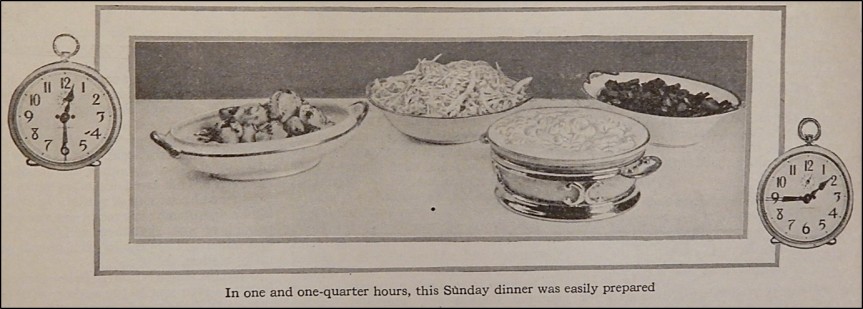
Both in 1920 and in 2020, it can sometimes be challenging to get a meal prepared in a timely manner. Here are some excerpts from a hundred-year-old article in Good Housekeeping about successfully preparing a Sunday dinner:

The After-Church Dinner

Can I join my family at church on Sunday when there is a hearty dinner to prepare? 

“Yes,” answers Good Housekeeping Institute. “Let us show you the way. Go to church – then cook your dinner afterward, a dinner simple, yet hearty and tasty. Simplicity should be the keynote of the Sunday dinner.”

Save your more complicated meat, vegetable dishes, and desserts for the week-day meals, when time is not go great an item nor rest so essential. In their place serve broiled or baked chops, steaks, small roasts, or fish – meats which require little or no preparation and little time for cooking.

Simplify the vegetable courses by avoiding all scalloped or cream dishes which take so much time to prepare. Serve your potatoes baked in their jackets, boiled, or broiled, depending upon the various seasonings at hand to give variety to the vegetable. Serve carrots, turnips, celery, Brussels sprouts, and such vegetables in their simplest form, that is, either whole, sliced, or diced, according  to the vegetable; when properly cooked and delicately seasoned with salt, pepper, paprika, parsley, butter, etc., you will not long for the more elaborate dishes. Frequently serve from your store of home or commercially canned vegetables; these are cooked and require only reheating and proper seasoning to make them delicious. A salad course may or may not be included in your menu. 

At all times fruit is an acceptable dessert, particularly as a quick-time dessert. Many enjoy the fruit as it comes from the market; others prefer it cut up, slightly sweetened, and served plain or with cream. When fresh fruits are scarce, use your own canned fruit or that commercially canned. Such a dessert served with homemade cookies or cake cannot be surpassed. 

Good Housekeeping (February, 1920)

Old-fashioned Baked Honey Custard

Individual Serving of Baked Honey CustardFall is in the air, the days are getting shorter, and I’ve been craving comfort food. So I was thrilled to find a hundred-year-old recipe for Baked Honey Custard. The recipe is a winner. Baked Honey Custard was easy to make, and had a delicate, silky texture. The honey and cinnamon flavors merged beautifully to create a delightfully flavored custard.
Here’s the original recipe:

Recipe for Baked Honey Custard
Source: American Cookery (January, 1920)

Here’s the recipe updated for modern cooks:

Baked Honey Custard

  • Servings: 7 - 9
  • Difficulty: moderate
  • Print

4 cups milk

5 eggs

1/2 cup honey

1/4 teaspoon cinnamon

1/4 teaspoon milk

Preheat oven to 350° F.

Scald the milk by putting in a saucepan, then heat using medium heat until the milk steams and is almost ready to begin boiling; stir constantly while heating the milk. (Another option is to scald the milk using a microwave. Set aside.)

In the meantime, put the eggs into a mixing bowl, and beat just until smooth. Add the honey, cinnamon, and salt; beat until the ingredients are combined. Add a small amount (approximately 1 – 2 tablespoons) of the hot scalded milk, while stirring. Continue to very slowly add the hot milk while stirring constantly.  [The egg is first combined with a little of the hot mixture to prevent it from turning into scrambled eggs when introduced into the hot combination.]

Pour into custard cups. Place cups 13 X 9 X 2 inch baking pan. Pour very hot water into pan around cups to within 1/2 inch of top of cups.

Bake about 45 minutes or until knife inserted halfway between center and edge comes out clean. Remove cups from water. Serve custard warm or chilled.

http://www.ahundredyearsago.com

Types of Cheese Available in 1920

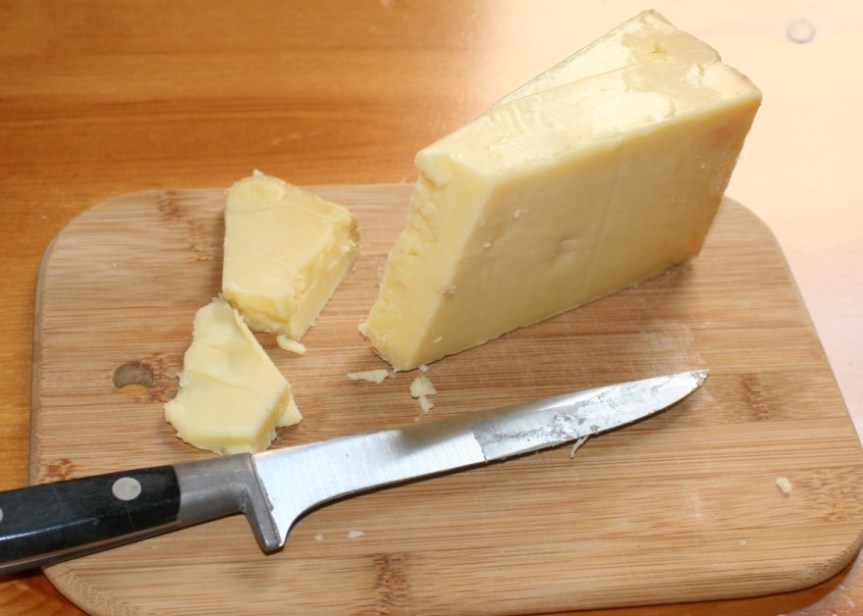
Cheddar Cheese and Knife on Cutting BoardToday there are a huge number of varieties of cheese. There were also lots of types of cheese a hundred years ago. Here’s what a 1920 magazine said:
Cheese

Cheese contains more than twice as much nourishment, pound for pound, as the best beefsteak.

There are over 500 varieties of cheese.

Cheddar, or the American dairy cheese, is characterized by its solid, close texture, delicate, mild aroma, and pleasing flavor.

A “green” or freshly made cheese lacks in flavor and is rubbery – more like the pressed curd from which it comes.

A “ripe” cheese is that which has aged and developed a full flavor and a rich, mellow consistency.

Those cheeses known as Pimiento, club, pineapple, and sage cheese, are of the Cheddar type and of distinctive shape or flavor.

Roquefort is cheese is made in Roquefort, France of goats’ milk, and is ripened by a secret “moldy bread process.”

Swiss cheese is of a somewhat different flavor, due doubtless to the presence of micro-organisms which are thought to be the cause of the numerous holes that perforate this food. It is claimed that an expert can tell the porousness of a Swiss cheese by the sound which it gives when it is tapped.

Edam and Parmesan cheeses are of a hard variety caused by pressing out all of the water. For this reason, they grate well and being of rich flavor, are desirable for seasoning.

Neufchatel cheese is made from thick, sour milk. It does not keep as the other cheeses do, and so one must be careful to purchase it fresh to have it at its best.

American Cookery (May, 1920)

Old-fashioned Flavored Beets


Flavored Beets in serving dish

Beets are a perfect vegetable. They are colorful, tasty, high in fiber, and nutritious. They are a good source of folate, manganese, potassium, iron, and vitamin C.

I recently came across a hundred-year-old recipe for Flavored Beets. When I read the ingredient list, the Flavored Beets sounded a lot like the Harvard Beets that my mother made in my youth, so I decided to give the recipe a try.

The Flavored Beets turned out wonderfully. This recipe is a keeper. The delightful sweet sour sauce was lovely, and worked perfectly to enhance the rich, earthy flavor of the beets. The sauce was not as thick as I remember the Harvard Beet sauce my mother made, but the taste was very similar.

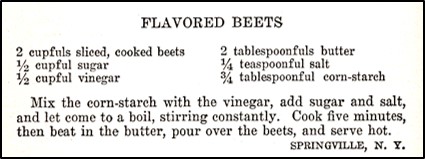
Here’s the original recipe:

recipe for flavored beets
Source: Good Housekeeping’s Book of Recipes and Discoveries

Here’s the recipe updated for modern cooks:

Flavored Beets

  • Servings: 3 - 4
  • Difficulty: moderate
  • Print

2 cups sliced, cooked beets (I boiled, then sliced 4 medium beets – though canned beets would also work.)

3/4 tablespoon cornstarch

1/2 cup vinegar

1/2 cup sugar

1/4 teaspoon salt

2 tablespoons butter

Put the cornstarch and vinegar in a saucepan; stir until smooth. Add sugar and salt, and bring to a boil using medium heat while stirring constantly. Reduce heat and simmer for 5 minutes while continuing to stir. Add butter, and stir until melted. Add beets, and reheat until the beets are hot while gently stirring. Serve

http://www.ahundredyearsago.com