Valentine Milk Biscuit Novelties

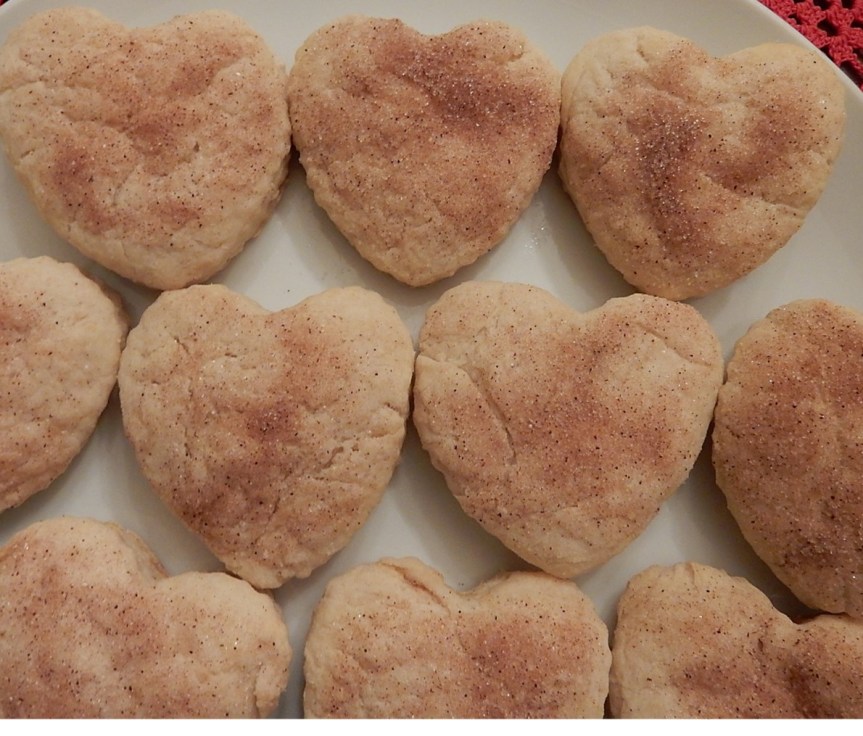
Heart-shaped biscuits on plateHappy Valentine’s Day!

You might enjoy this hundred-year-old recipe for Valentine Milk Biscuit Novelties. These sweet biscuits with a cinnamon and sugar topping are tasty and easy to make,

Here’s the original recipe:

Recipe for Valentine Milk Biscuit Novelties
Source: Mrs. Scott’s Seasonal Cook Books (The North American Newspaper, Philadelphia, Winter, 1921)

The original recipe makes a lot of biscuits so when I updated the recipe I made it for half of the old recipe.

Valentine Milk Biscuit Novelties

  • Servings: approximately 20 biscuits
  • Difficulty: moderate
  • Print

2 cups flour

2 teaspoons baking powder

1/2 teaspoon salt

1/4 cup sugar

1/2 cup butter (1 stick) softened

3/4 cup milk

melted butter

sugar and cinnamon

Preheat oven to 450° F.  Combine flour, baking powder, sugar, and salt in a mixing bowl. Cut in butter. Add most of the milk and mix using a fork until dough starts to cling together. Add more milk if needed. Roll dough on a prepared floured surface into a rectangle 1/2-inch thick. Cut with heart-shaped cookie cutter. Brush with melted butter, then sprinkle with sugar and cinnamon. Place on an ungreased baking sheet. Bake for approximately 12-20 minutes (or until lightly browned).
http://www.ahundredyearsago.com

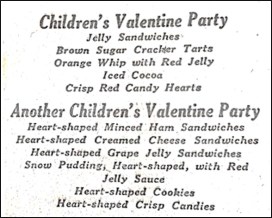
1921 Menus for Children’s Valentine Parties

Menus for Children's Valentines Parties
Source: Mrs. Scott’s Seasonal Cook Books (The North American Newspaper, Philadelphia, Autumn, 1920)

Valentine’s Day parties used to be one of the big annual elementary school events. Remember making valentine “mailboxes” out of shoeboxes? . . . And, remember reflecting on who to give which card? And, the anticipation and suspense before opening the valentines?

A hundred-years ago Valentine’s Day parties were also popular. A 1921 newspaper recipe supplement contained several menus for children’s valentine parties. Some of the recipes, like Brown Sugar Cracker Tarts, sound intriguing; others less so. Somehow heart-shaped minced ham sandwiches and heart-shaped creamed cheese sandwiches don’t quite work for me.

Old-fashioned Coconut Pie

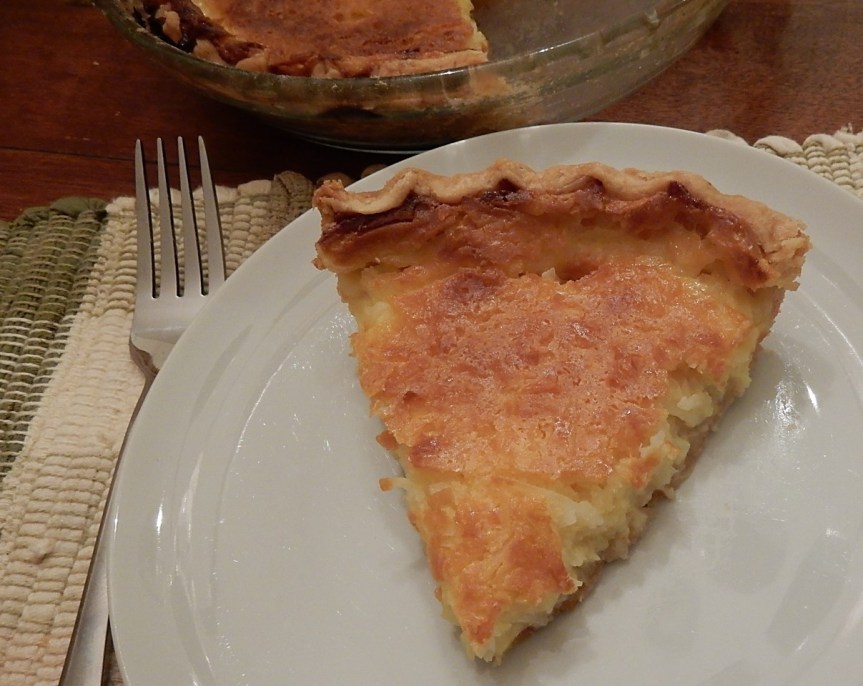
slice of coconut pie on plateSometimes I crave classic old-fashioned cream pies.  I recently came across a lovely recipe for Coconut Pie in a hundred-year-old cookbook. This pie differs from many modern coconut pies because, in addition to the usual milk, egg yolks, and coconut, the recipe calls for grated lemon rind and lemon juice. The lemon adds a lovely sunny note to this rich creamy pie.

Here’s the original recipe:

Recipe for Coconut Pie
Source: Lowney’s Cook Book, Revised Edition (1921)

When I updated the recipe I updated the spelling of coconut. “Cocoanut” is an archaic way of spelling coconut that I sometimes see in old recipes and cookbooks.

Here’s the recipe updated for modern cooks:

Coconut Pie

  • Servings: 6-8
  • Difficulty: moderate
  • Print

2 cups milk

3 egg yolks

1/2 cup sugar

2 tablespoons cornstarch

1/4 teaspoon salt

1 tablespoon butter melted

grated rind and juice from 1 lemon

1 cup grated coconut

1 10-inch pie shell

Preheat oven to 425° F. Put milk, egg yolks, sugar, cornstarch, salt, butter, and lemon juice in a mixing bowl. Beat until smooth. Stir in grated lemon rind and coconut. Pour into pie shell.  Bake for 10 minutes. Reduce heat to 350° F.. Bake additional 60 minutes or until knife inserted into center of pie comes out clean.

http://www.ahundredyearsago.com

1921 Kitchen Design and Layout

kitchen
Source: Elementary Home Economics (1921) by Mary Lockwood Matthews

A 1921 home economics textbook offered these recommendations for a well-designed kitchen:

The Kitchen

The kitchen is a workshop where food is cared for, prepared, cooked and served. 

The most convenient kitchen has windows or doors on two sides of the room, so that when these are open, a cross draft of air clears the room of smoke and odors. 

The kitchen should be the cleanest room in the house. The most sanitary kitchen has walls finished in materials that can be washed, such as oil paint or tile. Walls and woodwork should be light in color, because this makes the room seem more cheerful and also makes it easy to “see the dirt”, which then may be removed. 

Hard-wood floors may be oiled or waxed and used without covering. Soft-wood floors may be covered with linoleum or cork carpet, or they may be painted. 

The kitchen should have built-in cupboards with plenty of space for utensils. 

The sink, with a drain board at each end, should be set where there is plenty of light, and it should be open underneath to avoid the dampness often found in sink cupboards. 

The kitchen may have a built-in ice-box arranged to be iced from the outside of the house. Some kitchens have a dumb waiter to the basement. Kitchen floorplan

If an ironing-board is used in the kitchen, it may be built into a space in the wall, being let down when needed and folded back when not in use. 

Other devices sometimes found in the kitchen are: a closet for cleaning implements, such as broom, bucket and brushes; a cupboard for the leaves of the dining-table, and a built-in kitchen cabinet. There may also be a pantry. 

Each housekeeper decides for herself how to make the kitchen a well arranged and equipped workshop. In a well arranged kitchen the equipment is so placed the housekeeper can use it without losing time or wasting strength in walking. 

Elementary Home Economics (1921) by Mary Lockwood Matthews

Dressed Celery Recipe

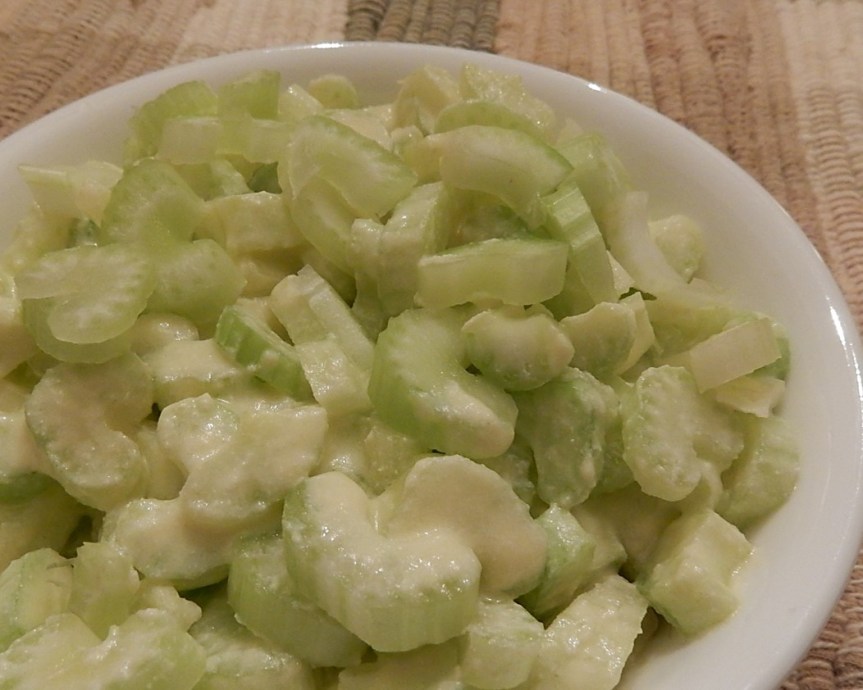
Dressed Celery in DishSome vegetables are often featured in salads and side dishes – others, such as celery, not so much. A hundred years ago celery was more popular than it is today, and I see old recipes for celery dishes from time to time.
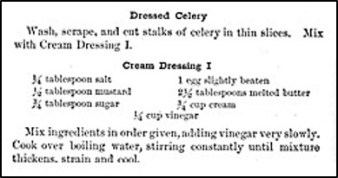
I recently came across a 1921 recipe for an easy-to-make salad called Dressed Celery, and decided to give it a try. Thinly sliced celery is served with a lovely egg-based cream dressing. The Dressed Celery made a nice side salad.

Here’s the original recipe:

Recipe for Dressed Celery
Source: The Boston Cooking-School Cook Book, Revised Edition (1921)

Here’s the recipe updated for modern cooks:

Dressed Celery

  • Servings: 2-3
  • Difficulty: easy
  • Print

2 cups thinly sliced celery

Cream Dressing (see below)

Mix celery with desired amount of Cream Dressing. (Any extra dressing can be reserved and used with another salad.)

Cream Dressing

1/4 teaspoon salt

1 1/2 teaspoons dry mustard

3/4 tablespoon sugar

1 egg, beaten

2 1/2 tablespoons butter

3/4 cup cream

1/4 cup vinegar

Mix the ingredients in the order given. Slowly stir in the cream and vinegar while stirring to make a smooth liquid. Put in a sauce pan, and heat using medium heat while stirring constantly. Cook until the mixture thickens, then strain, and cool before using.

http://www.ahundredyearsago.com

Fried Bananas with Crumbs and Lemon Sauce

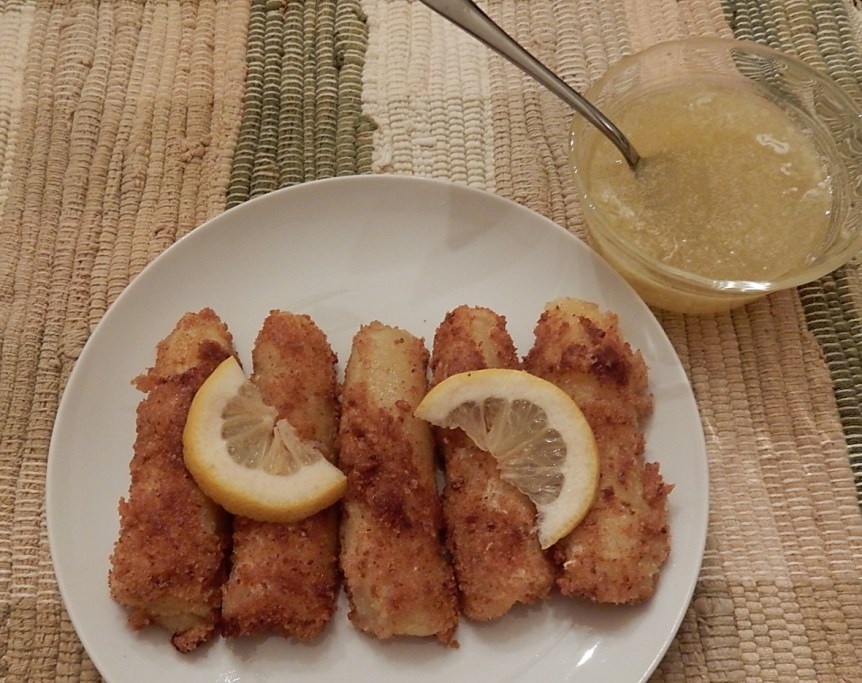
Fried Bananas on plate

I was recently browsing through a hundred-year-old cookbook, and came across a recipe for Fried Bananas with Crumbs, and decided to give it with a try. The recipe said that the Fried Bananas could be served with Lemon Sauce, so I also made the sauce.

I wasn’t quite sure what to expect, but the Fried Bananas with Crumbs and Lemon Sauce were surprisingly tasty. The Fried Bananas were crispy on the outside, and the Lemon Sauce added a bright, sunny, sweet-sour flavor.

Here’s the original recipe:

Recipe for Fried Bananas with Crumbs
Source: Lowney’s Cook Book, Revised Edition, 1921

Six bananas seemed like a lot, so I divided the recipe in half when I made it.

I garnished the Fried Bananas with lemon slices, but I just couldn’t bring myself to follow the directions in the old cookbook and also garnish them with parsley. But, who knows, maybe the bananas would have looked better if I’d also used parsley.

Both Sherry Sauce and Lemon Sauce sounded good. Unfortunately, Lowney’s Cook Book, the cookbook that I got the Fried Bananas recipe out of, did not have a recipe for Sherry Sauce; but it did contain a recipe for Lemon Sauce, so the decision about which sauce to make was easy. I made Lemon Sauce.

Recipe for Lemon Sauce
Source: Lowney’s Cook Book, Revised Edition, 1921

The Lemon Sauce recipe also looked like it would make a lot of sauce, so I divided it into half.

Here are the recipes updated for modern cooks:

Fried Bananas with Crumbs and Lemon Sauce

  • Servings: 3
  • Difficulty: moderate
  • Print

Fried Bananas in Crumbs

3 bananas

salt and pepper

juice of 1/2 lemon

1/2 cup flour

1 egg, beaten

1/2 cup fine plain breadcrumbs (I put 1 bread slice, that I tore into several pieces, into the blender to make the breadcrumbs.)

shortening or vegetable oil

lemon pieces or slices (for garnish, if desired)

parsley (for garnish, if desired)

Place flour on a plate or in a small bowl, and  place the bread crumbs on another plate or small bowl. Put the beaten egg in a small bowl.

Peel bananas; cut into half both lengthwise and crosswise. Sprinkle with salt and pepper, and lemon juice. Roll in the flour, then in the egg, and finally in the bread crumbs.

Heat about 1/2 inch of shortening or vegetable oil in a skillet, then put the breaded banana pieces in the hot shortening or oil. Fry until lightly browned on the bottom, then gently turn to brown the other side. When browned, remove bananas from the skillet. Drain on paper towels, then serve with Lemon Sauce. If desired, garnish with lemon pieces or slices and parsley.

Lemon Sauce

1 teaspoon cornstarch

1/2 cup sugar

1 cup water

juice of 1/2 lemon

grated rind of 1/2 lemon

3/4 tablespoon butter

Mix the sugar and cornstarch together in a saucepan. Stir in the water, and heat using medium heat until the mixture boils. Reduce heat and simmer until the mixture thickens (about 10-20 minutes). Remove from heat and stir in the lemon juice, grated lemon rind, and butter. Serve hot.

http://www.ahundredyearsago.com