 Here’s what a 1921 cookbook had to say about how to substitute various sweets for sugar in recipes:
As substitutes for sugar for cooking purposes, corn sirup, molasses, glucose, maple sugar and sirup, and also honey come in for their share of usefulness. The question arises in the mind of many a housewife as to how much of these diluted sugars should be substituted in customary recipes. For this reason, the following facts may be of interest.
Corn sirup and maple sirup are not so sweet as sugar, and when used to replace it, should be increased from one half to two thirds. For instance, if a recipe calls for 1 cup of sugar, use as substitute 1 1/2 to 1/2/3 cups of sirup. In this case, allowance must be made for the increase in liquid. Every cup of sirup furnishes 1/4 cup of liquid; there for every cup of sirup that is substituted for sugar, reduce the original amount of liquid in the recipe 1/4 cup. Unless such allowance is made for the liquid that the sirup adds, an extra amount of flour is needed to obtain the necessary thickness to the batter, and a poor product is likely to result.
In using molasses and brown sugar, no change need to be made so far as amounts for sweetening purposes are concerned, because what these lack in sweetness is largely made up in flavor. However, the same allowance must be made for the liquid as when sirup is used. Glucose is best when used with part sugar, say 1/3 sugar to 2/3 glucose by measure. When used thus, it is suitable for canning purposes, also for making of sauces, etc.
Honey, one of the most staple sweetenings in the world, and probably the longest used, as not been in very common use for cooking purposes. Its sweetening power is about the same as that of sugar, and it should be used in the same proportions as white sugar, except that one fourth less of liquid should be used in a recipe with honey than with sugar. Honey is best adapted for table use; and for this purpose, it had better replace white sugar entirely.
The Science of Food and Cookery (1921) by H. S. Anderson
The substitution amounts probably haven’t changed across the years – but the spelling has. “Sirup” is now often spelled “syrup,” and “sweetenings” are now “sweeteners.” There sugar substitution recommendations in the old cookbook for both “corn sirup” and “glucose.” I’ve always thought that corn syrup and glucose were the same thing, but apparently they are different.
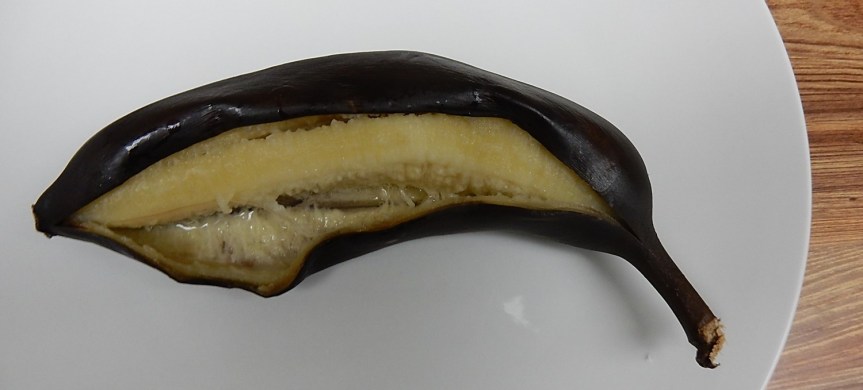 I’d never heard of Baked Bananas, so was intrigued when I flipped through a hundred-year-old cookbook and saw not one, but two, recipes for Baked Bananas. The first recipe involved peeling the banana, adding several ingredients and then baking. The second recipe just called for baking the banana in the skin. Over the years, I’ve learned that the easiest and simplest recipes are sometimes the best, so I decided to go with the second recipe.
 Here’s the original recipe: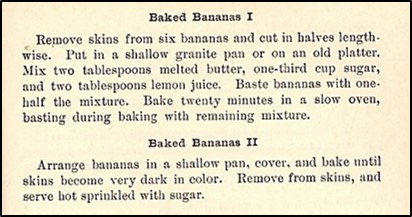
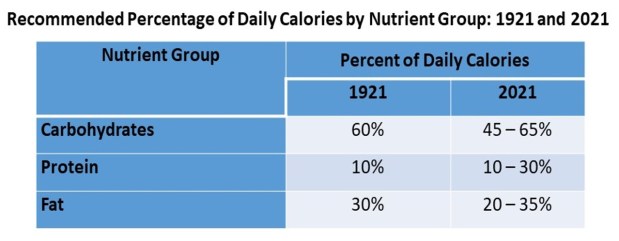 Both a hundred years ago and now, there were recommendations for distributing calories across nutrient groups.

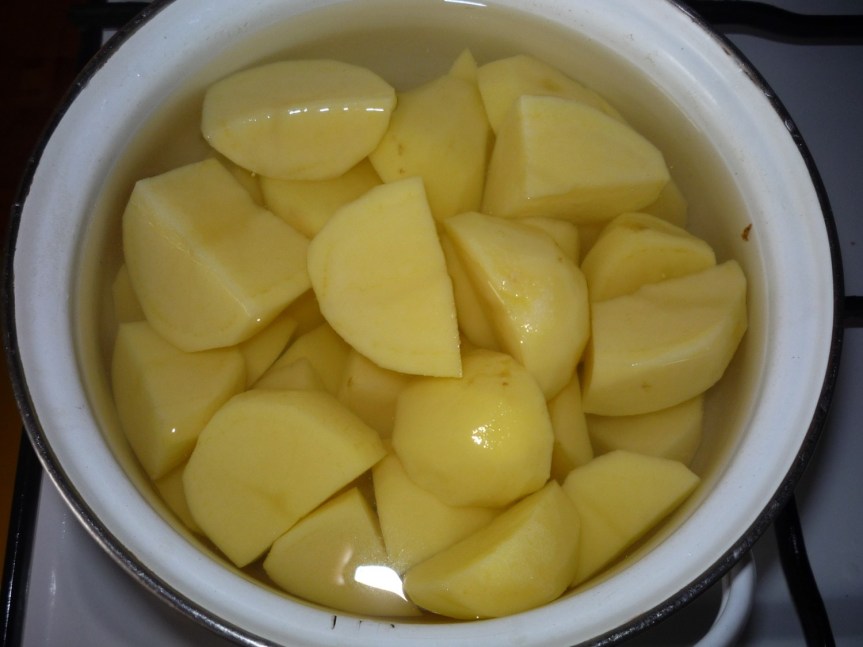 I often make boiled potatoes. I think that they are out of style and considered old-fashioned; but, to be totally honest, I enjoy meals that feature meat and boiled potatoes. A hundred years ago boiled potatoes were more popular than they are now. Here are some 1921 tips for cooking potatoes: