Busy planning menus for holiday gatherings? Maybe some hundred-year-old December menus for special occasions might give you some ideas.

Busy planning menus for holiday gatherings? Maybe some hundred-year-old December menus for special occasions might give you some ideas.
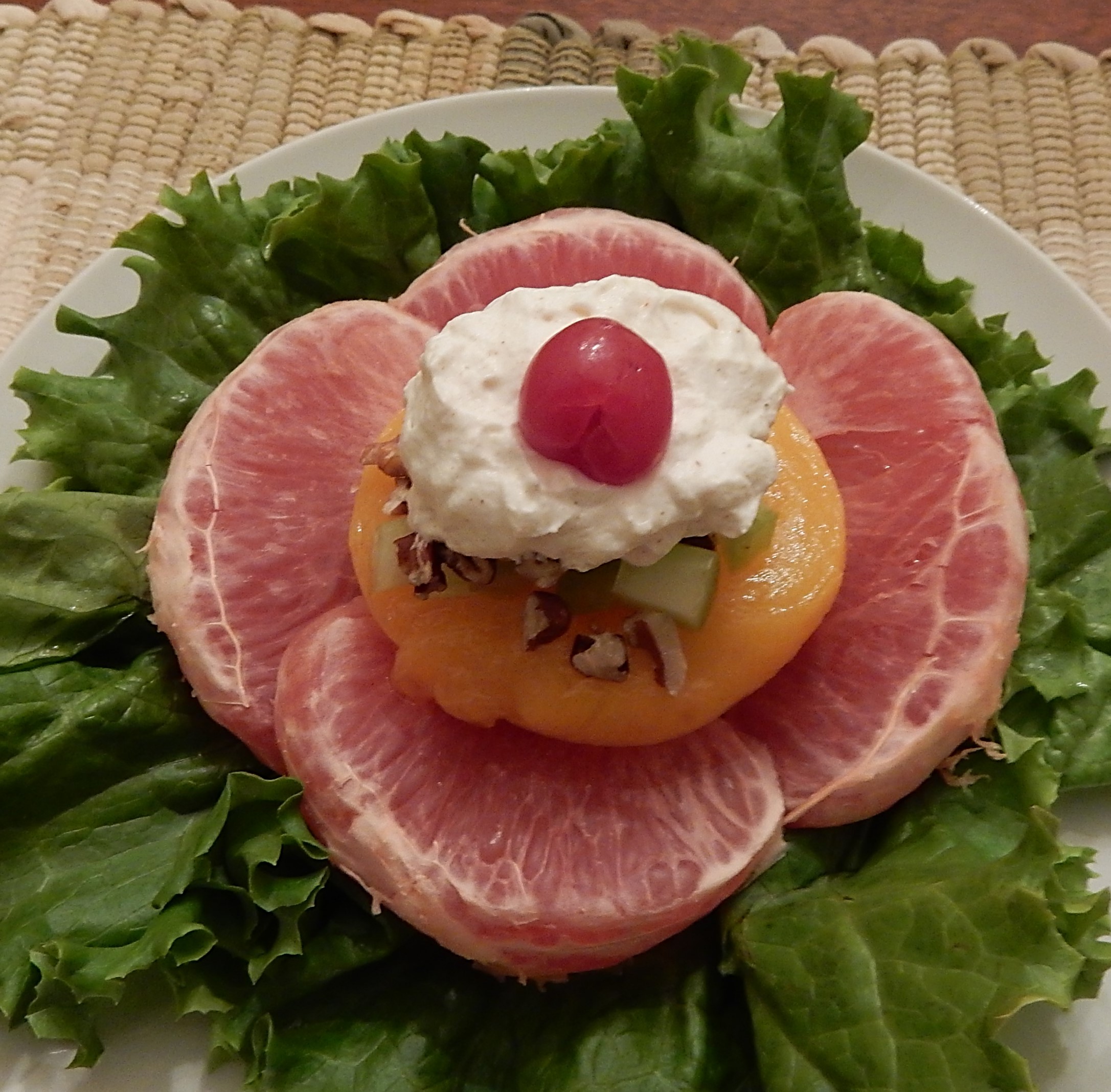
Some holiday foods seem to have largely gone out of style. I have vague memories of decorative salads made by carefully arranging canned fruits and other ingredients on individual plates that were served at holiday gatherings when I was a child – but haven’t had one of these salads in years. But when I saw a recipe for Winter Salad in the December, 1922 issue of American Cookery, I was intrigued, and decided to give it a try. A canned peach half, that is surrounded by grapefruit segments, is filled with chopped celery and pecans, and placed on some lettuce leaves. It is then topped with whipped cream flavored with paprika and topped with a candied cherry. (I used a Maraschino cherry.)
I wasn’t quite sure about this recipe – the combination of ingredients seemed very unusual and I thought it extremely unusual to flavor whipped cream with paprika instead of sugar. That said, the Winter Salad was very attractive in an old-fashioned way.
This recipe won’t quite make the cut for the family Christmas dinner. I can’t quite picture serving it to friends and family at a holiday event (some things are just out of style); however, the combination of ingredients and flavors actually worked – and I can honestly say that the salad was tasty.
Here’s the original recipe:

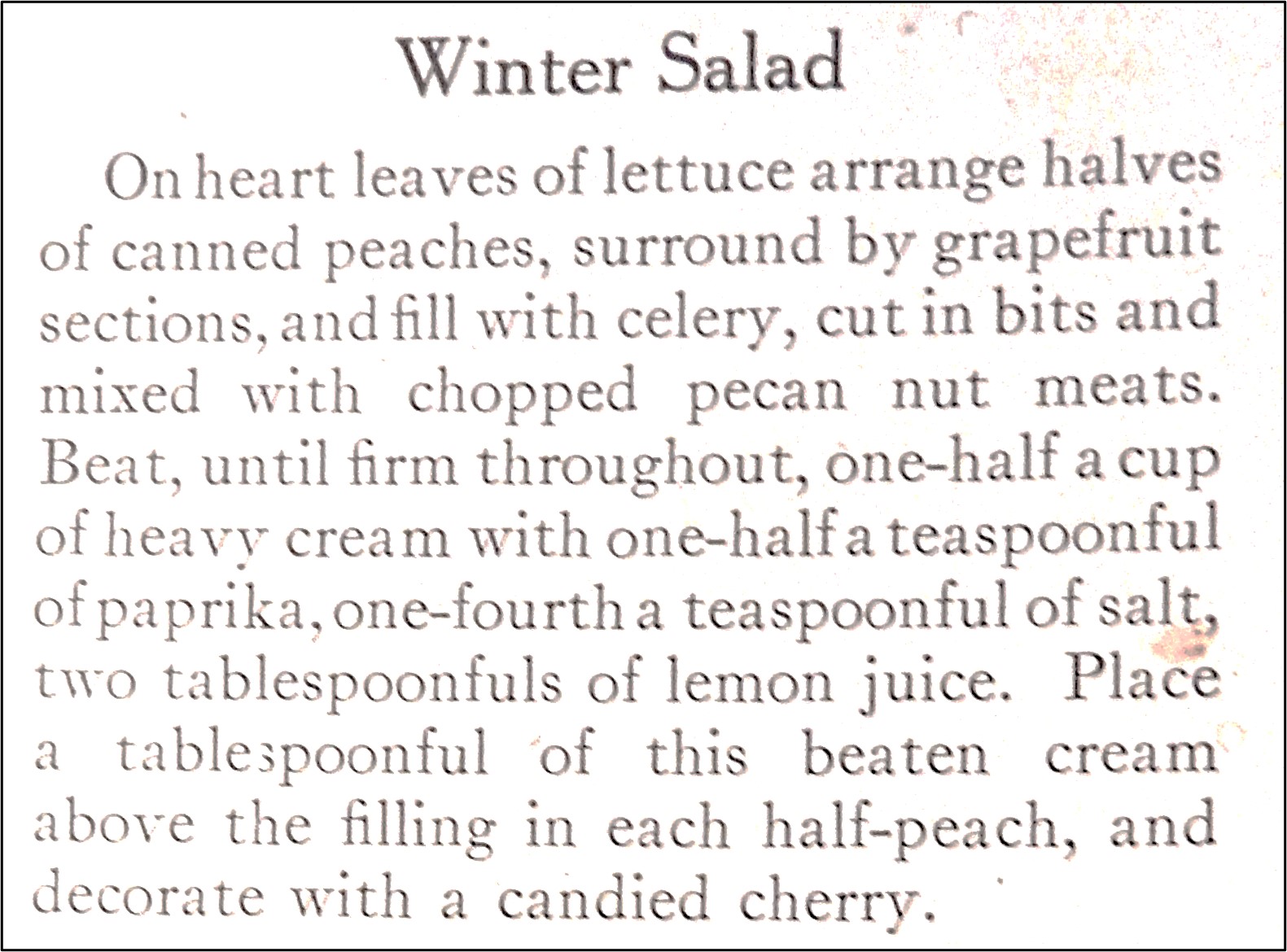
The recipe provides no information about how many peach halves should be used; however it does say that 1/2 cup of cream should be whipped. This recipe makes a lot of whipped cream, so I think that the recipe is for a large can (29 ounce) of peaches (or a quart of home canned peaches) – which typically contain about 8 peach halves. So I indicated below that the recipe is for 8 servings. However, it is easy to use smaller amounts of the various ingredients if fewer servings are needed.
Here’s the recipe updated for modern cooks:
Leaf lettuce
29-ounce can peach halves (8 peach halves)
2 -3 grapefruit (peeled and separated into segments)
2 stalks celery, chopped
1/4 cup pecans, chopped
1/2 cup heavy cream
1/2 teaspoon paprika
1/4 teaspoon salt
2 tablespoons lemon juice
8 candied or Maraschino cherries
Arrange lettuce leaves on individual salad plates, and top with a peach half. Surround the peach half with grapefruit segments. Fill each half with a mixture of the chopped celery and pecans.
Meanwhile, put the heavy cream in a deep mixing bowl; beat until soft peaks form. Add the paprika, salt, and lemon juice; beat to combine. Spoon 1 tablespoon of the whipped cream on top of each filled peach, then top with a cherry.
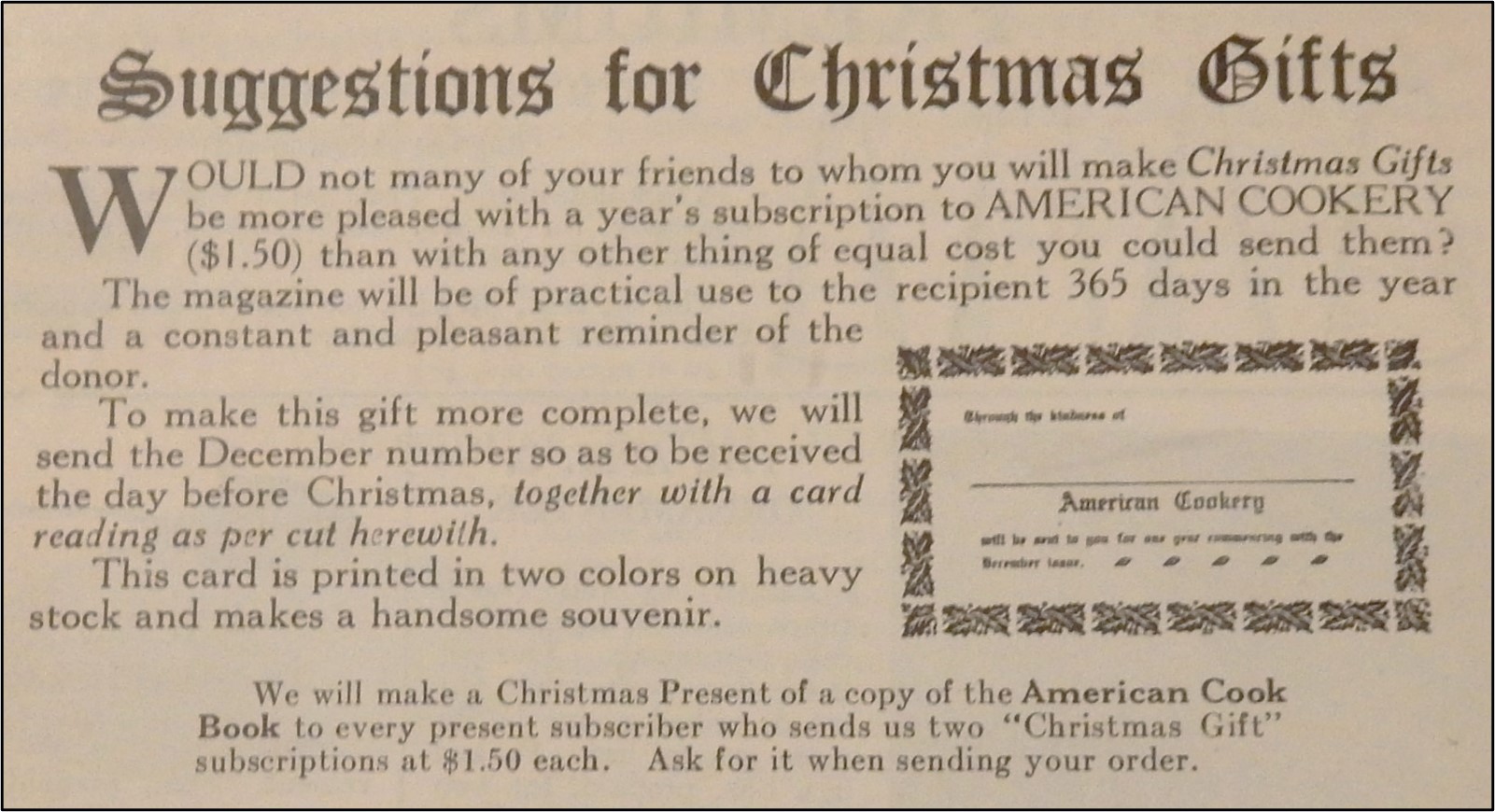
Still look for Christmas gift ideas? Well . . . one idea in the December, 1922 issue of American Cookery was to give subscriptions to the magazine. And, the price was right at only $1.50 for a one-year subscription.

Macaroni and Cheese is a wonderful comfort food – and it seems more popular than even. Kids love it, and it’s also often on the menu at very fancy restaurants. So when I saw a recipe in a hundred-year-old cookbook for Macaroni with Cheese, I decided to give it a try. The process for making the Macaroni with Cheese was a little different from the modern way of making the dish. The old recipe called for putting layers of bread crumbs (small pieces of torn bread), macaroni, and cheese into a casserole dish. Thin cream (half and half) is then poured over the layers. The dish is then baked until the bread crumbs are lightly browned.
The Macaroni with Cheese turned out nicely, and was very tasty. The bread crumb layers blended nicely with the macaroni and cheese, and I couldn’t identify separate layers in the finished dish. It just seemed like a typical Macaroni and Cheese.
Here is the original recipe:

Apparently macaroni was different a hundred years ago from what it is now. The recipe calls for breaking the macaroni into inch pieces. Today, it is already cut into pieces that are about an inch long.
When I read this recipe I wasn’t clear whether the three teaspoons of salt went into the water that the macaroni was boiled in, or if it was sprinkled on the layers of macaroni in the casserole dish. In any case, it seemed like a lot of salt, so I instead cooked the macaroni in water that contained 1 teaspoon salt, and just sprinkled a little salt on the layers in the dish.
450° F. seemed like a very high temperature to bake this dish, but it worked. The Macaroni with Cheese cooked very quickly at this temperature.
Here’s the recipe updated for modern cooks:
3 cups macaroni
1 teaspoon salt
1 cup grated cheese (I used cheddar.)
2 slices bread torn into very small pieces (about 1 cup of bread pieces)
1/4 cup butter
1 cup half and half
salt and pepper
Preheat oven to 450° F. Put water and 1 teaspoon salt into a large saucepan, and bring to a boil using high heat. Add macaroni, and reduce heat so that the water gently simmers. Cook the macaroni until al dente, then drain and rinse with cold water.
Cover the bottom of a buttered 2-quart casserole dish with 1/4 of the bread crumbs. Add a layer with 1/3 of the macaroni. Sprinkle with 1/3 of the grated cheese; then sprinkle with salt and pepper, and dot with bits of the butter. Repeat the layers, ending with a layer of bread crumbs.
Pour the cream over the top of the layers. Put in oven and bake for 30 minutes or until the bread crumbs are lightly browned and the mixture is hot and bubbly.
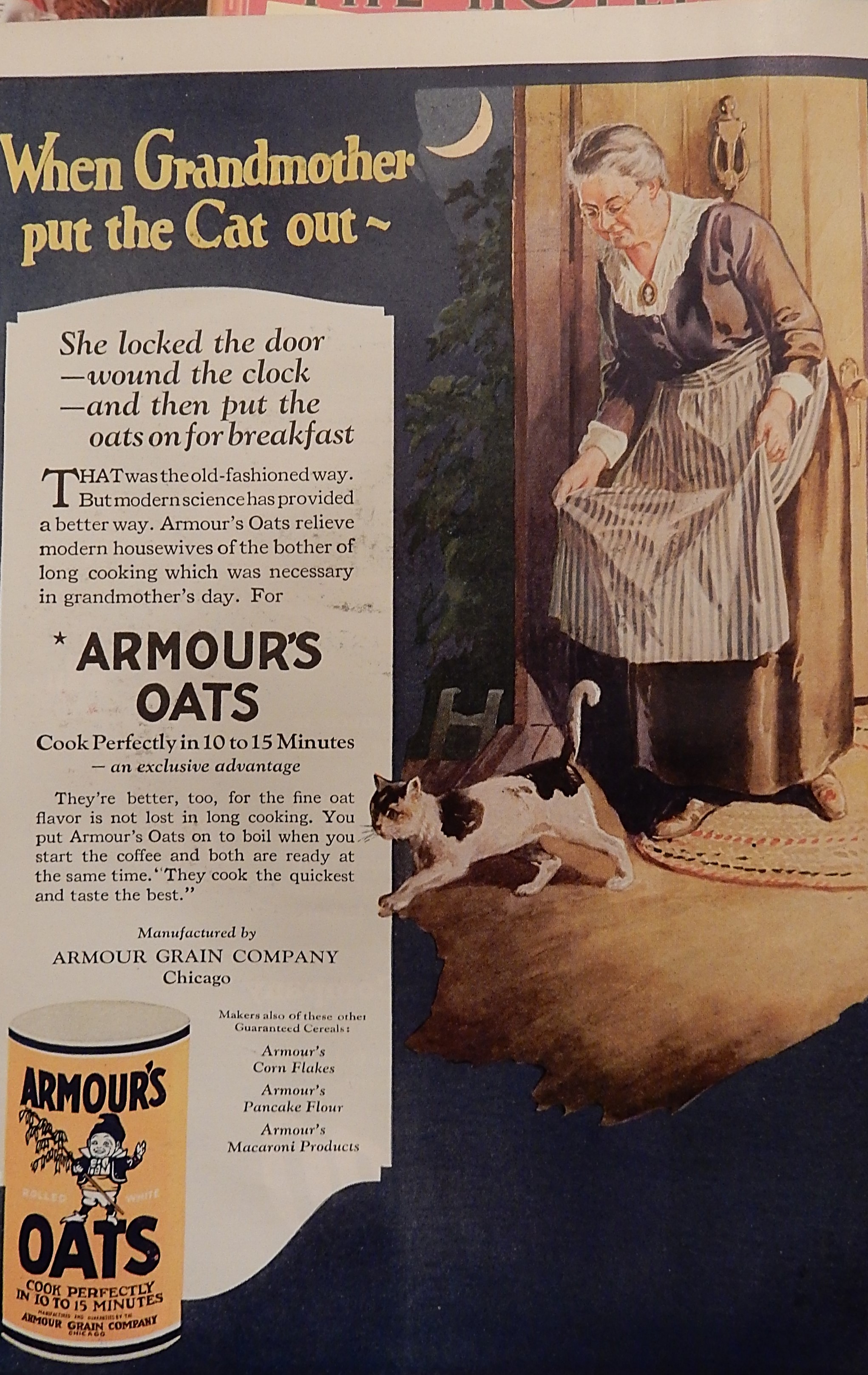
I think that Amour’s Oats are long gone, but I still enjoyed this advertisement so decided to share it with you.
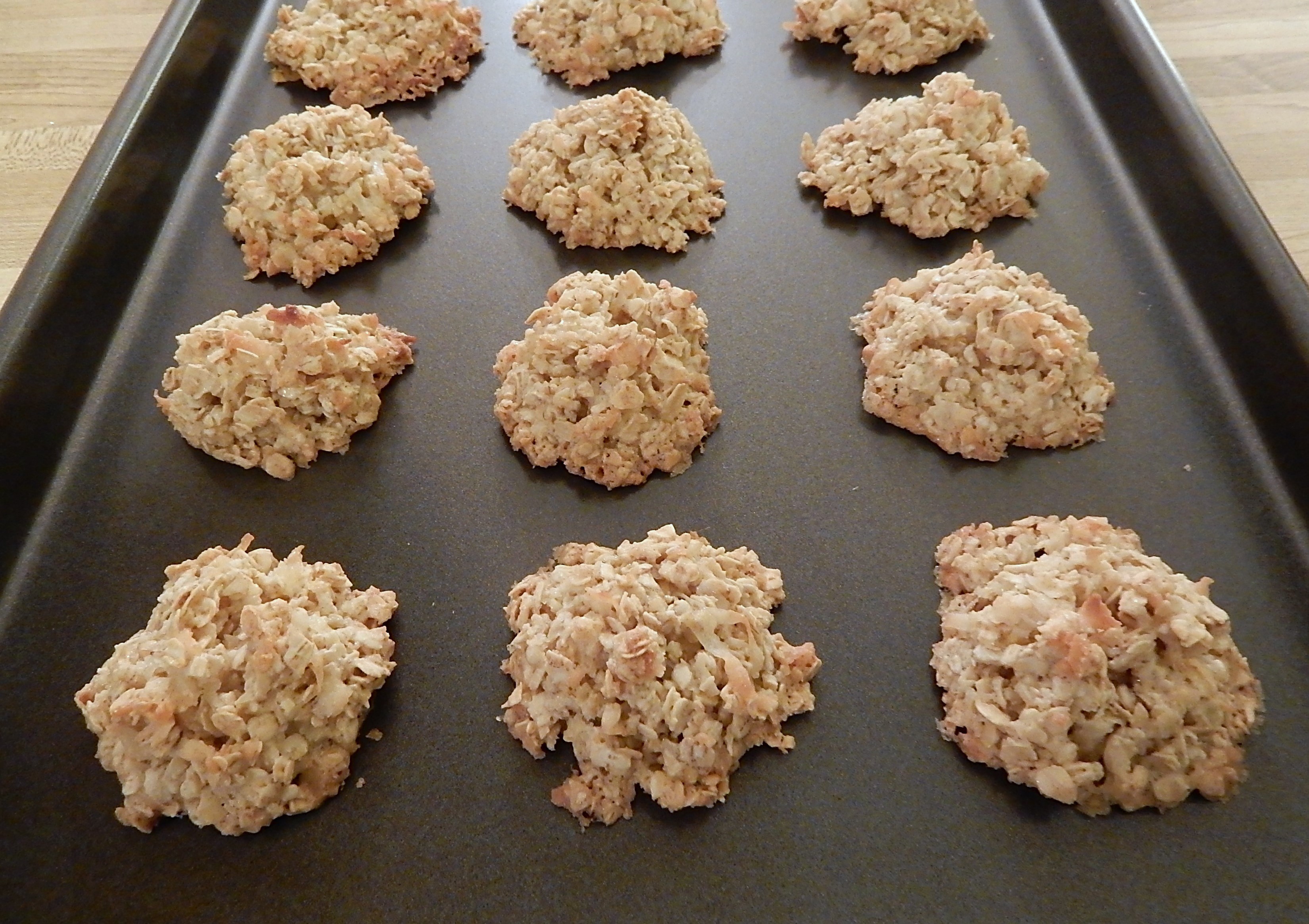
I’m always looking for cookie recipes that are both easy to make and tasty, so when I saw a recipe for Oat Macaroons in a hundred-year-old cookbook, I decided to give it a try.
The Oat Macaroons contain oatmeal and coconut. They are light and tasty with just the right amount of sweetness. An added bonus is that they are gluten free. This recipe is a winner and I plan to make it again. The would be a wonderful addition to a holiday cookie tray.
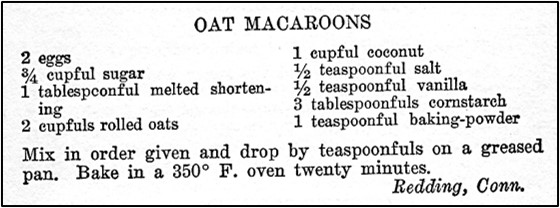
I used butter instead of melted shortening when I made this recipe, and I used quick minute (oatmeal) for the rolled oats. I also did not mix in order given. I thought that it would be difficult to get the salt, vanilla, cornstarch, and baking powder evenly distributed in the cookie dough if added at the end, so I stirred those ingredients in prior to adding the oatmeal and coconut.
Here’s the recipe updated for modern cooks:
2 eggs
3/4 cup sugar
3 tablespoons cornstarch
1 teaspoon baking powder
1/2 teaspoon salt
1/2 teaspoon vanilla
1 tablespoon butter, melted
2 cups quick (1 minute) oatmeal
1 cup flake coconut
Preheat oven to 350° F. Put the eggs, sugar, cornstarch, baking powder, salt, and vanilla in a mixing bowl; stir. Add melted butter and stir until smooth. Add oatmeal and coconut; stir until combined. Drop heaping teaspoons of the dough on greased baking sheet. As needed, gently press the dough together to create a firm dropped cookie. Place in oven and bake for 20 minutes or until lightly browned. Remove from oven, wait minute and then remove from baking sheet to wire rack for further cooling.
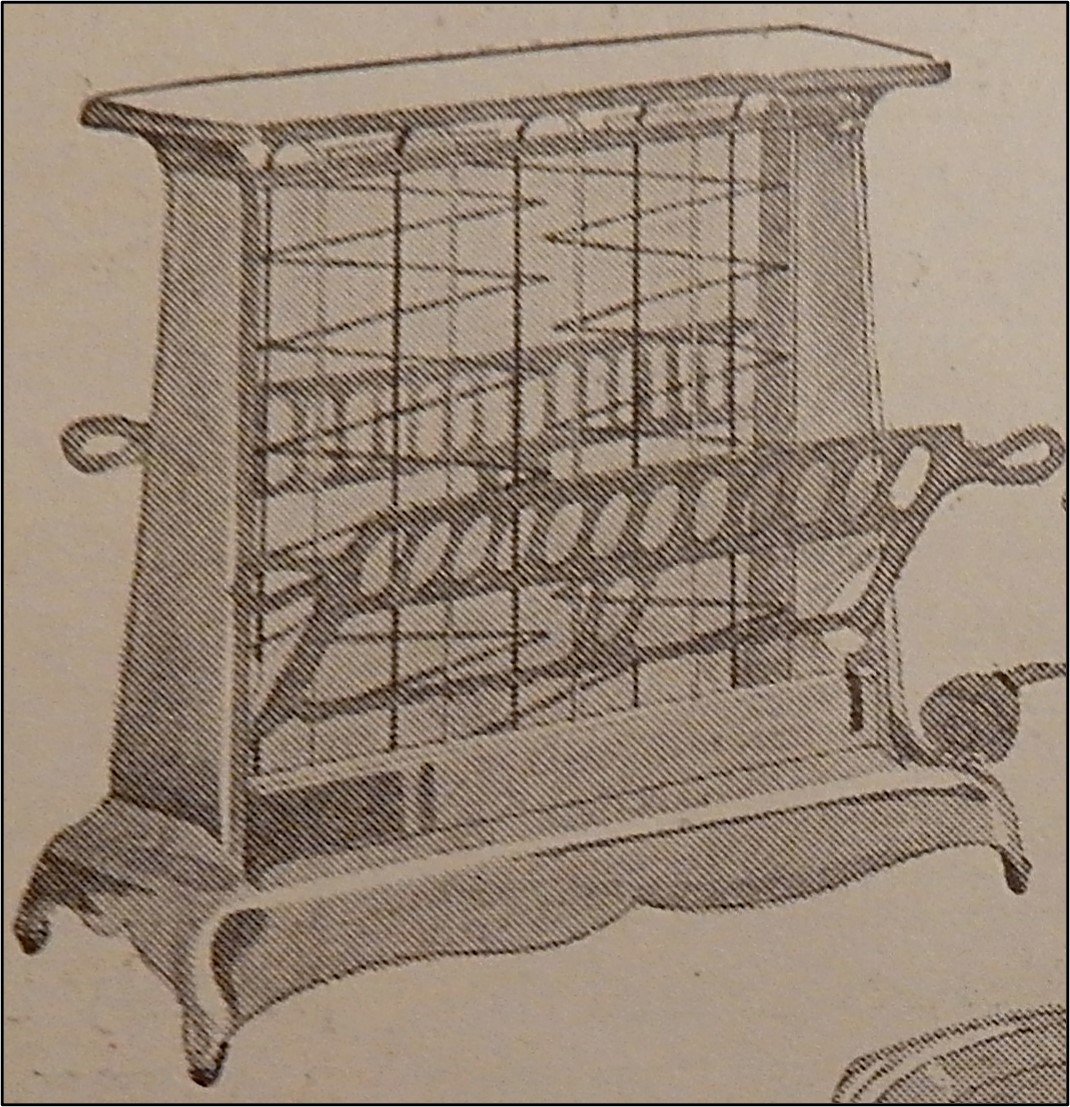
Looking for some good Christmas gift ideas? Here are three “practical gift ideas” in a hundred-year-old magazine.
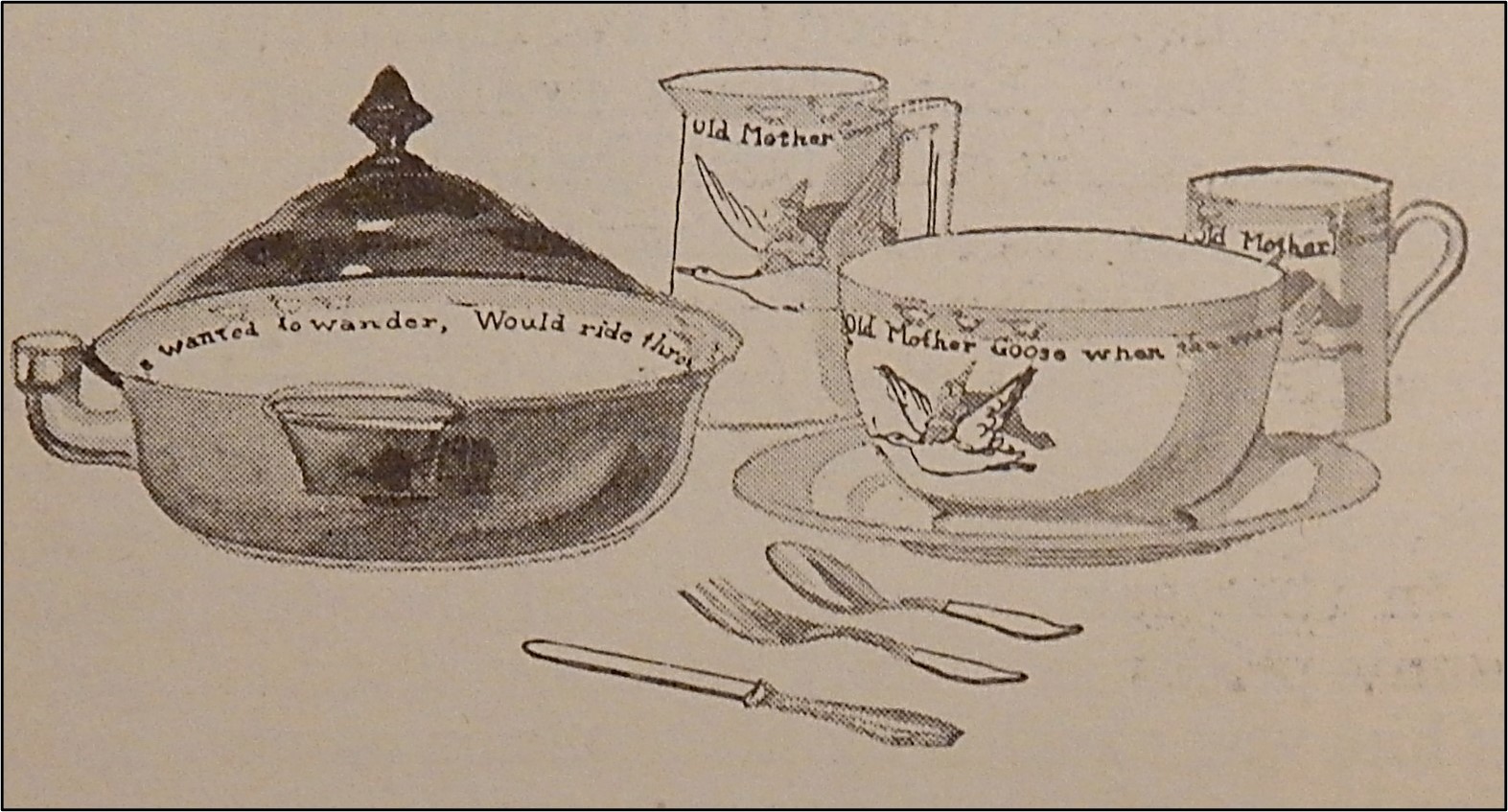
Mother Goose Cereal Set
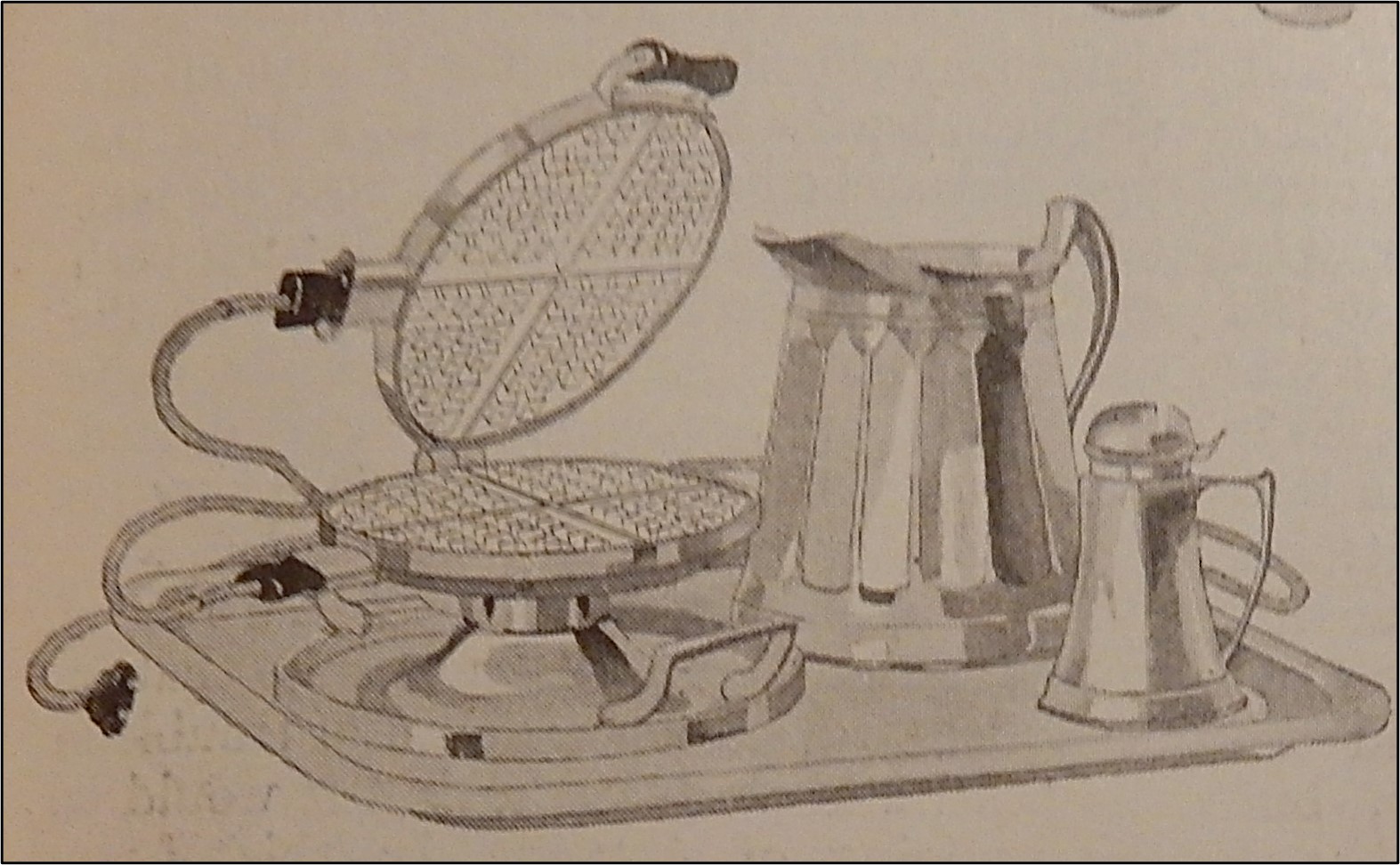
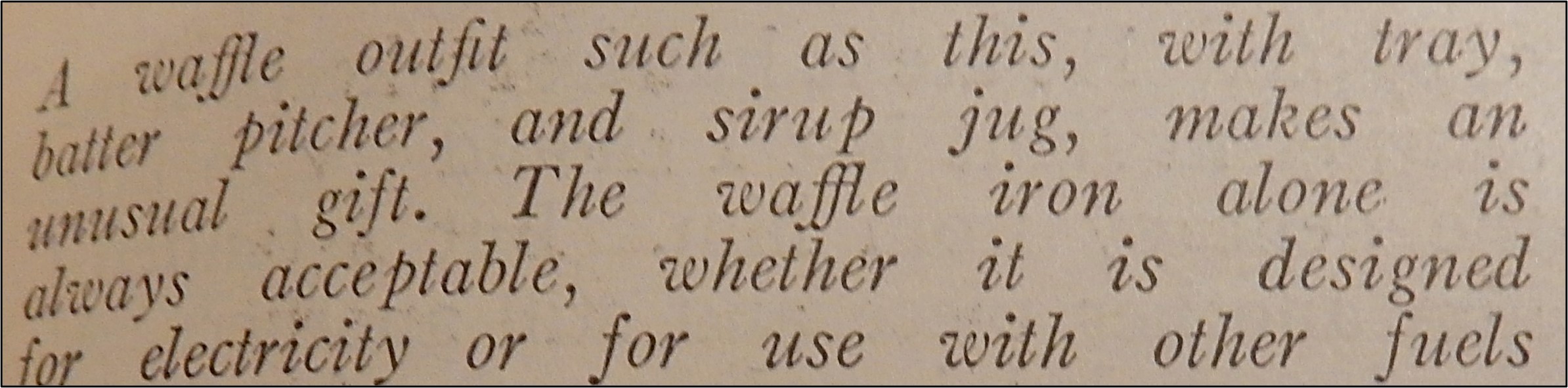
Waffle Outfit