
Which church did Grandma attend?

15-year-old Helena Muffly wrote exactly 100 years ago today: 

Sunday, February 5, 1911: Went to Sunday school this morning. Went to church this evening with Ruth. It was rather quiet today. Everything seemed so quiet.

 Her middle-aged granddaughter’s comments 100 years later: 

There are so many pieces to the jig-saw puzzle that make up our ancestors’  lives. Questions like, “Which church did Grandma attend?” probably aren’t very important in the bigger scheme of things—but I’m curious. I asked my father. I searched for member records in church histories and other supplemental documents. However, the available data were inconclusive, and I still don’t definitively know the answer.

Based on a scan of the diary I can’t find any place where Grandma said which church she attended—though the diary entries indicate that she faithfully attended Sunday school. There were two or three churches in McEwensville one hundred years ago: St. John’s Reformed Church, Messiah Lutheran— and maybe a Baptist Church.

In the diary Grandma mentions the Lutheran and Reformed churches by name when she visits them—but she provides no church name when she attended her regular church. This suggests that she didn’t attend either of those churches–but  rather that she went to the Baptist one. However, I’m somewhat uncomfortable with that conclusion since I know that the Baptist church closed early in the 20th century. Agnes Beard wrote in 1939 in her History of McEwensville

“The Baptist Church, a brick edifice, has fallen into ruins, there being no members in or near the place to keep it in repair.”

Agnes Beard (1939)

Prior to reading Grandma’s diary I never thought about her religious beliefs. After she married Raymond Swartz she attended Messiah Lutheran Church. I don’t remember Grandma ever discussing religion—and was somewhat surprised that she probably was raised in a somewhat more conservative tradition than what she practiced as an adult.

Recent photo of building that once housed Messiah Lutheran Church.

As an older woman Grandma enjoyed visiting with friends in the “old ladies Sunday School class” at Messiah Lutheran.  Both Grandma and Helen “Tweet” Wesner were in that class. Tweet never married and lived her entire life in McEwensville. It’s kind of cool how life-long friendships and relationships developed in this small community.
The cows need milking

15-year-old Helena wrote a hundred years ago today:

Saturday, February 4, 1911. Got up late this morning. The time we usually get up on Saturday mornings. Went to Watsontown this afternoon. Bought some valentines. I was rather fortunate. I got a ride both ways from and to home which I was glad of because the roads were so slushy. Ruth did my milking tonight. Twas a wonder.

Her middle-aged granddaughter’s comments 100 years later:

Did Grandma have to milk the cows every evening?  . . . what about in the morning? Did she milk them before walking to school each morning? It seems like needing to milk cows daily was a major commitment, yet she never mentioned it during the entire first month of the diary. Apparently from Grandma’s perspective it was  only worth mentioning on the day when she went to town and her sister Ruth had to do her milking for her.

Watsontown is about 2 miles west of the Muffly farm, and is somewhat larger than McEwensville. The MyWatsontown web site has some wonderful old photos—and lots of other history resources—that provide a sense of what Watsontown was like in 1911.

Just not into ice skating?

15-year-old Helena wrote a hundred years ago today:

Friday, February 3, 1911. I got out of school early this afternoon. They all went skating except me. Helen Wesner was here and is going to stay all night. I’ll have to retire to another sleeping corner but I don’t care. It is only for one night, so what’s the diff? I may have some peace.

 Her middle-aged granddaughter’s comments 100 years later:

Sounds like Grandma’s sister Ruth invited a friend over for a sleep-over. This is the third time in the diary that Grandma mentions ice skating—but indicates that she didn’t go (see January 17 and 26). And, no diary entries  indicated that Grandma went skating. It seems odd that she never goes since the skating area apparently is on the creek right next to the  Muffly home. Why? . . Was Grandma  a poor skater?. . . Didn’t enjoy the company? . . . Skates didn’t fit and hurt her feet? . . . Didn’t like the cold?. . .

Groundhog Day

15-year-old Helena Muffly wrote exactly 100 years ago today: 

Thursday, February 2, 1911: I soon get discouraged, and stop writing in my diary if I don’t soon find something of some interest to write. I made a short errand at noon in behalf of my adored sister. It was to deliver a note to one of her bosom friends with exceedingly good care.

Pennsylvania news exactly 100  years ago today:

February 2, 1911:  About a hundred twenty-five miles west of McEwenville, the 26th annual Groundhog Day festivities took place in Punxsutawney.

Monthly Poem in Diary

15-year-old Helena wrote a hundred years ago today:

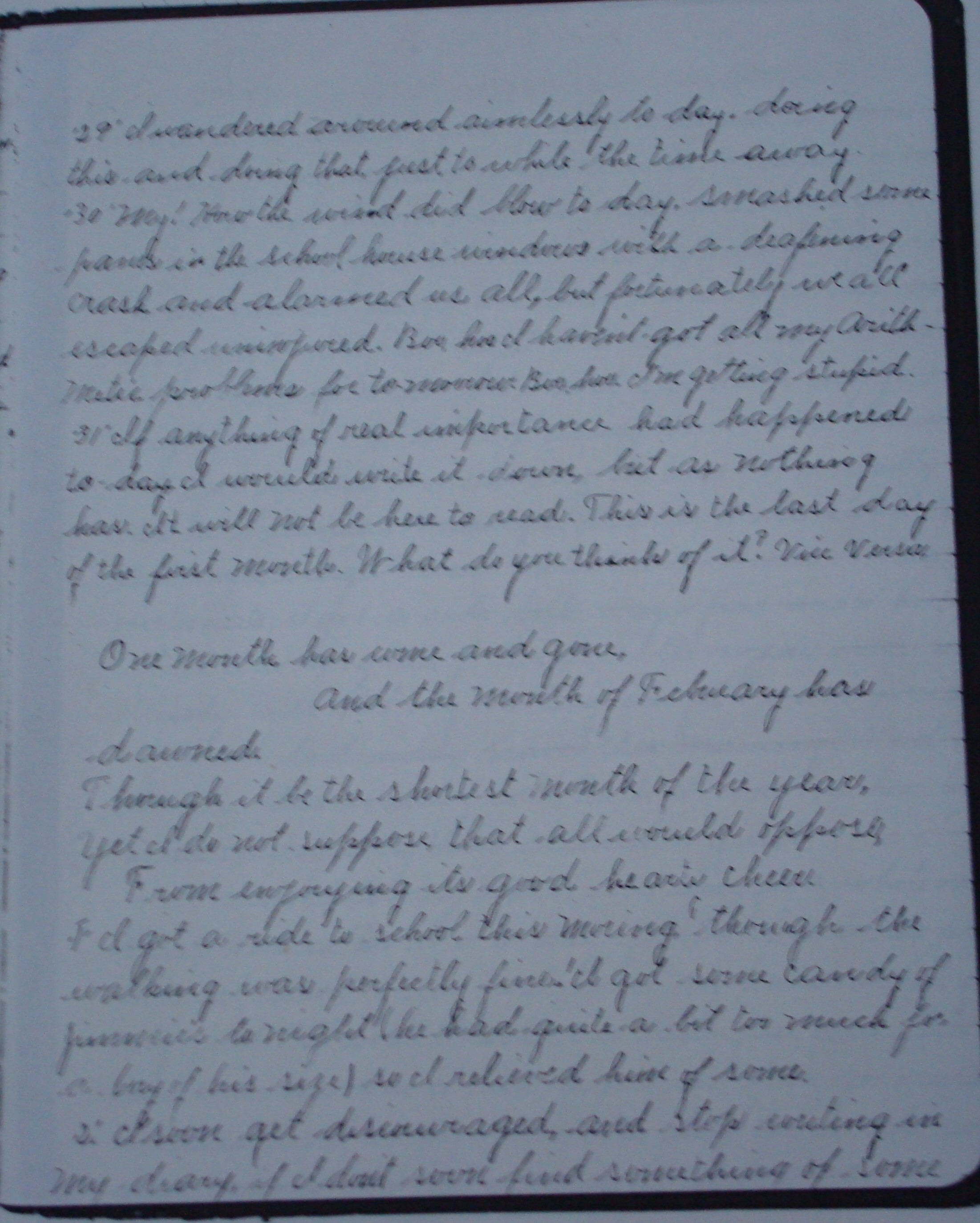
Wednesday, February 1, 1911.

One month come and gone,

And the month of February has dawned.

Though it be the shortest month of the year,

Yet I do not suppose that all would oppose.

From enjoying its good years cheer.

I got a ride to school this morning, though the walking was perfectly fine! I got some candy of Jimmie’s tonight (he had quite a bit too much for a boy of his size so I relieved him of some).

Her middle-aged granddaughter’s comments 100 years later:

The diary was written in a blank lined paper book. Each month of the diary begins with a poem. I wonder if Grandma wrote the poems or if she got them out of a book or magazine.

A hundred years ago poetry was much more popular than it is now.  Magazines such as Ladies Home Journal included entire pages of poetry.  Students were regularly required to memorize poems and teachers had poetry books that they used as sources for these poems. Pamphlets were printed by various religious denominations that contained poems which Sunday School children could memorize and then present.

This month’s poem doesn’t really work for me—and maybe Grandma wrote it—though I’m guessing that she got these monthly poems from other some source. I’ll probably never know for sure.

This is the first time that Jimmie is mentioned in the diary. He was Grandma’s six-year-old brother.

Odd, Unusual, and Strange Math Problems

15-year-old Helena wrote a hundred years ago today:

Tuesday, January 31, 1911.  If anything of real importance happened today I would write it down, but as nothing has it will not be here to read. This is the last day of the first month. What do you think of it? Vice versa.

Her middle-aged granddaughter’s comments 100 years later:

No mention of arithmetic problems in today’s diary entry. Maybe it went better today than yesterday.

I’m still fascinated by the problems in the 1911 high school arithmetic textbook that I found. The book contains some really strange problems–including some that deal with topics that probably would be considered unacceptable today.  

1. If 44 cannons, firing 30 rounds an hour for 3 hours a day consume 300 barrels of powder in 5 days, how long will 400 barrels last 66 cannons, firing 40 rounds an hour for 5 hours a day?

2. Bought by avoirdupois weight, 20 pounds of opium at 40 cents an ounce, and sold the same by Troy weight at 50 cents an ounce; did I gain or lose, and how much?

3. A wine merchant imported 1000 dekaliters of wine, at a cost of 75 cents a liter, delivered. At what price per gallon must he sell the same to clear $2000 on the shipment?

4. A certain number of men, twice as many women, and three times as many boys, earn $123.80 in 5 days; each man earned $1.20, each woman 66 1/3 cents, and each boy 53 1/3 cents per day. How many were there of each?

Kimball’s Commercial Arithmetic: Prepared for Use in Normal, Commercial and High Schools and the Higher Grades of the Common School (1911)

Remember that a hundred years ago patent medicines containing opium were legal, child labor laws were just being enacted, and it was way before woman had equal rights.

If you want to do the opium problem here are a couple of definitions:

Avoidupois weight (The usual system used in the U.S.):  16 ounces = 1 pound

Troy weight:  12 ounces = 1 pound

Arithmetic Problems in 1911 High School Text Book

15-year-old Helena wrote a hundred years ago today:

Monday, January 30, 1911. My! How the wind did blow today, smashed some panes in the school house windows with a deafening crash and alarmed us all, fortunately we escaped uninjured. Boo hoo I haven’t got all my arithmetic problems for tomorrow. Boo hoo. I’m getting stupid.

Her middle-aged granddaughter’s comments 100 years later:

It was either a damn strong wind–or the windows weren’t very strong. I wonder if the panes blew out when the class was working on the dreaded arithmetic.  To get a sense of what the problems were like I found a high school arithmetic book that was published in 1911. Here are the written exercises in the chapter titled The Equation:

1. To four times a certain number I add 16, and obtain as a result 188. What is the number?

2. A man having $100 spent a part of it; he afterwards received five times as much as he had spent, and then his money was double what it was at first. How much did he spend?

3. A farmer had two flocks of sheep, each containing the same number. He sold 21 sheep from one flock and 70 from the other, and then found that he had left in one flock twice as many as in the other. How many had he in each?

4. Divide 100 into two such parts that a fourth of one part diminished by a third of the other part may be equal to 11.

5. Find the area of a square field whose diagonal is 50 rods.

Kimball’s Commercial Arithmetic: Prepared for Use in Normal, Commercial and High Schools and the Higher Grades of the Common School (1911)