Biplane Whirling Aloft at the 1912 Milton Fair

17-year-old Helena Muffly wrote exactly 100 years ago today: 

Thursday, October 3, 1912:  I really did go after all my doubtings, but now I feel just as tired as there is any use in being. Saw a flying machine whirling aloft in the air for at least 10 minutes. I think twas quite a sight to see.
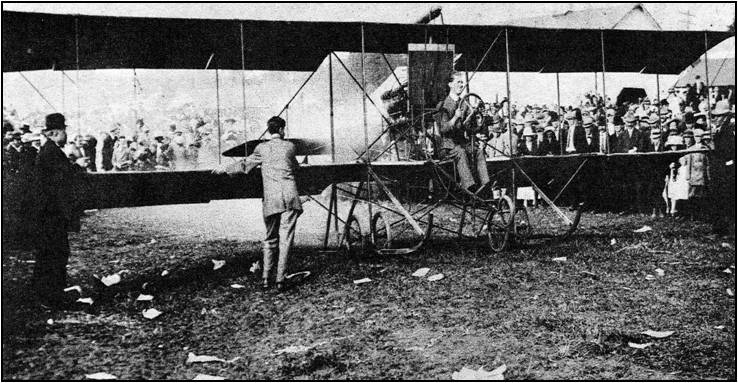
Biplane at 1912 Milton Fair. (Source: Chronicles and Legends of Milton by George Venios. Used with permission.)

Her middle-aged granddaughter’s comments 100 years later:

Grandma went to the fair in the nearby town of Milton. She wrote the previous day that she planned to go.

Whew—I can hardly believe it, but I found a picture of the flying machine Grandma saw.

George Venios, in his book titled Chronicles and Legends of Milton, writes about the Milton Fair. And, he includes a picture of the plane that was at the 1912 fair.

The photo caption in the book says:

The photo, taken in 1912, is a pusher type biplane and is believed to be one of the first aircraft to land here while on a hair-raising “barnstorming” tour.

I contacted George and he generously gave me permission to include the photo in this post, so that you could see it. Thank you!

When I found the photo, I got my magnifying glass out to see if I could find Grandma in the crowd; though, of course, I couldn’t.

George also sent me a picture of a mural in Milton that reflects the history of transportation in the town. The mural includes an image of the 1912 biplane.
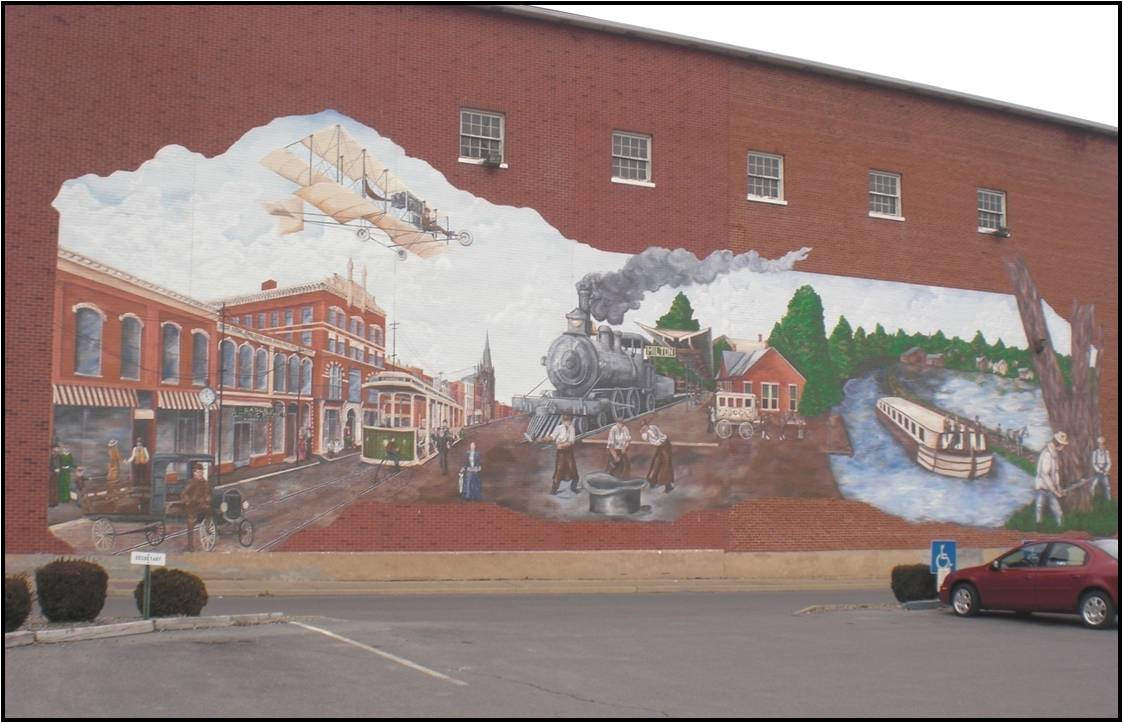
Transportation mural in Milton (Source: George Venios. Used with permission.)

Chronicles and Legends of Milton is an awesome resource that tells the story of Milton, and is full of wonderful photos. Milton has a really interesting history—and I’d encourage anyone interested in its story to get a copy of the book.

School Will Close for Two Days So Students Can Attend Fair

17-year-old Helena Muffly wrote exactly 100 years ago today:

Wednesday, October 2, 1912:  I guess I’ll go tomorrow. We have Thursday and Friday off. Think I’m glad of it

Milton, PA
Recent photo of Milton. In the early 1900’s,the fairgrounds were north of town.

Her middle-aged granddaughter’s comments 100 years later:

Grandma  was referring to the Milton Fair in this post. The previous day, she mentioned that it was fair week.

It’s interesting how the school closed for two days so that students could attend the fair. What was the educational aspect of the fair? . . .or maybe the teacher just figured that students would skip school anyway for the fair, so he might as well give them the days off.

I think that when I was a child that we got a half day off to attend another fair–the Bloomsburg Fair. I wonder if schools do that any more.

Events Occur with a Predictable Regularly

17-year-old Helena Muffly wrote exactly 100 years ago today: 

Thursday, October 10, 1912:

So here comes the month of October.

Arrayed in a many hued gown

Trimmed with the tints of bright Autumn,

The purple, the orange, the red and the brown.

This is Fair week, and I hope that the weather will be that also. I long to go, but I do not know whether we’ll get a day off or not. Must try and find out tomorrow.

Her middle-aged granddaughter’s comments 100 years later:

My life has a routine with a predictable seasonal ebb and flow, with recurring events that occur at predictable times.

Today marks the beginning of my 22nd month posting Grandma’s diary entries—and I find that I’m also beginning to get a sense of the ebb and flow of her routine a hundred years ago.

Grandma began each month with a poem that either gave her perspective of the upcoming month—or mourned the passing of the previous month.  She also talked about harvesting crops and watching cows with amazing regularly across the two years, and in early autumn each year she wrote about Fair Week in the nearby town of Milton.

On September 20, 1911 she wrote:

Papa and Mamma and Jimsey went to the fair this afternoon. I expect to go tomorrow if the weather is favorable. We have Thursday and Friday off for the fair.

And, I’m starting to notice exceptions to patterns. The fair held about two weeks later 1912 than in 1911. I wonder why.

Elected Class Secretary

17-year-old Helena Muffly wrote exactly 100 years ago today: 

Monday, September 30, 1912:  Our class had a meeting this evening after school. I had the misfortune to be elected secretary. But better, or rather it suits me better to have been that, than president or treasurer would have suited me.

Her middle-aged granddaughter’s comments 100 years later:

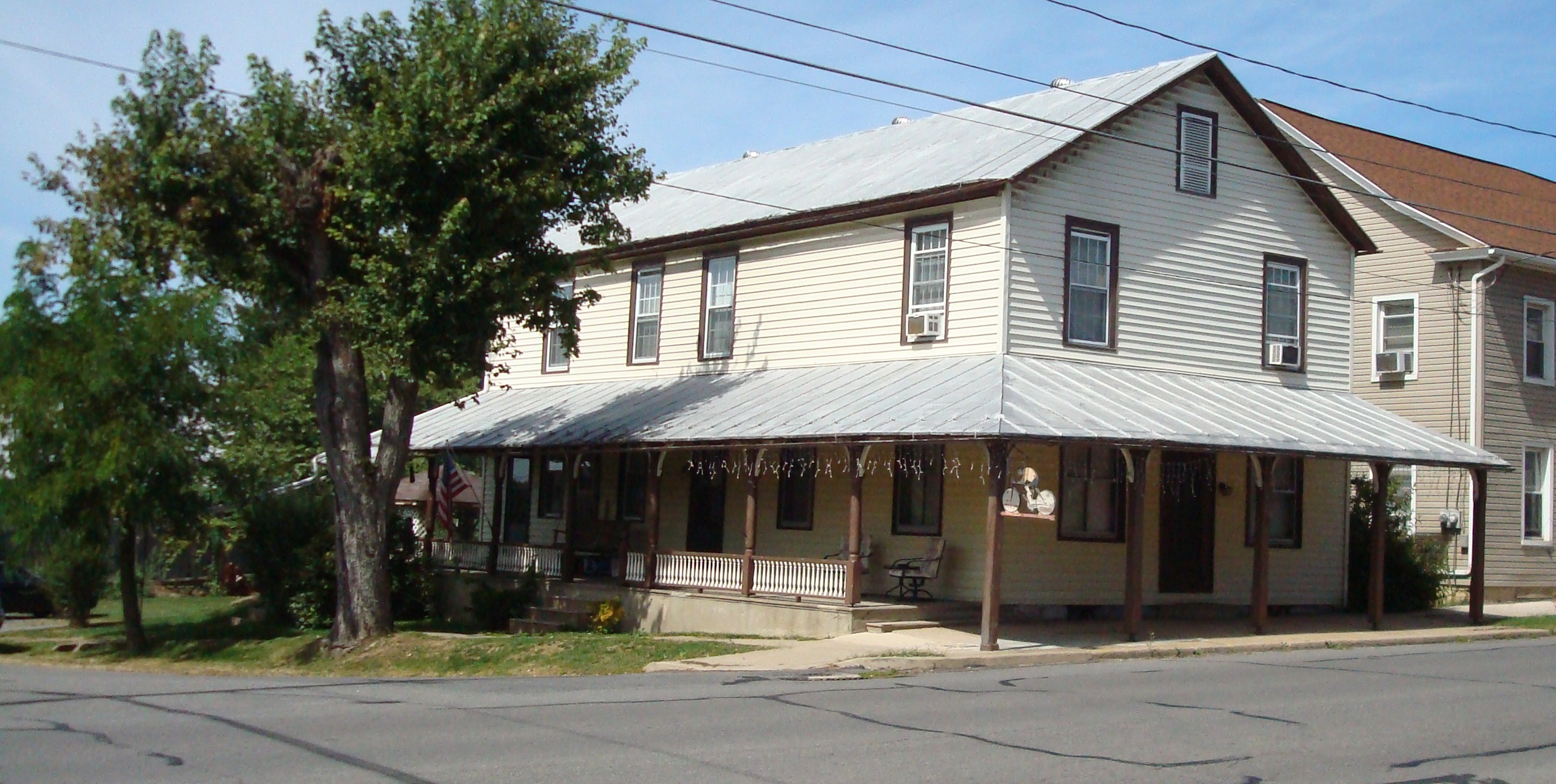
Where did the class members meet? At the school? . . . at the home of one of the students? . . . at a restaurant? I believe that this building was a restaurant a hundred years ago. Maybe they met there.

It’s awesome that Grandma got elected class secretary—though she seemed slightly annoyed.

Maybe I’m trying to read too much between the lines, but  was Grandma really hoping that she won’t be elected to any position–or had she hoped to be elected president or treasurer?

Weather in Cities Across the Country: September 29, 1912

17-year-old Helena Muffly wrote exactly 100 years ago today: 

Sunday, September 29, 1912: Rained so that I didn’t go to Sunday School. Miss Bryson was here today having come down on the train last night.

Her middle-aged granddaughter’s comments 100 years later:

I wonder if it was an all-day storm or just a brief shower. In general, the weather across the US was pretty good on September 29, 1912–though many cities got a little precipitation.

TEMPERATURE AND PRECIPITATION

SEPTEMBER 29, 1912

Source: Minneapolis Morning Tribune, September 30, 1912

Miss Bryson refers to Blanche Bryson. She was a friend of Grandma and her sister Ruth. The Susquehanna, Bloomsburg, and Berwick railroad tracks crossed the Muffly farm, and there was a whistle stop at a nearby feed mill. I’m not sure where Blanche lived in 1912, but I think that she was a teacher and probably lived outside the immediate area.

What is the Difference Between Butternuts and Black Walnuts?

17-year-old Helena Muffly wrote exactly 100 years ago today: 

Saturday, September 28, 1912:  Mater went to a sale today. I got busy this afternoon and went for to gather some butternuts. Was rewarded by getting almost a bushel, any way it was dreadful heavy to carry, but I got them home at last.

butternut
Butternut (Photo source: Wikipedia)

Her middle-aged granddaughter’s comments 100 years later:

I never heard of butternuts until I read this diary. What are they?  What does a butternut tree look like? Are there still any butternut trees around?

According to the Ohio Department of Natural Resources:

Butternut: Also known as White Walnut, this relative of Black Walnut is slower growing and much less frequently encountered than its well-known cousin. Butternut prefers moist bottomlands and ravines like Black Walnut, but its lightweight wood is beige-pink in color and is not nearly as sought-out for making veneer and furniture. Its kernel within the fruit gives it the common name of Butternut, as it is sweet and very oily.

Butternut trees have oval nuts; black walnuts have round nuts.

I now realize that maybe I can’t tell the difference between butternut and black walnut trees—and that I’ll need to look more carefully the next time I see a walnut tree to figure out which type it is.

An aside—

Last week-end my husband and I gathered black walnuts. We hulled them and set them out to dry. I can hardly wait until they are dry enough to crack and use. I absolutely love their wonderful complex, sharp, rich, nutty taste in cakes and cookies.

Here are the links to the posts I wrote last year about black walnuts:

Hulling Black Walnuts

How to Crack Black Walnuts

Old-time Black Walnut Cake Recipe 

Fun Fact from a Hundred Years Ago: Short Skirts Are Healthier

17-year-old Helena Muffly wrote exactly 100 years ago today: 

Friday, September 27, 1912:  Nothing to write.

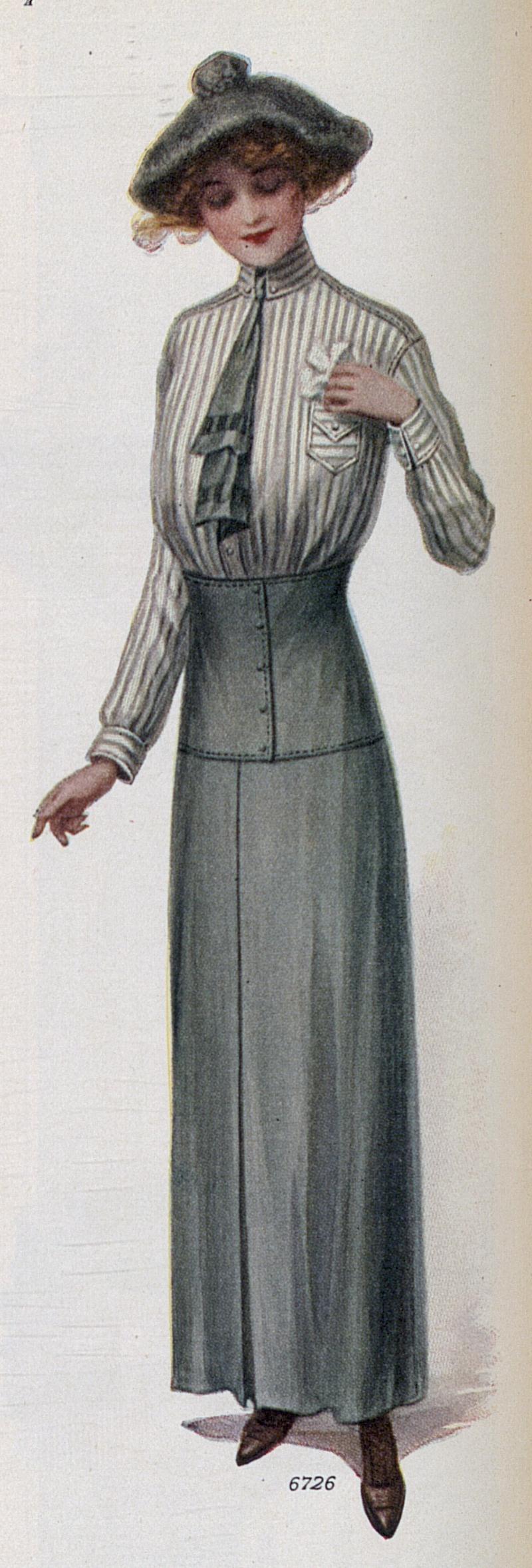
1912 dress
“Short” skirt for walking (Ladies Home Journal, July 1912)

Her middle-aged granddaughter’s comments 100 years later:

Since Grandma didn’t write much a hundred years ago today, I’ll share some fun information I found in a hundred-year-old book about how short skirts—that is skirts which were five inches from the ground—were healthier. Who would have guessed?

The present vogue of having the walking skirt five inches from the ground is an excellent one, as it not only considerably diminishes the weight of the skirt, but it interferes much less with the forward swing of the leg in walking.

The chief exertion in walking is caused by the raising of the foot and lifting it to the point at which it goes forward and downward. By any artificial shortening of the step, such as is caused, for instance, by long skirts, it requires much more muscular effort to walk the same distance. Besides which, there is the additional friction of the skirts, which is increased by the slightest wind.

Another most important reason for not wearing long dresses on the street is that they stir up the dust and collect microbes, and thus contribute materially to the dissemination of the germs of disease and subject the wearer and her family to the risk of infection.

Personal Hygiene and Physical Training for Women (1911) by Anna M. Galbraith