Several Variations of an Old Saying

17-year-old Helena Muffly wrote exactly 100 years ago today: 

Thursday, September 26, 1912:  Excuse me, but you know there is an old saying: Don’t talk when you’ve nothing to say, so I’ll just change it to: don’t write, when you’ve nothing to write.

Source: Wikimedia Commons

Her middle-aged granddaughter’s comments 100 years later:

To keep with the theme—

Don’t blog when you’ve nothing to blog.  🙂

Bad Grade in Geometry

17-year-old Helena Muffly wrote exactly 100 years ago today: 

Wednesday, September 25, 1912:  Was rather surprised at the mark I made yesterday. Didn’t think I would hardly get that. Twas the kind that dummies get.

What did Grandma consider a bad grade? . . . D? . . . F?

Her middle-aged granddaughter’s comments 100 years later:

Whew, I’m surprised that Grandma did poorly on this geometry test. She never worried about the upcoming test during the days preceding the test, and the previous day she’d merely written, “I had a test in geometry.” and then moved on to other topics.

Usually Grandma had a pretty good sense of how she was doing in classes, and if she needed to study—though sometimes she never actually got around to studying.

Two Old Mental Math Tricks for Adding Fractions

17-year-old Helena Muffly wrote exactly 100 years ago today: 

Tuesday, September 24, 1912:  It is raining now. I guess or was. Had an exam in Geometry. Took up Arithmetic today. Didn’t have to but I chose to do so.

Her middle-aged granddaughter’s comments 100 years later:

High school courses apparently were only a month of so long a hundred years ago.

I wonder why Grandma decided to take Arithmetic if it wasn’t required. Maybe she enjoyed doing mental math.

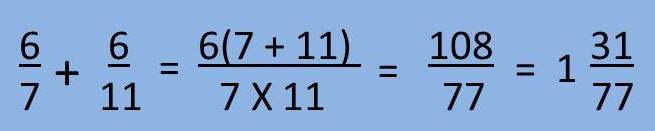
Here are two mental math tricks for adding fractions that I found in a hundred year old textbook:

Example 1: Add two fractions whose numerators are 1.

Solution: Add the denominators, and place the sum over the product of the denominators.

Example 2: Add two fractions whose numerators are alike and greater than 1.

Solution: Add the denominators and multiply the sum by the numerator of either of the fractions, and write the product over the product of the denominators.

Source: Kimball’s Commercial Arithmetic (1911)

If you like  math, you might also enjoy these previous posts:

An Old Mental Math Trick

Odd, Unusual, and Strange Math Problems

More Odd, Unusual, and Strange Math Problems

Cube Root Word Problems

1911 Algebra Problems: The Lusitania and Molasses

Old Math Problems

Building the Brick Road Between Watsontown and McEwensville

17-year-old Helena Muffly wrote exactly 100 years ago today: 

Monday, September 23, 1912:  Walked the muddy way to school this morning. Don’t have much to write these days.

Recent photo of the road that went between McEwensville and Watsontown in Grandma’s day.  . . Once dirt, then brick, and now paved. . .

Her middle-aged granddaughter’s comments 100 years later:

With all the mud, it’s a good thing that Grandma got new rubber overshoes  the previous Saturday. September, 1912 must have been a rainy month.  On September 18  Grandma also wrote about the muddy walk to school.

1912 was the last year that Grandma had to walk the entire way on dirt roads.  She lived between McEwensville and Watsontown, and a brick road was apparently under construction that would replace the old dirt road.

According to George Wesner in  History in McEwensville (1976):

The brick road leading from McEwensville to Watsontown was one of the first of its kind to be built in Pennsylvania. Construction was begun at McEwsville in 1912 and completed the following year. . .

It was built by the construction firm Fiss and Christiana of Shamokin, Pennsylvania. In grading, the ground was moved by horse-drawn dump wagons which were loaded by manual labor. While some local people were employed most of the laborers were Italian immigrants. Very few could speak English. They were quartered in a labor camp which was located in a ravine on the farm of Isiah Elliot,  now owned by Samuel Raup. All the materials, sand, gravel, brick and cement were hauled by teams and horses. The only mechanical equipment used was a steam roller. . .

On an occasion when a period of bad weather had caused the operation to run behind schedule, the contractors, in an effort to catch up, requested that they work on Sunday. . . .

I wonder if the wet days that Grandma wrote about during September 1912 were when the road-building crews got behind schedule.

Grandma would have walked this road to school every day while it was being transformed from  a muddy dirt road to fancy brick one. It sounds like a major activity to me, yet she never thought it worth mentioning in the diary. Sigh. . .

How Does Catechize Differ From Catechism?

17-year-old Helena Muffly wrote exactly 100 years ago today:

Sunday, September 22, 1912:  Went to S.S. this afternoon and attended Catechize.

McEwensville
Recent photo of the site where the McEwensville Baptist Church once stood.

Her middle-aged granddaughter’s comments 100 years later:

When I read this diary entry, I got stuck on a simple vocabulary question. I remember going to “catechism” class when I was in middle school. How does “catechize” differ from “catechism”? Is it a different part of speech?

The Free Online Dictionary defines catechize as “to teach the principles of Christian dogma, discipline, and ethics by means of questions and answers.”

While catechism is “a book giving a brief summary of the basic principles of Christianity in question-and-answer form.”

Grandma  was 17-years-old when she wrote this entry. I’m surprised that she hadn’t completed catechize and joined the church when she was in her early teens.

Mother Remodeled Skirt

17-year-old Helena Muffly wrote exactly 100 years ago today: 

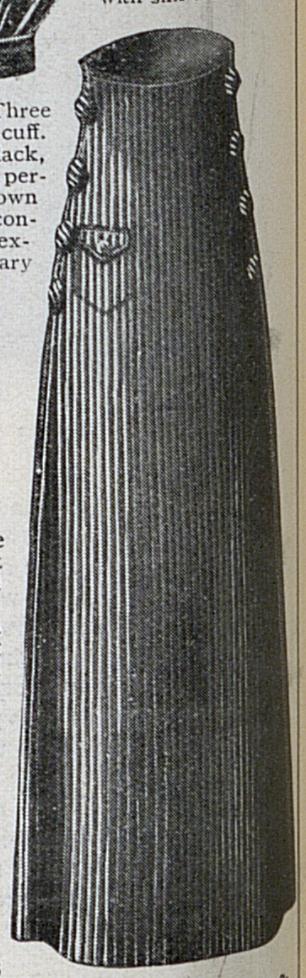
Saturday, September 21, 1912:  Ma made over a skirt for me. Got a pair of rubbers today.

From Bedell Company advertisement in November, 1912 issue of Ladies Home Journal.

Her middle-aged granddaughter’s comments 100 years later:

I guess that Grandma’s mother was trying to save about $1.98 by making over the skirt. I can’t remember the last time I remodeled a skirt . . . or dress.  (Actually, I don’t think that I’ve ever remodeled one.) Yet, Grandma and her mother did it regularly.

On June 3, 1912, Grandma wrote:

I am trying to remodel a skirt which was once the property of the benevolent Ruthie. I’ll know whether I’ll wear it or not after it’s finished.

And, on February 24, 1912 she wrote:

I fixed over a dress for myself this afternoon. It was one of my Aunt Annie’s cast-offs. I had one trying time a getting the waist and skirt together. I have it fixed now and tried it on to see the result. I’m not so much pleased with my sewing. It seems rather short in the back.

Grandma sounded like she wasn’t very satisfied with either of her remodeling efforts, but she didn’t express any similar qualms about the skirt her mother remodeled.  Apparently her mother was more proficient at sewing than she was.

—-

On September 18, Grandma mentioned walking to school through the rain and mud—hopefully her new rubber overshoes made the trek slightly less arduous the next time it rained.

Old-Fashioned Watermelon Rind Pickles

17-year-old Helena Muffly wrote exactly 100 years ago today: 

Friday, September 20, 1912:  Don’t have much for today.

watermelon pickles

Her middle-aged granddaughter’s comments 100 years later:

I continue to enjoy making foods that were popular in central Pennsylvania in the early 20th century. Since Grandma didn’t write much I’ll tell you about my latest cooking endeavor.

Pickled foods were incredibly popular a hundred years ago.

I  decided to make old-fashioned watermelon pickles—and they looked lovely and tasted great.

It was a three-day process, but well worth the effort.

Old Fashioned Watermelon Pickles

4-5 quarts watermelon rind

Water

Salt

2 cups apple cider vinegar

7 cups sugar

1 tablespoon whole cloves

3 sticks cinnamon

1 inch cube of fresh ginger

Select watermelon with a thick, firm rind. Cut off the outer green skin, and remove the red watermelon flesh, leaving a very thin layer of pink. Cut into 1-inch squares. Place in a 2 gallon glass  bowl or crock. (I used 2 smaller bowls).

Cover with a salt water solution (2 tablespoons salt to 4 quarts water). Cover and let stand for 24 hours at room temperature.

After 24 hours, drain and rinse with cold water. Cover with ice water. Let stand for 1 hour, then drain.

Place the rind in a large pan, and cover with boiling water. Bring to a boil; then reduce heat and simmer for 10 minutes. Drain.

Put spices in a cheesecloth bag. Combine vinegar, sugar, and spices in large pan. Bring to a boil. Add rind. Simmer until rind is translucent.

Put rind and syrup into large glass bowl or crock. Cover; and let stand for 24 hours at room temperature.

Remove spice bag. Drain off syrup, put into a pan, and heat to boiling.

Pack the rind into hot pint jars; cover with the hot syrup, fill to 1/4 inch of top. Wipe jar rim and put lid on.

Process in boiling water bath for 5 minutes.

Makes approximately 6 pints.