18-year-old Helena Muffly wrote exactly 100 years ago today:
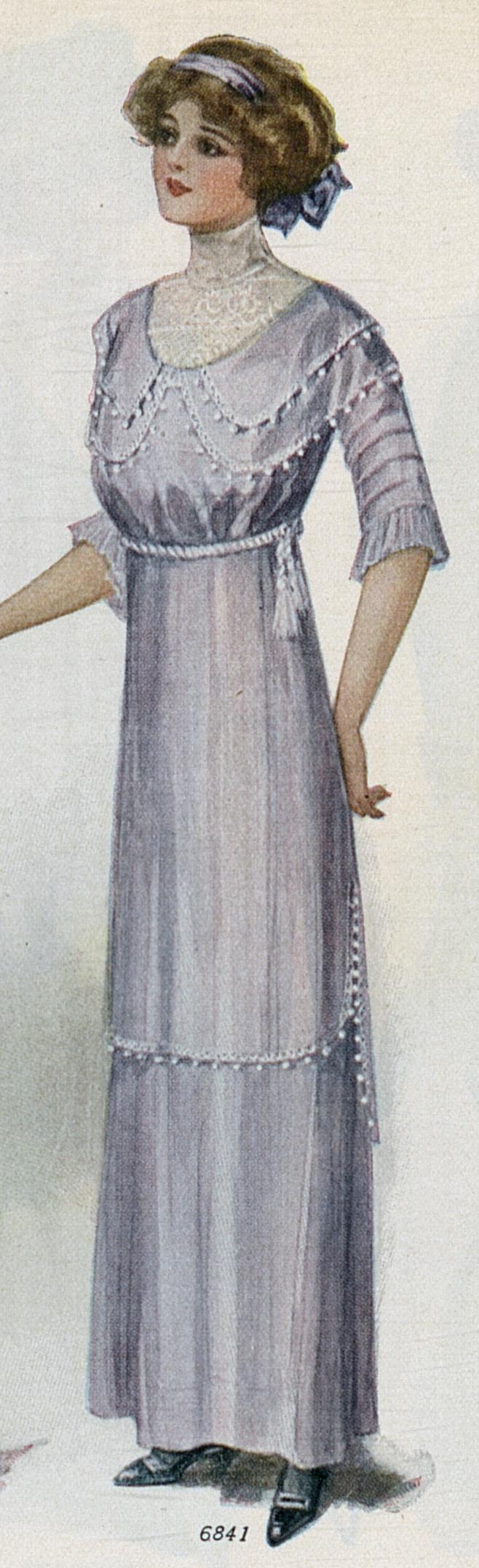
Saturday, May 24, 1913: Ma started to make my dress I got for a graduation present. I want it finished by May 30th.
Source: Ladies Home Journal (July, 1912)
Her middle-aged granddaughter’s comments 100 years later:
Sometimes Grandma worded things differently than I would.
If I had written the first sentence I would have said something like, “Ma started to make the cloth that I got for a graduation gift into a dress.” Instead it seems almost like Grandma was referring to both the cloth used to make the outfit and the finished product as a dress.
“Dress” can be used both as a noun and a verb–and has multiple meanings; but I think that the noun “dress” had a broader meaning in 1913 than it does now.
This is the second time in the diary that Grandma referred to the materials used to make a dress as a “dress”. On March 29, 1913 she wrote:
Ma and I went to Milton this morning. The chief object of which was the buying of me a graduation dress. It is a plain white batiste to be trimmed with lace insertion and edging.
18-year-old Helena Muffly wrote exactly 100 years ago today:
Friday, May 23, 1913: It was rather a dreary day today. Got three more presents today. Mother was up to Turbotville and brought them home with her. Wish it would stop raining soon.
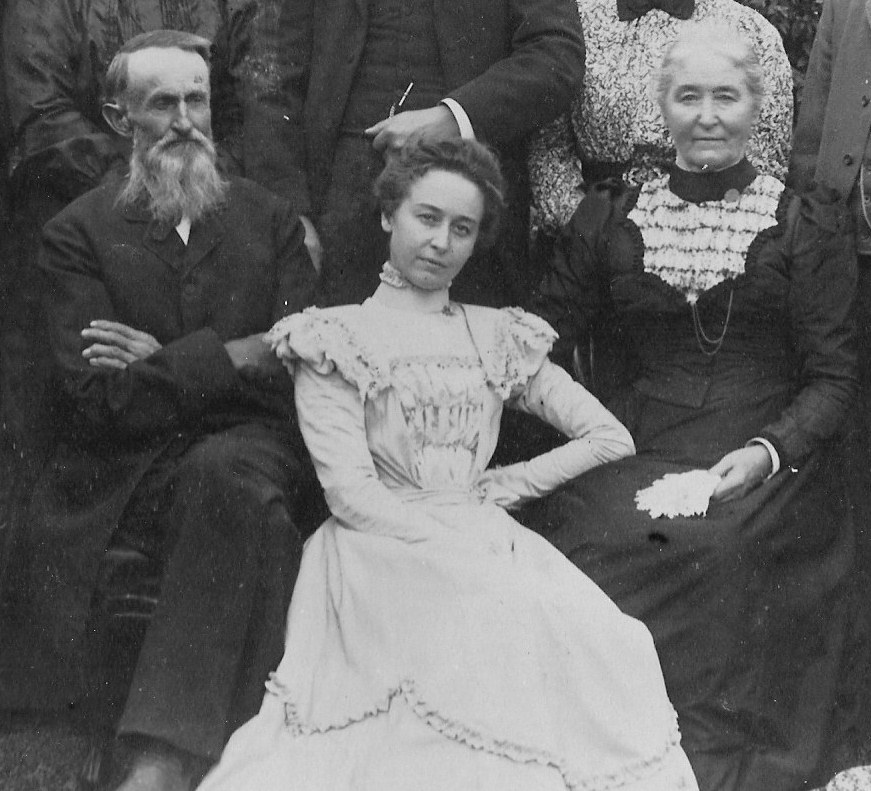
John and Sarah Derr with daughter Annie (circa 1900)
Her middle-aged granddaughter’s comments 100 years later:
Grandma’s graduation gifts sure straggled in over a long period of time. She graduated from McEwensville High School on April 23, 1913—exactly one month before this diary entry.
The presents probably were from her grandparents and an aunt. Grandma’s maternal grandparents, John and Sarah Derr lived in Turbotvile.
Grandma also had at least one aunt—Annie Van Sant— who lived in Turbotville. Aunt Annie was grandma’s mother’s youngest sister. She was married to a doctor, but had no children. Based upon previous entries, I have the impression that Aunt Annie tended to give very nice gifts.
I wonder how many graduation gifts in total Grandma received. On May 4, she wrote:
Although it is over a week since commencement, I received a present today. Making eighteen in all.
So, Grandma received at least 21 gifts—the previous 18 plus the additional 3.
18-year-old Helena Muffly wrote exactly 100 years ago today:
Thursday, May 22, 1913: Went to Watsontown this afternoon. It was rather muddy, and my shoes were a sight.
Did the red sky predict rain–which led to the mud Grandma encountered? Source: Wikimedia Commons
Her middle-aged granddaughter’s comments 100 years later:
It must have recently rained. A hundred years ago, you couldn’t instantly get good weather information via the internet or television—but accurately predicting the weather was important for farm families.
Did Grandma use old weather proverbs and sayings to forecast the weather?
Here’s what a 1913 article in her local newspaper had to say about weather proverbs:
OLD PROVERBS ON WEATHER ARE TRUE
Ancient Sayings Based on Experience Are Approved by Uncle Sam’s Scientific Investigators
The idea that old weather proverbs and traditional natural signs are of no value in these days of scientific weather forecasting is not sustained by such an eminent authority as W.J. Humphreys, professor of meteorological physics in the United States Bureau.
He gives credit to the weather prescience of farmers, fishermen, woodsmen and others who make a practice of depending on natural signs to give them knowledge of impending weather changes.
Quoting the jingle about a sailor’s warning and a sailor’s delight, Professor Humphreys says:
“If the evening sky, not far up but near the western horizon, is yellow, greenish, or some other sort wave-length color, then all the greater the chance for clear weather, for these colors indicate ever less condensation and therefore drier air than does red.”
Professor Humphreys says a good word for such old-time proverbs as:
Frost year, fruit year
Year of snow, fruit will grow
A year of snow, a year of plenty
“That these and similar statements commonly are true,” he writes, “is evident from the fact that a more or less continuous covering of snow, incident to a cold winter, not only delays the blossoming of fruit trees until after the probable season of killing frosts but also prevents that alternate thawing and freezing so ruinous in fruit. In short, as another proverb puts it, a late spring never deceives.
The appearance of the moon depends upon the conditions of the atmosphere. Clear moon, frost soon, and moonlit night has the heaviest frosts and others of this class are true enough he says, because on the clearest nights the cooling of the earth’s surface by radiation is greatest, and hence most likely to cause, through the low temperature reached, precipitation in the form of dew or frost.
18-year-old Helena Muffly wrote exactly 100 years ago today:
Wednesday, May 21, 1913: Didn’t feel very well with morning, so I tried to take it out in making Ruthie miserable. Although I don’t I succeeded.
Ruth Muffly
Her middle-aged granddaughter’s comments 100 years later:
What did Grandma do to her sister Ruth? It must have been pretty bad if she admitted that she wasn’t nice in the diary.
Usually when Grandma and her sister Ruth weren’t getting along, Grandma would use her author’s prerogative and blame the problem on Ruth—though Grandma generally called Ruth, Rufus when she was angry.
18-year-old Helena Muffly wrote exactly 100 years ago today:
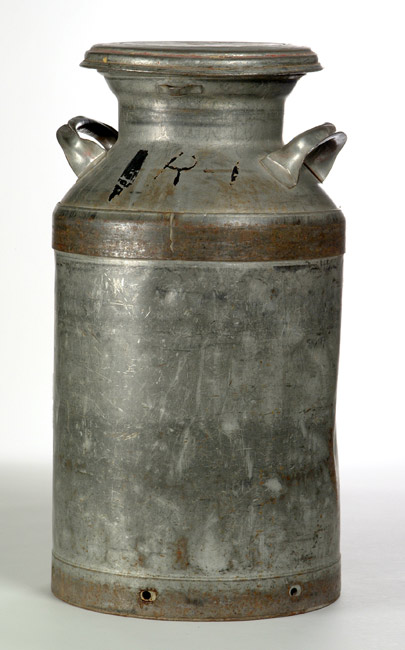
Monday, May 20, 1913: Ruthie and me a nice little wooden wagon in which to haul milk over to the spring, and this would save us from breaking our backs for that can of milk is almost a dead weight.
Milk Can (Photo Source: Grant-Kohrs Ranch National Historic Site)
Her middle-aged granddaughter’s comments 100 years later:
Grandma’s family had several milk cows. The milk from the cows was put into large cans. The cans filled with milk were then stored for a day or two until it was sold to a dairy or made into butter.
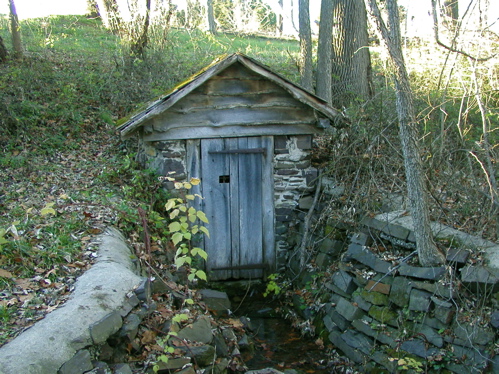
Spring houses were used in the days before electric refrigeration to keep the milk cold. A small building was built over a spring, and the milk cans were placed in the cool water that flowed through the building.
An Example of a Spring House (This spring house is not on the Muffly farm.) (Source: Wikipedia)
I’d have demanded a cart, too. Milk cans filled with milk were heavy. I don’t know where the spring house was located, but it probably was some distance away from the barn.
Did Grandma’s mother take the suggestion seriously—or did the request go in one ear and out the other?
18-year-old Helena Muffly wrote exactly 100 years ago today:
Monday, May 19, 1913: Saw the kitchen papered this afternoon. It looks quite stylish.
Her middle-aged granddaughter’s comments 100 years later:
Whow! I’ve totally missed the context of the diary entries the past few days. (I probably should read further ahead.)
I thought that spring housecleaning lasted for a couple weeks when I read diary entries that said things like, “Nothing much doing, but the doing of rubbing, scrubbing, etc.” (May 14, 1913).
Really, they probably did the spring house cleaning in early May, and then moved on to removing old wall paper from the kitchen wall in preparation of re-papering.
The caption on this black and white picture in the an article called, “Good Taste in the Farm House” in the October, 1913 issue of Ladies Home Journal says:
“Here striped wall paper in two tons of green was used to give the effect of great height to this low-ceiled room. The furniture was painted a willow green to harmonize with the walls and the cretonne curtains.”
Did the rather stylish Muffly kitchen look anything like the picture in the magazine?
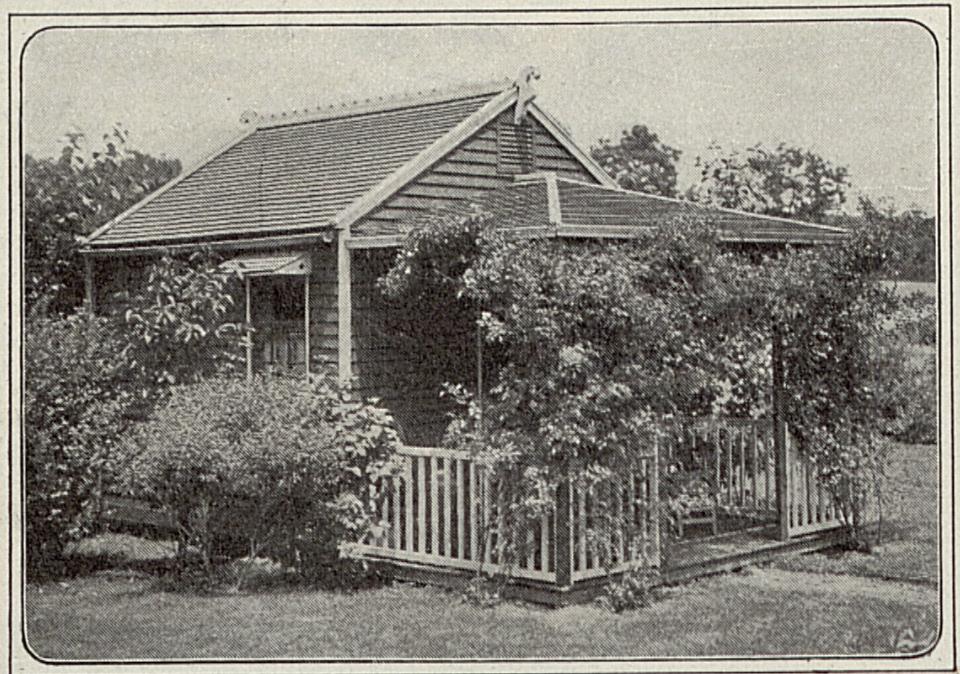
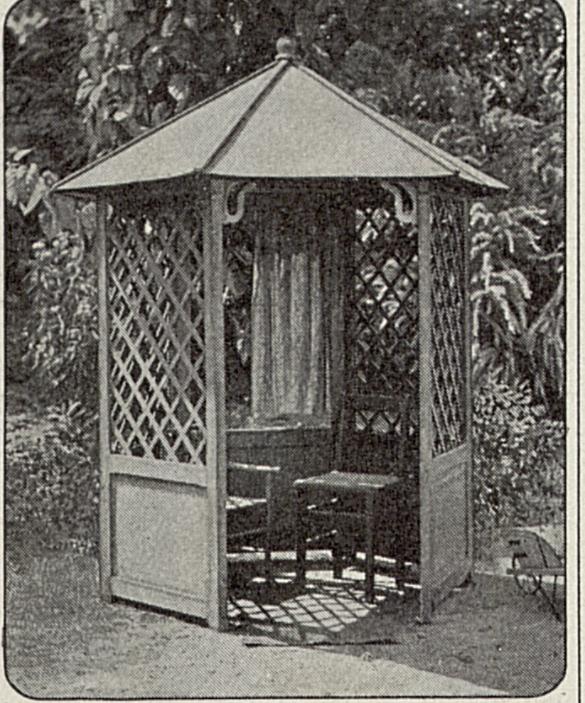
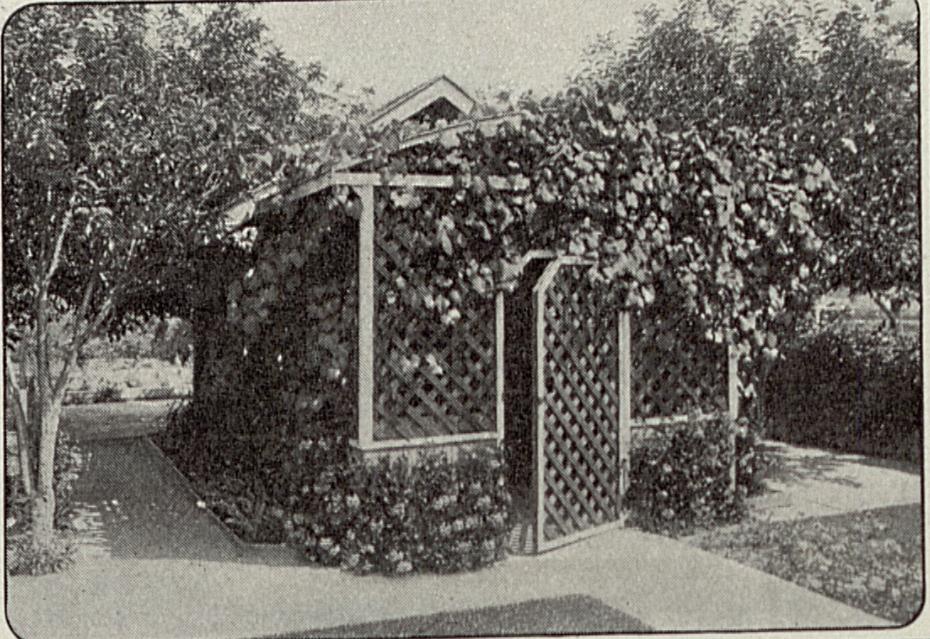
A little latticed playhouse covered with a grapevine which keeps it cool.
This is what it looks like inside. What a delightful place to play school!
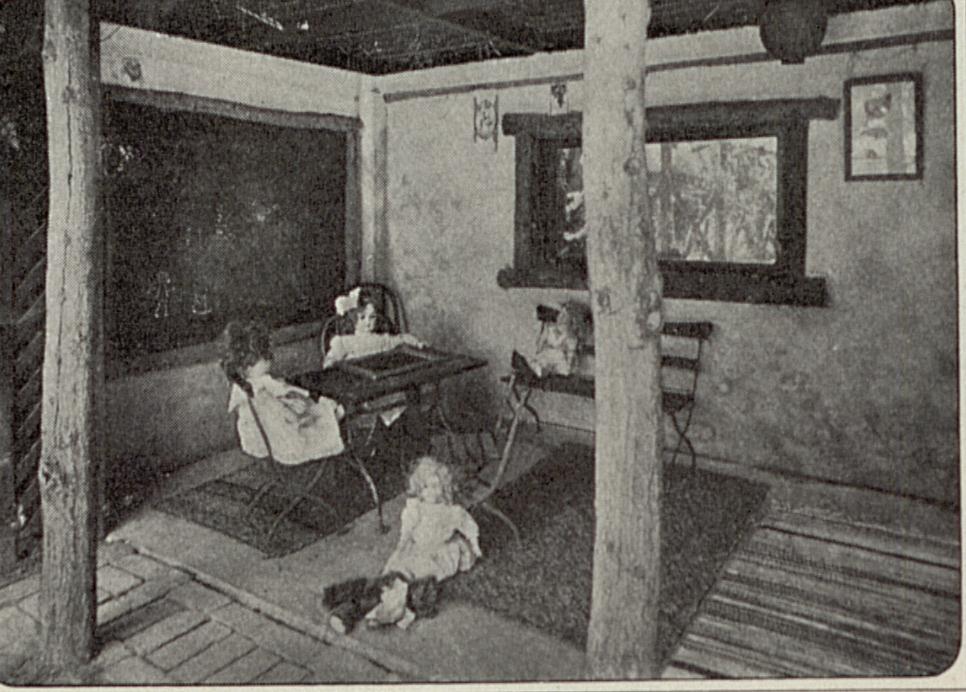
A portable playhouse that may be moved from one part of the yard to another, so that when it is too sunny in one spot it may be moved into the shade.