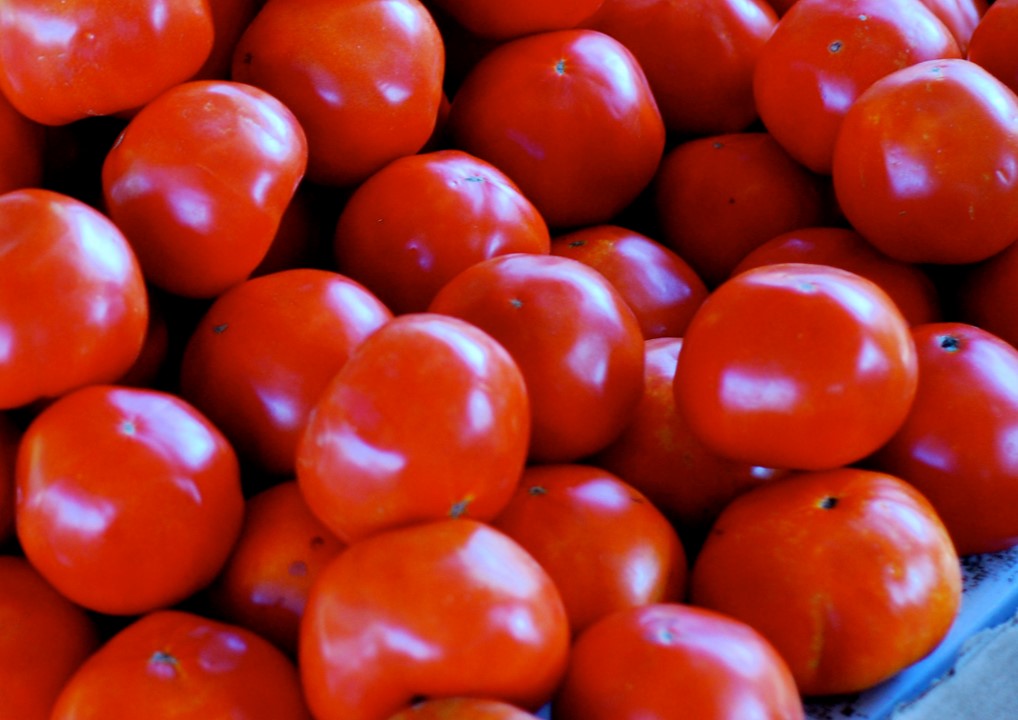
Influence of Rainfall on the Composition of Tomatoes

tomatoes

I’ve often thought that fruits and vegetables seem “waterlogged” when I harvest them after a rainfall. I recently discovered why the composition varies when I read an article in a hundred-year-old trade magazine for the canning industry called The American Food Journal. I also enjoyed seeing how a scientific study was written up in the early 1900’s. Here’s a few excerpts:

Influence of Rainfall on Composition of Tomatoes

It is the experience of many canners that tomatoes are unusually “sloppy” in seasons of excessive rainfall. They find this is evident both from the amount of water that separates on the peeling table on in the can during or after processing.

The composition of tomatoes varies through rather wide limits because of the environment in which they are grown. Arrangements were made with the Bureau of Plant Industry and the Maryland Experiment Station by which the laboratory secured samples of tomatoes of known varieties grown on plants set aside by these institutions for that purpose. During the growing seasons of 1914 and 1915 tomatoes were picked as fast as they ripened (usually two or three times a week).

In both the years mentioned the rainfall was higher before the tomato season than during the season, and the ground was well saturated at the time the tomatoes began to ripen.

There was considerable variation in the composition of successive pickings, which could not be explained by variation in rainfall. There appears to be a general tendency for the soluble solids to decrease in amounts as the season advances. Tomatoes ripening in September and October may contain less solids than those ripening in August because of the cooler weather.

We are not warranted, therefore, in concluding that the high rainfall and the relatively high soluble solids in the first part of the season are evidence of a relation between the two. The question would have been simplified if we had, as we hoped to have, a heavy, soaking rain preceded and followed by dry weather. However, it appears improbable that the “watery” condition of tomatoes observed after a heavy rain is due to a greater percentage of water in the tomatoes.

The American Food Journal (February, 1916)


Baked Acorn Squash with Molasses

baked acorn squash with molasses

Each Fall my husband and I drive out into the country to see the leaves – and to buy pumpkins and winter squash. There’s a farmer who sells incredible produce directly from a farm wagon – and each year we worry that his tiny roadside market will be gone.

But this year (like every year), just when we were sure we won’t find his wagon, we went around a bend and there it was–and the selection of pumpkins and squash was the best it’s ever been. We stocked up on lots of Fall produce. Right now most of the squash are on our front porch with the pumpkins, but I decided to use an acorn squash immediately – which leads me to the point of this post. I needed to find a hundred-year-old recipe for acorn squash.

I browsed through my old cookbooks and found a delightful recipe for baked squash which called for molasses.

The recipe worked perfectly with my acorn squash. The savory nuttiness of the squash is enhanced by the rustic sweetness of the molasses.

baked-squash-w-molassas-recipe

Here’s the recipe updated for modern cooks.

Baked Acorn Squash with Molasses

  • Servings: 2 - 4
  • Difficulty: easy
  • Print

1 acorn squash

approximately 1 tablespoon molasses

salt and pepper

approximately 1 tablespoon butter 

Preheat oven to 400° F. Depending upon squash size, halve or quarter the acorn squash to create serving-sized pieces. Remove seeds and the stringy portion. Place on a baking sheet that has been lined with aluminum foil to make clean-up easier. Brush with molasses, and sprinkle lightly with salt and pepper.  Place in oven and bake until the squash is tender when poked with a fork. While baking, baste 2 or 3 times with additional molasses. After the squash is removed from the oven put a small dab on butter in the middle of each squash piece.

Hundred-Year-Old Ways to Tell Whether a Cake is Done

cake-in-pan-b

I’m often surprised how little has changed over the past hundred-years.  I recently was browsing through a hundred-year-old home economics textbook, and came across a section on how to tell whether a cake was done. As I read,  I’m mentally noting the similarities between then and now – cake springs back when lightly touched, toothpick comes out clean. And, then suddenly the text thrusts me into a whole different world of how to test whether a cake is done. . . .

Tests to Determine Whether a Cake is Done

Experienced cake-makers have various tests to determine when a cake is done. One touches the top lightly with her finger, and if the dent made springs back quickly she knows the cake is done. If the dent remains, she knows the cake batter is still too soft.

Another housewife depends entirely upon a broom-splint or one of the modern toothpicks. She thrusts one of these into the center of the cake, and if it is the least bit sticky when it is taken out she knows that the cake needs more baking. A box of toothpicks is rather a necessary part of kitchen equipment – not to be used as the name indicates, but for testing cakes and similar uses. It is much more sanitary to use a toothpick than a broom splint, unless a wisp-broom is kept expressly for this purpose.

How to Cook and Why by Elizabeth Condit and Jessie A. Long (1914)

Old-fashioned Cream of Onion Soup Recipe

cream of onion soup

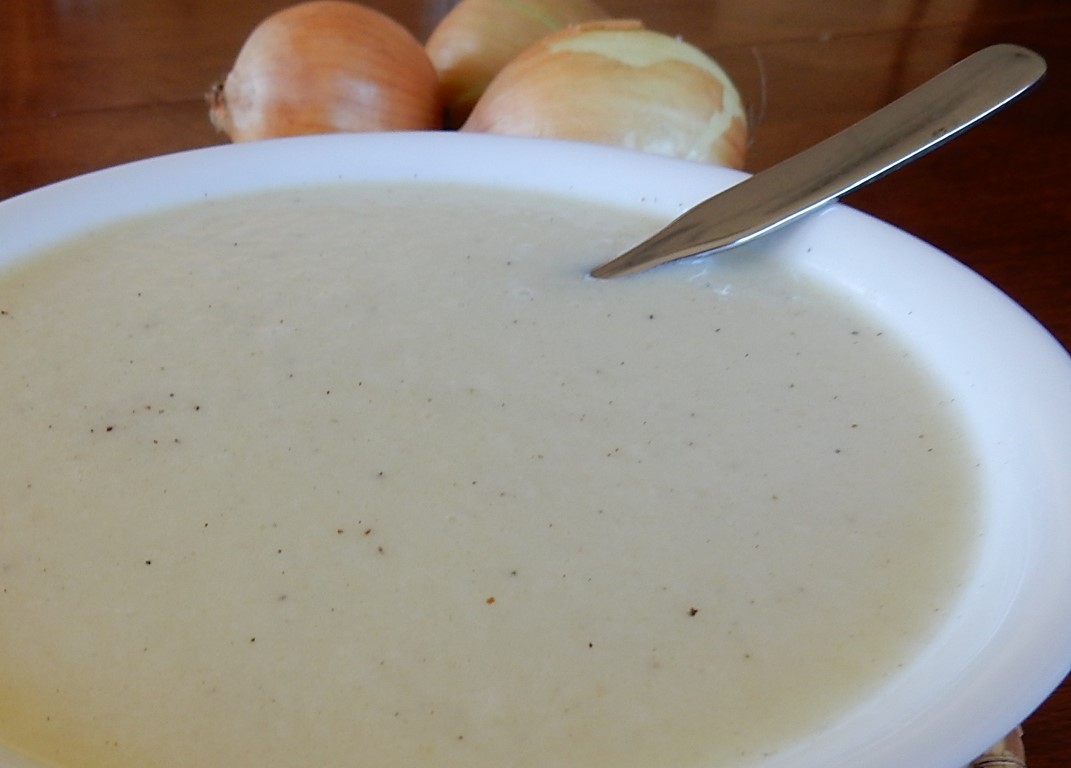
There’s starting to be a nip in the air; a few trees are turning lovely hues of red and yellow, and the days are getting shorter. Autumn is here – and I had a sudden urge to make soup.

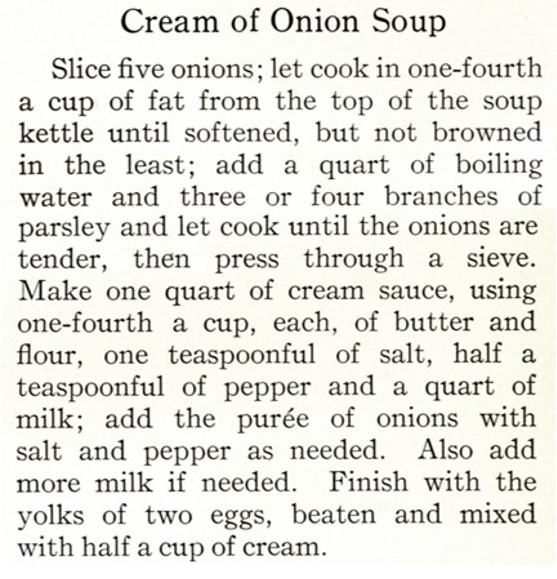
I found a lovely  hundred-year-old recipe for Cream of Onion Soup. The soup was rich and creamy with flecks of onions. The recipe called for 1/2 teaspoon of pepper which gave the Cream of Onion Soup a delightful peppery undertone.

Source: American Cookery (Boston Cooking School Magazine), March, 1916

Here is the recipe updated for modern cooks:

Cream of Onion Soup

  • Servings: 7 - 9
  • Difficulty: moderate
  • Print

5 onions, sliced (approximately 3 cups)

1/4 cup butter + 1/4 cup butter

4 cups water

4 sprigs parsley

1/4 cup flour

1 teaspoon salt

1/2 teaspoon pepper

4 cups milk

2 egg yolks

1/2 cup cream

Melt 1/4 cup butter in large saucepan, add sliced onions and saute until the onions are soft and semi-transparent (but not browned).  Add water and parsley, bring to a boil and then reduce heat and simmer for about 10 minutes or until onions are tender. Remove from heat and cool slightly, then puree in a blender or food processor.

Meanwhile, in a dutch oven, using medium heat, melt 1/4 cup butter; then stir in the flour, salt and pepper. Gradually add the milk while stirring constantly; then add the pureed onion mixture.

In a small mixing bowl, beat egg yolks; add cream and stir to blend. Add a small amount (approximately 1 – 2 tablespoons) of onion mixture and  stir quickly to prevent the egg from coagulating. Then stir the egg and cream mixture into the onion mixture in the dutch oven. Bring to a simmer and then serve.

Hundred-Year-Old Advice for Getting Multiple Foods Ready to Serve at the Same Time

Image source: Reliable Recipes (published by Calumet Baking Powder Co., 1912)

When cooking a meal do you struggle to get all the dishes ready to serve at the same time? Here’s some hundred-year-old advice that might help:

A menu being decided upon, it needs an accurate sense of time, forethought, and promptness, to have a number of dishes ready at the same time, or in proper sequence if several courses are served. Such questions as the following must be answered:

  1. What steps in preparation can be taken ahead of times, as washing, paring, cutting, etc.?
  2. What dishes take the longest to cook?
  3. Which must be served the moment they are done?
  4. Which can be kept hot for some time without injury?
  5. Which can be finished and cooled perhaps several hours before?
  6. What is the order of serving?

The fact is obvious that in preparing a meal you cannot finish the dishes one at a time, but that steps individual to each dish must be interwoven with each other, and the cook must have them all “on her mind,” and is often doing half a dozen things at once.

The woman at home will devise many ways of easing and shortening the labor just before the meal is served, avoiding haste, and anxiety in this way. A dessert can be prepared and be cooking as breakfast dishes are washed, and at the time left overs are put away they can be arranged ready for serving, as in the case of poultry or meat to be served cold.

Foods and Household Management: A Textbook of the Household Arts (1913)

Hundred-Year-Old Walnut Brownies Recipe

brownies

Old-fashioned Brownies with Walnuts are an ultimate comfort dessert, and I found a delightful recipe in a hundred-year-old cookbook. They were moist and  chewy. The top of the Brownies was less crusty than many modern brownies – but the Brownies were wonderful. And, my husband and I devoured the entire pan  within 24 hours.

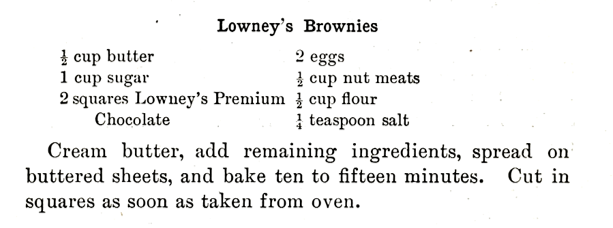
This recipe was in one of my favorite hundred-year-old cookbooks, Lowney’s Cookbook. It is a general cookbook (though it was published by a chocolate manufacturer), and I tend to think of it as being an old-time equivalent of the Betty Crocker Cookbook.  Here’s the hundred-year-old recipe:

Source: Lowney's Cook Book (1912)
Source: Lowney’s Cook Book (1912)

This recipe was one of the signature recipes in the old cookbook. Of course Lowney’s  Premium Chocolate is long gone, so I substituted unsweetened baking chocolate. I was also surprised that the recipe didn’t call for baking powder or baking soda – but the recipe turned out just fine without it.  I baked the brownies at 350° F. and it took longer than 15 minutes for them bake.

Here’s the recipe updated for modern cooks:

Walnut Brownies

  • Servings: 36 brownies
  • Difficulty: easy
  • Print

2 squares (2 ounces) unsweetened baking chocolate, melted

1/2 cup butter, softened

1 cup sugar

2 eggs

1/2 cup flour

1/4 teaspoon salt

1/2 cup chopped walnuts

Preheat oven to 350 degrees. Cream butter in a mixing bowl; stir in sugar and chocolate. Add eggs, flour, and salt, and stir until combined.; then stir in walnuts. Spread in greased 8-inch square pan.  Bake for  approximately 25 minutes or until an inserted toothpick comes out clean.  Cut into 36 squares.