Try the “New” Salad Oils: 1918 Good Housekeeping Magazine Recommendations

Source: Good Housekeeping (August, 1918)

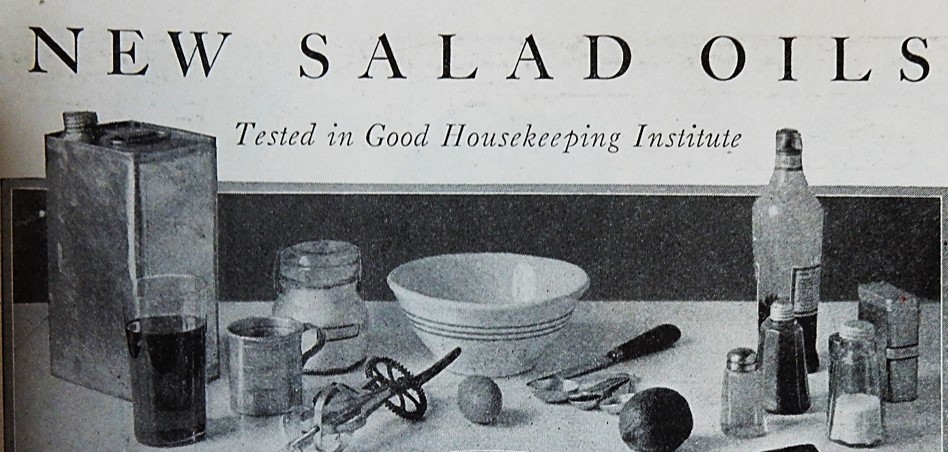
Oils are a component of most salad dressings, but in 1918 cooks were urged to reduce their use of fats to support the troops in World War I. And, even if they could get olive oil, it was expensive. An article that year in Good Housekeeping recommended that cooks use the “new” salad oils. Here’s some excerpts:

New Salad Oils

This is the time of year, above all others, when the palate craves the coolness and pungency of salads. Since the salad dressing is often the making of the salad, it is the chief consideration. The main ingredient of most salad dressings is the fat. We have been asked to be sparing in our use of all fats, but fortunately for us the new vegetable oils have come to our rescue.

Olive oil is becoming scarce in this country, and is, in consequence, high in price, but there are plenty of good substitutes in the cottonseed, peanut and corn oils which have been placed on the markets.

While to the lover of olive oil none of these makes quite so good a dressing as the olive oil itself, it is not difficult to prepare satisfactory dressings, and the untrained palate often finds them even better. The more refined and desirable these vegetable oils are for salad oils, the more tasteless they are. They are, therefore, excellent conveyors of condiment. If the flavor of olive oil has become a necessary and fixed habit, a dressing can be made by using one-third olive oil to two-thirds of any substitute oil. For this purpose purchase a heavy, highly-flavored oil oil.

Good Housekeeping (August, 1918)
 

Old-fashioned Scalloped Cucumbers

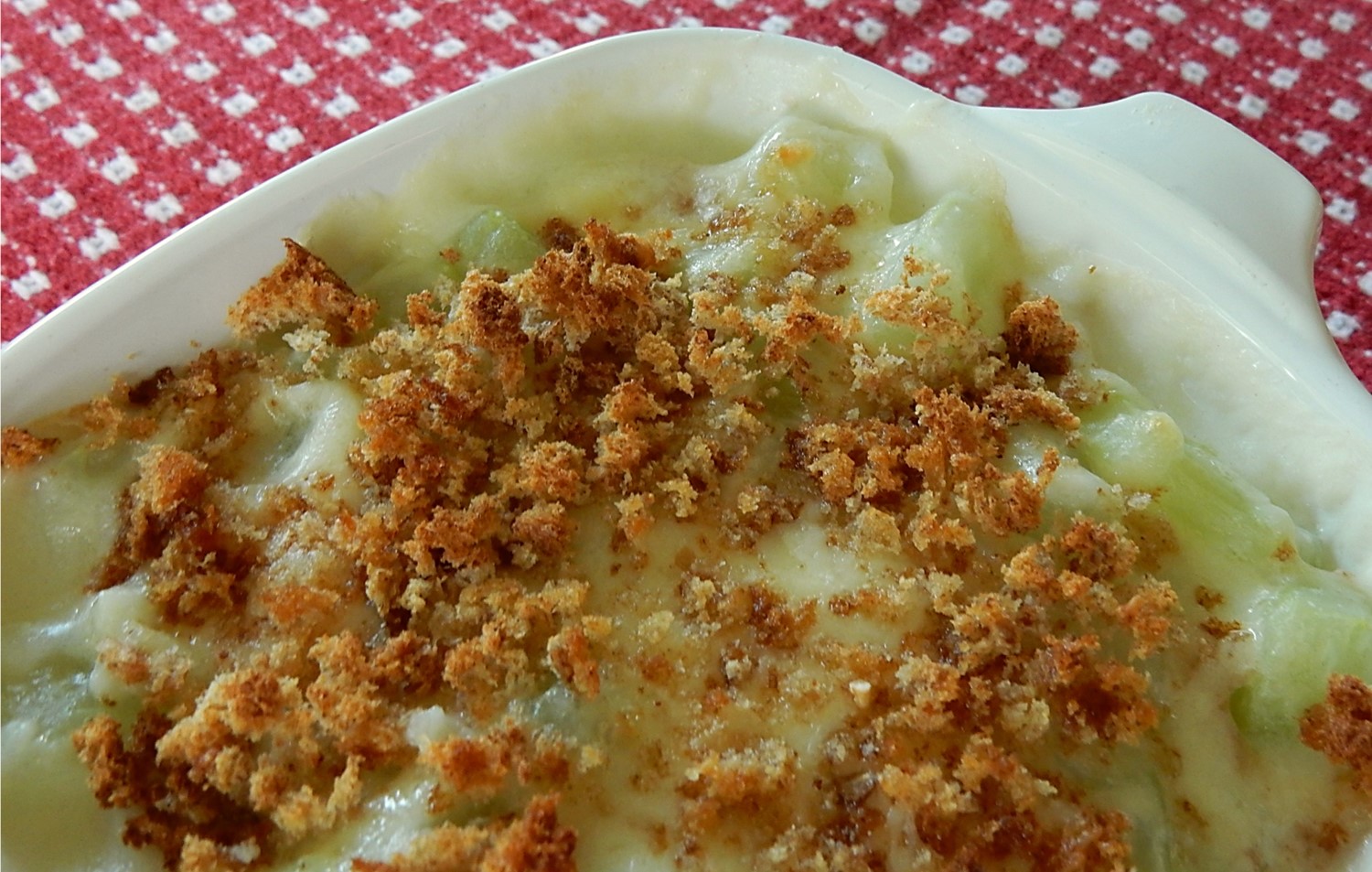
Why do we almost always eat some vegetables raw, while others are typically cooked? I don’t have an answer, but I know that I was surprised when I recently saw a hundred-year-recipe for Scalloped Cucumbers. And, since it’s cucumber season, I decided to give the recipe a try.

The Scalloped Cucumbers were delightful. The cooked cucumbers still had a hint of crispness, and when mixed with onion slices in a creamy sauce, and topped with cheese and breadcrumbs, this makes a perfect vegetable side dish. Cucumbers are a  tasty vegetable . . . regardless of whether eaten raw or cooked.

Source: The Housewife’s Cook Book (1917) by Lilla Frich

And, here’s the recipe updated for modern cooks:

Scalloped Cucumbers

  • Servings: 5 - 7
  • Difficulty: moderate
  • Print

4 large cucumbers

6 medium onions

4 tablespoons butter

4 tablespoons flour

3/4 teaspoon salt

2 cups milk

3/4 cup cheddar cheese, grated*

1/2 cup fine bread crumbs*

Preheat oven to 375° F. Peel cucumbers, and quarter length-wise. Remove the seeds, and then dice the cucumbers into bite-sized chunks. Place in a saucepan and cover with water. Bring to a boil and cook until tender (about 10 – 15 minutes). (Cucumbers are still somewhat firm even when cooked.)

Remove the skins from the onions, and then thinly slice. Place in a saucepan and cover with water. Bring to a boil and cook until tender (about 10 – 15 minutes).

In the meantime, in another pan, using medium heat, melt butter; then stir in the flour, salt, and pepper. Gradually, add the milk while stirring constantly. Continue stirring until the white sauce thickens.

In a large buttered casserole dish, layer the white sauce, cucumbers, and onions. End with a layer of white sauce. Then sprinkle the grated cheese and breadcrumbs on the top. Bake in the oven for 20 – 30 minutes or until hot and bubbly.

*The original hundred-year-old recipe also indicated that nuts or cereal could be used as a topping.

I didn’t salt the water when I cooked the cucumbers and onions: instead I put some salt in the white sauce. And, I didn’t “butter and crumb” my casserole dish; I just buttered the dish. It worked fine with the crumbs just sprinkled on top of the dish.

Conserve Food for the Troops: Diet

Source: Good Housekeeping (September, 1918)

I’ve dieted over the years for many reasons: to look better, to be healthier, to be a good example for others. But there’s one reason I never considered: dieting to support our soldiers.

According to a hundred-year-old issue of Good Housekeeping, we should diet to support the troops. During World War I, a lot of food needed to be shipped to Europe to feed the troops, and there were food shortages in the U.S. The magazine had a regular feature with Kewpie cartoons. The Kewpies were supposed to be baby cupid figures and were very popular at the time. (There also are Kewpie dolls.)  The title of the Kewpie cartoons in the September, 1918 issue was “The Kewpies and Food Conservation.”

Hundred-Year-Old Plum Conserve Recipe

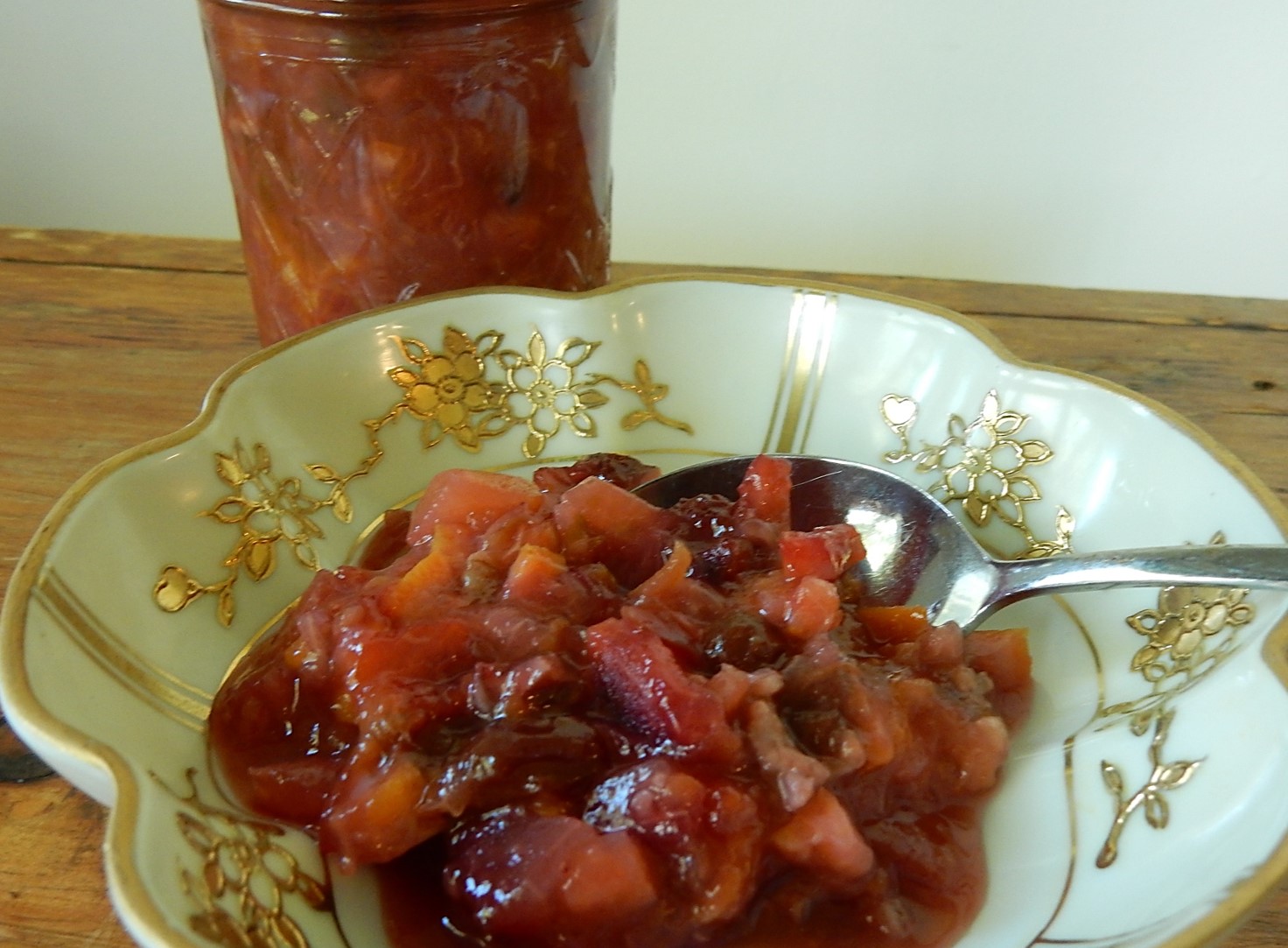
Plums are coming into season, and are relatively inexpensive at the store, so I was pleased to find a hundred-year-old recipe for Plum Conserve. Conserves are a type of jam or marmalade that often includes citrus fruit, raisins, and nuts.

In addition to plums, this Plum Conserve contains a peach, an orange (including the peel), raisins, and pecans. It has a beautiful purple hue and is delightful on scones, baguettes, and other breads. It is also lovely with cheese (think brie and crackers).

Here’s the original recipe:

Source: American Cookery (Boston Cooking School Magazine, October, 1915)

This recipe makes a lot of conserve. When I made the recipe, I halved it and I still got about 8 half-pints of Plum Conserve.

Here’s the recipe updated for modern cooks:

Plum Conserve

  • Servings: approximately 8 half-pints
  • Difficulty: easy
  • Print

2 quarts tart purple plums (about 2 pounds) – Plums that are not quite ripe work well in this recipe.

1 peach

1 orange

1/2 cup raisins

3 cups sugar

1/2 cup pecans, chopped

Remove stones from plums and coarsely chop. Remove skin and stone from peach (I dipped the peach in boiling water for about 30 seconds, then slipped the skin off.); coarsely chop. Remove peel (and any excess white pith) from orange, and coarsely chop. Finely chop the orange peel.

Place the chopped plums, peach, orange, orange peel, and raisins in a dutch oven or large saucepan. Bring to a boil using medium heat while stirring occasionally. Reduce heat and cook for 5 minutes, then stir in the sugar and pecans.

Continue to boil gently for 30-40 minutes or until the mixture is the consistency of jam. Stir frequently — especially towards the end of the cooking time.

A good way to tell if the mixture is the right consistency is to lay the spoon that is used for stirring on a plate. Allow the liquid clinging to the spoon to cool for a few seconds, and see if it has a jam-like consistency.

Pour mixture into hot one-half pint jars to within 1/4 inch of the top. Wipe jar rim and adjust lids. Process in boiling water bath for 5 minutes.

Hundred-Year-Old Advice on Selecting Meat to Purchase

When shopping for meat, do you ever find it difficult to select the “best” meat? Here’s some hundred-year-old advice:

Selecting Meat

In selecting meat one must consider: (1) the taste of the family with regard to kind and cut; (2) the cost, being sure to note carefully the amount of waste, such as bone, rind, and rough fiber, or fat that cannot be used; (3) the fuel that will be required in cooking; (4) time and labor required for preparation.

The number of individuals in a family influences one in the choice of cuts and the method of cooking. Steaks for broiling should be comparatively thick; therefore, if the family is small a sirloin steak is too large unless only half of it is cooked at a time. A large roast may be used if carefully reheated in various forms.

In addition to the cut, there are certain standards of quality to be observed. The meat from fat animals is of higher food value and of better flavor than that from thin animals. If a cut of meat is excessively fat, there is, of course, a waste, but meat from a comparatively fat animal will be of the best quality. A cut from the round of the best beef is better than the choicest cuts of inferior animals.

Good meat is odorless except for a certain fleshy smell, not tainted, strong, or musty. Meat must be dry on the surface – thick plump, and firm, but not hard to the touch or coarse in fiber; it should feel like velvet and should be easy to cut with a sharp knife. The bones of old animals are white and hard; of young ones, reddish and soft.

Good meat should be well marbled with fat; roasts and chops from mature animals should have a layer of fat on the outside from one-fourth to one-half inch thick.

The Science of Home Making: A Textbook in Home Economics (1915) by Emma M. Pirie

Old-Fashioned Bacon and Corn, Camp Style

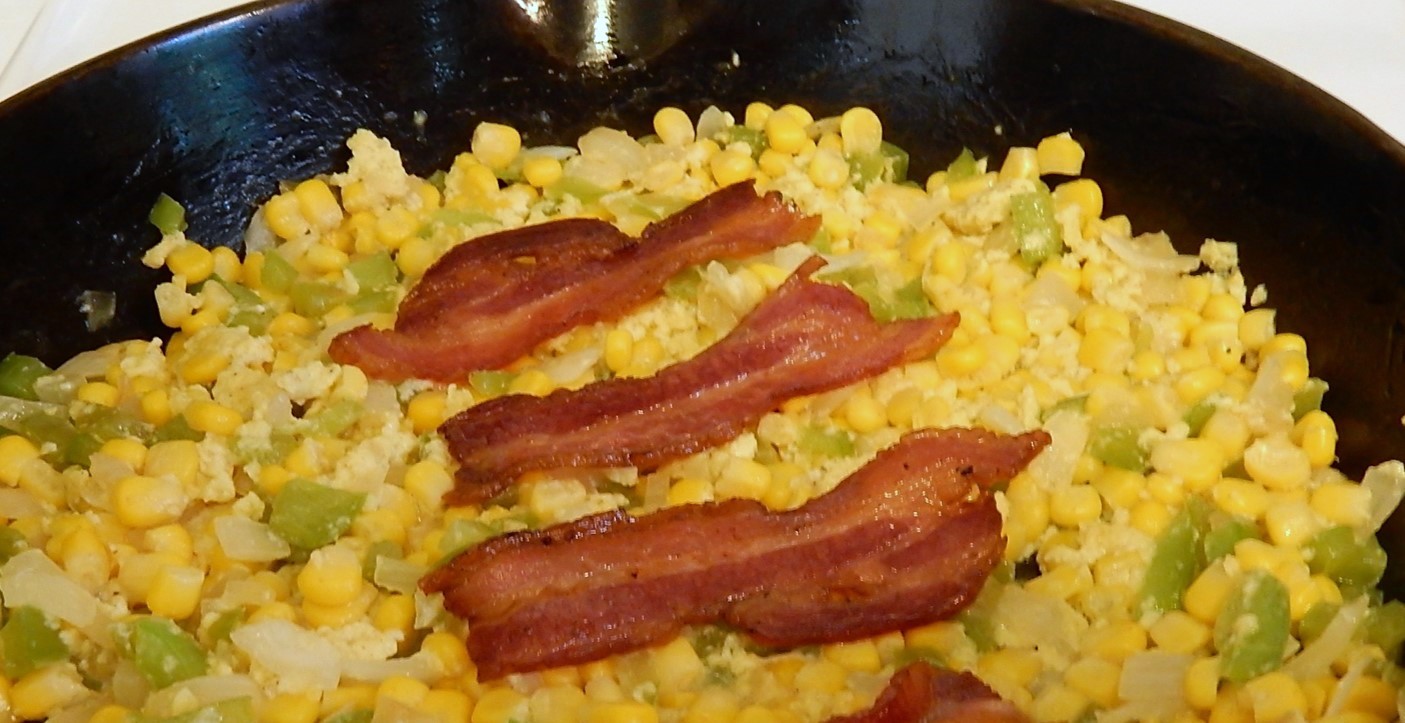
I’m always on the look-out for foods that are easy to make when camping, so I was thrilled to find a hundred-year-old recipe for Bacon and Corn, Camp Style. In addition to bacon and eggs, this dish contains eggs, green pepper, and onion, and is easy to make in a skillet. It is both hearty and tasty, and would be perfect for breakfast or dinner while camping. It also is a nice, easy dish to make at home.

Here’s the original recipe:

Source: Good Housekeeping (September, 1917)

And, here’s the recipe updated for modern cooks:

Bacon and Corn, Camp Style

  • Servings: 4 - 6
  • Difficulty: easy
  • Print

12 slices bacon (If desired, less may be used.)

1/2 green pepper, chopped

1 small onion, chopped

2 eggs, beaten

1/4 teaspoon salt

1/8 teaspoon pepper

2 cups corn, canned or boiled and cut from the cob (I used a 15 oz. can of corn which is a little less than 2 cups, but it worked well in this recipe.)

Using medium heat, cook bacon in a skillet until crisp. Remove bacon from pan and set aside, but keep warm. Drain most of the fat from pan, while reserving a small amount to saute the vegetables. Add the green pepper and onion, and saute until tender, about 5 minutes. Add eggs, salt, and pepper; stir to combine. Stir in the corn. Let cook until curds begin to form, then gently scrape the bottom of the pan and stir to turn the mixture to scramble the eggs. Continue cooking and scrambling until the eggs are set. Remove from the heat and serve. If desired garnish with some of the bacon strips. Serve the remaining bacon on the side.

Barrington Hall Coffee Advertisement

Source: Tried and True Cook Book, compiled and published by The Willing Workers (Minneapolis Incarnation Parish, 1910)

Sometimes I come across hundred-year-old advertisements for brands that have long vanished from the scene. For example, I recently found an advertisement for Barrington Hall coffee. According to the ad, it is “baker-ized” and “steel cut.”

What the heck is steel-cut coffee? It sounds like it should be a type of oats and not coffee. And, baker-ized sounds like cakes or cookies rather than coffee.