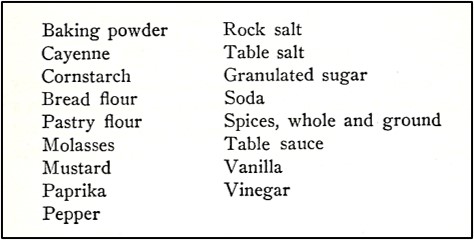
Oh dear – I only have 14 of the 17 pantry essentials that people usually kept on hand a hundred years ago – no pastry flour, rock salt, table sauce. What the heck is table sauce?

Oh dear – I only have 14 of the 17 pantry essentials that people usually kept on hand a hundred years ago – no pastry flour, rock salt, table sauce. What the heck is table sauce?

How come recipes are sometimes a success, and other times a failure? Here’s what it said in a hundred-year-old magazine.
Ten percent of every culinary success is common sense and a good recipe. The other ninety — ah, there is the mystery!
American Cookery (March, 1922)

Who were “New Women” a hundred years ago? — flappers,?
A hundred-year-old church cookbook from Alpena, Michigan had a different definltion. This fun poem was at the beginning of the Desserts and Puddings chapter. Alpena is on Lake Huron in northeastern Michigan.

You might enjoy this 1922 article that gave definitions for several terms associated with the day-to-day operation of a home. The article was written in response to a reader’s request for definitions.
Definitions Wanted
We find that these terms are variously defined, sometimes they are all taken to mean pretty much the same thing, sometimes the distinctions are quite arbitrary and neither included nor connoted in the common significance of the word. We are glad to define them as they appear to us to be distinguished one from another:.
Domestic Science. The application of scientific methods of thought and work to the problems of the house, or to household problems.
Domestic Art. The application to the house, in its exterior and interior, of the artistic principles of form and color, also of materials used. Building, decorating, tinting, and furnishing are included also – but properly by no means chiefly – artistic clothing. The term is very much a misnomer when applied to work in plain sewing.
Household Economy. Following the Greek word from which “economy” is derived, this means the “running” of the entire household, with regard to division of labor, expenditure of incomes, provision of food, care in sickness, and provision of amusement and recreation. In our modern use of the term, a careful thrift is connoted.
Household Management. The direction and care of the household, as in the foregoing, but not necessarily, with any implication of thrift. The house of a millionaire can be “managed” without thought of the cost.
Household Engineering. Here we have a more mechanical ordering of the house. Both “economy” and “management” seem to us to include the human element in all its phases, as co-dwellers in the house. “Engineering” appears to consider the human element only as a means to an end, the end of the mechanical ordering of the dwelling.
Household Administration. This includes both the economy, and also the management and engineering – but, as though it were done by a ruler who sits aloft and directs the activities without either sharing them, or giving his heart to them. He does it all with brains like the administrator of an estate. At least, it sounds like that to us.
Home Economics. The new word, “home,” in this term, introduces an ethical and even spiritual element which all the others lack. It signifies economics as under definition (3), but with one whole eye on higher, rather than material values. It means running the house with common sense, but also with uncommon sense, and always subordinating the common and the uncommon. This means that the spirit of the home will be the first and chiefest, and most important thing to be considered, and will always come before the mere care of the house.
American Cookery (December, 1922)

Here are a few excerpts from a hundred-year-old article about vitamins and colds.
Have vitamins anything to do with one’s immunity to colds? Through some years of watching the needs of a family, in dietetics, and in nursing, I have concluded that they have.
In the days when the real necessity for raw foods was unknown, when fruits were cooked for winter serving and we used canned vegetables, colds were very common. The longing for spring and fresh things was almost irresistible. The one really well person in the house was great grandma who never left her chair, ate only what she liked, but who always had her morning orange, her cream, and fresh laid eggs. We went through many dense years, fighting through the winter, to spring.
When the children went to college, a wonderful inspiration made me insist that, while there, they ate freely of apples and oranges, to break up the concentrated diet. Soon, the young people joined Grandma in the ranks of those who took few colds.
The children have graduated, but they stick to their love for fresh fruits and salads, and quickly throw off contagion.
Abridged from American Cookery (March, 1922)

Parents both now and a hundred years ago sometime have difficulty getting their children to drink milk. The 1922 edition of Good Housekeeping’s Book of Menus, Recipes, and Household Discoveries had the following tips:


The December, 1921 issue of Ladies Home Journal had several “little forest people” drawings that could be cut out. and used as Christmas decoration or for holiday table place cards. Here’s one I thought you might enjoy.
MERRY CHRISTIMAS